







Low-Cost DevOps Courses in Pune: A Beginner's Guide
How beginners in Pune can judge low-cost DevOps courses: what drives cost, what to learn free first, how to compare courses and red flags. No fee lists.

A low-cost DevOps course for beginners in Pune is good value only if it gives you real lab time on Linux, Git, CI/CD, Docker and Kubernetes, a trainer who answers questions, and a clear syllabus. Before paying anything, learn the basics from free official documentation, then judge each paid course by hands-on hours and support rather than by the lowest price.
This guide does not quote fees for any institute, including ours. Prices change, and a number without context tells a beginner very little. Instead, it explains what drives cost, what you can learn for free first, and how to tell a cheap course that works from one that wastes your time. For a breakdown of what makes training cost more or less, see our DevOps training fees in Pune post.
Key takeaways
- Do not choose on price alone. The cheapest course is expensive if you finish it unable to build a pipeline.
- Learn Linux commands, Git basics and Docker concepts from free official docs before you pay for anything.
- Value comes from lab hours, trainer access, batch size and an up-to-date syllabus.
- Ask what is included: lab machines, cloud accounts, recordings, doubt sessions and exam preparation.
- Exam fees are set by the certifier and usually sit outside the course price. Check them on the certifier's own site.
- Ignore guaranteed placement promises in budget course adverts. No course can guarantee a job.
What makes a DevOps course low cost or expensive
Course prices in Pune vary for reasons that are worth understanding. Longer courses with more modules cost more to run. Classroom courses carry rent and equipment costs. Courses that include cloud lab accounts pay for those accounts. Small batches cost more per learner than large ones because the trainer's time is split fewer ways. Experienced trainers who work on production systems usually cost more than trainers who only teach.
A lower price usually means one or more of these was reduced. That is not always bad. A beginner may not need a long course covering every cloud. But you should know which cost was cut. A course that is cheap because it is short and focused can be a smart buy. A course that is cheap because it has no labs is not.
| Cost driver | Why it matters to a beginner | Question to ask |
|---|---|---|
| Lab environment | DevOps is learned by doing, not watching | Will I get my own lab machine or cloud account? |
| Batch size | Large batches mean less help when you are stuck | How many learners are in a batch? |
| Trainer experience | Production experience improves answers to "why" | Who teaches, and what systems have they run? |
| Course length | Too short skips basics; too long may include topics you do not need yet | How many hours are hands-on? |
| Support after class | Beginners get stuck between sessions | Is there a doubt-clearing channel or session? |
| Recordings | Helpful when you miss a class | Are sessions recorded and for how long can I access them? |
Learn the basics for free first
The cheapest way to make any course better value is to arrive prepared. A lot of the beginner material is available free from the projects themselves. Spending two or three weeks on it before you enrol means the paid course can focus on harder topics and practice.
Start with Linux. Install a Linux distribution in a virtual machine or use the Windows Subsystem for Linux, then practise moving around the file system, editing files, managing users and permissions, and reading logs. Red Hat's RHCSA exam objectives, published on Red Hat's site, give you a free checklist of what a Linux administrator should know.
Next, learn Git. The official Pro Git book is free to read on git-scm.com. Work through creating a repository, committing, branching and merging until you can do it without notes.
Then learn Docker concepts from the official Docker documentation, and read the Kubernetes concepts and tutorials on kubernetes.io. You do not need to master Kubernetes alone, but you should know what a pod, a deployment and a service are before a paid course reaches them.
Free resources have a limit: nobody checks your work or answers your questions when something breaks. That is what a paid course should add.
What a beginner course should cover
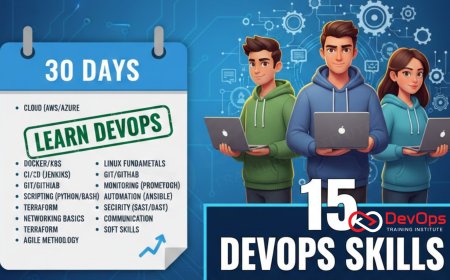
A sound beginner DevOps course follows the order teams use at work. It starts with Linux administration and shell scripting. Then Git and branching. Then continuous integration with a tool such as Jenkins or GitLab CI. Then containers with Docker, and Kubernetes basics. Good courses add infrastructure as code with Terraform or Ansible, cloud basics on one provider, and monitoring with Prometheus and Grafana.
Each module should end with something you built. If a syllabus lists twenty tools but shows no projects, be careful. A beginner who deeply understands six tools will do better in interviews than one who has seen twenty on slides.
Check that versions are current. Kubernetes releases often, and the CKA exam is now based on Kubernetes v1.37. Red Hat's RHCSA exam is based on RHEL 10. A low-cost course using old material may teach commands that no longer match what employers run.
How to compare low-cost courses
Make a simple sheet with the same columns for every course you consider: total hands-on hours, batch size, trainer background, lab setup, recordings, support between classes, certification preparation and what happens if you miss sessions. Fill it in from counselling calls and demos, not from adverts.
Attend a demo class if one is offered. Watch whether the trainer types real commands or reads slides. Ask a beginner question and see how it is answered. Check whether the lab works on your laptop.
Look at the total cost to you, not just the headline fee. Travel to a classroom every week adds up. Missing work for daytime batches has a cost. An online course may be cheaper overall even if the fee is similar. Exam fees are separate in most cases; check the certifier's page, because they set the price.
Ask whether the course can be paid in parts if that matters to you, and read the refund policy before you pay. A course you cannot leave after one bad week is riskier than one with a fair refund window.
Online versus classroom for budget learners
Online courses often cost less to run, and they save you travel time and money. They suit learners who can study at home without distractions and have a stable internet connection. The risk is that it is easier to drift away from an online batch.
Classroom courses suit learners who need structure and in-person help. Our classroom is in Kharadi, Pune, and we run the same course live online. For people elsewhere in India, all our training is online. If you are deciding between formats, our part-time DevOps training in Pune post covers schedules for working learners.
Red flags in budget DevOps courses
A guaranteed job is the biggest red flag. No course controls who an employer hires. Courses that promise placement in return for a low fee often add conditions you only see later. Our guide on verifying DevOps placement claims explains what to check.
Other warning signs include a syllabus with no projects, no named trainer, very large batches, pressure to pay today for a discount, and reviews that all sound the same. Be wary of salary figures in adverts too. They are rarely linked to a source and rarely apply to beginners.
Also watch for "certification included" claims. Some courses issue their own completion certificate, which is not the same as an industry exam such as RHCSA or CKA. Ask exactly which certificate you will get and who issues it.
A sensible plan for a beginner on a budget
Spend the first few weeks on free material: Linux, Git and Docker basics. Then choose one paid course with strong labs and a trainer you can reach. During the course, build a small project at each stage and push it to GitHub. After the course, pick one certification that matches your target jobs, usually RHCSA or CKA first.
Keep your spending focused. One good course and one exam, backed by projects, will help more than several cheap courses that overlap. Our post on DevOps certification paths in Pune suggests an order, and DevOps training for non-IT students helps if you are switching careers.
If you want a structured course, our DevOps training in Pune covers the full beginner path, and the Linux administration course is a smaller first step if you want to start with fundamentals only. Ask us for the current fee and what it includes, and compare it with the same sheet you use for everyone else.
Common mistakes beginners make
Paying for advanced topics too early is the first. A beginner does not need a multi-cloud architecture module. Get the basics right first.
Skipping practice is the second. Watching recordings feels like progress, but DevOps skill comes from typing commands, breaking things and fixing them. Plan practice time every week.
Buying several cheap courses is the third. Overlapping courses repeat the same basics. One focused course with good support usually costs less in the end and teaches more.
Setting up a practice lab on a budget
You do not need expensive hardware to practise. A laptop with enough memory to run a Linux virtual machine and a few containers is enough for most beginner work. Install a free hypervisor, create a Linux virtual machine and use it for every Linux exercise. Keep notes of each command you learn in a Git repository; it doubles as revision material and as proof of practice.
For Kubernetes, small local tools can run a single-node cluster on a laptop. These are fine for learning pods, deployments and services, and they cost nothing beyond your electricity. If your laptop struggles, ask any course you consider whether it provides cloud lab machines. That can be one of the most useful things a paid course includes.
Cloud providers offer free tiers and trial credits, but read their terms carefully and set billing alerts before you start. Beginners sometimes leave resources running and get an unexpected bill. Learn to delete what you create at the end of every session.
How to get the most from a low-cost course
Arrive at each class having repeated the previous lab on your own. Ask questions during sessions instead of saving them, because doubt-clearing time is often limited in budget courses. Join or form a small study group with batchmates, so you can help each other between classes. Build a project at each stage and ask the trainer to review it. These habits cost nothing and can make a modest course as useful as a much more expensive one.
When paying more is worth it
A low price is not always the best value. Paying more can make sense when the extra money buys something you need: a smaller batch if you learn slowly in large groups, cloud lab accounts if your laptop cannot run the tools, a trainer with production experience if you want deeper answers, or a classroom if you struggle to study at home. Write down which of these matter to you before you compare prices.
Equally, paying more for things you will not use is waste. Long lists of tools, extra certificates from the institute itself, or modules on clouds you do not plan to work with add cost without helping a beginner much. Match the course to the job you want, check the job posts in your target area, and buy only what gets you there.
Questions to ask before you pay
Ask for the total cost in writing, including anything charged separately such as lab access, recordings or exam vouchers. Ask how many hands-on hours the course has and how many learners are in a batch. Ask who the trainer is and whether you can attend a demo. Ask about the refund policy and what happens if you miss classes. Clear answers to these questions matter more than the headline price.
References
- Pro Git book (git-scm.com)
- Docker: Get started
- Kubernetes tutorials
- Red Hat: EX200 RHCSA exam objectives
- Linux Foundation: CKA
FAQs
Can I learn DevOps for free?
You can learn the basics free from official sources such as the Pro Git book, Docker's get started guide and the Kubernetes tutorials. A paid course adds structured labs, feedback and a trainer to help when you get stuck.
How much does a low-cost DevOps course in Pune cost?
We do not quote fees for any institute here because prices change often. Ask each provider for the current fee and exactly what it includes, then compare on lab hours and support.
Are cheap DevOps courses worth it?
They can be, if the low price comes from a shorter, focused syllabus rather than missing labs or support. Check hands-on hours, batch size and trainer access before you decide.
Is the certification exam fee included in course fees?
Usually not. Certifiers such as Red Hat and the Linux Foundation set exam prices. Check the certifier's own page and ask the course provider whether any voucher is included.
Which topics should a beginner DevOps course cover?
Linux, shell scripting, Git, CI/CD, Docker and Kubernetes basics, with infrastructure as code, one cloud provider and monitoring as later modules.
Is online DevOps training cheaper than classroom?
It often costs less overall because you save travel time and money. The right choice depends on whether you can study steadily at home.
Do low-cost courses offer placement?
No course can guarantee a job. Treat placement promises in budget adverts with caution and verify any claim before paying.
What's Your Reaction?
 Like
0
 Dislike
0
 Love
0
 Funny
0
 Angry
0
 Sad
0
 Wow
0