

![Kong Interview Preparation Guide [2025]](https://www.devopstraininginstitute.com/blog/uploads/images/202509/image_430x256_68dbb95326997.jpg)

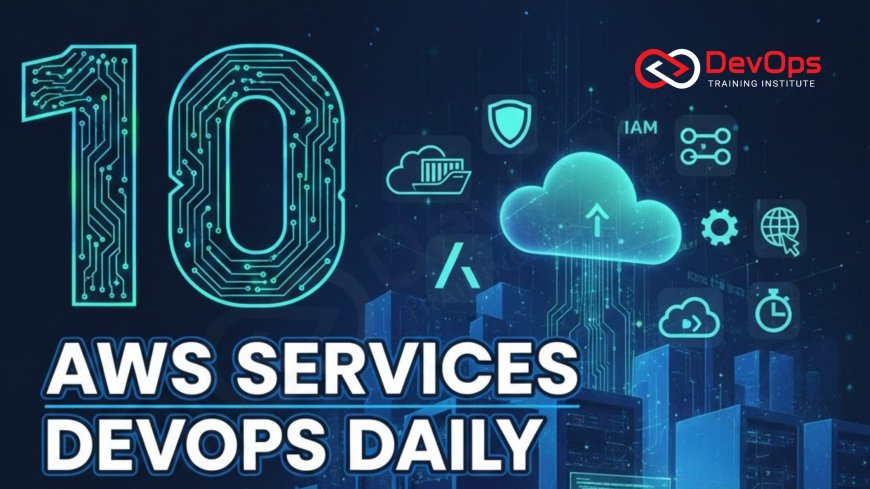
Top 10 AWS Services DevOps Engineers Use Daily
Discover the top 10 Amazon Web Services (AWS) that are indispensable for every modern DevOps engineer. This comprehensive, beginner-friendly guide breaks down the essential cloud services for CI/CD, Infrastructure as Code, monitoring, and serverless computing, including EC2, S3, CloudFormation, and the AWS CodeSuite. Master these foundational tools to automate workflows, ensure application reliability, and accelerate software delivery in the cloud. Learn how to leverage AWS for scaling, security, and achieving true operational excellence in a cloud-native environment, becoming a highly effective and in-demand DevOps professional.
Introduction
The role of a DevOps engineer is fundamentally intertwined with the world of cloud computing, and Amazon Web Services (AWS) is arguably the dominant platform shaping this landscape. DevOps, a philosophy centered on automating processes, fostering collaboration, and accelerating the software delivery pipeline, finds its most powerful implementation through AWS's vast suite of scalable, on-demand services. By leveraging AWS, engineers can move beyond managing physical hardware to defining entire infrastructures as code, enabling repeatable, reliable, and high-velocity deployments across multiple environments. The transition from traditional infrastructure management to cloud-native operations necessitates a deep understanding of the core AWS services that facilitate this transformation.
For any professional looking to succeed in a modern, cloud-first DevOps role, mastering the specific AWS services that power the continuous integration, continuous delivery (CI/CD), and operational monitoring processes is not just beneficial, but absolutely mandatory. These services act as the building blocks for creating resilient, secure, and highly available applications at scale. This guide will walk you through the ten most frequently used AWS services that form the daily toolkit of a DevOps engineer, explaining their primary functions and how they contribute to the overarching goals of automation and efficiency. Understanding these tools is the key to unlocking the full potential of cloud DevOps practices.
1. Amazon Elastic Compute Cloud (EC2)
Amazon EC2, or Elastic Compute Cloud, is the foundational building block for any compute requirement on AWS and is an essential tool in a DevOps engineer's arsenal. It provides resizable compute capacity in the cloud in the form of virtual servers, known as instances. DevOps engineers utilize EC2 to quickly provision and manage environments for development, testing, staging, and production, offering complete control over the operating system, network configuration, and security settings. The ability to launch an instance in minutes and terminate it just as quickly is crucial for the ephemeral nature of testing environments, allowing teams to achieve rapid iteration and experimentation without significant upfront cost or commitment.
Key to the DevOps utility of EC2 are features like Auto Scaling Groups (ASG) and the ability to provision instances using Infrastructure as Code (IaC) tools like AWS CloudFormation. ASGs automatically adjust the number of EC2 instances running based on defined metrics, such as CPU utilization or request queue size, ensuring application availability and performance while optimizing costs. This elasticity is a core principle of cloud architecture that DevOps teams manage daily. Furthermore, EC2 instances serve as the targets for deployment services like AWS CodeDeploy, making them central components in any CI/CD pipeline that relies on virtual machine-based hosting for its application workloads.
2. Amazon Simple Storage Service (S3)
Amazon S3, the Simple Storage Service, is a highly scalable, durable, and secure object storage service that acts as the digital backbone for countless DevOps processes and application architectures. Unlike traditional file systems, S3 stores data as objects within buckets and is designed to handle immense volumes of data with industry-leading durability. For a DevOps engineer, S3 is crucial for several use cases, primarily serving as the central repository for deployment artifacts, backups, and static website hosting. Once code is built and packaged by services like CodeBuild, the resulting deployable files are often stored in an S3 bucket before being pulled down by CodeDeploy or other services for final deployment.
Beyond its use in the CI/CD pipeline, S3 is integral to logging and monitoring strategies. Services like CloudTrail and CloudWatch can be configured to deliver detailed log data directly to S3, providing a durable, cost-effective archive for auditing and deep analysis. This centralized log storage is vital for troubleshooting and security compliance. Moreover, S3 is often the landing zone for large datasets in analytics pipelines and provides the storage layer for state files used by IaC tools such as Terraform, making it one of the most frequently interacted-with AWS services on a daily basis for any engineer focused on managing cloud infrastructure efficiently.
3. AWS Identity and Access Management (IAM)
AWS IAM, or Identity and Access Management, is the service that controls all authenticated access to AWS resources and is paramount for maintaining a secure and compliant cloud environment. For DevOps engineers, managing and enforcing the principle of least privilege is a critical daily responsibility, which is achieved through the configuration of IAM users, groups, roles, and policies. A core tenet of modern security practices is ensuring that systems and people only have the minimum permissions necessary to perform their required tasks, which directly prevents accidental or malicious compromise of critical infrastructure components like production databases or deployment pipelines.
DevOps workflows rely heavily on IAM Roles, which grant temporary access permissions to AWS services themselves (like an EC2 instance or a Lambda function) so they can interact with other services (like S3 or DynamoDB) without requiring hardcoded access keys. This practice dramatically enhances security and is a fundamental part of integrating security into the DevOps pipeline (DevSecOps). Every automated process, from a CI/CD job to a serverless function, requires a properly scoped IAM role, making its creation and maintenance an inescapable and critical task for all DevOps professionals working within the AWS ecosystem every single day.
4. AWS CloudFormation
AWS CloudFormation is the native AWS service for implementing Infrastructure as Code (IaC), a practice where the entire cloud environment, including networks, compute resources, and application services, is defined in configuration files rather than being manually set up through the console. This declarative approach allows DevOps teams to create, update, and manage their infrastructure in an orderly, predictable, and repeatable fashion using YAML or JSON templates. The primary benefit of using CloudFormation is ensuring environment parity, meaning that development, testing, and production environments are consistently configured, which eliminates the common "it worked on my machine" problem and dramatically reduces deployment errors.
CloudFormation manages resources as a single unit called a "stack," handling dependencies between resources automatically and, crucially, offering automatic rollback capabilities. If any part of the stack creation or update fails, CloudFormation can revert all changes to the last known stable state, providing a safety net that is invaluable in a fast-paced environment. By embedding infrastructure definitions into source control, the environment itself becomes versioned and auditable. This powerful capability to define complex infrastructure configurations as code is central to achieving the automation and consistency required for an effective cloud infrastructure management strategy.
5. AWS CodeSuite (CodePipeline, CodeBuild, CodeDeploy)
The AWS CodeSuite is a set of developer tools that forms the core of a fully managed Continuous Integration and Continuous Delivery (CI/CD) pipeline on AWS. This suite is often the very first toolset a DevOps engineer configures when setting up automated software delivery. It consists of three primary services, which are designed to work seamlessly together:
- AWS CodePipeline: This is the orchestration service that models, visualizes, and automates the steps required to release your software. It is the central nervous system of the CI/CD process, defining the entire workflow from code commit to final production deployment. A DevOps engineer uses CodePipeline to integrate source control, trigger builds, run tests, and manage approval gates.
- AWS CodeBuild: This is a fully managed build service that compiles source code, runs unit tests, and produces deployable software artifacts. It scales automatically to meet peak build requests and eliminates the need for engineers to manage, patch, or scale their own build servers. CodeBuild is where the "heavy lifting" of the integration phase takes place.
- AWS CodeDeploy: This service automates software deployments to a variety of compute services, including EC2 instances, AWS Lambda, and Amazon ECS. It supports various deployment strategies, such as in-place, rolling, and blue/green deployments, ensuring application updates occur with minimal or zero downtime, which is essential for maintaining high availability.
Together, the CodeSuite accelerates the delivery process, making small, frequent code releases practical, and embodying the core principle of automation in the DevOps methodology. These services are the daily workhorses for pushing application updates quickly and reliably.
| Service Name | Category | Primary DevOps Use Case | Key Benefit |
|---|---|---|---|
| Amazon EC2 | Compute | Hosting applications, provisioning test and production servers. | Scalability, full control over OS and network settings. |
| Amazon S3 | Storage | Storing build artifacts, backups, configuration files, and logs. | High durability, cost-effectiveness, and web accessibility. |
| AWS IAM | Security | Managing user access, assigning roles to services for inter-service communication. | Enforces the principle of least privilege, enhancing cloud security. |
| CloudFormation | IaC | Defining and provisioning all infrastructure resources as versioned code. | Environment consistency, automation, and reliable rollback capabilities. |
| CodePipeline | CI/CD | Orchestrating and visualizing the entire release process from start to finish. | End-to-end automation and quick visibility into deployment status. |
6. Amazon CloudWatch
Amazon CloudWatch is the central monitoring and observability service on AWS, providing data and insights into the performance and health of the entire application and infrastructure stack. A DevOps engineer relies on CloudWatch daily to maintain operational excellence, as it collects metrics, logs, and events from virtually all AWS resources and applications. This data is critical for real-time performance tracking, capacity planning, and proactive issue detection. It allows teams to set alarms that trigger notifications or automated actions when a metric, such as CPU utilization or error rate, crosses a predefined threshold, enabling faster response times.
CloudWatch Logs is particularly important, as it aggregates, monitors, and stores log files from EC2 instances, Lambda functions, and other services in a centralized location. Using CloudWatch Logs Insights, engineers can query this log data using a powerful, yet simple, language to quickly diagnose root causes during an incident investigation. Furthermore, the metrics collected by CloudWatch are often used as the input for Auto Scaling policies, creating a closed-loop system where application demand is constantly met without manual intervention, which is a foundational component of modern, reliable, and scalable infrastructure design.
7. AWS Lambda
AWS Lambda is the premier serverless compute service that allows developers to run code without provisioning or managing servers, and it has quickly become a game-changer for DevOps automation. In a serverless architecture, the engineer only uploads the code, and Lambda automatically handles all the underlying infrastructure scaling and availability. While developers use Lambda for application logic, DevOps engineers leverage it heavily for automating operational tasks, integrating services, and building event-driven workflows.
For example, a Lambda function can be triggered instantly when a new file is uploaded to an S3 bucket to process that file, or when a CloudWatch alarm triggers an alert, the function can automatically initiate a remediation action, such as restarting an instance or cleaning up resources. This ability to execute code in response to events makes it perfect for creating lightweight, cost-effective automation scripts that enhance the CI/CD pipeline and improve overall operational agility. Lambda is the key to achieving "serverless DevOps" and dramatically reduces the overhead associated with managing dedicated automation servers, allowing teams to focus more on value delivery.
8. Amazon Elastic Kubernetes Service (EKS)
Containerization, primarily driven by Docker and Kubernetes, has become a standard practice in modern DevOps for packaging and deploying microservices. Amazon EKS, the Elastic Kubernetes Service, is a fully managed service that simplifies running Kubernetes on AWS, removing the operational complexity of managing the Kubernetes control plane. For a DevOps engineer managing containerized applications, EKS provides the scalable and highly available foundation necessary to orchestrate vast fleets of containers, abstracting away the underlying infrastructure.
Engineers use EKS to deploy, manage, and scale their application containers using standard Kubernetes APIs and tooling, but with the added benefit of tight integration with AWS services like IAM and VPC. Mastery of EKS, alongside tools like Helm for package management, is essential for organizations embracing microservices, as it provides the mechanism for reliably running applications across diverse environments. EKS is where the principles of immutability and declarative configuration, central to modern DevOps, come together to support complex, high-traffic distributed applications and is a primary tool for those involved in container SRE and DevOps roles.
9. Amazon Virtual Private Cloud (VPC)
Amazon VPC, or Virtual Private Cloud, allows DevOps engineers to provision a logically isolated section of the AWS Cloud where they can launch AWS resources in a virtual network that they define and control. This foundational networking service is critical for security, isolation, and connecting on-premises data centers to the cloud. Before any application can be deployed, the network infrastructure must be meticulously defined, which is a key responsibility managed through VPC and its associated components.
Engineers use VPC to define IP address ranges, subnets, route tables, and network gateways. Crucially, VPC Security Groups and Network Access Control Lists (NACLs) function as firewalls at the instance and subnet levels, respectively, which are configured to control inbound and outbound traffic. Defining this network topology using Infrastructure as Code (e.g., CloudFormation or Terraform) ensures that environments are isolated, secure, and reproducible. A deep understanding of VPC and its features is necessary to ensure that applications not only run correctly but also adhere to strict security and compliance policies, which often takes up a significant portion of a DevOps engineer's time when designing a new cloud deployment.
10. Amazon RDS and DynamoDB
While often seen as traditional database services, Amazon RDS (Relational Database Service) and DynamoDB are fundamental to DevOps because they simplify the operational overhead of managing data persistence, freeing up engineers to focus on automation and application delivery. RDS is a managed service that makes it easy to set up, operate, and scale a relational database in the cloud, supporting engines like MySQL, PostgreSQL, and SQL Server. DynamoDB is a fast and flexible NoSQL database service, designed for applications requiring consistent, single-digit-millisecond latency at any scale. [Image of AWS RDS Managed Database Architecture]
For a DevOps team, using these managed database services means the complex, time-consuming tasks of database patching, backups, fault tolerance, and scaling are handled automatically by AWS. This automation allows for the database layer to be easily included in IaC templates and seamlessly integrated into the CI/CD pipeline, such as through automated schema migrations. The reliability and reduced administrative burden of RDS and DynamoDB enable the entire organization to operate at the high velocity required by a modern DevOps approach, shifting effort away from manual maintenance toward continuous improvement and feature development, proving that DevOps supports database operations effectively.
Conclusion
The journey to becoming a proficient DevOps engineer in the cloud is defined by mastery of the core services that automate and orchestrate modern software delivery. The services outlined, ranging from the fundamental compute and storage providers like EC2 and S3 to the specialized automation tools like the AWS CodeSuite and the serverless capabilities of Lambda, represent the daily toolkit of professionals in this field. They collectively provide the foundation for building scalable, resilient, and secure applications. By embracing Infrastructure as Code with CloudFormation and ensuring operational visibility through CloudWatch, engineers can transform complex workflows into streamlined, automated pipelines.
Ultimately, these AWS services empower DevOps teams to achieve high velocity while maintaining quality, security, and stability, transforming the cultural philosophy of DevOps into tangible, working reality. A continuous commitment to learning and integrating new AWS services as they evolve is what separates a good DevOps engineer from a great one. Understanding the interplay between these tools, from IAM security roles to EKS container orchestration, is the defining skill set for accelerating business outcomes in any cloud-native organization today.
Frequently Asked Questions
What is the difference between EC2 and AWS Lambda?
EC2 provides virtual servers that you manage, whereas Lambda is a serverless function that automatically manages the underlying compute resources for you.
Why is AWS IAM so important for DevOps?
IAM is crucial because it controls access permissions for users and services, ensuring security and compliance via the principle of least privilege.
How does Amazon S3 fit into a CI/CD pipeline?
S3 primarily serves as a durable and accessible repository for storing compiled application code and build artifacts before deployment occurs.
What is the main advantage of using CloudFormation?
The main advantage is defining infrastructure as code, which guarantees environment consistency and provides safe, automated rollback capabilities.
Which AWS service orchestrates the CI/CD workflow?
AWS CodePipeline is the orchestration service that automates the sequence of building, testing, and deploying the application code.
What does Amazon CloudWatch monitor?
CloudWatch monitors metrics, logs, and events from all AWS resources and applications, providing real-time operational visibility.
What is the key benefit of serverless computing with Lambda?
The key benefit is eliminating server management overhead, allowing engineers to focus solely on writing and executing the application code.
What is Amazon EKS used for in DevOps?
Amazon EKS is used for the fully managed orchestration, deployment, and scaling of containerized applications using Kubernetes.
How do DevOps engineers use Amazon VPC?
They use VPC to define the private, isolated network structure, including subnets and security rules, for all deployed resources.
What administrative tasks do RDS and DynamoDB automate?
These managed services automate tasks like patching, backups, replication, and scaling, reducing the database operational burden.
Can I use third-party tools with the AWS CodeSuite?
Yes, AWS CodePipeline is designed to integrate seamlessly with various popular third-party tools for source control, testing, and deployment.
Is AWS the only cloud platform for DevOps?
No, there are other major cloud platforms, but AWS offers a vast and mature ecosystem of integrated services highly favored by DevOps teams.
Where are CloudWatch Logs typically stored long-term?
Although CloudWatch stores them, long-term archival storage is often configured to be an Amazon S3 bucket due to its durability and cost-effectiveness.
What is the 'F' in the IAM concept (Users, Groups, Roles)?
The F doesn't exist. The core concepts are Users, Groups, Roles, and Policies, all managed within the IAM service.
What does Infrastructure as Code mean for speed?
IaC drastically increases speed by automating infrastructure provisioning and making environment setup repeatable and virtually instantaneous.
What's Your Reaction?
 Like
0
Like
0
 Dislike
0
Dislike
0
 Love
0
Love
0
 Funny
0
Funny
0
 Angry
0
Angry
0
 Sad
0
Sad
0
 Wow
0
Wow
0


![100+ Azure DevOps Interview Questions and Answers [Updated 2025]](https://www.devopstraininginstitute.com/blog/uploads/images/202509/image_140x98_68c40aa9a3834.jpg)





![Future Scope of DevOps Careers in Pune [Updated 2025]](https://www.devopstraininginstitute.com/blog/uploads/images/202510/image_140x98_68e3a84652312.jpg)