

![Kong Interview Preparation Guide [2025]](https://www.devopstraininginstitute.com/blog/uploads/images/202509/image_430x256_68dbb95326997.jpg)

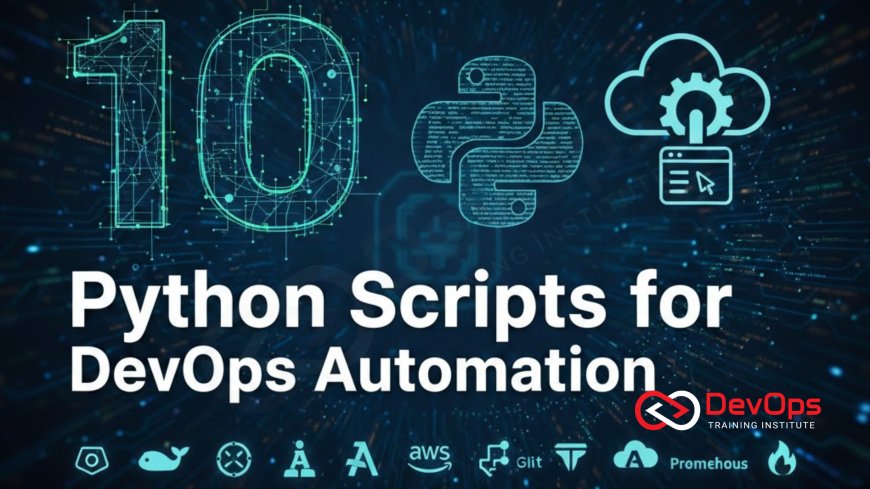
Top 10 Python Scripts for DevOps Automation
Discover the 10 most indispensable Python scripts and libraries that form the backbone of modern DevOps automation. This guide provides actionable examples and use cases for everything from provisioning cloud infrastructure with Boto3 and Paramiko to orchestrating containers with the Kubernetes Python Client. Learn how to leverage Python's simplicity and vast ecosystem to reduce manual toil, enhance CI/CD pipelines, and implement robust monitoring and security checks across your environment, dramatically increasing efficiency and deployment reliability for your entire engineering team.
Introduction
Python has firmly established itself as the lingua franca of DevOps, largely due to its simple syntax, extensive standard library, and massive ecosystem of third-party modules that cater specifically to automation needs. For DevOps engineers, Python is more than just a scripting language; it is a universal glue that connects disparate systems, manages cloud resources, orchestrates containers, and handles complex data transformations within automated pipelines. Its readability and cross-platform compatibility make it the perfect choice for writing the custom, repeatable, and maintainable scripts that eliminate manual toil and reduce human error in the software delivery process.
The true power of Python lies in its integration capabilities. It offers official Software Development Kits (SDKs) for every major cloud provider and native APIs for nearly every popular DevOps tool, allowing engineers to manage complex distributed systems using a single programming language. This capability enables teams to build sophisticated automation workflows that go far beyond simple shell scripts, allowing for complex decision-making, advanced error handling, and seamless integration with external APIs and services. Mastering Python is therefore a prerequisite for any engineer aiming to build and manage highly efficient, cloud-native infrastructure, accelerating the delivery of business value through enhanced automation.
This guide breaks down the 10 most essential types of Python scripts and the corresponding libraries that every DevOps engineer should master. These scripts address the most common and time-consuming operational tasks, proving Python's value in every stage of the CI/CD lifecycle, from infrastructure provisioning to monitoring and incident response. By integrating these examples into your daily workflow, you can drastically improve your team's efficiency and reliability, focusing efforts on innovation rather than repetitive manual configuration.
1. Cloud Resource Management (Boto3, Azure SDK, Google Cloud SDK)
Automating interactions with public cloud providers is arguably the most frequent use case for Python in a DevOps role, and the official SDKs make this task straightforward and programmatic. For Amazon Web Services (AWS), the Boto3 library is the key tool. It allows engineers to write Python scripts that directly provision, configure, and manage any AWS resource, including EC2 instances, S3 buckets, Lambda functions, and IAM policies. This capability ensures that infrastructure provisioning is consistent and can be easily triggered as part of an automated workflow or CI/CD pipeline, turning infrastructure setup into a version-controlled, repeatable process.
A typical script might involve dynamically creating a new EC2 instance, attaching specific security groups, and tagging the resource for cost tracking, all without manually touching the AWS console. Similarly, the Azure SDK for Python and the Google Cloud SDK for Python perform the same essential function for their respective platforms, enabling true multi-cloud automation. These scripts often function as custom logic wrappers around declarative tools like Terraform, adding complex conditional logic or executing clean-up actions that the declarative tools cannot handle natively. This programmatic control over cloud assets is fundamental to achieving scalable and cost-optimized cloud infrastructure management.
2. Remote Execution and Configuration (Paramiko, Fabric)
Even in the age of containers and immutable infrastructure, DevOps engineers frequently need to connect to remote servers via SSH to perform ad-hoc maintenance, run diagnostics, or execute specific commands during deployment. Libraries like Paramiko and Fabric simplify and streamline this process, moving far beyond basic shell scripting to provide robust, programmatic remote execution capabilities. Paramiko, a pure Python implementation of the SSHv2 protocol, allows for secure connections, command execution, and file transfers, forming the low-level technical backbone for many higher-level tools.
Fabric builds upon Paramiko, offering a higher-level, more user-friendly interface for common tasks like deploying applications, running remote tests, and managing system services across multiple servers simultaneously. A Python script using Fabric can easily execute a rolling restart of a web service across a dozen servers, capture the output, and handle errors gracefully, ensuring that the entire operation is consistent and auditable. While configuration management tools like Ansible (which is itself written in Python) handle the core configuration, these libraries offer a flexible solution for custom, high-speed remote operations, reducing the reliance on manual terminal interaction and increasing deployment speed.
3. Container Orchestration Management (Kubernetes Python Client, Docker SDK)
Managing containers and Kubernetes clusters programmatically is a critical DevOps task, often requiring complex automation that goes beyond standard YAML manifests or kubectl commands. Python provides powerful SDKs for both. The official Kubernetes Python Client grants full, programmatic access to the Kubernetes API, allowing engineers to write scripts that interact with any cluster resource, such as Pods, Deployments, Services, and Namespaces. This is invaluable for building custom monitoring tools, generating reports, or automating cleanup tasks, directly leveraging the power of Python to manage the orchestration layer.
Similarly, the Docker SDK for Python allows direct control over the Docker daemon, enabling scripts to build images, run containers, manage networks, and clean up dangling resources. A common use case involves writing a script to automatically spin up a self-contained test environment by starting a series of Docker containers and configuring their network topology. For Kubernetes, scripts can be used to dynamically modify Helm chart values before deployment, fetch status updates during a rolling rollout, or automatically delete old, unused Pods, making the CI/CD pipeline smarter and more reactive to cluster conditions, which enhances overall system health and reliability. These functions demonstrate that the relationship between Python-based automation and the container platform is key to aligning with DevOps and SRE goals.
4. CI/CD Pipeline Scripting and API Interaction (Requests)
The vast majority of modern CI/CD tools and external services (like Slack, PagerDuty, or security scanners) expose their functionality via REST APIs. The Python Requests library is the de facto standard for making HTTP requests, simplifying interaction with these APIs and serving as the perfect mechanism for gluing different services together within a pipeline. Scripts using Requests can perform numerous critical functions, such as fetching secrets from HashiCorp Vault, triggering a downstream Jenkins job, or posting deployment status notifications to a Slack channel.
A key script type involves implementing custom "quality gates" within the CI/CD pipeline. For example, a Python script can execute after a deployment to query the application's health endpoint, check response times against an SLA, and, based on the results, either proceed with the deployment or automatically trigger a rollback by communicating with the pipeline orchestration tool's API. This use of Python for custom communication ensures that the CI/CD process remains flexible and highly integrated, allowing teams to implement precise control and custom validation logic beyond the standardized steps provided by the CI tool itself, supporting the mastery of tools to master in 2025.
5. Configuration File Manipulation (PyYAML, ConfigParser)
DevOps workflows rely heavily on configuration files, particularly those written in YAML (for Kubernetes, Ansible, or CloudFormation) or INI/JSON formats. Manually editing these files, especially when deployments target multiple environments with slight variations, is prone to error and incredibly time-consuming. The PyYAML library provides robust tools for reading, writing, and manipulating YAML data structures directly within a Python script, allowing for safe and programmatic configuration modification. Similarly, the built-in ConfigParser handles INI files, and the `json` module manages JSON configuration.
A vital script would dynamically generate environment-specific configuration files. For example, a single Python script could take a base YAML template, read environment variables (e.g., development, staging, production), and inject the correct database credentials, replica counts, or cloud regions into the final manifest before deployment. This approach guarantees that all configuration changes are managed through code, eliminating manual copy-pasting errors and ensuring that the configuration for all environments remains version-controlled and consistent, which is a core tenet of modern, reliable DevOps culture management.
| Script Focus | Key Library(s) | Common Use Case |
|---|---|---|
| 1. Cloud Resource Provisioning | Boto3 / Azure SDK / Google Cloud SDK | Automating EC2 instance creation, S3 bucket management, and cloud resource clean-up after testing. |
| 2. Remote Command Execution | Paramiko / Fabric | Running remote health checks, restarting services, or applying patches across a fleet of servers via SSH. |
| 3. Container Orchestration | Kubernetes Python Client / Docker SDK | Dynamically modifying K8s deployments, managing container lifecycles, and cleaning up old Pods/images. |
| 4. API/CI/CD Integration | Requests | Triggering webhooks, fetching secrets from Vault, or sending deployment status notifications to communication platforms. |
| 5. Configuration Management | PyYAML / ConfigParser | Programmatically reading, writing, and templating application or infrastructure configuration files for different environments. |
6. System Health and Monitoring (Psutil, SMTPLIB)
Proactive monitoring of server health is essential to prevent downtime, and Python excels at creating lightweight, custom monitoring agents. The Psutil library provides an interface to system processes and hardware utilization (CPU, memory, disk, network) on almost any operating system. A simple but effective script can be written using Psutil to constantly check server metrics against predefined thresholds and, if exceeded, automatically trigger an alert. This level of granular control over system data is often necessary to fill the gaps left by complex, heavy monitoring platforms.
Coupling Psutil with the built-in smtplib library for sending emails or the Requests library for posting to Slack or PagerDuty creates a complete custom alerting solution. This enables DevOps teams to monitor critical metrics that might be unique to their application or environment and receive instant notifications if usage spikes or services fail. These scripts can be scheduled via a system cron job or integrated into a monitoring stack, providing a vital, always-on health check layer that contributes significantly to overall system reliability and ensures immediate attention to potential incidents.
7. Log Analysis and Error Reporting (Re, Glob, Pandas)
Dealing with massive volumes of application and system logs is a daily challenge, and manual log searching is inefficient and tedious. Python scripts are perfectly suited for automating log analysis, offering significant speed and accuracy improvements. The built-in re (Regular Expression) module is crucial for pattern matching and extracting specific error codes, timestamps, or user IDs from raw log entries. Libraries like Glob simplify the process of finding and iterating through all log files within a specific directory structure, regardless of naming conventions.
For more advanced analysis, libraries like Pandas can be used to structure log data into data frames, allowing for complex querying, aggregation, and error reporting. A custom script might run daily, parse all new log entries, extract all lines containing "FATAL" or "ERROR," aggregate them by application component, and generate a summary CSV or HTML report for the development team. This automated reporting mechanism allows teams to transition from reactive log searching during an outage to proactive identification of recurring errors and performance bottlenecks, leading to quicker code fixes and improved stability, and providing the data necessary to evaluate which metrics matter most for success.
8. Automated Data and Database Backups (Shutil, SQL Libraries)
Ensuring data durability is a primary responsibility for Operations teams, and automating database and file system backups is a non-negotiable task. Python's built-in Shutil module handles high-level file operations, making it easy to copy directories, compress files (e.g., using `make_archive` for tar.gz), and manage backup rotation locally. For database backups, Python's ecosystem provides dedicated libraries like psycopg2 for PostgreSQL, MySQLdb for MySQL, and cx_Oracle for Oracle, allowing scripts to connect to databases and execute native dump commands or SQL queries programmatically.
A professional backup script will not only perform the data dump but will also handle the secure transfer of the resulting backup file to off-site or cloud storage (e.g., using Boto3 for S3 uploads), ensure proper naming conventions with timestamps, and manage retention policies by deleting old backups after a defined period. This end-to-end automation of the backup lifecycle is essential for compliance and disaster recovery, turning a complex, high-risk operational task into a reliable, set-and-forget background process, which is necessary for high operational maturity.
9. Testing and Quality Gates in CI/CD (Pytest, Unittest)
Quality gates within the Continuous Integration process are vital for maintaining code integrity and delivery speed. Python’s testing frameworks, such as Pytest and the built-in Unittest module, are the core components used to automate this critical step. DevOps engineers often use these tools not only to run application unit tests but also to perform infrastructure or deployment validation, such as smoke tests or contract tests, immediately after deployment to a staging environment. This immediate feedback loop is critical for catching errors before they reach production.
A Python script using Pytest can be integrated into the CI pipeline to run a suite of tests against a newly provisioned infrastructure component. For instance, it can check if all required ports are open, verify that the application returns a specific status code on its health endpoint, or confirm that database connectivity is established. If any test fails, the script will exit with a non-zero return code, immediately failing the CI/CD pipeline and preventing the faulty deployment from proceeding. This integration of testing into the automated flow is a cornerstone of modern, high-velocity software delivery, supporting the integrated security model that is leading developers to shift toward DevSecOps.
10. Custom Automation Utilities (Subprocess, Argparse)
Many complex DevOps tasks require the orchestration of multiple external command-line tools (like Git, Terraform CLI, or Ansible). The built-in Python Subprocess module is the ideal tool for running these external commands, capturing their output, and managing their exit codes. This allows Python to act as a wrapper for infrastructure provisioning workflows, chaining together steps like `terraform init`, `terraform plan`, and `terraform apply` with complex Python logic in between, providing superior error handling and logging compared to simple shell scripts.
Furthermore, the Argparse module is essential for building professional, user-friendly command-line tools. It allows engineers to easily define command-line arguments, options, and flags for their custom automation scripts, enabling teams to execute complex workflows with simple, documented commands. For example, a single Python script can be designed to accept an environment name (e.g., `prod` or `dev`) as an argument and use this input to determine which configuration files to load and which cloud resources to target. These custom utilities become an integral part of the team's shared toolbox, streamlining daily operations.
Conclusion
Python's versatility, extensive ecosystem, and inherent readability make it the undisputed automation champion for DevOps engineers. By mastering the 10 types of scripts outlined in this guide, from managing cloud resources with Boto3 to orchestrating containers with the Kubernetes client, engineers can effectively address the most common bottlenecks in the software delivery lifecycle. These scripts empower teams to move beyond manual intervention and embrace true programmatic control over their infrastructure and applications, ensuring consistency, reliability, and auditability in every operation.
Adopting this Python-centric approach transforms the DevOps role from one of reactive maintenance into one of proactive automation and system design. The key takeaway is the power of integration: Python serves as the universal language that seamlessly glues together CI/CD platforms, cloud APIs, container runtimes, and monitoring tools. By prioritizing the creation of modular, well-tested Python automation scripts, engineering teams can unlock significant gains in efficiency, allowing them to accelerate their software delivery and focus on creating value rather than managing the complexity of their underlying infrastructure, proving that DevOps is a real methodology, not just hype.
Frequently Asked Questions
Why is Python preferred over Bash for complex automation?
Python offers better error handling, a vast standard library, and superior readability, making complex scripts more maintainable and reliable than Bash.
What is the primary role of Boto3 in DevOps?
Boto3 allows Python scripts to directly provision, configure, and manage all Amazon Web Services (AWS) resources, automating infrastructure tasks.
How does Paramiko help in remote management?
Paramiko is a pure Python library that simplifies secure SSH connections, command execution, and file transfer to remote servers programmatically.
What Python library should be used to interact with Kubernetes?
The official Kubernetes Python Client should be used, as it provides full access to the Kubernetes API for managing cluster resources.
How do Python scripts handle environment-specific configuration?
They use libraries like PyYAML to dynamically read a base configuration file and inject environment-specific values like credentials or replica counts.
What is the main use case for the Requests library in CI/CD?
Requests is used to make HTTP calls to external APIs, enabling scripts to trigger webhooks, fetch secrets, or send deployment notifications.
Does Python replace configuration management tools like Ansible?
No, Python often complements them; it can be used to generate dynamic inventory for Ansible or write custom Ansible modules, enhancing its functionality.
What Python library is essential for server health checks?
The Psutil library is essential as it provides access to cross-platform system metrics like CPU usage, memory, disk utilization, and network statistics.
What is the Subprocess module used for?
Subprocess is used to execute external commands and programs, like Terraform CLI or Git, and manage their input/output directly within a Python script.
Which Python tool is best for command-line interface development?
Argparse is the best tool, as it simplifies the creation of user-friendly interfaces with structured arguments and robust help documentation.
How are Python scripts integrated into a CI/CD pipeline?
They are executed as a step using `python script_name.py`, with the pipeline checking the script's exit code to determine success or failure.
What is a common Python task for log analysis?
A common task is using the 're' (Regular Expression) module to parse log files, extract specific error patterns, and generate automated reports.
Why is Python preferred over Go for scripting tasks?
Python is generally preferred for simple scripting due to its faster development speed, huge ecosystem, and high-level, readable syntax.
How does Python aid in DevSecOps practices?
It aids DevSecOps by automating security checks, fetching secrets from Vault, and enforcing policy via programmatic interaction within the pipeline.
What is the benefit of automating backups with Python?
It ensures consistency, allows for customizable retention policies, and enables secure, automated transfer of backup archives to off-site storage.
What's Your Reaction?
 Like
0
Like
0
 Dislike
0
Dislike
0
 Love
0
Love
0
 Funny
0
Funny
0
 Angry
0
Angry
0
 Sad
0
Sad
0
 Wow
0
Wow
0

![100+ Azure DevOps Interview Questions and Answers [Updated 2025]](https://www.devopstraininginstitute.com/blog/uploads/images/202509/image_140x98_68c40aa9a3834.jpg)




![Future Scope of DevOps Careers in Pune [Updated 2025]](https://www.devopstraininginstitute.com/blog/uploads/images/202510/image_140x98_68e3a84652312.jpg)