










![Kong Interview Preparation Guide [2025]](https://www.devopstraininginstitute.com/blog/uploads/images/202509/image_430x256_68dbb95326997.jpg)








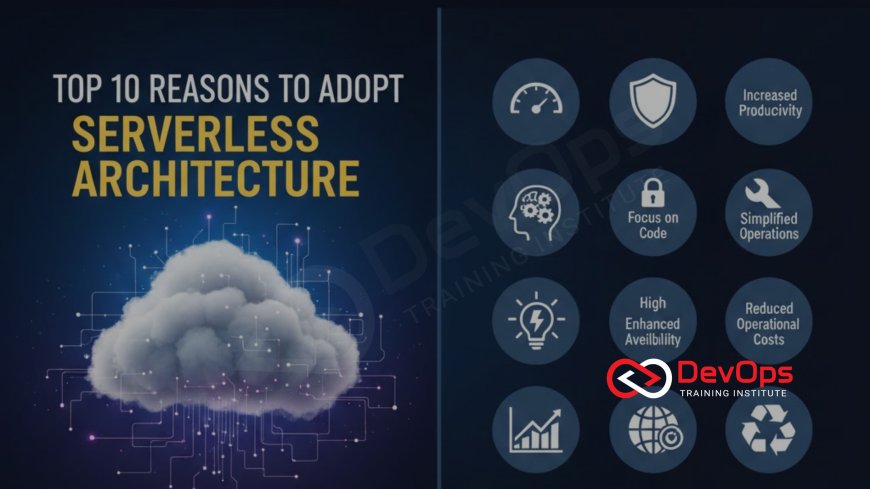
Top 10 Reasons to Adopt Serverless Architecture
Discover the top 10 compelling reasons why modern enterprises and startups are rapidly adopting serverless architectures like AWS Lambda, Azure Functions, and Google Cloud Functions. This guide breaks down the core benefits, focusing on massive cost savings achieved through pay-per-use billing, eliminating operational overhead, achieving infinite scalability on demand, and drastically improving developer velocity. Learn how serverless transforms development by abstracting infrastructure management, allowing teams to focus entirely on writing business logic and accelerating time-to-market for applications in a highly scalable and resilient environment, leveraging modern cloud practices.
Introduction: Moving Beyond the Server
The term "serverless" is often misunderstood, but it represents one of the most significant paradigm shifts in cloud computing since the introduction of Infrastructure as a Service (IaaS) itself. It does not mean that servers no longer exist; rather, it means that the cloud provider (AWS, Azure, GCP) completely manages the underlying infrastructure, operating system, network, and scaling aspects for the customer. This abstraction frees developers and operations teams from the mundane, repetitive, and time-consuming tasks of provisioning, patching, updating, and scaling servers, a burden often referred to as "undifferentiated heavy lifting."
Serverless architecture primarily revolves around Function as a Service (FaaS), where code is executed in stateless, ephemeral containers in response to specific events, such as an HTTP request, a database change, or a file upload. By embracing this model, organizations fundamentally change their operating model, shifting labor and cost away from maintenance and towards innovation. The simplicity and efficiency gained by offloading these core operational duties have made serverless the architecture of choice for everything from backend APIs and complex data processing pipelines to lightweight web applications. The decision to adopt serverless is often a strategic one, aimed at maximizing business agility and minimizing Total Cost of Ownership (TCO).
Massive Cost Savings Through Pay-Per-Use Billing
The financial model of serverless computing is arguably its most compelling advantage, representing a radical departure from the traditional cloud billing based on provisioned capacity. In the serverless model, exemplified by services like AWS Lambda or Azure Functions, customers only pay for the exact compute time their code consumes, measured often in milliseconds, and the number of times their functions are executed. This pay-per-use structure leads to massive cost savings, especially for applications with highly variable or intermittent traffic patterns.
This contrasts sharply with virtual machines (VMs) or container clusters (Kubernetes), where capacity must be provisioned and paid for 24/7, even during periods of zero utilization, leading to significant wasted expenditure on idle resources. For instance, a function triggered only 10 times a day costs virtually nothing, whereas a continuously running VM would incur full hourly charges. By aligning cost directly with actual usage, the serverless model inherently achieves nearly perfect resource utilization, translating directly into a healthier bottom line for the business, simplifying financial forecasting and directly supporting FinOps initiatives.
Elimination of Operational Overhead
The second primary reason for the widespread adoption of serverless is the complete elimination of operational management overhead. When adopting serverless technologies, the customer is fully relieved of the responsibility for managing core infrastructure concerns. This is a crucial distinction from IaaS or Container as a Service (CaaS), where the user is still responsible for the security patching, operating system maintenance, and ensuring the network is correctly configured. Serverless abstracts all of these traditionally complex and time-consuming tasks away, allowing engineering teams to reclaim significant labor hours, which can then be redirected toward product development.
The operational tasks eliminated include:
- Server Patching and Maintenance: The cloud provider handles all operating system and host security patches automatically and continuously.
- Resource Provisioning: There is no need to manually select VM types, storage volumes, or networking components; the platform manages resource allocation dynamically.
- Scaling and Load Balancing: Automatic provisioning of capacity and internal load balancing is managed entirely by the serverless platform based on incoming traffic demand.
- OS/Network Configuration: Tasks such as configuring firewalls, setting up network interface cards, and managing underlying network routes become the responsibility of the cloud provider, significantly simplifying the engineering burden, especially around complex network protocols and services that rely on specific cloud network configurations, which often relate to concepts like load balancing and network topologies, sometimes touching upon how subnetting affects load balancing in cloud network designs.
Automatic and Near-Infinite Scalability
Serverless architectures are inherently designed to scale automatically and almost instantaneously in response to event triggers, allowing applications to handle massive, unpredictable traffic spikes without manual intervention or pre-provisioning. This elastic, on-demand scalability is a critical enabler for modern, high-traffic applications, especially in areas like e-commerce during flash sales or streaming services during peak events, where traffic volumes can surge unpredictably in minutes.
The serverless model automatically spins up and down the number of execution environments needed to handle the workload concurrently, ensuring latency remains low even under extreme load. This capability means applications can effectively scale to "infinite" capacity (limited only by global resource quotas and the cloud provider's network capabilities) without the need for manual Auto Scaling Group configuration, cluster management, or constant monitoring of performance metrics. This resilience is key to maintaining a high Service Level Objective (SLO) for mission-critical applications and is a major improvement over traditional VM-based horizontal scaling, which is often slower and more complex to configure and manage for peak efficiency.
Faster Time-to-Market (Developer Velocity)
By offloading all infrastructure management to the cloud provider, serverless developers are able to focus entirely on writing business logic that delivers direct value to the customer. This hyper-focus dramatically improves developer velocity and accelerates the time-to-market for new features, which is a major competitive advantage in today's rapid-fire digital economy. The elimination of operational toil directly translates into more time spent on product innovation.
A serverless workflow involves writing the code, packaging it with necessary dependencies, and defining the event triggers, allowing for near-instant deployment. There is no need to provision servers, configure firewalls, manage Kubernetes manifest files, or set up load balancers for each new application component. This streamlined delivery process aligns perfectly with modern agile and DevOps methodology practices, enabling organizations to prototype, test, and release small, incremental updates much more frequently than ever before, speeding up the entire feedback loop from code inception to customer adoption.
Enhanced Security and Compliance
While serverless does not make applications inherently secure, it significantly shifts and simplifies the security burden for the customer by enforcing the cloud's Shared Responsibility Model in their favor. The cloud provider assumes full responsibility for the security of the underlying platform, including the operating system, host machine, and network hardware, reducing the customer's attack surface and the necessary vulnerability patching schedule.
Furthermore, the ephemeral nature of FaaS functions adds another layer of security: code executes only for milliseconds and then vanishes, minimizing the attack window. For the customer's code, fine-grained, least-privilege security is enforced naturally through Identity and Access Management (IAM) roles, ensuring each function only has the exact, necessary permissions required to execute its task and nothing more. This contrasts with monolithic applications running on persistent servers, where over-permissioning and security drift are persistent risks. Serverless makes it easier to adopt a true security-first approach.
| # | Serverless Benefit | IaaS (VM/Containers) Challenge | Core Business Impact |
|---|---|---|---|
| 1 | Pay-Per-Use Billing | Paying for Idle/Unused Capacity (24/7) | Massive Cost Reduction / FinOps Alignment |
| 2 | Zero Operational Management | OS Patching, Server Updates, Infrastructure Toil | Reclaiming Engineer Time for Innovation |
| 3 | Instant, Automatic Scaling | Manual Configuration of Auto Scaling Groups | Resilience to Traffic Spikes / High Availability |
| 4 | Faster Time-to-Market | Infrastructure Provisioning Bottlenecks | Competitive Advantage / Rapid Feature Release |
| 5 | Reduced Attack Surface | OS-level Vulnerability Management | Enhanced Security and Compliance Posture |
Inherent High Availability and Fault Tolerance
Serverless platforms are designed to be natively resilient, automatically distributing workload execution across multiple Availability Zones (AZs) within a region without requiring any specific configuration by the user. If an execution environment or an entire AZ fails, the platform automatically redirects incoming events and functions to healthy zones instantly. This built-in fault tolerance means that applications achieve high availability and disaster recovery objectives with minimal to zero engineering effort. Unlike traditional infrastructure, where fault tolerance requires setting up complex, multi-AZ deployment topologies and replication services using network protocols and load balancers, the serverless provider handles the entire process transparently, making the application inherently more robust and reliable under failure conditions.
This automated resilience drastically reduces the complexity associated with achieving a high Service Level Agreement (SLA), allowing teams to focus on application logic reliability rather than infrastructure resilience. The high availability is simply a feature of the platform, not an engineering challenge to be solved by every development team. This architectural approach, where resilience is a default setting, is a major benefit for organizations managing mission-critical systems and those focused on meeting stringent uptime targets for their user base.
Event-Driven Architecture (EDA) Simplification
Serverless computing is the ideal paradigm for implementing modern Event-Driven Architectures (EDA). In an EDA, services communicate indirectly through events, reacting to state changes rather than calling each other directly. Serverless platforms provide native, seamless integration with a vast ecosystem of event sources, such as message queues, object storage changes, database modifications, and stream processing services. This makes building complex, decoupled applications incredibly straightforward and minimizes the amount of integration code developers need to write. For example, triggering a function when a new file is uploaded to an S3 bucket is a native feature, requiring only a few clicks or lines of configuration.
This focus on reacting to events naturally decouples the application components, leading to systems that are easier to develop, debug, and scale independently. This simplified integration is a huge advantage over traditional architectures that require developers to manually set up and manage polling mechanisms or message broker connections, streamlining the overall application design. Serverless accelerates the adoption of EDA, enabling the creation of responsive, scalable systems that can react intelligently to real-time changes in data and system state.
Focus on Business Logic, Not Undifferentiated Heavy Lifting
At its core, the adoption of serverless is a strategic decision to allocate precious engineering resources efficiently. By eliminating the necessity for engineers to manage operating systems, virtual machines, container orchestration layers (like Kubernetes control planes), and complex networking configurations, serverless allows the organization to focus its highly-paid talent entirely on what truly differentiates their product in the marketplace: the core business logic. Every minute spent managing a server is time not spent building a customer-facing feature, optimizing user experience, or designing intellectual property that contributes to revenue growth.
By abstracting away the underlying infrastructure entirely, serverless aligns with the strategic goal of minimizing expenditure on "undifferentiated heavy lifting"—tasks that, while necessary for the application to run, provide no unique competitive advantage. This strategic reallocation of resources is vital for startups needing to move fast and for large enterprises looking to cut operational costs and maximize innovation capacity, ensuring that every engineering hour delivers maximum product value, making it a powerful driver of business outcomes.
Simplified Development Environments
The serverless development workflow can be significantly simpler than that of containerized or VM-based applications. Developers no longer need powerful local machines to emulate production environments or manage complex Docker/Kubernetes setups locally, which often requires intimate knowledge of underlying networking concepts, such as TCP/IP models and virtualization technologies. Instead, the focus is on a small, deployable function packaged with its dependencies.
Frameworks like the Serverless Framework and AWS SAM (Serverless Application Model) abstract away much of the deployment and configuration complexity, allowing developers to define their functions and events in simple YAML files. This portability and reduced local environment setup complexity allow for faster developer onboarding and a more consistent experience across the entire development team, reducing the need for specialized knowledge of infrastructure components. This simplified flow minimizes friction and accelerates the transition from local coding to cloud deployment.
Reduced Footprint and Environmental Impact
In addition to financial and operational benefits, serverless architecture contributes positively to sustainability goals by ensuring optimal energy consumption. Because capacity is only consumed when code is actively executing, the system avoids generating the vast amount of wasted energy associated with idle, provisioned capacity that characterizes traditional VM or bare-metal setups. Serverless infrastructure enables high utilization rates across the cloud provider's global fleet of compute resources, minimizing the environmental impact per unit of work executed.
This efficiency is achieved at the cloud provider level by consolidating millions of idle functions onto shared infrastructure, meaning that the overall physical server footprint required to support the global serverless workload is significantly reduced compared to an equivalent workload deployed using dedicated, customer-provisioned virtual machines. For organizations prioritizing corporate social responsibility (CSR) and looking to reduce their carbon footprint, the move to serverless represents a tangible, measurable step toward more sustainable and energy-efficient cloud operations, aligning technological decisions with environmental values.
Conclusion
The adoption of serverless architecture is driven by a powerful confluence of economic, operational, and strategic benefits that fundamentally change how cloud applications are built and managed. By embracing the serverless model, organizations gain massive cost savings through granular pay-per-use billing, eliminate the vast operational toil associated with server management, and achieve virtually infinite, instant scalability and resilience by default. This architectural shift allows engineering teams to focus their talents entirely on developing differentiating business logic, accelerating the time-to-market for new features and maximizing competitive advantage.
For any organization aiming for true cloud agility and efficiency, serverless represents the next necessary step in cloud evolution, proving that in modern computing, less infrastructure management often translates directly into more business value and greater engineering efficiency. The ten compelling reasons outlined here underscore why serverless is no longer a niche choice but a critical, strategic imperative for any business striving for operational excellence and maximum profitability in the rapidly evolving cloud landscape.
Frequently Asked Questions
What is the biggest operational benefit of serverless?
The biggest benefit is the elimination of operational overhead, including managing server patching, operating system updates, and manual scaling tasks.
How does serverless save money compared to IaaS?
Serverless saves money by using a pay-per-use model, meaning you only pay for the exact compute time your code is actively executing, eliminating idle costs.
Does serverless mean I don't have to worry about security?
No, you are still responsible for code security, data protection, and IAM permissions, though the cloud provider handles the underlying OS and network security.
What does FaaS stand for?
FaaS stands for Function as a Service, the core component of serverless architecture where functions are executed in response to events.
Is serverless good for all types of applications?
Serverless is best suited for event-driven, stateless workloads, but it may not be ideal for long-running, constant-load applications due to potential cost and complexity tradeoffs.
How does serverless achieve high availability?
High availability is inherent because the platform automatically executes functions and distributes the workload across multiple geographical Availability Zones (AZs) by default.
What is "cold start" in serverless computing?
Cold start is the brief latency experienced when a function is invoked after a period of inactivity, requiring the system to spin up a fresh execution environment.
How does serverless simplify Event-Driven Architecture (EDA)?
Serverless simplifies EDA by providing native, seamless integration with various event sources (S3, message queues, databases) without requiring custom integration code.
What is the serverless alternative to a virtual machine (VM)?
The serverless alternative is a Function as a Service (FaaS) instance, such as AWS Lambda or Azure Functions, which handles the compute capacity on demand.
How does serverless improve developer velocity?
It improves velocity by abstracting infrastructure, allowing developers to focus 100% on writing business logic and releasing features faster.
Is serverless suitable for applications with heavy network traffic?
Yes, serverless scales automatically to handle massive traffic spikes, making it highly suitable for applications with highly variable or unpredictable network demands.
What role does the serverless framework play?
Frameworks like the Serverless Framework simplify the deployment and management of serverless applications by abstracting the complex cloud configuration files into simple YAML definitions.
Does serverless require knowledge of TCP/IP or networking?
It significantly reduces the need for explicit network configuration, although basic knowledge of network fundamentals is always beneficial for troubleshooting and advanced integration scenarios.
How does serverless support sustainability?
It supports sustainability by maximizing compute resource utilization and minimizing energy wastage by eliminating idle, provisioned server capacity, leading to a smaller environmental footprint.
What is one key security responsibility that remains with the user?
The user is always responsible for the security of their code, managing access to sensitive data, and defining the function's strict IAM access permissions (least privilege).
What's Your Reaction?
 Like
0
Like
0
 Dislike
0
Dislike
0
 Love
0
Love
0
 Funny
0
Funny
0
 Angry
0
Angry
0
 Sad
0
Sad
0
 Wow
0
Wow
0


![100+ Azure DevOps Interview Questions and Answers [Updated 2025]](https://www.devopstraininginstitute.com/blog/uploads/images/202509/image_140x98_68c40aa9a3834.jpg)






![Future Scope of DevOps Careers in Pune [Updated 2025]](https://www.devopstraininginstitute.com/blog/uploads/images/202510/image_140x98_68e3a84652312.jpg)