





![Kong Interview Preparation Guide [2025]](https://www.devopstraininginstitute.com/blog/uploads/images/202509/image_430x256_68dbb95326997.jpg)






Top 15 Scripting Languages Used in DevOps
Master the top 15 scripting languages essential for DevOps automation, infrastructure management, and pipeline development, including Python, Bash, PowerShell, and Groovy. This definitive guide explores how these languages are used to automate complex tasks, manage cloud APIs, provision infrastructure as code (IaC), and secure network configurations across diverse operating systems. For every aspiring or experienced engineer, understanding this polyglot environment is crucial for achieving continuous delivery, eliminating manual toil, and excelling in high-velocity cloud-native operations, making proficiency in these tools the bedrock of a successful DevOps career.
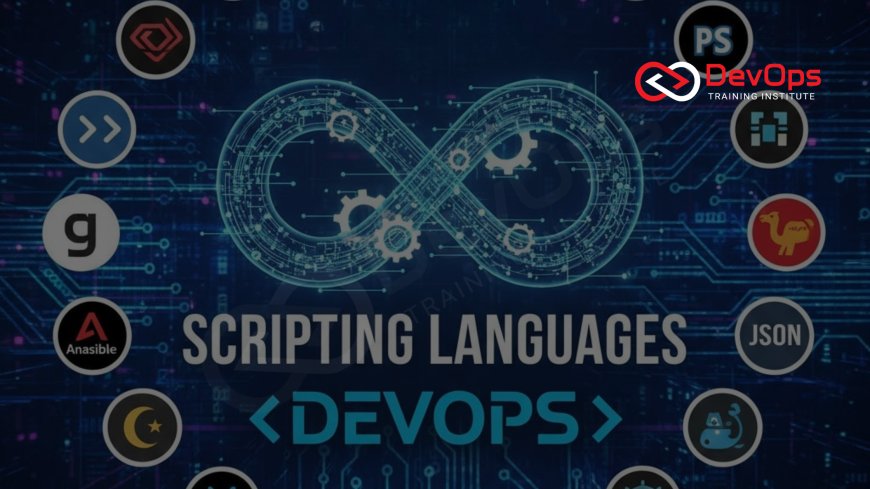
Introduction: The Language of DevOps Automation
DevOps is fundamentally a philosophy built on two pillars: collaboration and automation. While the cultural shift often receives the most attention, the technological engine driving the entire process is automation, and that engine runs almost entirely on scripting. A DevOps Engineer is, at their core, an automation specialist, transforming manual, repetitive, and error-prone tasks (known as "toil") into consistent, repeatable, and self-service code. In the high-velocity world of cloud computing, where infrastructure is ephemeral and applications are constantly changing, mastering a diverse set of scripting languages is not just beneficial—it is an absolute necessity for survival and success. These languages serve as the essential "glue code" that connects disparate systems, manages cloud APIs, enforces consistency across environments, and builds the seamless delivery pipelines that define modern software organizations.
Unlike traditional software development, which often centers around one or two core programming languages, the DevOps environment is inherently polyglot. Engineers must comfortably switch between declarative configuration languages used by infrastructure tools, powerful general-purpose languages for writing API wrappers and complex logic, and lightweight shell languages for interacting directly with the operating system and managing runtime environments. The choice of language is often dictated by the specific task—whether it’s provisioning a virtual network, orchestrating a Kubernetes deployment, or writing a simple cron job to clean up logs. Understanding this landscape and knowing which tool to apply to which problem is the hallmark of a senior, effective DevOps professional, allowing them to bridge the gap between application code and operational realities.
This guide dives deep into the top 15 scripting and configuration languages that form the essential toolkit of every modern DevOps team. We will explore not only their primary use cases but also their specific strengths in cloud automation, CI/CD pipelines, and network configuration, demonstrating why the modern engineer must be fluent in a diverse linguistic portfolio to maintain the speed, reliability, and scale required by enterprise-level cloud operations. The ability to speak the right technical language at the right time is the key to accelerating the entire value stream from code commit to production deployment.
The Unrivaled King: Python
1. Python holds the undisputed crown as the most essential and widely used scripting language in the DevOps domain. Its dominance stems from its exceptional readability, huge standard library, and massive third-party ecosystem, which makes it an ideal "glue language" for connecting diverse systems and cloud APIs. Engineers leverage Python to write complex automation scripts, create custom CI/CD pipeline steps, build internal tooling, and write sophisticated monitoring agents. Python's versatility allows it to seamlessly handle tasks ranging from simple text processing and data manipulation to building fully functional web services and powerful command-line interface (CLI) tools, making it the default choice for solving almost any automation problem that exceeds the capabilities of simple shell scripting.
Python's strength in DevOps is powerfully demonstrated through its extensive library support for virtually every major cloud provider (Boto3 for AWS, Azure SDK, Google Cloud client libraries), making it the language of choice for writing complex cloud-agnostic management code and provisioning custom resources that Infrastructure as Code (IaC) tools alone cannot handle. Furthermore, Python is widely used in automated testing frameworks (Pytest) and security automation, enabling engineers to write custom checks to enforce compliance and security standards within the CI/CD pipeline. Its clear syntax and powerful structure significantly reduce the debugging time compared to older languages, directly contributing to the speed and reliability of the automated processes, which is a core tenet of modern system operations. Understanding how to handle data structures efficiently for networking configuration is often a Python task, as well, used for calculating IPs and managing network address data.
System and Orchestration Fundamentals
These languages are indispensable for interacting directly with the operating system, orchestrating processes across machines, and defining the automation logic within CI/CD engines. They represent the low-level workhorses of the DevOps world, providing the immediate power required to execute commands, manage files, and automate system administration tasks effectively across both Linux and Windows environments. Mastery of these languages is fundamental for any engineer working with the command line or needing to define reusable pipeline steps for complex CI/CD workflows.
The following languages are foundational for system orchestration:
2. Bash/Shell: The quintessential command-line scripting language for Linux and Unix systems. Bash is essential for quick operational tasks, running external commands, manipulating files, and acting as the entry point for most CI/CD pipeline runners. While verbose for complex logic, its native access to system commands makes it unparalleled for managing runtime environments, setting up permissions, and automating system-level checks. Proficiency in Bash demonstrates a deep understanding of the operating system fundamentals, which is crucial for troubleshooting deployment issues and quickly interacting with low-level network settings and processes. Engineers often write short, powerful scripts to verify networking configurations, check on running processes, and ensure that the host machine adheres to security baselines before an application deploys.
3. PowerShell: Microsoft’s object-oriented shell and scripting language, PowerShell, is the equivalent of Bash for Windows and hybrid cloud environments (Azure). Its unique strength lies in its ability to handle objects rather than just text streams, making data manipulation robust and precise. PowerShell is mandatory for automating Windows Server configuration, managing Azure cloud resources through the Azure CLI, and orchestrating tasks in hybrid environments where both Windows and Linux nodes are present. For enterprises managing legacy infrastructure or heavy reliance on Microsoft services, PowerShell is the absolute core language for system administration, offering seamless integration with .NET framework and WMI (Windows Management Instrumentation) for advanced system interaction.
4. Groovy: This dynamic language is mandatory for anyone working heavily with Jenkins, as it is the primary language used to write Jenkinsfiles for "Pipeline as Code." Groovy is a highly expressive, Java-compatible language that is well-suited for defining and controlling complex CI/CD workflow logic, parallelizing builds, managing secrets, and orchestrating deployment stages. Its flexibility allows developers to integrate custom Java code or libraries directly into the pipeline, giving large organizations the power to create complex, customized, and highly sophisticated release processes that meet enterprise-level governance and auditing requirements, making it a specialization for pipeline architects.
The Declarative Core: YAML, HCL, and JSON
While not scripting languages in the traditional sense, these languages are the backbone of the Declarative Paradigm, a core concept in DevOps where the engineer specifies the desired state of the system, and the tools (like Kubernetes or Terraform) work to achieve and maintain that state. Mastery of these formats is non-negotiable, as they define virtually all modern infrastructure, application configuration, and deployment manifests. They abstract away the imperative "how" (the steps) and focus entirely on the declarative "what" (the end state).
5. YAML (YAML Ain't Markup Language): YAML is the universal language of configuration in the cloud-native world. Its simple, human-readable syntax is used everywhere, most notably for defining Kubernetes manifests, GitLab CI pipelines, and configuration files for thousands of other tools. While simple to read, YAML demands strict indentation and structure. Its pervasive use for defining complex Kubernetes resources, including deployments, services, and network policies, makes it a critical language for any DevOps engineer dealing with container orchestration and ensuring network traffic rules are correctly applied.
9. HCL (HashiCorp Configuration Language): Developed by HashiCorp, HCL is the specialized language used by Terraform and Vault for defining Infrastructure as Code. HCL is designed to be human-readable, balancing simplicity with the power to handle complex logic, loops, and resource dependencies. Its primary role is to declaratively define cloud resources (VPCs, subnets, instances, databases) across different providers, enabling engineers to automate massive infrastructure provisioning tasks with a single, unified codebase. The ability to manage and provision networks, particularly complex routing and subnetting rules, is a foundational application of HCL in the DevOps workflow.
10. JSON (JavaScript Object Notation): JSON serves as the universal data interchange format in the modern internet, making it crucial for DevOps, especially when interacting with REST APIs, cloud service APIs, and webhooks. Although often interchangeable with YAML in configuration, JSON is strictly enforced by tools like the AWS CLI and is the standard output/input format for API payloads. Its structured nature is vital for writing scripts in Python or Go that parse responses, extract relevant data points, and automate interactions with cloud platforms. Understanding how to securely handle JSON data that contains secrets or network credentials is a core security requirement.
Table: Top 5 Scripting Languages in DevOps
These five languages represent the absolute core skill set for any DevOps engineer, collectively providing the power needed for automation, orchestration, configuration, and API integration across heterogeneous cloud and system environments.
| # | Language | Primary DevOps Role | Key Tool Integration | Networking Application |
|---|---|---|---|---|
| 1 | Python | Glue Code, API Automation, Tooling | AWS Boto3, Ansible, SaltStack, Pytest | Custom network orchestration, data processing of logs and traffic metrics. |
| 2 | Bash/Shell | OS Interaction, Quick Automation, CI/CD Entry | Any Linux/Unix CI runner, Cron jobs, system administration tasks. | Checking port status, running netstat commands, managing firewall rules. |
| 3 | YAML | Configuration, Declarative State Definition | Kubernetes manifests, Ansible Playbooks, GitLab CI pipelines. | Defining Kubernetes Network Policies and Load Balancer configurations. |
| 4 | HCL | Infrastructure as Code (IaC) | Terraform, HashiCorp Vault, Consul. | Provisioning VPCs, subnets, routing tables, and firewall security groups. |
| 5 | PowerShell | Windows/Azure Automation, System Administration | Azure CLI, Windows Server Management, Desired State Configuration (DSC). | Managing Windows firewall rules, configuring network interfaces, and hybrid cloud networking. |
Compiled, High-Performance Languages
While most DevOps tasks rely on dynamic scripting languages, some complex needs require the speed and concurrency of compiled or strongly typed languages. These languages are used less for simple daily automation and more for building robust, scalable, and high-performance internal tools, custom controllers, and network services that form the core infrastructure management platform, often used as the backend for DevOps tools themselves.
6. Go (Golang): Go has rapidly become the language of choice for building cloud-native infrastructure tooling. Its primary strengths are its exceptional performance, powerful concurrency model (goroutines), and static compilation into a single, small binary file, making deployment trivial. The entire Kubernetes ecosystem is built on Go, as are popular tools like Docker, Terraform, and Prometheus. DevOps teams leverage Go to write custom Kubernetes controllers, fast CLI tools, and scalable internal services where high speed and low latency are paramount for reliable operations. Its performance is often necessary for handling high-volume logging or traffic analysis within the network stack.
7. JavaScript/Node.js: JavaScript, through the Node.js runtime, is heavily used in environments that favor the language for both their frontend and backend applications, enabling a true full-stack engineering approach within DevOps teams. Node.js is excellent for building fast, non-blocking network services, custom APIs for internal tooling, and, increasingly, serverless functions that automate cloud tasks. The speed and vast ecosystem of npm packages make it quick to prototype and deploy automation logic, particularly for web-centric workflows and managing event-driven protocol handling and real-time application responses within the cloud environment.
Legacy, Configuration, and Pipeline Tools
This group includes specialized languages that remain critical for maintaining legacy infrastructure, configuring specific automation tools, or interacting with foundational data systems. Their importance in DevOps is often linked to major enterprise tools or specific niche tasks that are integral to the deployment and operational process, demanding their mastery despite their specialized use cases compared to general-purpose languages like Python or Go.
8. Ruby: While its popularity has waned slightly, Ruby remains mandatory for engineers specializing in Chef configuration management. Chef uses Ruby for its Domain Specific Language (DSL) to define infrastructure configuration "recipes." Furthermore, Ruby's readable syntax and strong community support for testing frameworks make it a common choice for writing end-to-end acceptance tests (Cucumber, RSpec) that validate application functionality within the CI/CD pipeline, often used to check connectivity and ensure successful deployment of services.
11. Scala: Used less for general automation and more for complex, high-throughput DataOps and big data pipelines, Scala is highly relevant in enterprises where data processing is core to the application's function (e.g., streaming services, finance). Its functional programming capabilities and deep integration with tools like Apache Spark make it essential for automating data infrastructure, managing complex data workflows, and applying DevOps principles to data engineering, ensuring the reliability of large data sets that feed core business applications.
12. Perl: Although its usage is in decline for new projects, Perl retains significance in DevOps for managing legacy systems and performing powerful text and log file processing. Perl's long history means it is often the language underlying complex, crucial scripts in older enterprise environments. Knowledge of Perl is necessary for maintaining stability and performing specific administrative tasks on systems where modernization is not yet feasible, and its text manipulation capabilities remain legendary in system administration circles.
15. SQL (Structured Query Language): Though strictly a database query language, SQL is fundamental to DevOps for automating schema migrations, managing database state, and integrating database provisioning into the CI/CD pipeline (Database as Code). Tools like Liquibase or Flyway use SQL to version-control database changes, ensuring that the database remains synchronized with the application code during continuous deployment, a critical factor for maintaining application stability and managing the complex state of application data reliably.
Advanced & Specialized Scripting Domains
As DevOps practices mature, specialized language subsets and tools are emerging to address advanced needs in security, code quality, and application scaling. These languages often blend the capabilities of general-purpose languages with strong type systems or focus entirely on domain-specific abstractions that simplify complexity for the end user, becoming necessary for tackling large-scale, enterprise-grade challenges in the cloud-native space. They represent the cutting edge of automation and developer enablement within the DevOps sphere.
13. DSLs (Domain Specific Languages): DSLs are specialized programming languages created for a specific application domain, offering highly targeted syntax that simplifies complex tasks. Examples include Puppet’s DSL for configuration management, or the specific syntax used by monitoring tools like PromQL (Prometheus Query Language). DevOps engineers must master these DSLs to effectively manage specific tools, write efficient configuration files, and query operational data. These languages allow engineers to directly address complexity without getting bogged down in the intricacies of a general-purpose language, often defining security policies or firewall rules in a simplified, highly readable format for auditability.
14. TypeScript: As a superset of JavaScript, TypeScript adds static typing and class-based object-oriented programming to the language. This makes TypeScript increasingly popular for building large-scale, maintainable internal DevOps tools, particularly for teams already using Node.js. It is also used by the Pulumi IaC framework, allowing engineers to define cloud infrastructure using familiar programming languages like Python or TypeScript. The robust type checking of TypeScript drastically reduces runtime errors and improves code quality in complex automation projects, which is critical for ensuring the stability of core provisioning logic, especially when dealing with advanced networking or Cloud networking configurations.
Conclusion: The Polyglot Engineer
The modern DevOps engineer must be a true Polyglot Engineer, proficiently navigating a diverse landscape of scripting and configuration languages. The need for Python for logic, Bash for operating system interaction, HCL for infrastructure provisioning, and YAML for configuration orchestration is undeniable. Mastery over this portfolio is what ultimately enables the speed, reliability, and security required by continuous delivery at scale. By investing heavily in these scripting skills, engineers transform themselves from manual system administrators into architects of automated systems, moving beyond merely solving problems to building repeatable, resilient solutions.
The core lesson from this landscape is that the right tool must be chosen for the right task. Whether you are using Python to check network topology, Bash to inspect the status of MAC addresses, or HCL to define cloud firewall rules, a deep understanding of the language's specific strengths and limitations is key to efficiency. This continuous pursuit of automation fluency is the single most important factor that separates high-performing DevOps teams from those struggling with manual toil, ensuring that the engineering organization adheres to best practices for securing network services and maximizing system reliability by applying code to every operational challenge.
Frequently Asked Questions
Why is Python considered the top scripting language for DevOps?
Python's vast ecosystem, readability, and strong cloud SDK support make it the ideal general-purpose language for automation, API interaction, and writing internal tooling.
What is the primary function of HCL (HashiCorp Configuration Language)?
HCL's primary function is to declaratively define and provision complex infrastructure resources as code using the Terraform and Vault frameworks.
Why must DevOps engineers understand the OSI and TCP/IP models?
Understanding these models is vital for troubleshooting connectivity issues, diagnosing latency, and accurately defining network and security policies for deployed applications.
What language is mandatory for Jenkins Pipeline as Code?
Groovy is mandatory for defining the logic, workflow, and stages of the automated CI/CD pipeline within the Jenkins automation server.
How is JavaScript (Node.js) used in DevOps?
Node.js is used for building fast, non-blocking internal APIs, custom tooling, and implementing serverless functions for event-driven cloud automation tasks.
What is the key benefit of PowerShell over Bash?
PowerShell’s key benefit is its object-oriented nature, which makes it far more robust and precise than Bash for automating complex tasks within Windows and Azure environments.
Why are YAML and JSON so important in cloud-native DevOps?
They are the core data formats used for defining the desired, declarative state of application configurations, Kubernetes manifests, and cloud service parameters.
What is a DSL in the context of configuration management?
A DSL (Domain Specific Language) is a specialized language (like Puppet or Chef’s syntax) designed only to solve specific configuration problems efficiently.
How is Go (Golang) used in infrastructure tooling?
Go is used to build high-performance, concurrent, and scalable tools like Docker, Kubernetes, and Prometheus due to its compilation speed and efficient concurrency model.
What is the role of SQL in the CI/CD pipeline?
SQL is used within specialized tools (Flyway, Liquibase) to version-control database schema changes, integrating database migrations reliably into the continuous deployment process.
Why do DevOps teams care about physical addressing in the network stack?
DevOps teams must understand physical addressing to troubleshoot network failures, configure advanced network policies, and ensure optimal performance in containerized environments.
How is Python used for configuring network devices?
Python libraries like NAPALM or Netmiko are used to automate the management and configuration of physical and virtual network devices programmatically.
What benefit does TypeScript offer over JavaScript for automation?
TypeScript adds static typing, reducing runtime errors and improving code quality and maintainability for complex, large-scale automation projects.
Why must the CI/CD pipeline enforce policies for network security?
The pipeline must enforce policies to automatically prevent the deployment of infrastructure that violates security rules, such as open firewalls or unencrypted traffic paths.
When is Perl still relevant in an enterprise DevOps environment?
Perl remains relevant for maintaining and integrating with critical, often older, legacy systems and performing complex text processing tasks that are still integral to certain operational workflows.
What's Your Reaction?
 Like
0
Like
0
 Dislike
0
Dislike
0
 Love
0
Love
0
 Funny
0
Funny
0
 Angry
0
Angry
0
 Sad
0
Sad
0
 Wow
0
Wow
0


![100+ Azure DevOps Interview Questions and Answers [Updated 2025]](https://www.devopstraininginstitute.com/blog/uploads/images/202509/image_140x98_68c40aa9a3834.jpg)






![Future Scope of DevOps Careers in Pune [Updated 2025]](https://www.devopstraininginstitute.com/blog/uploads/images/202510/image_140x98_68e3a84652312.jpg)