






![Kong Interview Preparation Guide [2025]](https://www.devopstraininginstitute.com/blog/uploads/images/202509/image_430x256_68dbb95326997.jpg)





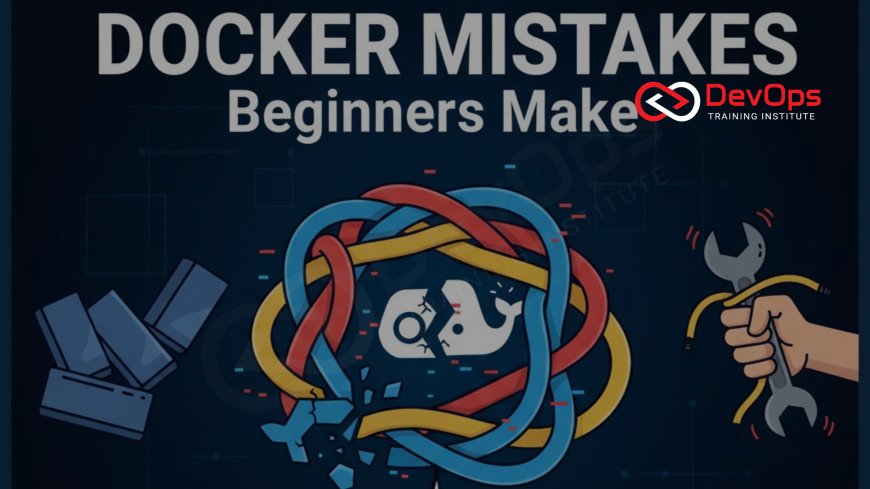
10 Common Docker Mistakes Beginners Make
Avoid the most painful Docker mistakes that trip up beginners in 2025. From bloated images and ignored .dockerignore files to running containers as root and exposing unnecessary ports. Learn the fixes that save hours of debugging and keep your containers secure and efficient.
Introduction
Docker makes development feel magical until you hit the classic pitfalls that every beginner faces. In 2025, these same mistakes still cause slow builds, oversized images, security vulnerabilities, and production outages even for experienced teams. The good news? They are completely avoidable once you know what to look for. This guide walks through the 10 most common Docker mistakes beginners make today, explains exactly why they are problematic, and gives you the professional fixes that instantly level up your skills. Whether you are just starting with containers or cleaning up a messy DevOps workflow, avoiding these will save you hours of frustration and make your containers faster, smaller, and far more secure.
1. Forgetting the .dockerignore File
Every beginner copies their entire project directory into the Docker build context. Without a .dockerignore file, this includes node_modules, .git folders, logs, and even secrets.
- Builds take minutes instead of seconds
- Cache gets invalidated on every unrelated change
- Sensitive files can end up baked into image layers
- Final image size increases by hundreds of MB
The Fix That Changes Everything
Create a .dockerignore file (just like .gitignore) and add node_modules, .git, *.log, .env, .aws/, dist/, build/. Your builds will instantly become lightning fast and far more secure.
2. Running Containers as Root User
By default, most Docker images run processes as root. If an attacker compromises your app, they instantly have root on the host.
- Violates Kubernetes restricted Pod Security Standards
- Makes container escape trivial
- Scanners like Trivy flag this as critical
The Fix
Add USER 1000 or create a specific non-root user in your Dockerfile. Place it as the last instruction so everything runs as that user. This is now considered mandatory for any production container.
3. Building Bloated Images with Poor Multi-Stage Usage
Multi-stage builds exist to create tiny production images, but beginners often copy everything from the builder stage.
- Final images contain compilers, source code, cache
- Images reach 1GB+ when they could be under 50MB
- Slower pull times and larger attack surface
The Fix
Only copy the final artifact (binary, dist folder) from the builder stage. Use alpine, distroless, or scratch as the final base image. Tools like dive show exactly what is in each layer.
4. Ignoring Docker Layer Caching
Placing COPY . . or ADD commands early in the Dockerfile invalidates cache for everything below, forcing full rebuilds every time.
- CI/CD pipelines become painfully slow
- Developers waste hours waiting for builds
The Fix
Order your Dockerfile from least to most frequently changed: FROM, RUN apt/apt-get, copy package files, install dependencies, then finally copy application code. This maximizes cache reuse and makes builds feel instant.
5. Exposing Unnecessary Ports and Using Wildcard Publishing
Many beginners write EXPOSE 80 443 22 3306 and then run containers with -p 0.0.0.0:0.0.0.0:80-3306, opening services they never intended.
- Creates huge attack surface
- Violates zero-trust networking
The Fix
Only expose ports your app actually uses. In production, let reverse proxies or Kubernetes handle external access. Never publish port ranges.
6. Not Implementing Health Checks
Docker has no way to know if your application inside the container is actually healthy without explicit health checks.
- Orchestrators think dead containers are fine
- Load balancers send traffic to broken instances
The Fix
Add HEALTHCHECK CMD curl --fail http://localhost/health || exit 1 with appropriate interval and timeout. This is required for proper liveness and readiness probes in orchestrators.
7. Storing Secrets in Dockerfiles or Images
Hardcoding passwords, API keys, or certificates directly in Dockerfiles or .env files is shockingly common and extremely dangerous.
- Secrets live forever in image layers
- Anyone with image access can extract them
- Appears in docker history and registry scans
The Fix
Never commit secrets. Use build args only when unavoidable. In production, use proper secret management: Docker secrets, Kubernetes secrets with external providers, or HashiCorp Vault injected at runtime.
8. Running Multiple Processes in One Container
Trying to run app server + nginx + cron jobs in a single container using supervisord or shell scripts breaks the Docker philosophy.
- Logs get mixed and unsearchable
- Signals don’t reach child processes properly
- Impossible to scale individual components
The Fix
One container = one process. Use Docker Compose or Kubernetes to orchestrate multiple containers. Your life becomes dramatically simpler and more reliable.
9. Using :latest Tag in Production
Tagging images as :latest seems convenient but destroys reproducibility and causes surprise breakages.
- No one knows exactly which version is running
- Rollbacks become guesswork
- Violates GitOps principles
The Fix
Use immutable tags: v1.2.3 or 20250315-abcd123. Promote the exact same image through environments. This is required for proper auditing and rollback.
10. Not Cleaning Up Unused Resources
Beginners rarely prune old images, stopped containers, unused networks, and dangling volumes.
- Disk space fills up unexpectedly
- Performance degrades over time
- Security scanners report old vulnerable images
The Fix
Run docker system prune -a regularly, or better yet, automate with cron or CI/CD cleanup jobs. In production, use registry garbage collection and lifecycle policies.
Common Docker Mistakes Quick Reference Table
| Mistake | Impact | Professional Fix |
|---|---|---|
| No .dockerignore | Slow builds, secrets in images | Create comprehensive .dockerignore |
| Running as root | Easy container escape | Add USER instruction |
| Poor layer ordering | Cache never reused | Copy code last |
| No health checks | Orchestrator confusion | Add HEALTHCHECK |
| :latest in prod | Unreproducible deploys | Use immutable tags |
Conclusion
These ten Docker mistakes are universal, timeless, and completely avoidable. The difference between a beginner and a professional often comes down to these exact details: a proper .dockerignore, running as non-root, smart layer ordering, health checks, and immutable tags. Fix these in your current projects today and you will immediately see faster builds, smaller images, better security, and happier production systems. Docker done right is simple and powerful. Avoid these common traps and you will write production-grade containers from day one.
Frequently Asked Questions
Is it really that bad to run containers as root?
Yes. A single vulnerability becomes instant host compromise.
Should I always use multi-stage builds?
For compiled languages yes. For Node/Python, minimal base images work well.
Can I just use Docker Desktop for production?
No. Use proper orchestration: Kubernetes, ECS, or Nomad.
Are official images always safe?
They are updated regularly but still run as root and can be large.
Do I need .dockerignore if I use Git?
Yes! They serve completely different purposes.
Is :latest ever acceptable?
Only in local development with one developer.
Should I pin package versions?
Always. Never use latest without a specific version.
Can environment variables store secrets safely?
No. They appear in docker inspect and logs.
Is Alpine always the best base image?
No. It has compatibility issues. Debian slim often better.
Do health checks matter without Kubernetes?
Yes! Docker restart policies depend on them.
Should I run databases in Docker for production?
Generally no. Use managed services instead.
Is Docker Compose enough for production?
For very small teams maybe, but most move to Kubernetes.
How do I know if my Dockerfile is good?
Run dive, hadolint, and Trivy. Aim for under 100MB and no root.
Are there tools to auto-fix these mistakes?
Hadolint, dive, and Dockerfile linters catch most in CI.
What single change helps the most?
Adding .dockerignore and non-root user. Do these today.
What's Your Reaction?
 Like
0
Like
0
 Dislike
0
Dislike
0
 Love
0
Love
0
 Funny
0
Funny
0
 Angry
0
Angry
0
 Sad
0
Sad
0
 Wow
0
Wow
0



![100+ Azure DevOps Interview Questions and Answers [Updated 2025]](https://www.devopstraininginstitute.com/blog/uploads/images/202509/image_140x98_68c40aa9a3834.jpg)





![Future Scope of DevOps Careers in Pune [Updated 2025]](https://www.devopstraininginstitute.com/blog/uploads/images/202510/image_140x98_68e3a84652312.jpg)