

![Kong Interview Preparation Guide [2025]](https://www.devopstraininginstitute.com/blog/uploads/images/202509/image_430x256_68dbb95326997.jpg)

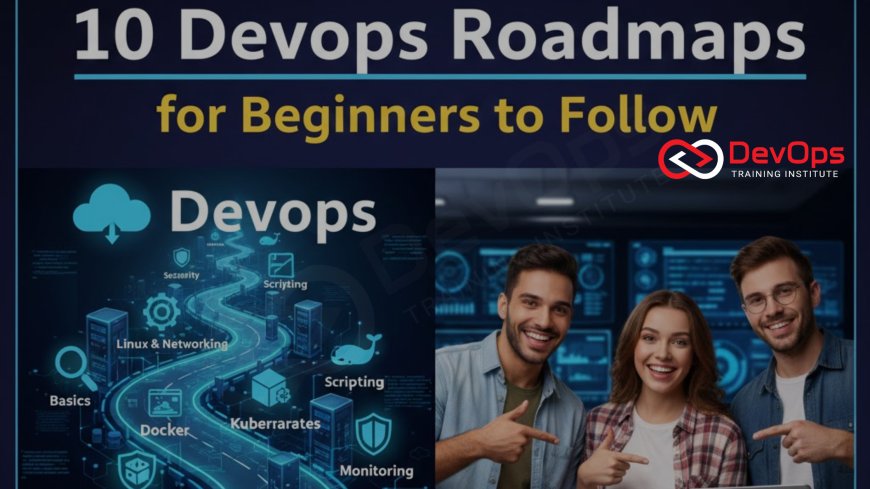
10 DevOps Roadmaps for Beginners to Follow in 2025
Starting your career in DevOps in 2025? Choose the perfect path with 10 detailed roadmaps tailored for beginners, covering essential foundational knowledge in Linux, cloud platforms (AWS, Azure, GCP), and crucial automation tools like Docker, Kubernetes, and Terraform. This guide breaks down complex domains like Site Reliability Engineering (SRE), DevSecOps, and Cloud Platform specialization into clear, manageable steps. Learn the core principles, master the most in-demand skills, and strategically plan your learning journey to become a highly paid and effective DevOps professional, ensuring you build a robust portfolio that stands out to hiring managers globally.
Introduction
The field of DevOps has evolved from a niche philosophy to the standard operating model for software delivery across the globe. As organizations increasingly rely on cloud infrastructure, containerization, and automation to achieve speed and reliability, the demand for skilled DevOps professionals has never been higher. However, for a beginner looking to enter this dynamic domain in 2025, the sheer volume of tools, technologies, and concepts can feel overwhelming. The term "DevOps" itself covers a vast spectrum of specialized knowledge, from networking and system administration to advanced coding and security practices. Knowing where to start and which skills to prioritize is the critical first step to a successful career transition or launch.
A successful transition into a highly sought-after DevOps role is not about mastering every single tool simultaneously; rather, it is about following a structured and deliberate learning path that builds a strong foundation before moving into specialized, high-value domains. The optimal learning sequence involves mastering the core operating system, version control, and cloud fundamentals before dedicating effort to advanced automation tools like Kubernetes and Terraform. To help you navigate this complexity, we have synthesized the most effective learning strategies into 10 distinct roadmaps, each tailored to a specific career goal or specialization within the broader DevOps landscape. Following a dedicated roadmap ensures your learning is focused, efficient, and aligned with industry demand, maximizing your potential for high earnings and rapid career growth in modern IT organizations.
The Foundational Prerequisite: The Core Skill Trinity
Regardless of the specialized career path you choose, every successful DevOps role is built upon a non-negotiable foundation of three core skill areas. Skipping these prerequisites will severely limit your ability to understand, troubleshoot, and automate complex distributed systems later in your journey. We strongly recommend dedicating the first 3-4 months of your learning exclusively to achieving a high level of proficiency in this core trinity before touching advanced CI/CD or container orchestration tools. This mastery is what separates a knowledgeable engineer from someone who simply executes commands without understanding the underlying mechanisms.
The universal prerequisites for every DevOps roadmap are:
- Linux Fundamentals and Scripting: Since the vast majority of cloud servers, containers, and orchestration tools run on Linux, mastering its command line is essential. Focus on file system navigation, user and permission management, process monitoring, and, most importantly, Shell Scripting (Bash). Scripting is the fundamental mechanism for low-level automation and system configuration, which underpins the entire DevOps philosophy.
- Version Control with Git: Git is the absolute backbone of the software development lifecycle. You must master core Git commands, common branching strategies (like Git Flow or Trunk-Based Development), and how to manage pull requests and resolve merge conflicts. Your infrastructure, application code, and CI/CD pipelines will all be stored and managed within Git.
- Networking and Security Basics: Understand the basics of how systems communicate: TCP/IP, DNS, HTTP/HTTPS, firewalls, and load balancing. Furthermore, grasp core security concepts like Identity and Access Management (IAM), SSH key management, and the Principle of Least Privilege. You cannot secure or connect applications effectively without this foundational knowledge.
Roadmap 1: The Cloud Platform Specialist (AWS/Azure/GCP)
This roadmap is ideal for beginners coming from a system administration or networking background who want to specialize in cloud infrastructure management. The focus is on deep mastery of a single major cloud provider, understanding their unique services, and deploying Infrastructure as Code (IaC) solutions within that ecosystem. This path quickly leads to roles like Cloud Infrastructure Engineer or Cloud DevOps Engineer, which command high salaries due to the business-critical nature of cloud resources.
Key learning modules for this roadmap include: 1. Deep dive into fundamental cloud services (e.g., AWS EC2/S3/RDS, Azure VMs/Storage/SQL, GCP Compute Engine). 2. Master IaC using Terraform for provisioning all resources, ensuring configurations are consistent and repeatable. 3. Learn the provider's native security and identity management services (AWS IAM, Azure AD) for secure access control. 4. Focus on networking: VPCs, subnets, routing, and load balancing within the chosen cloud. 5. Achieve a professional-level certification (e.g., AWS Certified DevOps Engineer Professional) to validate expertise and significantly boost earning potential, as mastering the complexities of cloud environments is highly rewarded by enterprise companies.
Roadmap 2: The Core Automation Pipeline Builder
This is the most direct route to becoming a classical DevOps Engineer, focusing on the core practice of automating the build, test, and deployment phases. This path is crucial for anyone who enjoys working with scripting, tooling, and system integration. The goal is to design and maintain a reliable Continuous Integration/Continuous Delivery (CI/CD) pipeline that moves code from a developer's laptop to production quickly and safely, maximizing deployment frequency for the entire engineering organization.
The learning path centers on: 1. Mastering containerization with Docker (writing Dockerfiles, managing images). 2. Deep dive into container orchestration with Kubernetes (understanding Pods, Deployments, Services, and Helm). 3. Mastering an industry-standard CI tool like Jenkins, GitLab CI/CD, or GitHub Actions for pipeline definition. 4. Learning automated testing integration (unit, integration, and security checks). 5. Building and deploying a full web application end-to-end using these tools on a public cloud, demonstrating a working automated pipeline. This integration of core DevOps tools is essential for day-to-day operations.
| # | Roadmap Title | Primary Goal | Key Tools & Focus Areas |
|---|---|---|---|
| 1 | Cloud Platform Specialist | Deep expertise in a single cloud provider's IaC and managed services. | Terraform, AWS/Azure/GCP, IAM, VPC Networking, Cloud Certification. |
| 2 | Core Automation Pipeline Builder | Design, build, and maintain end-to-end CI/CD workflows. | Docker, Kubernetes, Jenkins/GitLab CI, Helm, Automated Testing. |
| 3 | Site Reliability Engineer (SRE) | Achieve and maintain system reliability and continuous operational stability. | Python/Go, Prometheus, Grafana, SLOs/SLIs, Incident Response, Toil Reduction. |
| 4 | DevSecOps Specialist | Integrate automated security and compliance into the delivery pipeline. | SAST/DAST Tools, Vault, IAM, Policy-as-Code (OPA), Vulnerability Scanning. |
| 5 | Kubernetes Platform Master | Deep expertise in Kubernetes, focusing on clustering, networking, and scaling. | Advanced K8s, Istio (Service Mesh), CNCF Ecosystem, Certifications (CKA/CKS). |
Roadmap 3: The Site Reliability Engineer (SRE) Path
The SRE path is for those with a strong inclination toward combining deep programming skills with critical operations knowledge. SREs are primarily concerned with eliminating manual operational work ("toil") by writing automation code and ensuring the entire production system meets strict reliability targets (SLOs). This is one of the most highly paid specialization tracks, requiring expertise in monitoring and large-scale distributed systems, making it a natural career progression for experienced developers or operations engineers. The focus is always on engineering for reliability.
This roadmap requires: 1. Strong programming proficiency in Python or Go for writing automation and custom tooling. 2. Deep dive into observability tools: mastering Prometheus (metrics), Grafana (visualization), and ELK/Splunk (logging). 3. Understanding SRE concepts: defining SLOs, SLIs, error budgets, and practicing blameless post-mortems. 4. Incident response management and on-call processes. 5. Learning advanced state management concepts beyond containers. Understanding the core philosophy that SRE is engineering for reliability is key to mastering this domain.
Roadmap 4: The DevSecOps Specialist
This high-demand roadmap is designed for those passionate about security who want to embed continuous security and compliance checks directly into the CI/CD pipeline ("Shift Left"). The DevSecOps Specialist ensures that speed and automation do not compromise system integrity, reducing organizational risk and preventing costly security incidents in production. This path is financially rewarding due to the critical nature of its responsibilities in protecting enterprise assets.
Key modules include: 1. Learning application security fundamentals (OWASP Top 10). 2. Mastering automated vulnerability scanning tools (SAST/DAST) and dependency checkers. 3. Securely managing secrets using dedicated tools like HashiCorp Vault or cloud secrets managers. 4. Enforcing policy and compliance using Policy-as-Code (PaC) tools (e.g., OPA). 5. Understanding IAM/Role-Based Access Control (RBAC) and network security rules in the cloud. This specialization aligns perfectly with the industry trend that views security as a shared responsibility across all stages of development and deployment.
Roadmap 5: The Kubernetes Platform Master
This specialization builds directly upon the core automation roadmap, focusing exclusively on deep, expert-level knowledge of Kubernetes and the broader Cloud Native Computing Foundation (CNCF) ecosystem. The goal is to move beyond basic container deployment to managing production-grade, highly available, and resilient Kubernetes clusters at massive scale. This role is crucial for organizations fully committed to microservices architecture, leading to titles like Cloud Native Engineer or Platform Engineer, demanding top-tier compensation.
The learning focus is on: 1. Advanced Kubernetes topics: networking (CNI), storage (CSI), cluster security, and custom resource definitions (CRDs). 2. Mastering service mesh technologies like Istio or Linkerd for service-to-service communication, security, and traffic control. 3. Deep dive into GitOps automation using Argo CD or Flux to manage cluster configuration and application state from Git. 4. Achieving professional certifications like the Certified Kubernetes Administrator (CKA) and Certified Kubernetes Security Specialist (CKS) to validate enterprise-level operational competence.
Roadmap 6: The Infrastructure as Code (IaC) Expert
This path focuses on mastering the declarative provisioning of infrastructure, making it ideal for those who prefer configuration, architecture design, and automation consistency. The IaC Expert uses code to define, deploy, and manage the complete life cycle of cloud resources, guaranteeing environment parity between development, staging, and production environments. This specialization is vital for large organizations to achieve control, auditability, and cost efficiency in their cloud usage.
Key learning modules include: 1. Deep mastery of Terraform (HCL) for multi-cloud provisioning and advanced state file management, focusing on modularity and reusability. 2. Learning Configuration Management (CM) with Ansible (for setting up software inside VMs) to complement Terraform. 3. Understanding Policy-as-Code for governance. 4. Focusing on IaC security best practices and drift detection. This expertise is necessary to enforce consistency, which is the cornerstone of managing modern cloud infrastructure efficiently.
Roadmap 7: The DataOps Engineer (MLOps)
A cutting-edge specialization focused on applying DevOps principles to data science and machine learning pipelines. The DataOps Engineer automates the entire flow of data, models, and analytical code, ensuring that data scientists can deploy their work reliably and quickly. This path combines core DevOps skills with data architecture and machine learning concepts, making it one of the highest-growth and highest-paying specialization tracks of 2025.
The learning path integrates: 1. Core DevOps tools (CI/CD, Kubernetes) applied to data workloads. 2. Understanding data pipeline tools (Apache Airflow, Prefect). 3. MLOps tools (Kubeflow, MLflow) for model versioning and deployment. 4. Focusing on data quality testing and monitoring. 5. Understanding cloud data services (e.g., AWS SageMaker, GCP Vertex AI) to build automated, reliable data pipelines that handle massive throughput while maintaining integrity.
Roadmap 8: The Serverless Specialist
This roadmap is dedicated to mastering Function-as-a-Service (FaaS) and other serverless paradigms (like AWS Lambda, Azure Functions, GCP Cloud Run), minimizing infrastructure management entirely. The Serverless Specialist focuses on writing event-driven code and automating its deployment and scaling, achieving maximum agility and cost efficiency by only paying for compute time used. This path is ideal for developers looking to shed traditional operational duties entirely.
Key areas include: 1. Deep dive into a specific serverless platform (e.g., AWS Lambda, API Gateway, DynamoDB). 2. Mastering the Serverless Framework or AWS SAM for deployment and management. 3. Understanding event-driven architecture and asynchronous communication. 4. Focusing on monitoring and debugging serverless functions (cold starts, cost optimization). 5. Learning how serverless practices complement container orchestration for hybrid application designs.
Roadmap 9: The Security-First Developer
This roadmap targets software developers who want to specialize in writing secure code and embedding security knowledge deeply into the product team's workflow, a core component of the modern DevSecOps movement. The goal is to become the team's internal security champion, guiding feature development with a proactive, security-first mindset and ensuring compliance is built-in, not bolted-on after the fact. This path directly addresses the high demand for developers who understand security principles beyond basic vulnerability scanning.
The learning path focuses on: 1. Secure coding practices and defensive programming. 2. Authentication and authorization frameworks (OAuth, JWT, RBAC). 3. Integrating security testing libraries directly into unit and integration tests. 4. Understanding threat modeling and risk assessment. 5. Deep collaboration with DevSecOps and SRE teams to ensure that the code is protected in production, driving a strong and proactive security culture across the engineering organization.
Roadmap 10: The Multi-Cloud Automation Expert
The ultimate strategic roadmap for experienced beginners: mastering automation across two or more major cloud providers (AWS and Azure/GCP). This specialization is driven by the enterprise need for redundancy, flexibility, and vendor negotiation leverage, leading to roles like Multi-Cloud Architect. This is the highest-paying track but requires mastery of core skills (Roadmaps 1 and 2) applied to heterogeneous environments. The challenge is abstracting away cloud-specific differences.
Key modules require: 1. Expert-level proficiency in Terraform for multi-provider IaC. 2. Mastering vendor-agnostic container orchestration (Kubernetes, Helm). 3. Understanding multi-cloud networking and secure inter-cloud communication. 4. Utilizing open-source tools (Prometheus, Spinnaker) for universal monitoring and deployment orchestration. 5. Gaining professional certifications in two different cloud platforms to validate dual expertise, demonstrating the ability to manage complex cloud portfolios.
Conclusion
The field of DevOps in 2025 offers unprecedented opportunities for career growth, but success hinges on making a focused, strategic choice about your learning path. By building a solid foundation in Linux, Git, and networking, you unlock the doors to all ten specialized roadmaps. Whether you choose to prioritize the high reliability standards of the SRE path, the security focus of DevSecOps, or the infrastructure expertise of the Cloud Platform Specialist, committing to one of these structured roadmaps ensures your learning is efficient, goal-oriented, and aligned with the specific, high-demand needs of modern tech organizations. Remember that DevOps is not just about tools; it is a cultural and methodological shift that rewards continuous learning, problem-solving, and a dedication to automation and quality, positioning you for a highly paid and impactful career in cloud-native computing.
Frequently Asked Questions
Should I learn Python or Go for DevOps automation?
Both are excellent, but Python is recommended for beginners due to its ease of use; Go is better later for writing high-performance SRE tooling.
Is a computer science degree mandatory for DevOps?
No, practical skills in Linux, scripting, and cloud automation often outweigh the degree; many successful engineers transition from networking or sysadmin roles.
What is the difference between Docker and Kubernetes?
Docker packages the application into a container, while Kubernetes manages the deployment, scaling, and networking of many running containers.
How long does it take to complete the Core Automation roadmap?
With consistent effort, the core roadmap (Linux, Git, Docker, Kubernetes, CI/CD basics) typically takes an active beginner around 6 to 9 months.
Why is Linux fundamental to the DevOps role?
Linux is fundamental because most cloud infrastructure, containers, and automation tooling run on Linux-based systems, requiring deep command-line proficiency for troubleshooting and automation.
What is Policy-as-Code (PaC)?
PaC is the practice of defining security and compliance rules using code, which is then automatically enforced during the CI/CD pipeline using tools like OPA.
Which cloud certification should a beginner target first?
A beginner should target an entry-level cloud certification like AWS Certified Cloud Practitioner or Microsoft Azure Fundamentals for broad platform knowledge.
What is "toil" in the SRE context?
Toil refers to manual, repetitive, tactical operational work that lacks lasting value and can be automated, which SREs strive to eliminate entirely.
Is Terraform always used with Ansible?
Terraform is used for infrastructure provisioning (creating VMs), while Ansible is often used for configuration management (installing software inside the VMs) for a complete solution.
What is the GitOps methodology?
GitOps is a delivery method where Git serves as the single source of truth; any change in the system's desired state is made by changing the code in Git, which is then automatically deployed.
What should I include in my DevOps portfolio?
A strong portfolio must include end-to-end projects demonstrating CI/CD pipelines, Terraform IaC, working Kubernetes deployments, and a functioning observability stack.
What is the focus of a DataOps Engineer?
The DataOps Engineer focuses on automating and ensuring the reliability, consistency, and quality of data pipelines used by data scientists and business intelligence systems.
Is the Serverless Specialist path limited to AWS Lambda?
No, the path encompasses all serverless technologies, including Azure Functions and GCP Cloud Run, focusing on event-driven architecture and resource optimization.
What is the most crucial skill for the Multi-Cloud Expert?
The most crucial skill is advanced Terraform proficiency, specifically in creating reusable modules and managing state across different cloud providers effectively.
Why is observability more important than traditional monitoring?
Observability provides deeper context by correlating logs, metrics, and traces, allowing engineers to ask novel questions about the system's behavior, leading to faster diagnosis.
What's Your Reaction?
 Like
0
Like
0
 Dislike
0
Dislike
0
 Love
0
Love
0
 Funny
0
Funny
0
 Angry
0
Angry
0
 Sad
0
Sad
0
 Wow
0
Wow
0

![100+ Azure DevOps Interview Questions and Answers [Updated 2025]](https://www.devopstraininginstitute.com/blog/uploads/images/202509/image_140x98_68c40aa9a3834.jpg)



![Future Scope of DevOps Careers in Pune [Updated 2025]](https://www.devopstraininginstitute.com/blog/uploads/images/202510/image_140x98_68e3a84652312.jpg)