

![Kong Interview Preparation Guide [2025]](https://www.devopstraininginstitute.com/blog/uploads/images/202509/image_430x256_68dbb95326997.jpg)

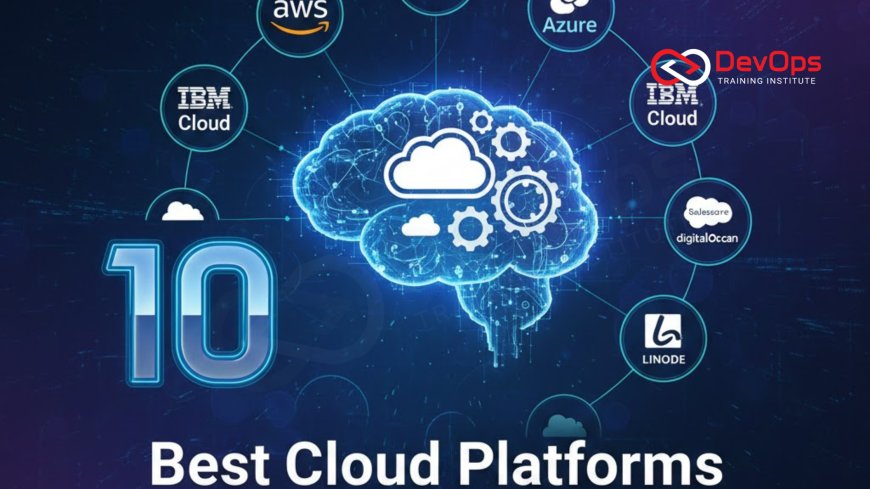
10 Best Cloud Platforms for DevOps Engineers
In 2026, the cloud landscape for DevOps has shifted toward AI-first ecosystems, platform engineering, and high-performance hybrid architectures. This comprehensive guide reviews the ten best cloud platforms for DevOps engineers, comparing traditional giants like AWS and Azure with modern, developer-centric platforms like Northflank and Fly.io. Discover the specific strengths of each provider in areas like Kubernetes orchestration, MLOps, FinOps analytics, and edge computing. Whether you are managing global microservices or building a private sovereign cloud, this expert analysis provides the technical insights and use cases needed to select the ideal platform for your engineering team’s scalability and automation goals today.
Introduction to the 2026 Cloud Ecosystem
As we navigate through 2026, the cloud is no longer just a place to host virtual machines; it has become an intelligent, autonomous ecosystem designed to fuel rapid software delivery. For DevOps engineers, the choice of a cloud platform is the most critical decision in their technical roadmap. The current market is defined by a split between the "Hyperscalers" that offer vast, complex service catalogs and "Modern Developer Platforms" that prioritize developer experience through extreme abstraction and GitOps-native workflows. This evolution reflects the industry's move toward platform engineering and the need to reduce cognitive load on engineering squads.
In this era, a top-tier cloud platform must excel in four dimensions: AI-integrated automation, cost transparency (FinOps), security by design (DevSecOps), and multi-cloud interoperability. Organizations are moving away from being locked into a single provider, instead choosing specialized platforms for different workloads—such as using GCP for data analytics while keeping core enterprise apps on Azure. This guide evaluates the ten most impactful platforms for 2026, providing a professional look at their core offerings, trade-offs, and ideal use cases to help you build a resilient, future-proof technical foundation for your business.
AWS: The Undisputed Leader in Service Breadth
Amazon Web Services (AWS) remains the heavyweight champion of the cloud world in 2026, offering the most extensive service catalog in existence. For DevOps engineers, AWS provides unparalleled depth in infrastructure automation through services like CloudFormation and the CDK. Its global infrastructure ensures that you can deploy applications with ultra-low latency to almost any corner of the globe. AWS has also taken the lead in AI-augmented devops, with Bedrock and CodeWhisperer now deeply integrated into the management console to provide predictive scaling and automated code fixes.
However, the sheer size of AWS is its greatest challenge. The learning curve remains steep, and pricing can be notoriously complex without dedicated FinOps oversight. DevOps professionals on AWS often find themselves specializing in "AWS-native" patterns, leveraging Lambda for serverless architectures or EKS for enterprise-grade Kubernetes. It is the best choice for large organizations that require maximum flexibility and the ability to build highly custom, proprietary architectures. Despite the complexity, AWS continues to set the standard for cluster states management and high-availability systems that power the world's largest digital enterprises.
Microsoft Azure: The Enterprise and Hybrid Powerhouse
Microsoft Azure has solidified its position as the premier choice for enterprise DevOps, especially those already integrated into the Microsoft ecosystem. Its greatest strength lies in its seamless hybrid cloud capabilities through Azure Arc, allowing engineers to manage on-premises servers, edge devices, and other clouds from a single Azure control plane. This is a critical trend for 2026, as large corporations look to maintain continuous synchronization between their legacy data centers and modern cloud-native apps. Azure DevOps remains a top-tier all-in-one platform for planning, coding, and deploying.
The platform’s deep integration with GitHub and OpenAI has made it a leader in AI-first software engineering. Azure provides "golden paths" for .NET developers while offering robust support for Linux and open-source toolchains. While the UI can occasionally feel dated compared to newer platforms, its compliance certifications and security features are second to none, making it the go-to for finance, healthcare, and government sectors. As who drives cultural change in large enterprises, Azure provides the governance and stability needed to scale DevOps practices across thousands of engineers globally.
Google Cloud (GCP): Data, AI, and Kubernetes Excellence
Google Cloud Platform (GCP) continues to win over DevOps teams that prioritize data analytics, machine learning, and pure Kubernetes-native development. As the birthplace of Kubernetes, GCP’s GKE (Google Kubernetes Engine) is widely considered the most automated and easiest-to-manage K8s service in the industry. In 2026, Google’s focus on Vertex AI has made it the primary destination for MLOps, where engineers can automate the entire lifecycle of machine learning models with the same rigor they apply to traditional software code.
GCP stands out for its commitment to open-source standards and multi-cloud portability through Anthos. It offers a cleaner, more developer-friendly interface than its larger rivals and a highly efficient global network. While its service catalog is smaller than AWS, it focuses on "doing a few things better than anyone else." For startups and data-driven businesses, GCP provides the most powerful cloud architecture patterns for real-time analytics and AI inference. It is a platform designed for engineers who want to spend less time managing the cloud and more time extracting value from their data pipelines and automated delivery systems.
Comparison of Top Cloud Platforms for 2026
| Platform Name | Primary DevOps Strength | Target Use Case | Pricing Model |
|---|---|---|---|
| AWS | Extreme Service Breadth | Complex Enterprise Apps | Pay-as-you-go (Complex) |
| Microsoft Azure | Hybrid & Microsoft Sync | Enterprise Hybrid Cloud | Usage-based / EA |
| Google Cloud | K8s & AI/ML Platforms | Data-Intensive & AI/ML | Usage with Discounts |
| DigitalOcean | Simplicity & Value | SMBs & Developers | Fixed/Predictable |
| Northflank | Abstraction & Speed | Rapid Modern Deployment | Transparent / Tiered |
Modern Contenders: DigitalOcean and Northflank
DigitalOcean has successfully pivoted from a simple VPS provider to a robust cloud platform for small to medium-sized businesses and independent DevOps teams. It offers "Managed Kubernetes" and an "App Platform" that removes the complexity of cluster management, allowing engineers to focus on continuous delivery. Its hallmark remains predictable pricing and a community-driven documentation library that is the envy of the industry. It is the ideal "paved road" for teams that need to scale without the overhead of a dedicated SRE department.
Northflank represents the new wave of "Infrastructure-as-a-Service" (IaaS) that abstracts the hyperscalers themselves. It allows DevOps engineers to deploy any workload—apps, databases, or AI models—across AWS, GCP, or Azure using a single, unified interface. Northflank’s GitOps-native workflow means that every commit can trigger a deployment to any cloud provider without writing a single line of provider-specific YAML. This is the ultimate tool for multi-cloud management in 2026, offering the flexibility of the big clouds with the simplicity of a Heroku-like experience.
Specialized Clouds: Oracle, IBM, and Vultr
Oracle Cloud Infrastructure (OCI) has carved out a niche by offering superior price-performance for database-heavy workloads and high-performance computing (HPC). For DevOps teams managing massive Oracle databases, OCI is the only platform that offers deep, native optimization and automated scaling for those specific stacks. IBM Cloud, on the other hand, is the leader in sovereign cloud and heavily regulated industries. By integrating Red Hat OpenShift, IBM provides an enterprise-grade platform that can run on-premises or in the cloud with identical security and compliance controls.
Vultr has emerged as a favorite for engineers who need bare-metal performance and global distribution without the "hyperscaler tax." With over 32 data center locations, Vultr is excellent for edge computing and low-latency applications like gaming or real-time communications. These specialized providers prove that in 2026, DevOps engineers are choosing their platforms based on the specific technical requirements of the workload rather than a generic "one cloud fits all" approach. Using architecture patterns optimized for these platforms can lead to significant cost savings and performance gains.
Emerging Trends: Fly.io and Railway
Fly.io and Railway are at the forefront of the "Continuous Resilience" movement. Fly.io specializes in global edge deployments, turning your application into microVMs that run close to your users worldwide. This is a game-changer for incident handling and latency reduction. Railway offers an "Infrastructure-as-a-Template" model that allows teams to spin up entire environments—including databases and networking—in seconds. These platforms are pushing the boundaries of continuous verification, ensuring that the infrastructure itself is as agile as the code it hosts.
- Edge Deployment: Deploying workloads to globally distributed microVMs for ultra-low latency and higher system availability.
- Infrastructure Templates: Using pre-configured templates to spin up complex, multi-service environments in a single click or command.
- GitOps Mastery: Using how gitops maintains synchronization techniques to ensure production always matches the source code.
- Autonomous Remediation: Platforms that can automatically detect and fix common infrastructure failures without human intervention.
- Resource Optimization: Leveraging AI-driven FinOps to ensure you only pay for the exact compute power your applications require at any given second.
As we look toward the future, these platforms are becoming the primary interface for platform engineering. They allow small, agile teams to deliver global-scale applications that would have required a massive operations department just a few years ago. By utilizing chatops techniques and AI assistants, DevOps engineers can now manage these sophisticated environments through conversational interfaces, making the cloud more accessible and powerful than ever before. The future of the cloud is not just about compute—it is about the intelligence and automation that powers the delivery process.
Conclusion: Choosing Your DevOps Foundation
In conclusion, the ten best cloud platforms of 2026 provide a diverse set of options for every possible DevOps requirement. Whether you need the massive global reach of AWS, the enterprise hybrid consistency of Azure, or the rapid, abstracted speed of Northflank and Fly.io, the key is to align the platform with your organization's technical culture and business goals. There is no longer a single "best" cloud; instead, there is a best cloud for your specific microservice, AI model, or legacy database. The most successful engineers are those who master the multi-cloud landscape and use the right tool for each unique challenge.
As the industry moves toward more AI augmented devops capabilities, the role of the cloud provider will continue to evolve into a proactive, anti-fragile partner. Staying informed about which release strategies enable faster time to market and the latest cluster synchronization technologies will be key to your career growth. By building on a solid cloud foundation today, you are ensuring that your organization can navigate the complexities of 2026 and beyond with confidence, security, and unprecedented technical agility. Choose wisely, automate everything, and keep your users at the center of every architectural decision.
Frequently Asked Questions
Which cloud platform is best for Kubernetes in 2026?
Google Cloud (GCP) remains the leader for Kubernetes because GKE offers the most advanced automation and easiest management for K8s clusters.
Is AWS still the most popular cloud for DevOps?
Yes, AWS holds the largest market share and offers the most extensive catalog of services for custom and enterprise-scale DevOps architectures.
What is a "Modern Developer Platform" like Northflank?
These platforms abstract underlying cloud providers, offering a unified, GitOps-native interface that prioritizes developer speed and extreme operational simplicity for teams.
How does Azure help with hybrid cloud deployments?
Azure Arc allows DevOps engineers to manage on-premises and multi-cloud resources from a single Azure control plane, ensuring consistent governance and synchronization.
Why should I choose DigitalOcean for my startup?
DigitalOcean offers straightforward configurations and predictable, fixed pricing, making it ideal for teams that need to scale without complex billing surprises.
What is the benefit of using Fly.io for DevOps?
Fly.io specializes in global edge deployments using microVMs, allowing you to run your applications very close to your users for ultra-low latency.
Does IBM Cloud offer better security for regulated industries?
Yes, IBM Cloud specializes in sovereign cloud and industry-specific compliance, making it a top choice for finance, healthcare, and government organizations globally.
What role does AI play in 2026 cloud platforms?
AI is now inherently built into platforms to provide predictive scaling, automated resource optimization, and "self-healing" infrastructure capabilities for DevOps engineering teams.
Is it easy to move between cloud providers in 2026?
It is easier than ever due to containerization and multi-cloud platforms like Northflank, which provide a single interface to manage multiple cloud environments.
What is OCI best used for in a DevOps context?
Oracle Cloud Infrastructure (OCI) is best for high-performance computing and massive Oracle database workloads that require specific native technical optimizations and efficiency.
How do I manage cloud costs (FinOps) effectively?
Use platforms with native AI-driven cost analytics and automated right-sizing tools to ensure every dollar spent delivers measurable business and technical value.
What is the difference between IaaS and a developer platform?
IaaS provides raw building blocks (VMs, storage), while a developer platform provides an abstracted, automated workflow that handles the underlying infrastructure for you.
Can I run serverless workloads on all these platforms?
Yes, all major platforms now offer robust serverless and event-driven architectures to reduce operational overhead and improve your application's overall technical scalability.
What is "GreenOps" in 2026 cloud computing?
GreenOps involves optimizing cloud resources to reduce the carbon footprint of IT operations, aligning technical decisions with corporate ESG and sustainability goals.
What is the first step in choosing a cloud platform?
Start by identifying your specific business goals, current tech stack, and primary use cases to match them with a provider's core strengths.
What's Your Reaction?
 Like
0
Like
0
 Dislike
0
Dislike
0
 Love
0
Love
0
 Funny
0
Funny
0
 Angry
0
Angry
0
 Sad
0
Sad
0
 Wow
0
Wow
0


![100+ Azure DevOps Interview Questions and Answers [Updated 2025]](https://www.devopstraininginstitute.com/blog/uploads/images/202509/image_140x98_68c40aa9a3834.jpg)





![Future Scope of DevOps Careers in Pune [Updated 2025]](https://www.devopstraininginstitute.com/blog/uploads/images/202510/image_140x98_68e3a84652312.jpg)