

![Kong Interview Preparation Guide [2025]](https://www.devopstraininginstitute.com/blog/uploads/images/202509/image_430x256_68dbb95326997.jpg)


10 CI/CD Tools for Edge Computing Applications
Explore the top 10 Continuous Integration and Continuous Delivery (CI/CD) tools essential for managing the complex, geographically dispersed nature of Edge Computing applications. Learn how specialized automation is necessary to handle low-bandwidth connectivity, diverse hardware, and intermittent network issues inherent in edge deployments. This comprehensive guide covers tools ranging from cloud-native CI/CD pipelines to lightweight, container-focused orchestration platforms, providing developers and operations teams with the knowledge to select and implement the best solutions for efficient, secure, and reliable software delivery to thousands of remote edge devices. Understand the unique challenges and the best tooling strategies for maintaining rapid release cycles at the edge.
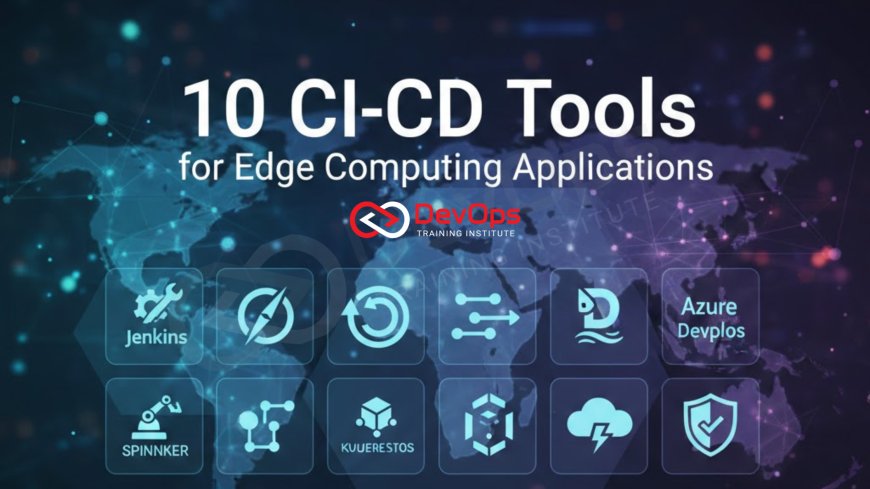
Introduction to CI/CD in Distributed Edge Environments
Edge Computing represents a paradigm shift from centralized processing in the cloud to localized processing closer to the source of data generation, such as smart factories, retail locations, or connected vehicles. While this architectural change reduces latency and improves resilience, it introduces significant complexities for software delivery. The traditional Continuous Integration and Continuous Delivery (CI/CD) pipeline, designed for reliable, high-bandwidth cloud or data center environments, often struggles with the unique challenges of the edge, including intermittent connectivity, diverse hardware footprints, and the sheer scale of devices.
The essence of CI/CD for the edge is to automate the build, test, and deployment process across a sprawling, heterogeneous fleet of devices, ensuring consistency and reliability despite network instability. This requires tools that are lightweight, resilient to disconnection, and designed for remote configuration and fleet management. Deploying software to a single data center is simple compared to rolling out updates to thousands of devices spread across a large geographical area, each with potentially different processing power and storage. The right CI/CD tool must address the last-mile delivery problem and the challenge of atomic, reversible updates to avoid bricking remote devices.
Selecting the appropriate tools is the first critical step toward mastering edge CI/CD. The ideal solution provides centralized control for orchestration, robust error handling, and minimal bandwidth usage. As organizations increasingly rely on real-time insights from IoT and edge devices, the ability to rapidly and securely update applications becomes a competitive necessity. The following sections explore ten powerful tools that have emerged as leaders in tackling the specific demands of Continuous Delivery to the edge.
Jenkins The Extensible Pioneer
Jenkins is arguably the most recognizable and widely adopted CI/CD automation server, built on an **open source** model. Its strength in the edge computing space comes from its massive plugin ecosystem and unparalleled flexibility. While primarily designed for centralized servers, Jenkins can be configured to manage distributed builds and deployments using its agent-based architecture, which is crucial for edge environments. Teams often use Jenkins to handle the initial CI phase, building, testing, and containerizing the application into a secure artifact before handing off deployment to a more specialized edge delivery tool.
For edge applications, Jenkins’ ability to manage a wide variety of build environments is a key advantage. It can orchestrate cross-compilation for diverse edge hardware architectures, such as ARM and x86, from a single centralized interface. Developers can create complex pipelines that automatically generate manifests for different device profiles. However, using Jenkins for the final deployment to thousands of edge devices can be complex, often requiring custom scripting and robust network handling plugins to account for unreliable connections and low-bandwidth constraints at the device level. Its utility truly shines in the initial stages of the pipeline.
GitLab CI The Unified DevSecOps Platform
GitLab CI, integrated directly into the comprehensive GitLab platform, offers a seamless, single-application experience for the entire DevOps lifecycle, from source code management to security and deployment. For edge computing, its tight integration with Git and its philosophy of "GitOps" provide a powerful foundation. By treating the desired state of all edge applications and infrastructure as code within a Git repository, teams gain a clear, auditable trail of all deployments across the fleet. This centralization is essential for maintaining control over distributed system architectures.
GitLab CI's runners can be deployed locally on larger edge devices or regional gateways, allowing for localized building and deployment closer to the target devices. This distributed runner architecture minimizes latency and reduces reliance on high-bandwidth communication with the central cloud. The platform’s robust support for Kubernetes, particularly lightweight distributions like K3s that are common at the edge, makes it highly effective for orchestrating containerized workloads. It also includes built-in security scanning (DevSecOps), which is vital for ensuring that only hardened, secure containers are pushed to vulnerable edge locations.
K3s and Rancher The Edge Kubernetes Solution
While not strictly a CI/CD tool itself, K3s (a lightweight, certified Kubernetes distribution) and its management layer, Rancher, are foundational to modern edge CI/CD. The complexity of running full Kubernetes is often too great for resource-constrained edge devices. K3s solves this by being packaged as a single binary that is roughly half the memory footprint of upstream Kubernetes, making it ideal for edge scenarios. Its simplicity and small size allow it to be deployed easily on everything from Raspberry Pis to small industrial servers, bringing the power of container orchestration to the edge.
Rancher, as a multi-cluster management platform, provides a centralized interface for deploying and managing hundreds or even thousands of K3s clusters scattered across diverse edge locations. It streamlines the lifecycle of these clusters, including initial setup, upgrades, and configuration management. By using Rancher to deploy applications via a GitOps tool like Fleet (also built by Rancher), teams can apply CI/CD updates consistently across the entire distributed fleet, abstracting away the geographical and network complexities. This combination provides a scalable, repeatable, and robust platform for edge delivery.
AWS IoT Greengrass and Azure IoT Edge The Cloud Providers
For organizations deeply invested in a single cloud provider, AWS IoT Greengrass and Azure IoT Edge offer powerful, integrated CI/CD capabilities specifically tailored for edge deployments. These services extend the cloud programming and operational models to local devices. They are designed to handle the complexity of managing application logic, data synchronization, and machine learning models on potentially unreliable edge hardware. The CI phase often uses the cloud provider's native CI tools (AWS CodePipeline or Azure DevOps Pipelines) to build and containerize the code.
The unique value of these tools is in their deployment mechanisms. They use a centralized control plane to securely distribute application components and configurations to the edge devices over MQTT or other lightweight protocols. They handle critical edge challenges such as ensuring local communication, enabling offline functionality, and managing local resource utilization. The deployment process is highly fault-tolerant, allowing updates to resume even after network loss. Their deep integration with cloud services, particularly for monitoring and security, simplifies operations, making them a default choice for enterprises already utilizing AWS or Azure for their core infrastructure.
Comparison of Edge CI/CD Tool Categories
Edge CI/CD solutions can broadly be categorized based on their primary function and complexity. Understanding these categories helps in building a hybrid pipeline that utilizes the strengths of multiple tools to address the end-to-end edge deployment challenge. The key differentiator is whether the tool is designed for centralized build and orchestration or for resilient, last-mile delivery to the device.
| Tool Category | Primary Focus | Best Suited For | Key Edge Challenge Addressed |
|---|---|---|---|
| Centralized Orchestrators | Code integration, containerization, and main pipeline logic. | Initial build, testing, and artifact creation. | Cross-architecture compilation and centralized control. |
| Edge Orchestration Platforms | Fleet management, cluster lifecycle, and GitOps delivery. | Managing thousands of distributed Kubernetes clusters (e.g., K3s). | Scalability, cluster diversity, and centralized provisioning. |
| Cloud-Native IoT Services | Last-mile deployment, security, and integration with cloud services. | Organizations leveraging deep integration with AWS, Azure, or GCP. | Intermittent connectivity, security, and offline operation. |
| Specialized Fleet Managers | OS-level updates, transactional updates, and device lifecycle. | Embedded systems and environments requiring OS image updates. | Atomic updates and device recovery (anti-bricking). |
Harness Continuous Delivery for Modern Platforms
Harness is a next-generation CI/CD platform that offers features specifically designed to address the challenges of modern distributed architectures, including the edge. Its strength lies in its ability to automate the deployment process intelligently, with built-in mechanisms for canary and blue/green deployments that minimize risk. For edge environments, this means new application versions can be rolled out to a small subset of devices first, and then automatically verified using machine learning-based Continuous Verification before proceeding to the entire fleet. This level of automation is crucial when human oversight of every deployment is impossible due to sheer volume.
Harness simplifies the creation of complex deployment pipelines across different environments, from the central cloud to various edge locations. It handles secrets management securely and provides full visibility into the deployment status of every target device. Its ability to integrate with diverse infrastructure types, including Kubernetes, virtual machines, and specialized edge virtualization environments, makes it a highly versatile choice. By focusing on intelligent automation and verification, Harness helps teams deliver updates to the edge quickly and safely, drastically reducing the risk of a fleet-wide failure caused by a bad deployment.
Spinnaker The Multi-Cloud and Multi-Target Orchestrator
Developed by Netflix and open sourced, Spinnaker excels as an open source, continuous delivery platform capable of handling complex deployments across multiple cloud providers and various deployment targets. While it’s traditionally associated with large-scale cloud applications, its architecture makes it uniquely suited for the complexities of edge computing where a single application may span a central cloud and numerous diverse edge locations. Spinnaker standardizes the deployment process across these heterogeneous environments.
Spinnaker’s pipeline management is highly sophisticated, offering complex deployment strategies like canary releases, rolling updates, and automated rollbacks with ease. For edge deployments, this is indispensable, as the potential impact of a faulty update is exponentially higher when distributed across hundreds or thousands of physical locations. Teams utilize Spinnaker’s standardized interfaces to manage deployments to Kubernetes clusters, virtual machines, and even custom deployment endpoints at the edge, abstracting the underlying network and hardware differences. Its focus on operational safety through verification and automated recovery helps maintain high availability across the sprawling edge fleet.
Argo CD GitOps for Edge Kubernetes
Argo CD is a declarative, GitOps-focused continuous delivery tool specifically for Kubernetes. In the context of edge computing, where lightweight Kubernetes distributions like K3s are prevalent, Argo CD becomes a powerful deployment engine. GitOps, as an operational model, is naturally suited for the edge because it allows a central source of truth (the Git repository) to dictate the state of potentially thousands of remote, loosely connected clusters. The Argo CD controller running on each edge cluster continuously monitors the Git repository for changes.
The key benefit of Argo CD at the edge is its resilience to intermittent connectivity. The controller on the edge device pulls the latest configuration from Git, meaning the deployment is triggered by the edge system itself, not pushed by a central server. If the connection drops, the controller simply waits and retries, ensuring eventual consistency. This pull-based deployment model is far more reliable than push-based methods in low-bandwidth or unstable network conditions. Furthermore, Argo CD provides immediate visual feedback on the synchronization status of every edge cluster, giving the central operations team crucial visibility into the distributed fleet.
Balena.io The IoT Fleet Manager
Balena.io is an integrated platform specifically designed for developing, deploying, and managing fleets of internet-connected devices, making it a powerful dedicated solution for edge CI/CD. It combines a container-focused operating system (balenaOS), an open source command line interface, and a cloud dashboard for fleet management. The core value of Balena lies in its robust, fault-tolerant OTA (Over-The-Air) update mechanism, which is critical for remote devices.
- Atomic Updates: Balena ensures that application updates are atomic, meaning they either succeed completely or fail gracefully, allowing the device to roll back to the last known working state. This prevents devices from being "bricked" by partial or faulty updates.
- Delta Updates: To conserve bandwidth, especially important at the edge, Balena only sends the differences (deltas) between the current and the new container images, minimizing data transfer costs and time.
- Hardware Diversity: The platform seamlessly handles application deployment across a vast array of hardware architectures, abstracting away the complexities of device-specific configuration and boot processes, which simplifies the CI phase significantly.
By providing a complete, vertically integrated stack from the host OS up to the application containers, Balena drastically lowers the operational complexity of managing large, heterogeneous edge fleets. It’s an excellent choice for companies whose primary challenge is the management and update reliability of physical embedded devices.
Concourse CI The Pipeline Automation Engine
Concourse CI is an open source CI/CD tool that differentiates itself with a functional, pipeline-as-code approach, focusing on clear, verifiable, and declarative pipelines. Everything in Concourse is modeled as a resource (such as a Git repository, a container image, or a deployment target) and tasks that act upon those resources. This declarative nature is highly valuable in the edge computing context for several reasons.
The simple, container-based task execution model ensures that every stage of the pipeline runs in an isolated, reproducible environment, regardless of where the CI worker is located. For edge, this means the build process for a device running in the cloud is identical to the build process running on an agent at a regional edge site. This consistency is essential when dealing with multiple architectures and varying resource constraints. While Concourse itself requires some customization for the final, last-mile deployment to thousands of edge devices, its powerful, clear orchestration capabilities make it an excellent choice for managing the initial build, test, and artifact creation stages for distributed systems.
GitLab Runner The Distributed Agent
While GitLab CI was mentioned as a full platform, the GitLab Runner deserves a separate mention as a crucial edge component. The Runner is the lightweight application that executes the CI/CD jobs defined in a GitLab pipeline. In the edge computing model, the power of the Runner lies in its ability to be installed anywhere, including directly on edge gateway devices or in small, regional data centers. By distributing the runners geographically, the CI/CD execution moves closer to the point of deployment.
- Reduced Network Traffic: By running build tasks at the edge, the amount of data transferred back and forth to the central cloud is significantly reduced, saving on bandwidth costs and improving build times.
- Hardware Optimization: Runners can be specifically tagged and configured to execute jobs only on devices with certain hardware capabilities or architectures (e.g., ARM processors), ensuring that the correct binaries are compiled for the specific edge device profile.
- Security Isolation: Each job is executed in a clean, isolated environment, often using containers, which enhances security by ensuring build dependencies do not leak between projects.
The flexibility and ease of deployment of the GitLab Runner make it an essential tool for scaling CI/CD processes to the challenging, distributed environment of edge computing. It provides the crucial link between the central source of truth in the cloud and the actual execution environment at the device level.
Conclusion Embracing the Right Edge CI/CD Strategy
The successful deployment and management of edge computing applications hinge entirely on adopting a robust, fault-tolerant CI/CD strategy. The unique characteristics of the edge—geographical distribution, heterogeneous hardware, and unreliable networks—demand a departure from traditional cloud-centric deployment models. The ten tools discussed demonstrate that a successful edge pipeline often involves a hybrid strategy, combining the strengths of centralized orchestrators like Jenkins or GitLab CI for the build and test phases, with specialized edge platforms like K3s/Rancher, Argo CD, or Balena.io for the last-mile delivery and fleet management.
Key takeaways for building an effective edge CI/CD pipeline include prioritizing the GitOps model for its inherent resilience and auditability, embracing lightweight container orchestration like K3s, and utilizing deployment mechanisms that support atomic, delta-based, and pull-based updates. The goal is to maximize automation and minimize the risk of a remote device failure. By carefully selecting and integrating the tools that best address the challenges of connectivity and diversity, organizations can maintain the rapid release cycles of DevOps while ensuring the stability and security of their sprawling edge infrastructure. The future of distributed computing relies on mastering these specialized CI/CD techniques.
Frequently Asked Questions
What defines an Edge Computing application?
An edge application processes data closer to the source rather than sending it all back to a central cloud or data center.
How does edge CI/CD differ from cloud CI/CD?
Edge CI/CD must handle challenges like low bandwidth, intermittent network connectivity, and diverse hardware architectures at the device level.
What is GitOps and why is it useful for the edge?
GitOps uses Git as the single source of truth; its pull-based nature is ideal for unreliable connections at the edge.
What role does K3s play in edge CI/CD?
K3s is a lightweight Kubernetes distribution that brings container orchestration capabilities to resource-constrained edge devices efficiently.
What is an atomic update in edge deployment?
An atomic update ensures an application update either completes entirely or fails, with the system rolling back to the previous working version.
Why is cross-compilation important for edge CI?
Edge devices often use different processor architectures (like ARM), requiring the CI tool to compile the code for those specific targets.
How do delta updates help edge deployments?
Delta updates send only the changed parts of an application or container image, significantly reducing bandwidth consumption.
Which cloud provider tools are specialized for the edge?
AWS IoT Greengrass and Azure IoT Edge are specialized services that extend cloud CI/CD logic directly to remote devices.
What is the purpose of a GitLab Runner in an edge deployment?
The Runner executes CI/CD jobs locally on edge gateways, minimizing latency and optimizing the use of local compute resources.
What is fleet management in the context of edge CI/CD?
It is the centralized process of monitoring, deploying, and maintaining the software running on a large group of distributed edge devices.
How does Spinnaker help with multi-target deployment?
Spinnaker provides a unified interface and standardized pipelines for deploying applications across various cloud and edge environments.
What is the main security risk in edge CI/CD?
The main risk is securely transmitting and installing updates to unmonitored physical devices and managing secrets across the distributed fleet.
Why are containers preferred for edge applications?
Containers provide a reproducible, isolated environment that packages the application and its dependencies, simplifying deployment across various hardware.
What kind of network resilience is needed in edge CI/CD tools?
Tools must be able to pause, store state, and resume deployments after a network connection has been temporarily lost or interrupted.
What alternative to full virtualization is often used at the edge?
Containerization is often used for its lower resource overhead compared to full virtual machines, making it ideal for resource-constrained devices.
What's Your Reaction?
 Like
0
Like
0
 Dislike
0
Dislike
0
 Love
0
Love
0
 Funny
0
Funny
0
 Angry
0
Angry
0
 Sad
0
Sad
0
 Wow
0
Wow
0

![100+ Azure DevOps Interview Questions and Answers [Updated 2025]](https://www.devopstraininginstitute.com/blog/uploads/images/202509/image_140x98_68c40aa9a3834.jpg)





![Future Scope of DevOps Careers in Pune [Updated 2025]](https://www.devopstraininginstitute.com/blog/uploads/images/202510/image_140x98_68e3a84652312.jpg)