




![Kong Interview Preparation Guide [2025]](https://www.devopstraininginstitute.com/blog/uploads/images/202509/image_430x256_68dbb95326997.jpg)



10 DevOps Tools for Big Data Applications
Discover the top ten DevOps tools specifically designed to manage big data applications in twenty twenty six. This comprehensive guide explores how to integrate data engineering with automated operational workflows to ensure scalability, reliability, and security. Learn about essential platforms for distributed processing, automated data pipelines, and containerized analytics that help modern engineering teams handle massive datasets with unprecedented speed. From Apache Spark orchestration to cloud native data warehousing, master the technical foundation required to bridge the gap between data science and production grade reliability in today's demanding and competitive global technical landscape.
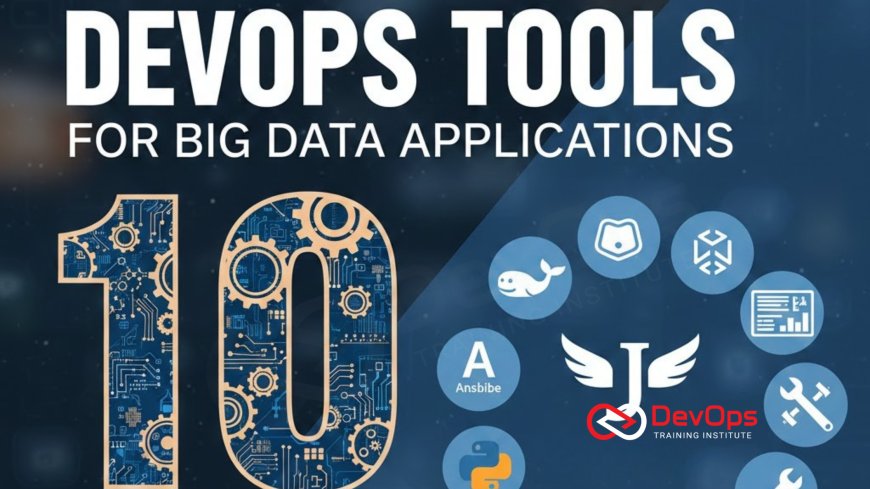
Introduction to Big Data DevOps
Managing big data applications presents a unique set of challenges that traditional DevOps practices must evolve to meet. While standard software focuses on code deployments, big data DevOps—often referred to as DataOps—must handle the massive scale of information, complex data schemas, and long running processing jobs. In twenty twenty six, the intersection of data engineering and operations is critical for businesses that rely on real time analytics to drive decision making. Without a robust set of automated tools, the data pipeline becomes a bottleneck, leading to stale insights and high operational costs across the entire organization.
The goal of big data DevOps is to bring the same level of predictability and speed to data workflows that developers enjoy in modern web applications. This involves automating the provisioning of massive clusters, ensuring continuous synchronization of data across environments, and implementing rigorous quality checks within the pipeline. By adopting specialized tools, teams can manage distributed systems with ease, ensuring that their big data applications are as resilient as they are powerful. This guide explores ten essential tools that are currently powering the world's most sophisticated data platforms, providing the technical foundation for a scalable and secure future.
Apache Spark and Kubernetes Integration
Apache Spark has long been the gold standard for distributed data processing, but managing Spark clusters manually is a significant operational burden. Modern DevOps teams now run Spark on Kubernetes to achieve greater elasticity and resource isolation. By using the Spark on Kubernetes operator, engineers can treat data processing jobs as standard containerized workloads, allowing them to leverage the same CI/CD pipelines used for their microservices. This integration simplifies the management of cluster states and allows for rapid scaling of compute resources based on the specific needs of each data job.
Running Spark in a containerized environment also improves environment parity, ensuring that a data transformation script that works on a developer's laptop will behave exactly the same way in production. It allows teams to utilize containerd for efficient runtime execution, reducing the overhead of spinning up large worker nodes. This approach fosters a cultural change where data scientists and DevOps engineers work together on a unified platform, leading to faster iteration cycles and more reliable data products that can handle petabytes of information with high precision and technical excellence.
Orchestrating Pipelines with Apache Airflow
In a big data ecosystem, the order of operations is everything. Apache Airflow is the leading orchestration tool used by DevOps professionals to manage complex Directed Acyclic Graphs (DAGs) of data tasks. Airflow allows you to define your data pipelines as code, making them versionable, testable, and easy to maintain. It acts as the "brain" of your data infrastructure, triggering jobs in Spark, Snowflake, or BigQuery based on specific schedules or event triggers. This automation is essential for maintaining continuous synchronization across a multi stage data platform where dependencies are numerous and critical.
The extensibility of Airflow is its greatest strength, offering a wide range of operators that connect to almost any cloud service or database. DevOps experts use Airflow to implement incident handling logic within their pipelines, such as automated retries or alerting when a specific data load fails. By visualizing the entire workflow in the Airflow UI, teams gain deep observability into their data delivery process. This level of transparency is vital for large scale enterprises where data integrity is paramount. It ensures that the right data is in the right place at the right time, providing a solid foundation for real time analytics and machine learning applications.
Terraform for Big Data Infrastructure
Building the infrastructure for big data—such as managed Hadoop clusters, data lakes, and networking for high throughput data transfer—requires a high degree of precision. Terraform is the industry standard for Infrastructure as Code (IaC) that allows DevOps teams to define and provision their data environments using declarative configuration files. This ensures that your cloud architecture patterns are reproducible and that your production environment is always in sync with your documented design. Terraform eliminates the risk of "configuration drift" that often plagues manually managed data clusters.
With Terraform, you can manage complex cloud resources like Amazon EMR, Google Cloud Dataproc, or Snowflake accounts with a single command. It allows teams to implement cultural change by enabling developers to request their own data environments through automated pull requests. By integrating secret scanning tools into your Terraform pipelines, you can ensure that the sensitive credentials needed to access your data lakes are never exposed in your configuration code. This disciplined approach to infrastructure management is essential for building a secure and scalable big data platform that can grow alongside the needs of the business.
Comparison of Big Data DevOps Tools
| Tool Name | Primary Function | DevOps Benefit | Scalability |
|---|---|---|---|
| Apache Kafka | Real-time Streaming | Decouples data producers | Extreme |
| Databricks | Unified Analytics | Managed Spark scaling | Very High |
| Snowflake | Data Warehousing | Zero-ops management | High |
| Prometheus | Monitoring/Alerting | Observability for jobs | Medium |
| dbt (data build tool) | Data Transformation | Version-controlled SQL | High |
Apache Kafka for Event-Driven Data Streams
In modern big data applications, data is often generated as a continuous stream of events rather than in static batches. Apache Kafka is the backbone of event driven architectures, providing a high throughput, low latency platform for handling real time data feeds. From a DevOps perspective, Kafka acts as a buffer that decouples your data producers from your consumers, allowing each component of the system to scale independently. This isolation is critical for maintaining system stability during traffic spikes and ensures that your release strategies for data services do not impact the availability of the entire platform.
Managing Kafka at scale requires specialized tools and expertise. DevOps engineers use GitOps to manage Kafka topics and access control lists, ensuring that the messaging layer is always configured correctly across all environments. Monitoring Kafka health—such as consumer lag and partition distribution—is a top priority for reliability engineering. By integrating Kafka with your monitoring stack, you can identify bottlenecks in your data flow before they lead to data loss or delayed analytics. Kafka provides the speed and durability needed for twenty twenty six's most demanding big data applications, from financial fraud detection to real time recommendation engines.
Snowflake and the Zero-Ops Data Warehouse
Snowflake has transformed the data warehousing landscape by offering a cloud native platform that separates compute from storage. For DevOps teams, this "Zero-Ops" approach means they no longer have to worry about traditional database maintenance tasks like indexing, vacuuming, or manual hardware provisioning. Snowflake handles these tasks automatically, allowing engineers to focus on higher level release strategies and data integration. This elasticity allows a business to scale its data processing power up or down in seconds, matching cost exactly with the current demand for analytics.
Despite the managed nature of Snowflake, DevOps still plays a vital role in its governance and automation. Engineers use tools like dbt (data build tool) to manage the transformations inside Snowflake as version controlled code. By using admission controllers logic for data access, teams can ensure that only authorized users can query sensitive datasets. This combination of a powerful managed platform and automated DevOps guardrails creates a highly efficient environment for data professionals. It supports cultural change by enabling data analysts to work in a self service fashion while maintaining the security and stability standards required by the organization.
Essential Tools for Big Data DevOps Excellence
- Apache Airflow: The definitive workflow orchestrator that allows you to schedule and monitor complex data pipelines as declarative code.
- Terraform: Provides the infrastructure as code foundation needed to provision and scale big data cloud resources with high precision.
- Databricks: A unified platform that simplifies the management of Apache Spark, allowing for collaborative data science and automated scaling.
- Apache Kafka: The standard for real-time data streaming that decouples system components and enables event-driven technical architectures.
- Snowflake: A highly scalable, cloud-native data warehouse that reduces operational overhead through automated management and elastic compute.
- dbt (data build tool): Enables data engineers to transform data in their warehouse using SQL while following software engineering best practices.
- Prometheus & Grafana: Provides essential observability for data jobs and cluster health, ensuring that incident handling is proactive rather than reactive.
- GitLab/GitHub: Acts as the single source of truth for all data pipeline code, infrastructure scripts, and transformation logic.
- Sentry: Critical for tracking errors within data transformation scripts and processing jobs in real-time.
- Continuous Verification: Utilize continuous verification to ensure data quality and pipeline performance throughout the delivery lifecycle.
Choosing the right mix of these tools depends on your specific data volume, processing latency requirements, and team expertise. Most successful big data DevOps strategies start with a strong foundation in infrastructure as code and automated orchestration. As your platform grows, you can add more specialized tools for data quality, security, and real time monitoring. Integrating ChatOps techniques into this flow will improve collaboration and transparency, making it easier for everyone to stay informed about the health of the data ecosystem. The future of big data is automated, and these tools are the keys to unlocking its full potential for your engineering organization.
Conclusion on Big Data DevOps Integration
In conclusion, the ten DevOps tools discussed in this guide represent the cutting edge of big data application management. By unifying data engineering with automated operational practices, organizations can build systems that are not only powerful but also resilient and secure. From the elastic compute of Snowflake to the robust orchestration of Airflow, these tools provide a comprehensive framework for handling the world's most complex data challenges. The shift toward DataOps is essential for any business that wants to move fast without compromising on data quality or system stability in the twenty twenty six digital era.
Looking ahead, the role of AI augmented devops will further enhance these big data pipelines by automating the detection of data anomalies and optimizing resource allocation in real time. Embracing continuous synchronization and automated testing at every stage will ensure that your data products are always reliable. By prioritizing these ten tools today, you are positioning your team for long term success in an increasingly data driven world. Big data is no longer just a technical hurdle; it is a major competitive advantage, and the right DevOps tools are what make that advantage possible for your business.
Frequently Asked Questions
What is the difference between DevOps and DataOps?
DevOps focuses on the software delivery lifecycle, while DataOps focuses specifically on the automated management and quality of data pipelines and datasets.
Why is Apache Spark often run on Kubernetes?
Kubernetes provides better resource isolation, elasticity, and simplified management for Spark jobs compared to traditional standalone Hadoop cluster setups and environments.
How does Terraform help in managing big data?
Terraform allows engineers to provision massive data lakes and processing clusters as version-controlled code, ensuring consistency and preventing manual configuration errors.
Can Apache Airflow handle real-time data processing?
Airflow is primarily a batch orchestrator; for real-time processing, it is often paired with streaming tools like Kafka or Flink for better latency.
What is dbt and why is it popular?
dbt allows data analysts to write transformation logic in SQL while applying software engineering practices like version control, testing, and documentation.
Is Snowflake a good choice for DevOps-led teams?
Yes, its managed nature reduces the operational burden on DevOps teams, allowing them to focus on automation rather than traditional database maintenance.
How do I monitor a big data pipeline?
Use tools like Prometheus and Grafana to track job durations, error rates, and resource usage across all components of your data infrastructure.
What role does Kafka play in a data ecosystem?
Kafka acts as a highly scalable message broker that decoupling data producers from consumers, enabling reliable real-time event streaming and processing.
How does 'Data Quality' fit into DevOps?
Data quality is treated like a software test; pipelines should include automated checks to ensure data meets specific standards before being processed.
What are the security risks in big data DevOps?
Key risks include unauthorized data access, credential leakage in scripts, and insecure data transfers across various cloud and on-premises technical environments.
Can I use GitOps for managing data warehouses?
Yes, GitOps can be used to manage warehouse configurations, user permissions, and transformation logic, providing a clear and versioned audit trail.
Why is data observability important?
It provides visibility into the health and performance of data pipelines, helping teams identify and resolve issues before they impact downstream analytics.
What is a Directed Acyclic Graph (DAG)?
A DAG is a collection of tasks organized in a way that reflects their dependencies, ensuring they are executed in the correct sequence.
Does big data DevOps require a specific team?
While often handled by a cross-functional team, it requires a combination of skills from data engineering, operations, and software development for success.
What is the first step to implementing DataOps?
Start by automating the deployment of your existing data processing scripts using a CI/CD pipeline and a version control system like Git.
What's Your Reaction?
 Like
0
Like
0
 Dislike
0
Dislike
0
 Love
0
Love
0
 Funny
0
Funny
0
 Angry
0
Angry
0
 Sad
0
Sad
0
 Wow
0
Wow
0

![100+ Azure DevOps Interview Questions and Answers [Updated 2025]](https://www.devopstraininginstitute.com/blog/uploads/images/202509/image_140x98_68c40aa9a3834.jpg)





![Future Scope of DevOps Careers in Pune [Updated 2025]](https://www.devopstraininginstitute.com/blog/uploads/images/202510/image_140x98_68e3a84652312.jpg)