

![Kong Interview Preparation Guide [2025]](https://www.devopstraininginstitute.com/blog/uploads/images/202509/image_430x256_68dbb95326997.jpg)

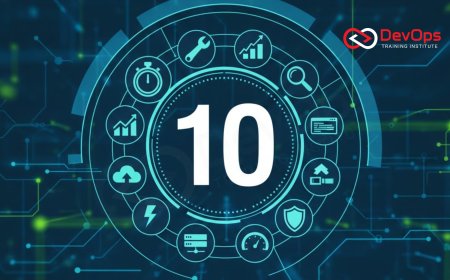
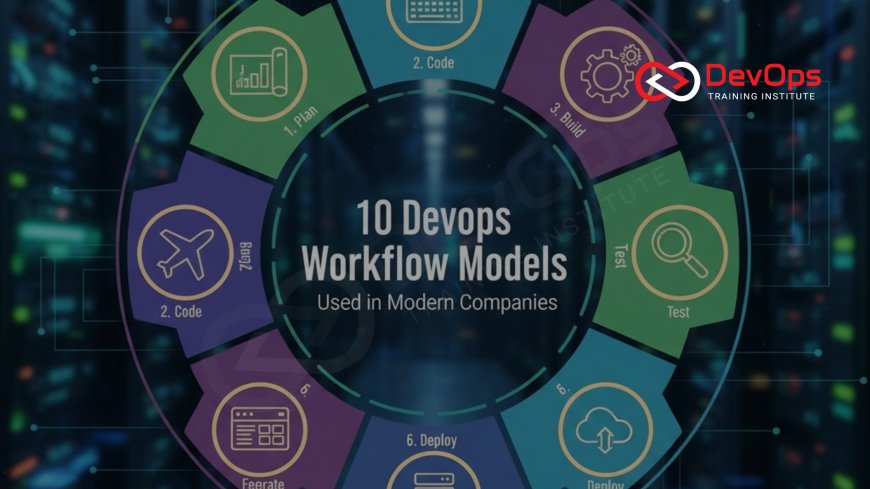
10 DevOps Workflow Models Used in Modern Companies
Explore the 10 essential DevOps workflow models and organizational structures that power continuous delivery in modern companies, from the classic CI/CD pipeline to specialized models like GitOps, SRE, and DevSecOps. Learn how high-performing teams organize their collaboration, automate infrastructure with IaC, enforce security controls, and manage application reliability at scale. This guide demystifies the strategic choices behind each model, helping organizations select the right approach—whether adopting a centralized Platform Team or embracing decentralized, shared responsibility—to maximize efficiency and achieve predictable, high-velocity software releases, moving beyond basic automation to strategic operational flow.
Introduction
The term DevOps represents a broad set of cultural principles and technical practices aimed at accelerating the pace of software delivery while maintaining system reliability. While the end goal is always faster, safer releases, the path to achieving it varies significantly across organizations based on their size, industry, application architecture (monolith vs. microservices), and complexity (single-cloud vs. multi-cloud). Consequently, modern companies do not follow a single, monolithic DevOps methodology; instead, they adopt specific workflow models designed to optimize the flow of value through their unique constraints and organizational structures.
These workflow models are essentially blueprints for how code moves from a developer's keyboard into the production environment, defining responsibilities, automation points, and quality gates at each stage. Understanding these models is crucial, as they determine the day-to-day work, the tools used, and the level of collaboration required between developers, operations staff, and security teams. Selecting the right model can transform a struggling IT department into a high-performing organization capable of deploying changes on demand, often multiple times per day, providing a definitive competitive edge in the market.
This guide will illuminate 10 of the most common and effective DevOps workflow models used in modern companies, categorizing them by their primary function—whether they focus on optimizing the technical pipeline, structuring the collaborative teams, or specializing the flow for complex emerging technologies like machine learning and security.
The Core Delivery Models (CI/CD & GitOps)
At the technical heart of DevOps lies the mechanism for moving code: the pipeline itself. These models define the fundamental, continuous stages of integration and delivery, forming the automated path that transforms raw source code into deployed, running software. They are the essential delivery systems upon which all other organizational and specialized models are built, and their maturity directly correlates with the organization's overall deployment frequency and release confidence.
1. The Classic CI/CD Pipeline Flow: This is the foundational workflow model adopted by nearly all mature DevOps teams. It is a sequential, multi-stage process that begins with a code commit (Source) and proceeds through automated stages: Build (compilation and packaging), Test (unit, integration, and security scans), Deploy (to staging/testing environments), and Release (manual or automatic deployment to production). The primary focus is on fast feedback loops and automation to ensure that code is validated and ready for deployment at any given time, eliminating manual handoffs and ensuring high confidence in the deployable artifact. This model relies heavily on tools like Jenkins, GitLab CI, or GitHub Actions for orchestration.
2. The GitOps Workflow: This model represents an evolution of continuous delivery, focused intensely on declarative deployment for cloud-native and Kubernetes environments. In the GitOps workflow, the Git repository is designated as the single source of truth for the *desired state* of the entire system, including application code, configuration files, and declarative infrastructure manifests. Operations are performed by a reconciliation agent (like Argo CD or Flux) running within the cluster, which continuously monitors Git and automatically pulls and applies any changes, ensuring the live state matches the committed state. This approach improves security, provides a complete audit trail via Git history, and enables robust drift detection, making deployments highly auditable and repeatable.
Organizational Structures Driving Workflow
The success of any workflow model is inextricably linked to how teams are structured and how responsibilities are distributed across the organization. These models shift the focus from technological tools to human collaboration, defining whether infrastructure is managed centrally or decentralized among product teams. The goal is to maximize the flow of value by minimizing the organizational friction often caused by traditional silos, promoting shared ownership and communication across the entire software delivery lifecycle.
3. The Platform Team Model: In this model, a dedicated, centralized Platform Team (often composed of specialized DevOps Engineers and SREs) is responsible for building and maintaining internal tools, standardized CI/CD pipelines, and a managed application runtime environment (Platform as a Service). The Platform Team's internal customers are the product development teams. This approach shields developers from infrastructure complexity, allowing them to focus purely on application logic, dramatically increasing development velocity. It is highly effective for large enterprises where consistency and governance are paramount, ensuring that every application is deployed according to best practices and compliance standards.
4. The Embedded DevOps Model: This model rejects the idea of a centralized DevOps Team silo. Instead, individual DevOps Specialists or Platform Engineers are embedded directly into cross-functional development teams for a defined period. Their role is to mentor developers on automation practices, infrastructure management, and pipeline development, effectively disseminating operational knowledge and shifting infrastructure accountability to the product team itself. Once the development team achieves competence, the specialist moves to another team. This model is focused on changing culture and skills across the organization, ensuring operational awareness becomes a shared team skill rather than a separate function.
The Reliability and Security Imperative
For modern, internet-scale companies, speed must be balanced with non-negotiable reliability and security requirements. These two models represent specialized workflows that embed these concerns deep into the delivery process, moving them from optional late-stage gates to continuous, automated checks. They institutionalize accountability for system stability and proactive risk mitigation, demonstrating that security and reliability are accelerators of speed, not bottlenecks.
5. The Site Reliability Engineering (SRE) Model: Highly adopted by companies with massive-scale systems, the SRE model formalizes the balance between feature velocity and production stability. The core workflow involves the SRE team defining rigorous Service Level Objectives (SLOs) and Service Level Indicators (SLIs) for the application. Any deployment that threatens these SLOs is blocked or rolled back automatically. The SRE workflow heavily prioritizes the reduction of manual toil through automation (often spending 50% of time coding) and disciplined incident response practices like Blameless Post-Mortems, ensuring that reliability is engineered, not maintained manually. This model is often integrated with a powerful internal system monitoring stack.
6. The DevSecOps Workflow (Shift Left): This specialized workflow integrates security practices and tooling throughout the entire CI/CD pipeline, implementing the "Shift Left" philosophy. In a DevSecOps workflow, security is not a final approval step but a continuous, automated activity. The flow includes mandatory stages for Static Application Security Testing (SAST) on source code, Dynamic Application Security Testing (DAST) on running environments, dependency scanning, and compliance checks (Policy-as-Code) before deployment. This model ensures that security vulnerabilities are discovered and fixed when they are cheapest and easiest to resolve, allowing teams to confidently deploy code at high velocity without compromising system integrity.
| # | Workflow Model | Primary Focus | Key Enablers/Tools | Core Benefit |
|---|---|---|---|---|
| 1 | Classic CI/CD Pipeline | Automation of Build, Test, Deploy | Jenkins, GitLab CI, Build Agents | Fast, predictable delivery cycle. |
| 2 | GitOps Workflow | Declarative Synchronization (CD) | Argo CD, Flux, Kubernetes, Helm | Auditable state, drift detection, and automated deployment. |
| 3 | Platform Team Model | Centralized Tooling & Governance | Internal PaaS, Cloud APIs, Standardized IaC Templates | Increased developer velocity and enterprise consistency. |
| 5 | SRE Model | Engineering Reliability via SLOs | Prometheus, Grafana, Coding (Python/Go), Incident Management Tools | Guaranteed service uptime and stability. |
| 6 | DevSecOps Workflow | Continuous Security Integration (Shift Left) | SAST/DAST Tools, Vault, Policy-as-Code (OPA) | Proactive risk mitigation and faster compliance. |
Developer Velocity and Delivery Models
These models are specifically engineered to optimize the way developers commit and integrate code, ensuring minimal friction and maximum confidence before the CI/CD pipeline even begins its work. They are concerned with managing code branches and minimizing integration conflict, addressing the problem of "integration hell" that often plagues large, collaborative engineering teams. Adopting one of these models is essential for supporting a high-frequency deployment strategy, as they prioritize small, incremental changes over large, risky releases.
7. Trunk-Based Development (TBD) Flow: The TBD model mandates that developers commit code to a single, main branch ("the trunk") very frequently, often multiple times a day. Feature branches are extremely short-lived, minimizing the opportunity for code divergence and complex merge conflicts that traditionally slow down the release process. TBD requires a rigorous CI system to run extensive automated tests on every commit, maintaining the trunk in a perpetual "shippable" state. Unfinished features are hidden from users using Feature Flags or Feature Toggles, which decouples the act of deployment from the act of releasing a feature, enabling high deployment frequency with minimal risk.
8. Database CI/CD (DbOps): Recognizing that the database is often the riskiest bottleneck in the deployment process, the DbOps model extends the CI/CD pipeline to include database schema changes and migrations. This specialized flow ensures that every schema change is treated as code, version-controlled, reviewed, and automatically applied using tools like Flyway or Liquibase. This guarantees that the database and the application code remain synchronized, eliminating manual migration steps, reducing the risk of data loss, and enabling true end-to-end continuous delivery for stateful applications. It ensures that the critical application data flows smoothly with the application logic.
Event-Driven and Scaled Delivery
As applications become highly distributed, leveraging serverless technology and massive organizational scaling frameworks like SAFe, the necessary workflows must adapt to manage complexity across hundreds of teams and asynchronous events. These models address architectural shifts and organizational scaling needs, providing structured flows for environments where deployment is triggered by events rather than scheduled manual processes, or where releases must be synchronized across numerous interdependent product groups.
9. Serverless/FaaS CI/CD Flow: This flow is optimized for Function-as-a-Service (FaaS) platforms like AWS Lambda or Azure Functions, where deployments are atomic and lightweight. The key difference is the lack of traditional infrastructure provisioning; the focus shifts entirely to application code, configuration (YAML), and event triggers. The workflow is often initiated by a code push, which triggers a build (creating a deployable zip file or container image), followed by automatic deployment to the FaaS environment. Since FaaS architectures are highly distributed and rely heavily on asynchronous event calls, the role of reliable networking, particularly understanding the differences between TCP and UDP, is critical for configuring proper event queues and reliable communication across services.
10. The Release Train Model: Common in very large organizations utilizing the Scaled Agile Framework (SAFe), this is an organizational model for coordinating releases across multiple, interdependent teams (known as Agile Release Trains or ARTs). The workflow synchronizes the work of hundreds of developers to deliver a large, integrated solution on a fixed cadence. While individual teams maintain their own fast CI/CD pipelines, the Release Train Model introduces coordination events—like PI Planning and Inspect & Adapt workshops—to manage cross-team dependencies, ensure business alignment, and execute synchronized final deployments in a tightly controlled manner. This ensures that the overall organization's complexity is managed effectively, providing a framework for continuous improvement that scales.
Integrating Networking and Observability
The efficiency of any DevOps workflow model, regardless of its specialization, is fundamentally dependent on the reliability of the underlying network infrastructure and the visibility provided by observability tools. Modern pipelines operate primarily on software-defined networks, where cloud resources are provisioned and configured as code, blurring the line between application logic and network topology. Understanding how data travels across these logical networks is crucial for troubleshooting and optimization, forming a critical component of operational expertise.
Network awareness ensures that automated deployments are reliable. For instance, the ability to trace traffic through subnets and load balancers is essential for diagnosing deployment failures when using advanced strategies like Blue/Green deployments, where the network layer handles the traffic switch. Furthermore, securing the pipeline requires knowledge of network fundamentals: ensuring only authorized traffic can access sensitive deployment endpoints by restricting specific exploitable port numbers and protocols. The transition from physical hardware management to elastic, virtual infrastructure means that DevOps Engineers must effectively be networking engineers who practice their discipline through code, understanding that every virtual machine, container, and function still relies on basic concepts like physical addressing for basic LAN communication, even in a highly abstracted cloud environment.
Conclusion
The journey toward mastering DevOps is defined not by the monolithic adoption of a single approach but by the strategic selection and adaptation of workflow models that best suit the organization’s scale, architecture, and cultural needs. From the technical rigor of the GitOps Workflow, ensuring auditable, declarative deployments, to the specialized focus of the SRE Model, guaranteeing measured system reliability, each model provides a distinct pathway to accelerating the delivery of business value. These models fundamentally institutionalize the principles of automation, continuous feedback, and shared responsibility, moving the organization beyond simply running software to reliably engineering its entire lifecycle.
Ultimately, high-performing companies often blend aspects of several models—a Platform Team builds the tools, product teams use the TBD flow, and SREs govern the reliability of the final system. Success hinges on a clear understanding that the optimal DevOps workflow model is one that continuously evolves, prioritizing rapid feedback and learning from the production environment, ensuring that the development and operations functions operate as a unified system, driving both speed and stability across the entire technology stack in the modern era of continuous delivery.
Frequently Asked Questions
What is the biggest difference between the Platform Team and Embedded Models?
The Platform Model centralizes the tool development for consistency, while the Embedded Model decentralizes expertise to change skills within product teams.
How does GitOps enforce deployment security?
GitOps enforces security by requiring all changes to be reviewed and approved in Git, creating an immutable audit trail before the automated deployment agent applies them.
What is "toil" in the SRE Model?
Toil refers to manual, repetitive, tactical tasks without enduring value. The SRE Model aims to eliminate toil through coding and automation to increase system reliability.
Why is the Release Train Model used?
It is used in large organizations (SAFe) to synchronize the work and releases of numerous interdependent product teams on a fixed, predictable cadence for complex solutions.
What is the purpose of Feature Flags in TBD?
Feature Flags decouple code deployment from feature release, allowing code to be pushed to production frequently while hiding the unfinished feature from end-users.
Why should a DevOps Engineer understand the OSI and TCP/IP models?
They should understand the OSI and TCP/IP models to effectively diagnose network issues, troubleshoot application communication failures, and secure distributed systems.
How does the Serverless Flow differ from traditional CI/CD?
The Serverless Flow is simpler because it lacks infrastructure provisioning; it focuses only on packaging the code and defining event triggers for deployment.
What is the primary risk addressed by the DevSecOps Workflow?
It addresses the risk of discovering costly security vulnerabilities late in the release cycle by automating security checks early (Shift Left) in the pipeline.
How are IaC tools like Terraform used in these models?
Terraform is used across multiple models to provision and manage cloud infrastructure declaratively, ensuring environment consistency and repeatability through code.
How is "environment parity" ensured across models?
Parity is ensured by managing all environments using Infrastructure as Code and containerization, eliminating manual changes and configuration drift between environments.
What is the importance of a device's MAC address in cloud deployments?
The MAC addresses serve as the unique hardware identifier. While abstracted, understanding them is key for diagnosing Layer 2 issues and certain cloud networking configurations.
What distinguishes the DbOps model?
The DbOps model distinguishes itself by treating database schema changes as code and fully automating their migration and synchronization within the CI/CD pipeline.
What is an essential goal of the SRE Model?
An essential goal is to use software engineering practices and quantitative metrics (SLOs) to ensure the service remains reliable and scalable for end-users, balancing speed with stability.
How does cloud networking differ from traditional on-prem networks?
Cloud networking is software-defined, abstracted, and elastic, relying on code for configuration rather than manual management of physical hardware and cables.
How can organizations combine different workflow models?
Organizations combine models by allowing specialized flows (DbOps, DevSecOps) to run as stages within the main delivery pipeline flow (Classic CI/CD or GitOps Workflow).
What's Your Reaction?
 Like
0
Like
0
 Dislike
0
Dislike
0
 Love
0
Love
0
 Funny
0
Funny
0
 Angry
0
Angry
0
 Sad
0
Sad
0
 Wow
0
Wow
0

![100+ Azure DevOps Interview Questions and Answers [Updated 2025]](https://www.devopstraininginstitute.com/blog/uploads/images/202509/image_140x98_68c40aa9a3834.jpg)





![Future Scope of DevOps Careers in Pune [Updated 2025]](https://www.devopstraininginstitute.com/blog/uploads/images/202510/image_140x98_68e3a84652312.jpg)