







![Kong Interview Preparation Guide [2025]](https://www.devopstraininginstitute.com/blog/uploads/images/202509/image_430x256_68dbb95326997.jpg)




10 Hidden Kubernetes Logs You Should Check
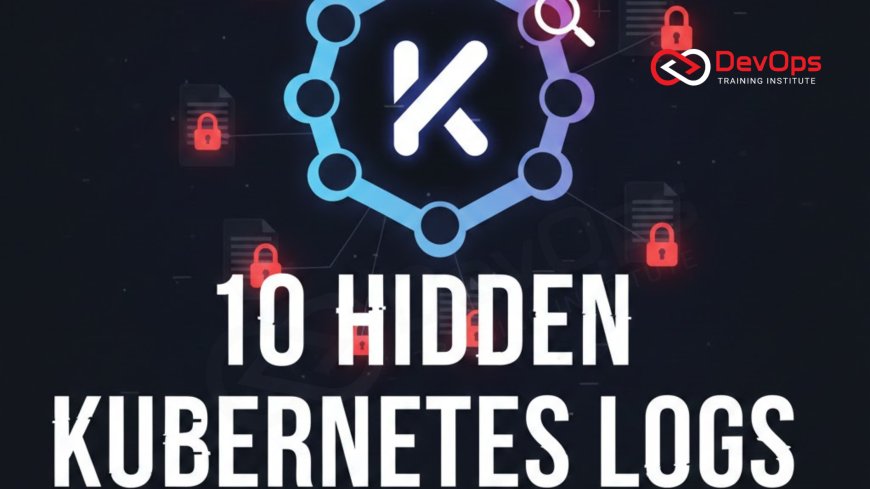
Unlock deep cluster visibility by exploring the ten hidden Kubernetes logs that every DevOps professional should check for advanced troubleshooting in twenty twenty six. This extensive guide moves beyond standard container logs to uncover critical insights from the API server, kubelet, etcd, and cloud-controller-manager. Learn how to diagnose silent failures, security breaches, and networking bottlenecks by accessing the raw telemetry data that often goes unnoticed in production environments. Master the art of full-stack observability and incident response by understanding where to find the most valuable diagnostic information buried within your infrastructure layers to maintain a highly resilient and secure container orchestration platform today.
Introduction to Deep Kubernetes Observability
When an application fails in Kubernetes, the first instinct for most developers is to check the pod logs using a simple kubectl logs command. While this is a great starting point for debugging application code, it only scratches the surface of the vast amounts of telemetry data generated by the cluster. Kubernetes is a complex distributed system, and many of the most critical failures—such as networking partitions, scheduling delays, and volume mounting errors—leave no trace in the application logs. To find the root cause of these systemic issues, you must look deeper into the hidden logs of the control plane and node-level components.
As we navigate the sophisticated infrastructure of twenty twenty six, mastering the art of deep observability is essential for maintaining high availability. Hidden logs provide the "why" behind the "what," offering a window into the internal decision-making process of the cluster. By knowing exactly where to look when a deployment stalls or a node enters a NotReady state, you can significantly reduce your mean time to resolution. This guide uncovers ten vital log sources that are often overlooked by beginners but are indispensable for professional DevOps engineers and site reliability experts managing mission-critical cluster states at scale.
The API Server Audit Logs
The Kubernetes API server is the central hub for all cluster activity, and its audit logs are a gold mine for both security and troubleshooting. These logs record every request made to the API, including who made the request, what they were trying to do, and whether the action was successful. If a resource suddenly disappears or a sensitive secret is accessed by an unauthorized user, the audit logs are often the only place to find a record of the event. They provide a chronological trail of the cultural change and administrative actions that shape your cluster environment over time.
By default, audit logging is often disabled or set to a low level of detail to save disk space. However, for production clusters, it is a professional requirement to enable detailed auditing and forward these logs to a secure, external location. You can configure different levels of logging, from just the metadata of the request to the full request and response body. Analyzing these logs helps you identify misconfigured release strategies or rogue automation scripts that might be overwhelming the API server. They are the ultimate source of truth for understanding the "who, what, and when" of your cluster's management layer.
Kubelet System Logs on the Node
If a pod is stuck in a ContainerCreating or Pending state for an extended period, the answer is rarely in the pod logs; it is usually in the Kubelet logs on the worker node. The Kubelet is responsible for talking to the container runtime, managing volumes, and performing health checks. When a node fails to pull an image or a persistent volume fails to attach, the Kubelet records the specific error message in the system logs. Because the Kubelet runs as a system service rather than a pod, these logs must be accessed directly through the node's journal or a specialized logging agent.
Checking the Kubelet logs is essential for diagnosing hardware-related issues or resource exhaustion that prevents pods from starting. For example, if you are debating when is it better to use containerd instead of docker, the Kubelet logs will show you the specific interaction between the orchestrator and the runtime. These logs also contain vital information about OOM (Out of Memory) kills and CPU throttling that might not be visible in high-level metrics. By monitoring the Kubelet, you gain visibility into the "last mile" of container orchestration, ensuring that your continuous synchronization between the API server's intent and the node's reality remains healthy and efficient.
The Scheduler and Controller Manager Logs
The Scheduler and the Controller Manager are the "brains" of the Kubernetes control plane, and their logs are critical for understanding why the cluster isn't behaving as expected. The Scheduler logs show you exactly why a pod was placed on a specific node—or why it couldn't be scheduled at all. If you have complex affinity rules or taints that aren't working as intended, the Scheduler logs will reveal the scoring and filtering process for each node. This is vital for maintaining a balanced and high-performing infrastructure that follows your intended architecture patterns.
Meanwhile, the Controller Manager logs provide insights into the lifecycle of higher-level resources like Deployments, StatefulSets, and Services. If a rolling update is stuck or a LoadBalancer service fails to provision a cloud IP, the Controller Manager is where the error will be recorded. These logs are often the first place to look when your incident handling involves resources that are managed by the cluster's internal logic. By understanding the logs of these control plane components, you can diagnose silent failures in the automated loops that keep your applications running, ensuring that your cultural change toward automation is backed by deep technical insight.
Summary of Hidden Kubernetes Log Sources
| Log Source | Location | Best For | Access Command |
|---|---|---|---|
| Audit Logs | API Server File | Security & Auditing | File Access |
| Kubelet | Node Journal | Pod Startup Errors | journalctl -u kubelet |
| etcd | Control Plane Pod | Storage Performance | kubectl logs -n kube-system |
| Kube-Proxy | System Pod/Node | Service Routing Issues | kubectl logs -n kube-system |
| Cloud Controller | Control Plane Pod | Cloud Provider Errors | kubectl logs -n kube-system |
The etcd Performance and Health Logs
The etcd database is the single source of truth for the entire cluster, and its performance directly impacts the speed and stability of your Kubernetes environment. If etcd is slow, every action in the cluster—from launching a pod to listing services—will feel sluggish. Hidden within the etcd logs are critical metrics about disk latency and network round-trip times. If you see warnings about "apply entries took too long," it is a clear sign that your storage backend is underperforming and could lead to a catastrophic cluster outage if not addressed immediately.
Monitoring etcd logs is especially important during large-scale events, such as mass deployments or node failures, where the volume of writes to the database increases significantly. You can find these logs by looking at the static pods in the kube-system namespace on your master nodes. Ensuring that etcd remains healthy is a foundational part of your continuous synchronization strategy. By integrating these logs into your central observability platform, you can set up alerts for etcd election changes or database fragmentation, allowing you to perform maintenance before the cluster's "memory" becomes a bottleneck for the entire engineering organization.
Kube-Proxy and Networking Service Logs
Service discovery and internal load balancing are managed by Kube-Proxy, and when networking fails, the Kube-Proxy logs are the first place to look. These logs record the creation and deletion of IPTables or IPVS rules that route traffic from services to individual pods. If a service is working for some users but failing for others, or if you are experiencing intermittent connection timeouts, Kube-Proxy will often show the specific rule that is causing the problem. This is a vital diagnostic tool for anyone managing complex cluster states with thousands of internal endpoints.
Furthermore, checking the logs of your CNI (Container Network Interface) plugin, such as Calico or Cilium, is essential for understanding lower-level networking failures. These "hidden" logs reveal issues with pod IP allocation and cross-node communication that are invisible to the Kubernetes API. By combining Kube-Proxy logs with CNI logs, you gain a complete view of the cluster's data plane. This level of detail is necessary for effective incident handling when troubleshooting the "black box" of Kubernetes networking. It ensures that your services remain accessible and that your network policies are being enforced correctly across the entire production environment.
Advanced Strategies for Log Management
- Centralize Everything: Use a logging agent like Fluentd or Vector to ship all hidden logs to a central location like Elasticsearch or BigQuery for long-term retention.
- Implement Log Rotation: Ensure your control plane components have proper log rotation configured to prevent them from filling up the master node's disk during a busy period.
- Use Structured Logging: Whenever possible, enable JSON logging for your components to make them easier to parse and analyze with automated AI augmented devops tools.
- Filter Noise: Use logging levels (info, warn, error) to filter out the massive amount of "noise" generated by healthy clusters, focusing only on actionable data.
- Secure Log Access: Use admission controllers to ensure that only authorized personnel can access the raw log files on your control plane and nodes.
- Scan for Secrets in Logs: Utilize secret scanning tools to ensure that no sensitive credentials are being accidentally leaked into your system logs.
- Correlate with Events: Use AI augmented devops to correlate hidden log entries with Kubernetes events and metrics to find the root cause of complex failures automatically.
Managing these hidden logs requires a disciplined approach to observability and a commitment to technical excellence. By making these logs easily accessible to your SRE and DevOps teams, you empower them to solve problems faster and with greater accuracy. As your cluster grows, you can move toward more advanced continuous verification strategies where your logs are automatically analyzed for anomalies. This proactive stance ensures that you are always one step ahead of potential issues, keeping your production environment stable and your engineering team productive in the face of increasing complexity.
Conclusion: Beyond the Pod Log
In conclusion, the ten hidden Kubernetes logs discussed in this guide are the essential "missing pieces" of the observability puzzle. By moving beyond simple pod logs and exploring the telemetry of the API server, Kubelet, etcd, and networking components, you gain a 360-degree view of your cluster's health and performance. These logs turn "mystery meat" infrastructure problems into clear, actionable technical challenges that can be resolved with precision. Mastering these log sources is what differentiates a beginner from an expert DevOps professional in the twenty twenty six digital landscape.
As you move forward, remember that release strategies and infrastructure updates should always be monitored through these deep diagnostic channels. The integration of AI augmented devops will continue to make this process easier, but there is no substitute for a human engineer who understands where to find the raw truth. By prioritizing the collection and analysis of these hidden logs today, you are building a more resilient, secure, and transparent Kubernetes operation. Stay curious, look beneath the surface, and use the data at your fingertips to drive innovation and excellence in everything you build and manage.
Frequently Asked Questions
Where are the Kubernetes API server logs usually stored?
In most clusters, these logs are stored as files on the master nodes or can be accessed via kubectl logs in the kube-system namespace.
How can I check the Kubelet logs on a specific worker node?
You must SSH into the node and use the command journalctl -u kubelet to view the real-time system logs for that specific component.
What is the purpose of Kubernetes Audit logs?
Audit logs provide a security trail of every request made to the API, showing who did what and when for better accountability.
Why should I check the etcd logs regularly?
Checking etcd logs helps identify storage latency and performance issues that can slow down or crash the entire Kubernetes control plane and API.
How do I access logs for the Kubernetes Scheduler?
Scheduler logs are available in the kube-system namespace; they help explain why a pod was assigned to a specific node or failed scheduling.
What information is found in Kube-Proxy logs?
These logs contain details about the network rules and load balancing logic used to route traffic from services to individual pod endpoints.
Can I see hidden logs using a standard dashboard?
Most basic dashboards only show pod logs; you need a full-stack observability tool like Grafana or ELK to view control plane and system logs.
What does "high cardinality" mean in the context of logs?
High cardinality refers to logs with a massive number of unique values, which can overwhelm your logging database and make searching very slow.
How does the Cloud Controller Manager log help?
It provides details on the interaction between Kubernetes and your cloud provider, such as errors when provisioning load balancers or attaching persistent volumes.
Are these hidden logs included in standard backups?
Usually no; you must specifically configure your logging agent to capture and store these system-level logs as part of your disaster recovery plan.
How do I handle the massive volume of logs in a large cluster?
Use log sampling, aggressive filtering, and structured JSON formats to ensure you are only storing and analyzing the most critical diagnostic information available.
Can I use kubectl to see node-level system logs?
Not directly; however, some plugins like kubectl-node-shell can provide an easy way to run journalctl commands without manually SSHing into the node itself.
What is a sidecar logging pattern?
It involves running a small container alongside your app to collect and ship logs, though system logs are better handled by a node-level agent.
Why are my container runtime logs important?
Logs from containerd or Docker show the low-level details of container creation and termination, helping diagnose failures that happen before the Kubelet takes over.
What is the first "hidden" log I should check during an outage?
The API server logs are usually the best starting point, as they record all the high-level errors and requests that occurred during the incident.
What's Your Reaction?
 Like
0
Like
0
 Dislike
0
Dislike
0
 Love
0
Love
0
 Funny
0
Funny
0
 Angry
0
Angry
0
 Sad
0
Sad
0
 Wow
0
Wow
0




![100+ Azure DevOps Interview Questions and Answers [Updated 2025]](https://www.devopstraininginstitute.com/blog/uploads/images/202509/image_140x98_68c40aa9a3834.jpg)






![Future Scope of DevOps Careers in Pune [Updated 2025]](https://www.devopstraininginstitute.com/blog/uploads/images/202510/image_140x98_68e3a84652312.jpg)