






![Kong Interview Preparation Guide [2025]](https://www.devopstraininginstitute.com/blog/uploads/images/202509/image_430x256_68dbb95326997.jpg)




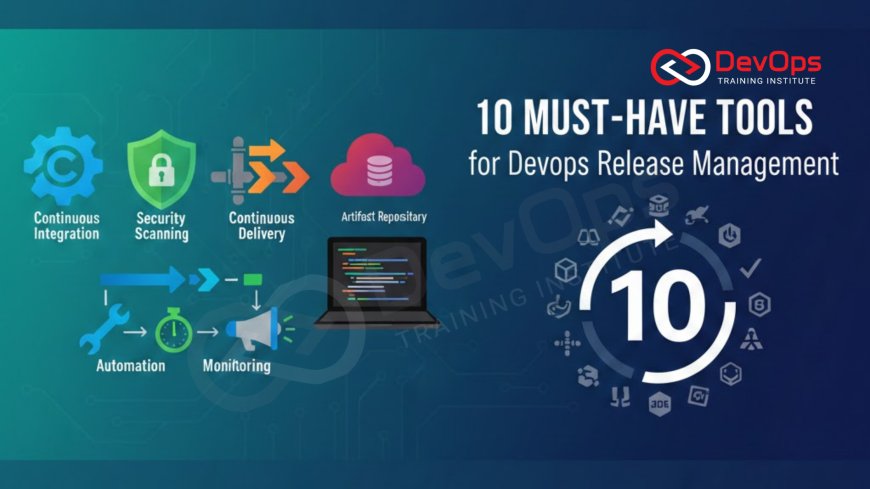
10 Must-Have Tools for DevOps Release Management
Discover the most essential tools for DevOps release management that are currently reshaping how high performing engineering teams deliver software in twenty twenty six. This detailed guide provides a deep dive into the top platforms for orchestration, deployment automation, and environment management, ensuring your organization can scale with precision and speed. Learn how to bridge the gap between development and production while maintaining high standards of quality and security across your entire technical stack. Stay ahead of the competition by mastering the latest release management technologies that prioritize stability, visibility, and rapid innovation for modern digital enterprises today.
Introduction to Modern Release Management
In the fast paced world of modern software development, release management has evolved from a manual gatekeeping process into a highly automated and strategic discipline. As organizations move toward microservices and cloud native architectures, the complexity of coordinating multiple deployments across diverse environments has grown exponentially. Release management tools provide the necessary structure to manage this complexity, ensuring that code moves from a developer's machine to the production environment without causing disruptions or compromising security standards.
The primary goal of these tools is to establish a repeatable and reliable path to production. By automating the planning, scheduling, and controlling of software builds, teams can reduce the risk of human error and significantly decrease their time to market. In twenty twenty six, the focus is not just on moving code but on doing so with total visibility and continuous verification. These tools act as the central nervous system for your delivery pipeline, providing a single source of truth for every version of every service running in your ecosystem today.
The Strategic Importance of Orchestration Tools
Orchestration is the bedrock of successful release management, as it coordinates the various moving parts of the software delivery lifecycle. Without a central tool to manage the workflow, teams often find themselves trapped in a web of disconnected scripts and manual approvals that slow down innovation. Modern orchestration platforms allow you to define complex release paths that include automated testing, manual gates, and security scans. This level of control is essential for maintaining a high release strategies cadence while ensuring that only high quality code reaches your end users.
Beyond simple automation, orchestration tools foster better collaboration between development, operations, and business stakeholders. They provide persona based dashboards that show the status of every release in real time, allowing everyone to stay aligned without constant status meetings. This transparency is vital for driving cultural change in large organizations, where silos can often lead to misunderstandings and delayed launches. By centralizing the release process, you create a culture of shared responsibility where every team member has the visibility they need to contribute to the success of the product.
Octopus Deploy for Complex Environment Management
Octopus Deploy has long been a favorite for teams that need to manage complex deployment scenarios across multiple environments. It excels at taking built artifacts and ensuring they are deployed consistently to development, test, and production servers. One of its standout features is the ability to manage environment specific variables with ease, reducing the risk of configuration drift. Whether you are deploying to on premises servers or modern cloud architecture patterns, Octopus provides a unified interface that simplifies the entire process for your engineering team.
The platform also offers robust support for multi tenancy, which is a game changer for companies that provide software as a service to many different clients. It allows you to use a single deployment process to update hundreds of customer specific instances simultaneously. This scalability is supported by a powerful runbook feature that automates routine operations tasks, further reducing the toil on your DevOps engineers. By utilizing ChatOps techniques, teams can even trigger these deployments directly from their favorite communication tools, making the entire workflow more integrated and responsive to business needs.
Digital.ai for Enterprise Release Orchestration
For large scale enterprises with complex regulatory requirements, Digital.ai offers a comprehensive release orchestration solution that emphasizes auditability and risk management. It provides a high level view of the entire software delivery value stream, allowing leaders to identify bottlenecks and optimize the flow of value to customers. The platform is designed to work with your existing tools, providing a layer of governance that ensures every release follows the organization's security and compliance policies without slowing down the development teams in their daily work.
Digital.ai is particularly strong in its ability to predict release risks using built in analytics. By analyzing historical data, it can warn teams about potential failures before they happen, allowing for proactive adjustments to the release plan. This predictive capability is a key component of AI augmented devops, where machine learning is used to enhance human decision making. For organizations in highly regulated industries like finance or healthcare, the automated "chain of custody" reports provided by Digital.ai are invaluable for passing audits with minimal manual effort and maximum confidence in the data provided.
Comparison of Top Release Management Tools
| Tool Name | Best For | Key Strength | Integration Level |
|---|---|---|---|
| Octopus Deploy | Complex Deployments | Environment Management | Very High |
| Digital.ai | Enterprise Governance | Predictive Analytics | High |
| Harness | Cloud Native CD | Automated Verification | High |
| Spinnaker | Multi Cloud Scale | Advanced Rollouts | Medium |
| Azure DevOps | Full Stack Teams | Seamless Ecosystem | Extreme |
Harnessing AI for Automated Deployment Verification
Harness has revolutionized the continuous delivery space by focusing on the "last mile" of the release process: verification. In traditional setups, after a deployment is finished, engineers must manually check dashboards and logs to ensure everything is working correctly. Harness automates this by using machine learning to compare post deployment performance with a baseline. If it detects any anomalies, such as increased error rates or latency, it can automatically trigger a rollback, minimizing the impact on users and saving the team from stressful manual troubleshooting sessions.
This "intelligent" approach to delivery allows teams to move faster with more confidence. It effectively eliminates the need for manual "watch parties" after every production update. By integrating Harness into your cluster states management, you ensure that every change is validated by data rather than just human intuition. This focus on automated feedback loops is a core part of continuous verification, ensuring that your systems remain stable and performant even as the rate of change increases to meet the demands of the modern digital marketplace.
Spinnaker for High Scale Multi-Cloud Delivery
Spinnaker, originally developed by Netflix, is the go to tool for organizations that need to manage massive, multi cloud deployments. It provides first class support for advanced deployment strategies like blue green and canary releases, which are essential for testing new features with a small subset of users before a full rollout. Spinnaker's pipeline builder is incredibly flexible, allowing you to create complex branching logic and parallel execution paths. This makes it ideal for teams that need to deploy hundreds of microservices across multiple regions and cloud providers simultaneously.
Managing Spinnaker can be a significant undertaking, but the benefits for large scale operations are undeniable. It provides a unified view of all your deployments, regardless of where they are running, which is critical for maintaining consistency in a distributed environment. When using Spinnaker to manage your cluster states, you gain a level of control and visibility that is difficult to achieve with simpler tools. It empowers your engineers to focus on building features rather than wrestling with the mechanics of deployment, leading to a more efficient and satisfied development organization in the long run.
Essential Features for Your Release Toolkit
- Visual Workflow Builder: A drag and drop interface that allows anyone to understand the release path at a glance.
- Automated Gates: The ability to stop a release automatically if it fails to meet specific quality or security criteria.
- Variable Management: Centralized storage for environment specific settings to prevent manual configuration errors.
- Security Scanning: Integration with secret scanning tools to ensure no sensitive data is leaked during the release process.
- Compliance Reporting: Automated generation of audit logs and release notes to satisfy internal and external requirements.
- Rollback Capabilities: One click or fully automated rollbacks to restore service quickly in the event of a failure.
- Policy Enforcement: Using admission controllers and other tools to ensure every release follows the organization's governance rules.
Choosing the right combination of these features will depend on your team's specific needs and the complexity of your application. While some teams may prioritize speed above all else, others might require strict approval workflows and detailed reporting. The best tools are those that can adapt to your unique process while still providing a solid foundation of automation and best practices. As you evaluate your options, consider how well each tool integrates with your existing CI CD pipeline and monitoring stack to ensure a seamless experience for your entire engineering team.
Conclusion: Building a Reliable Release Engine
In conclusion, the right release management tools are no longer a luxury but a fundamental necessity for any modern DevOps team. By investing in platforms like Octopus Deploy, Digital.ai, or Spinnaker, you are not just buying software; you are building a reliable engine for business growth. These tools provide the automation, visibility, and control needed to navigate the challenges of the twenty twenty six technical landscape with confidence. They allow your team to move away from the stress of "big bang" releases toward a more sustainable and predictable delivery cadence that benefits both your developers and your customers.
As you move forward, keep in mind that the most successful release management strategies are those that focus on continuous improvement. Use the data from your tools to identify areas where your release strategies can be optimized. Embrace faster time to market by reducing manual touchpoints and increasing automated verification. By staying focused on these core principles and leveraging the power of modern release management tools, you can ensure that your organization remains competitive and resilient in an ever changing digital world where speed and reliability are everything.
Frequently Asked Questions
What is the difference between CI/CD and release management?
CI/CD focuses on the technical pipeline of building and testing, while release management coordinates the entire business process of delivering software.
Why is environment management important in release management?
It ensures that each environment is configured correctly, preventing bugs that only appear because of differences between testing and production setups.
Can I use multiple release management tools together?
Yes, many teams use a combination of tools to handle different aspects of the release, such as orchestration and specific deployment tasks.
How does automated verification help DevOps teams?
It uses data to automatically check if a deployment was successful, allowing for faster rollbacks and reducing the need for manual monitoring.
Is Spinnaker better than Jenkins for release management?
Spinnaker is a dedicated continuous delivery tool with advanced rollout features, while Jenkins is a more general automation server that requires plugins.
What role does governance play in release management?
Governance ensures that all releases meet the required security, compliance, and quality standards before they are allowed into the production environment.
How does a release manager's role change with automation?
Automation shifts the role from manual task tracking to strategic oversight and optimization of the overall software delivery value stream for the team.
What is a blue green deployment strategy?
It involves running two identical production environments and switching traffic between them to ensure zero downtime during a new software release.
Can small startups benefit from release management tools?
Yes, even small teams benefit from the consistency and risk reduction that these tools provide, allowing them to scale more effectively as they grow.
What is a release gate in a DevOps pipeline?
A gate is a manual or automated checkpoint that code must pass before moving to the next stage of the delivery process.
How do secret scanning tools integrate with release management?
They scan the code and configuration for sensitive information during the release process to prevent accidental data leaks in the production system.
Why is visibility a key benefit of release orchestration?
It allows all stakeholders to see the progress and status of releases, which improves communication and helps teams identify and resolve bottlenecks.
What are DORA metrics and why do they matter?
DORA metrics measure the performance of your software delivery process, helping teams understand their velocity, stability, and areas for potential improvement.
How can I reduce the risk of a failed production release?
Use automated testing, canary deployments, and automated verification tools to catch and mitigate issues before they impact a large number of users.
Is there a free release management tool available?
Yes, several open source tools like Jenkins and Spinnaker are available, though they may require more effort to set up and manage.
What's Your Reaction?
 Like
0
Like
0
 Dislike
0
Dislike
0
 Love
0
Love
0
 Funny
0
Funny
0
 Angry
0
Angry
0
 Sad
0
Sad
0
 Wow
0
Wow
0

![100+ Azure DevOps Interview Questions and Answers [Updated 2025]](https://www.devopstraininginstitute.com/blog/uploads/images/202509/image_140x98_68c40aa9a3834.jpg)






![Future Scope of DevOps Careers in Pune [Updated 2025]](https://www.devopstraininginstitute.com/blog/uploads/images/202510/image_140x98_68e3a84652312.jpg)