


![Kong Interview Preparation Guide [2025]](https://www.devopstraininginstitute.com/blog/uploads/images/202509/image_430x256_68dbb95326997.jpg)

10 Cloud-Native Database Tools Used in DevOps
Explore the top ten cloud-native database tools currently reshaping the DevOps landscape in twenty twenty six. This comprehensive guide provides deep insights into distributed SQL, NoSQL, and database-as-code technologies that enable engineering teams to achieve massive scalability and high availability. Learn how to integrate tools like CockroachDB, TiDB, and Liquibase into your automated delivery pipelines to ensure seamless data management and synchronization across multi-cloud environments. Whether you are managing microservices or large-scale enterprise data, these essential tools will empower your DevOps team to maintain peak performance and data integrity in today’s demanding and fast-paced digital economy.
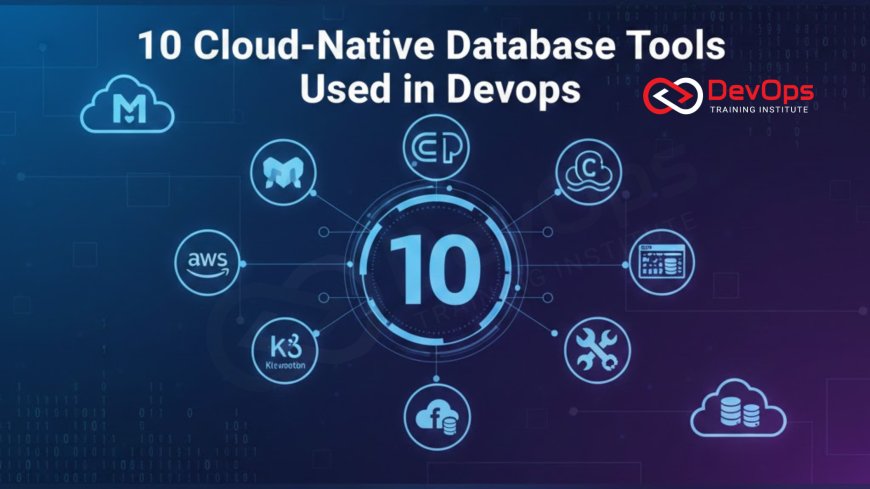
Introduction to the Cloud-Native Data Era
The transition to cloud-native architectures has fundamentally changed how we manage data within the DevOps lifecycle. In the past, databases were often seen as static, manual bottlenecks that slowed down the fast-paced world of continuous delivery. However, in twenty twenty six, a new generation of cloud-native database tools has emerged to provide the same level of agility and automation as containerized applications. These tools are designed to be distributed, elastic, and highly programmable, allowing engineering teams to treat their data infrastructure as code and integrate it seamlessly into their automated pipelines.
Managing data at scale requires a shift from traditional monolithic instances to distributed systems that can handle global traffic with ease. Cloud-native database tools offer features like automated sharding, multi-region replication, and self-healing capabilities that ensure high availability even during major infrastructure failures. By adopting these tools, organizations can eliminate the risks of manual schema changes and data silos, fostering a culture of continuous synchronization between their application logic and their persistent storage. This introduction serves as your guide to the most impactful data technologies driving modern DevOps excellence today.
Distributed SQL for Global Scalability
Distributed SQL databases like CockroachDB and TiDB have become essential for organizations that require the consistency of traditional relational databases with the horizontal scalability of the cloud. These tools allow you to spread your data across multiple nodes and geographic regions while maintaining a single, logical view of the database. This ensures that your application can survive the loss of an entire data center without any manual intervention. It is a cornerstone of modern architecture patterns designed for global resilience and technical confidence.
In a DevOps context, these tools provide automated orchestration that aligns perfectly with Kubernetes environments. You can scale your database capacity up or down simply by adding or removing pods, and the system automatically rebalances the data in the background. This elasticity is vital for handling unpredictable traffic spikes without over-provisioning resources. By utilizing these distributed SQL tools, you ensure that your data layer is just as flexible as your microservices, providing a robust and scalable foundation for your digital business growth in an increasingly connected world.
Database-as-Code and Schema Migration
One of the most significant challenges in DevOps is synchronizing schema changes with application deployments. Database-as-code tools like Liquibase and Flyway solve this by allowing you to define your database migrations in version-controlled scripts. These scripts are then executed automatically as part of your CI/CD pipeline, ensuring that every environment—from development to production—stays in sync. This eliminates the "schema drift" problem and reduces the likelihood of deployment failures caused by missing columns or incompatible data types.
By treating your schema changes as first-class citizens in your repository, you gain a clear audit trail and the ability to roll back changes just as easily as you would with application code. These tools often use GitOps principles to maintain the desired state of your database. Integrating schema migration into your automated flow is a vital step toward achieving true continuous delivery, allowing your team to move fast without breaking the underlying data structures that power your most critical business functions and user experiences.
Managed NoSQL for High-Velocity Apps
For applications dealing with unstructured data or requiring extremely high write speeds, managed NoSQL services like MongoDB Atlas and Amazon DynamoDB are the go-to choices. These cloud-native tools remove the operational burden of managing clusters, backups, and security patches, allowing DevOps teams to focus on building features. They offer flexible schemas that can evolve alongside your code, making them ideal for rapid prototyping and the iterative development cycles of twenty twenty six. This modularity is a key driver of technical agility in modern engineering squads.
Managed NoSQL platforms provide built-in observability and automated tuning that help you identify performance bottlenecks in real-time. By utilizing continuous verification, you can ensure that your database queries are meeting their latency targets during every rollout. These tools also feature robust security controls, such as field-level encryption and automated IAM integration, ensuring your sensitive data remains protected. They provide a high-performance, low-maintenance solution for modern web and mobile apps that need to scale rapidly across global user bases without traditional infrastructure limitations.
Top 10 Cloud-Native Database Tools Comparison
| Tool Name | Type | Primary DevOps Benefit | Cloud Support |
|---|---|---|---|
| CockroachDB | Distributed SQL | Survivability & Auto-Scaling | Multi-Cloud |
| PlanetScale | MySQL (Vitess) | Non-blocking schema changes | AWS / GCP |
| MongoDB Atlas | NoSQL | Managed scaling & global clusters | AWS / Azure / GCP |
| Liquibase | Migration Tool | Version-controlled schema sync | Any Cluster |
| Vitess | Sharding Tier | Horizontal scaling for MySQL | Kubernetes Native |
Data Resilience through Vitess and PlanetScale
Vitess is an open-source tool originally developed at YouTube to handle massive MySQL traffic by providing a powerful sharding layer. It has since become a CNCF graduated project and the engine behind platforms like PlanetScale. For DevOps teams, Vitess offers the ability to run MySQL in a way that is natively compatible with Kubernetes, managing complex sharding logic so that developers don't have to. This ensures that your data layer can grow seamlessly alongside your containerized microservices without ever hitting the capacity limits of a single master node.
PlanetScale takes this a step further by offering a "database branching" workflow that mimics Git. You can create a branch of your database to test schema changes in isolation and then merge them into production once they have been verified. This innovative approach to data management reduces the risk of production outages and improves the overall speed of the development lifecycle. By utilizing who drives cultural change strategies, you can encourage your team to adopt these safe, branch-based workflows to maintain high standards of quality and uptime.
Serverless Databases and Edge Persistence
The rise of serverless computing has paved the way for serverless databases like FaunaDB and Upstash. These tools are designed to scale to zero when not in use and provide instant global access with very low latency. For DevOps engineers, serverless databases eliminate the need for capacity planning and manual cluster configuration. They are perfect for event-driven architectures and edge computing scenarios where you need to persist data as close to the user as possible to maintain a responsive user experience across different geographic regions.
These tools often provide a globally distributed API that handles all the complexities of consistency and replication behind the scenes. This allows your team to focus on the business logic rather than the operational overhead of managing a distributed data store. By integrating ChatOps techniques, your team can receive real-time alerts about database usage and performance directly in their communication channels. Serverless databases represent the ultimate expression of cloud-native agility, providing a frictionless path to managing global data at any scale with minimal effort.
Best Practices for Cloud-Native Data Automation
- Version Your Migrations: Always store your database schema changes in Git alongside your application code to ensure they are tracked and auditable.
- Automate Backups: Use managed cloud features to ensure that your data is backed up regularly and can be restored quickly in the event of a failure.
- Implement Observability: Use tools to monitor query performance and resource usage in real-time to identify and fix data bottlenecks before they impact users.
- Secure Access: Utilize admission controllers to ensure that only authorized services can access your database clusters and sensitive information.
- Test Migrations in Staging: Never run a schema change in production without first verifying it in an environment that is identical to your production setup.
- Scan for Secrets: Use secret scanning tools to ensure that no database credentials are accidentally exposed in your migration scripts or logs.
- Optimize Runtime: Ensure your underlying compute layer uses containerd for better efficiency and performance when running containerized database tools.
Following these best practices will help you transition from a manual data management model to a fully automated, cloud-native approach. As your team becomes more comfortable with these tools, you can explore more advanced release strategies for your data layer, such as blue-green database deployments. The goal is to build a "paved road" for your data that is just as fast and reliable as your software delivery pipeline. By prioritizing automation and security today, you are positioning your organization for long-term success in an era where data is the most valuable and sensitive asset of any modern business.
Conclusion on Cloud-Native Database Excellence
In conclusion, the ten cloud-native database tools discussed in this guide provide a comprehensive roadmap for mastering data management within the DevOps lifecycle. From the global consistency of distributed SQL to the agility of serverless persistence and schema-as-code automation, these tools provide the foundation for building resilient and scalable systems. By eliminating manual bottlenecks and treating your data layer as part of your automated pipeline, you empower your team to ship features faster while maintaining the highest standards of data integrity and system uptime.
As we look toward the future, the integration of AI augmented devops will likely further simplify the management of distributed databases through predictive tuning and automated troubleshooting. Staying informed about AI augmented devops trends will ensure that your data strategy remains modern and efficient. Ultimately, the success of your cloud-native journey depends on your ability to unify development, operations, and data management into a single, cohesive workflow. Embrace these ten tools today to transform your data infrastructure into a powerful engine for innovation and global business growth.
Frequently Asked Questions
What is a cloud-native database?
A cloud-native database is designed to run in a distributed, elastic environment, utilizing containerization and orchestration to provide massive scalability and resilience.
How does Liquibase help in the DevOps lifecycle?
Liquibase automates database schema changes by allowing teams to define migrations as code, ensuring consistency across all development and production environments effectively.
What is the benefit of a distributed SQL database?
It combines the strong consistency of a relational database with the horizontal scaling and high availability features of cloud-native distributed systems and platforms.
Why is MongoDB Atlas popular for DevOps teams?
It is a fully managed NoSQL service that removes the operational burden of cluster management, allowing teams to focus on building features quickly.
What is Vitess and how does it relate to MySQL?
Vitess is a sharding layer that allows MySQL to scale horizontally, making it natively compatible with Kubernetes for handling massive volumes of web traffic.
Can I use GitOps for database management?
Yes, by using tools like Flyway or Liquibase within a GitOps workflow, you can ensure your database state always matches your version-controlled configurations.
What is a serverless database?
A serverless database automatically manages scaling and resource allocation, allowing you to pay only for the storage and requests your application actually uses.
How do I secure my cloud-native database?
Use a combination of automated IAM policies, network isolation, and encryption at rest and in transit to protect your sensitive data from unauthorized access.
What is schema drift and why is it a problem?
Schema drift occurs when database environments become inconsistent, leading to failed deployments and mysterious application bugs that are difficult to troubleshoot and fix.
How does CockroachDB handle regional failures?
It uses multi-region replication to ensure that if one region fails, the data remains accessible from other regions with zero manual intervention required.
What role does an admission controller play in database security?
It intercepts requests to the Kubernetes API and enforces policies that prevent insecure or unauthorized database instances from being deployed into your production cluster.
What is the difference between SQL and NoSQL in the cloud?
SQL focuses on strong consistency and relational data, while NoSQL offers more flexible schemas and higher performance for unstructured or rapidly changing data.
How can I monitor database performance in real-time?
Use observability tools like Prometheus or Datadog to track key metrics like query latency, connection counts, and resource utilization across your entire data fleet.
Does containerization impact database performance?
Modern runtimes like containerd have minimal overhead, but it is important to use persistent volumes and proper resource limits to ensure stable database operations.
What is the first step in automating my database?
The first step is to adopt a schema migration tool like Flyway and start version-controlling your database changes in your primary application code repository.
What's Your Reaction?
 Like
0
Like
0
 Dislike
0
Dislike
0
 Love
0
Love
0
 Funny
0
Funny
0
 Angry
0
Angry
0
 Sad
0
Sad
0
 Wow
0
Wow
0


![100+ Azure DevOps Interview Questions and Answers [Updated 2025]](https://www.devopstraininginstitute.com/blog/uploads/images/202509/image_140x98_68c40aa9a3834.jpg)





![Future Scope of DevOps Careers in Pune [Updated 2025]](https://www.devopstraininginstitute.com/blog/uploads/images/202510/image_140x98_68e3a84652312.jpg)