









![Kong Interview Preparation Guide [2025]](https://www.devopstraininginstitute.com/blog/uploads/images/202509/image_430x256_68dbb95326997.jpg)





20 Tools to Build Faster CI/CD Pipelines
Accelerate your software delivery lifecycle by discovering the twenty most powerful tools to build faster CI/CD pipelines in twenty twenty six. This extensive guide provides deep insights into build acceleration, test orchestration, and automated deployment technologies that help engineering teams reduce lead times and improve code quality. Learn how to optimize your resource utilization and eliminate bottlenecks using the latest innovations in cloud native automation and distributed caching. Whether you are a startup or an enterprise, these essential tools will empower your DevOps team to ship software with unprecedented speed and much higher reliability in today’s demanding digital landscape.
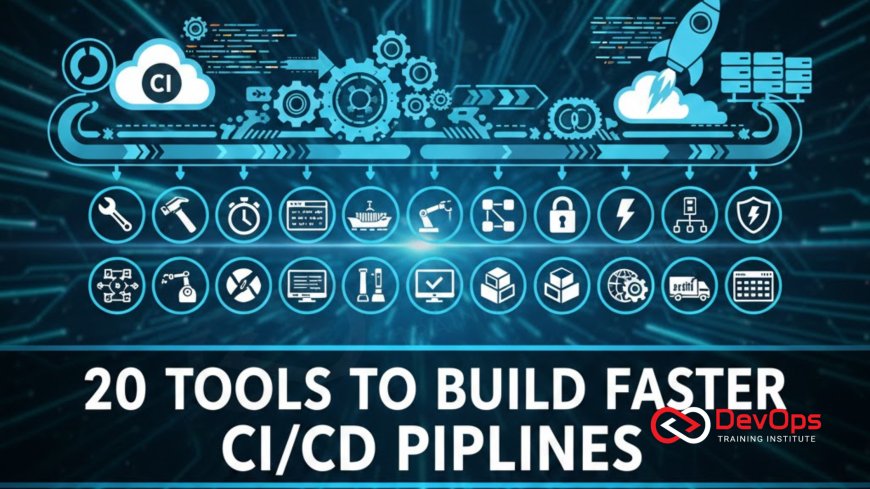
Introduction to High-Speed Delivery Pipelines
In the modern software era, the speed of your CI/CD pipeline is directly linked to your business agility. A slow pipeline acts as a bottleneck, forcing developers to wait hours for feedback and delaying the delivery of critical features to customers. To compete in twenty twenty six, engineering teams must move beyond basic automation and embrace a suite of specialized tools designed to shave seconds and minutes off every stage of the lifecycle. Building a faster pipeline is not just about raw compute power; it is about intelligent caching, parallel execution, and the strategic removal of manual intervention points.
This guide explores twenty essential tools that are currently redefining how high performing teams build and deploy software. From advanced build systems that only recompile what has changed to sophisticated orchestration platforms that manage global deployments, these tools provide the technical foundation for a frictionless "paved road." By integrating these technologies, you can foster a cultural change where shipping code becomes a fast, routine, and reliable process. Let us dive into the categories and specific tools that will help you achieve the ultimate goal of rapid, high quality software delivery in the cloud native age.
Next-Generation Build Systems and Compilers
The build phase is often the most time consuming part of any pipeline, especially for large scale projects with millions of lines of code. Traditional build tools often perform redundant work, recompiling files that haven't changed since the last execution. Modern build systems like Bazel and Pants address this by using advanced dependency analysis and distributed caching. They ensure that the pipeline only executes the minimum number of tasks required to produce the final artifact, which can reduce build times from hours to minutes. These tools are essential for managing continuous synchronization in massive monorepos.
For JavaScript and TypeScript environments, tools like Turborepo and Nx offer similar benefits by intelligently managing task execution across multiple packages. These systems understand the relationships between your components and can run tests and builds in parallel across multiple CPU cores. By reducing the overhead of the build stage, you provide developers with faster feedback loops, allowing them to iterate more quickly and catch errors earlier in the process. Investing in a high performance build system is one of the most effective ways to improve the overall throughput of your entire engineering organization.
Containerization and Image Optimization Tools
Containerization is the standard for modern deployments, but large and inefficient images can slow down your pipeline during the build, push, and pull phases. Tools like Buildah and Kaniko allow you to build OCI compliant images without requiring a background daemon, which is ideal for secure, rootless environments like Kubernetes. They are designed to be lightweight and fast, minimizing the time spent on layer creation. Furthermore, choosing the right containerd runtime integration can further optimize how these images are executed in your production clusters.
To further reduce the size of your artifacts, tools like Docker Slim and Dive help you analyze and optimize your image layers. Smaller images result in faster network transfers and quicker pod startup times, which is critical for scaling and incident handling scenarios. Additionally, using a centralized and high speed container registry like Harbor or Jfrog Artifactory ensures that your pipeline has reliable access to the dependencies it needs. By optimizing your container workflow, you ensure that the path from a successful build to a running application is as short and efficient as possible, maintaining high performance across all your cluster states.
Automated Testing and Quality Gates
Testing is frequently the longest stage of a CI/CD pipeline, but it is also the most vital for ensuring stability. To speed this up, teams are moving away from serial test execution toward massive parallelism using tools like TestContainers and Selenium Grid. These tools allow you to spin up isolated environments for every test suite, running them simultaneously across a distributed fleet of workers. This approach ensures that your total test time is limited only by the length of your longest single test, rather than the sum of all tests combined. It is a key part of modern release strategies that prioritize safety and speed.
In addition to speed, the accuracy of your quality gates is paramount. Tools like SonarQube and Snyk provide automated code analysis and security scanning directly within the pipeline. They act as admission controllers for your code, ensuring that only artifacts that meet your strict quality and security standards are allowed to progress. By catching vulnerabilities and technical debt automatically, you reduce the need for manual reviews and prevent costly production errors. This integration of security and quality into the automated flow is the core of a successful DevSecOps practice, allowing for faster and more confident deployments.
20 Tools for Faster CI/CD Comparison
| Tool Category | Example Tools | Primary Speed Benefit | Complexity |
|---|---|---|---|
| Orchestration | GitHub Actions, GitLab CI | Native cloud scaling | Low |
| Build Systems | Bazel, Turborepo | Incremental builds & cache | High |
| GitOps | ArgoCD, Flux | Automated sync to K8s | Medium |
| Secret Management | HashiCorp Vault, Doppler | Rapid credential injection | Medium |
| Infrastructure | Terraform, Pulumi | Declarative environment setup | Medium |
Deployment Orchestration and GitOps Tools
Once your code is built and tested, the final hurdle is deploying it safely and quickly. Traditional push based deployment scripts can be fragile and slow to execute across multiple clusters. GitOps tools like ArgoCD and Flux solve this by pulling the desired state directly from your Git repository and automatically synchronizing it with your Kubernetes environment. This ensures that your GitOps workflow is always the source of truth, reducing the risk of configuration drift and making rollouts incredibly fast and repeatable.
For complex release patterns, tools like Spinnaker or Harness provide advanced orchestration capabilities like blue green and canary deployments. These platforms allow you to automate the promotion of code through different environments based on real time health metrics. By utilizing ChatOps techniques, your team can monitor these deployments and trigger rollbacks directly from their communication channels. This combination of GitOps and advanced orchestration ensures that your deployment phase is not just fast, but also highly resilient and observable, which is essential for maintaining uptime in modern cloud architecture patterns.
Observability and Pipeline Performance Analytics
You cannot optimize what you do not measure. To build a truly fast CI/CD pipeline, you need deep visibility into where the time is actually being spent. Tools like Honeycomb and Datadog for CI provide specialized observability into your pipeline execution, allowing you to identify slow steps, flaky tests, and resource bottlenecks. They provide detailed traces of every build, helping you understand the impact of your optimization efforts over time. This data driven approach is critical for justifying the investment in AI augmented devops tools that can predict and prevent future slowdowns.
In addition to performance metrics, you must also monitor the health of your automated delivery process. Tools like Prometheus and Grafana can be used to visualize the success rates and lead times of your pipelines, providing the team with a clear dashboard of their technical performance. By integrating continuous verification into your monitoring stack, you ensure that every deployment is meeting its performance targets in production. This feedback loop allows you to continuously refine your pipeline, ensuring it remains a powerful engine for growth rather than a source of frustration for your developers.
Best Practices for Pipeline Optimization
- Parallelize Everything: Run independent tasks, such as linting, unit tests, and security scans, in parallel to minimize the total wall clock time of the pipeline.
- Use Ephemeral Runners: Leverage Kubernetes or serverless functions to spin up fresh build environments for every job, ensuring consistency and isolation.
- Implement Smart Caching: Cache your package manager dependencies (npm, maven, etc.) and build artifacts between runs to avoid redundant network and CPU work.
- Protect Your Secrets: Use secret scanning tools to ensure that no credentials are leaked in your pipeline logs or configuration files.
- Minimize Image Layers: Optimize your Dockerfiles to reduce the number of layers and keep your container images as small as possible for faster transfers.
- Automate Rollbacks: Ensure your deployment tools can automatically revert to a previous stable version if health checks fail after a release.
- Version Your Infrastructure: Use who drives cultural change strategies to encourage the use of Terraform or Pulumi for all environment configurations.
Building a high speed pipeline is an iterative journey that requires a commitment to technical excellence. As you adopt more of these 20 tools, you should focus on creating a seamless developer experience where the infrastructure handles the heavy lifting. By staying informed about AI augmented devops trends, you can ensure that your pipeline remains modern and efficient. The ultimate goal is to reach a state of continuous flow where code moves from a developer's machine to production with minimal friction, allowing your business to respond to market changes with unparalleled speed and confidence.
Conclusion: The Future of Rapid Software Delivery
In conclusion, the twenty tools discussed in this guide provide a comprehensive roadmap for any team looking to build faster and more reliable CI/CD pipelines. From the initial build with Bazel to the final deployment with ArgoCD, each tool plays a specific role in eliminating waste and accelerating the delivery lifecycle. By combining these technologies with a strong DevOps culture, you can transform your software delivery process into a major competitive advantage. The future of software is automated, fast, and secure, and these tools are the keys to unlocking that potential for your organization.
As you move forward, remember that the most successful pipelines are those that are constantly measured and improved. Use architecture patterns that support scalability and reliability in every stage. The integration of AI augmented devops will continue to push the boundaries of what is possible, making our delivery systems even more intelligent and proactive. By investing in these 20 tools today, you are building a future proof technical foundation that will support your business through every challenge and opportunity in the years to come. Speed is the new currency of tech, and your CI/CD pipeline is where that value is created.
Frequently Asked Questions
What is the fastest way to improve CI/CD pipeline speed?
The fastest way is usually to implement aggressive caching for dependencies and build artifacts, followed by parallelizing independent test and build tasks.
Do I need all 20 tools to have a fast pipeline?
No, you should identify your biggest bottleneck first and choose the specific tool that addresses that problem before adding more complexity.
Is Jenkins still a good tool for fast pipelines?
Jenkins is still very powerful, especially when used with ephemeral container agents, but modern cloud native tools often offer faster setup and scaling.
What is the benefit of Bazel over traditional build tools?
Bazel provides advanced incremental builds and distributed caching, ensuring that only the files that have changed are recompiled, saving massive amounts of time.
How does GitOps help with deployment speed?
GitOps automates the synchronization between your code repository and your cluster, eliminating manual steps and ensuring that deployments are consistent and fast.
Can small teams benefit from these advanced tools?
Yes, many of these tools are available as managed services, allowing small teams to achieve enterprise-grade pipeline speed without significant operational overhead.
What role does containerization play in pipeline speed?
Containerization provides a consistent environment, but the real speed benefit comes from optimizing image sizes and using fast container runtimes and registries.
Is it safe to run all my tests in parallel?
Yes, as long as your tests are truly isolated and do not depend on shared state, parallel execution is the best way to reduce test time.
What is a flaky test and how does it impact speed?
A flaky test is one that fails inconsistently; it slows down the pipeline by requiring re-runs and undermining trust in the automated quality gates.
How can AI improve my CI/CD pipeline?
AI can help by predicting which tests are most likely to fail, automatically optimizing resource allocation, and identifying the root cause of build failures.
What is the difference between CI and CD?
CI focuses on integrating and testing code changes frequently, while CD focuses on automating the release and deployment of those changes to production.
Do these tools work with all cloud providers?
Most of these tools are cloud-agnostic and work seamlessly with AWS, Azure, Google Cloud, and even on-premises private cloud environments.
How does secret management impact pipeline performance?
Secure secret management tools allow for rapid and safe injection of credentials, preventing the delays and risks associated with manual credential handling.
What is the "paved road" in DevOps?
The "paved road" is a set of standardized, automated tools and processes that make it easy for developers to ship code safely and quickly.
What should be my first step in optimizing my pipeline?
Your first step should be to implement detailed observability to find exactly where the longest delays and most frequent failures are occurring today.
What's Your Reaction?
 Like
0
Like
0
 Dislike
0
Dislike
0
 Love
0
Love
0
 Funny
0
Funny
0
 Angry
0
Angry
0
 Sad
0
Sad
0
 Wow
0
Wow
0

![100+ Azure DevOps Interview Questions and Answers [Updated 2025]](https://www.devopstraininginstitute.com/blog/uploads/images/202509/image_140x98_68c40aa9a3834.jpg)






![Future Scope of DevOps Careers in Pune [Updated 2025]](https://www.devopstraininginstitute.com/blog/uploads/images/202510/image_140x98_68e3a84652312.jpg)