

![Kong Interview Preparation Guide [2025]](https://www.devopstraininginstitute.com/blog/uploads/images/202509/image_430x256_68dbb95326997.jpg)

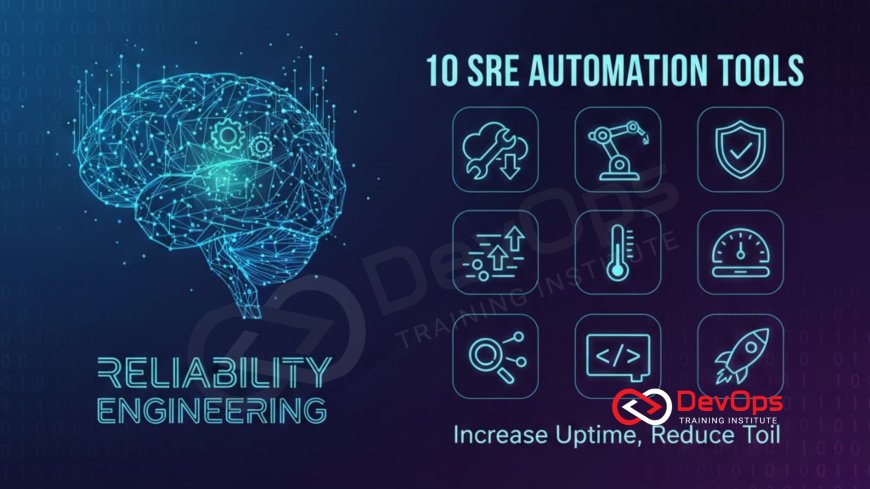
10 SRE Automation Tools for Reliability Engineering
Explore the top 10 SRE automation tools essential for enhancing system reliability, streamlining operations, and improving incident response. This comprehensive guide breaks down how these tools contribute to proactive error prevention, efficient resource management, and robust infrastructure. Discover solutions that empower Site Reliability Engineers to build more resilient and performant systems, ensuring uninterrupted service delivery and operational excellence in today's complex technological landscape. Elevate your SRE practices with practical insights and tool recommendations.
Introduction to SRE Automation
In today's fast-paced digital world, users expect services to be available, fast, and reliable at all times. This expectation places immense pressure on engineering teams, particularly Site Reliability Engineers (SREs). SRE is a discipline that incorporates aspects of software engineering and applies them to infrastructure and operations problems, aiming to create highly reliable and scalable software systems. A core tenet of SRE is the relentless pursuit of automation, which helps reduce manual toil, prevent human error, and enable quicker responses to system issues.
Automation is not just about making tasks faster; it's about making systems more predictable and less prone to the inconsistencies that come with manual operations. By automating repetitive tasks, SRE teams can free up valuable time to focus on strategic initiatives, such as improving system architecture, developing new features, and performing deeper analysis of system performance. This shift from reactive firefighting to proactive engineering is fundamental to achieving true reliability. This blog post will delve into some of the most impactful SRE automation tools available today, exploring how each contributes to building a more robust and resilient engineering environment.
The Role of Automation in SRE
Automation serves as the backbone of effective Site Reliability Engineering. Without it, SRE teams would be perpetually swamped with manual tasks, leaving little room for the strategic work that truly enhances reliability. Automation helps in maintaining desired service level objectives (SLOs) by ensuring consistent deployment, monitoring, and incident response. It minimizes the chances of human error, which is often a significant contributor to outages and performance degradation.
From automating routine maintenance tasks like patching and configuration management to orchestrating complex deployments and even predicting potential failures, automation allows SREs to manage large-scale distributed systems with greater efficiency and less stress. It’s about leveraging software to manage software, creating a virtuous cycle where reliability improvements are continually built into the operational fabric. The ultimate goal is to move towards a state where systems are self-healing and require minimal human intervention, allowing SREs to focus on innovation rather than just keeping the lights on.
Infrastructure as Code (IaC) Tools
Infrastructure as Code (IaC) is a crucial practice in modern SRE, treating infrastructure provisioning and management like software development. Instead of manually configuring servers and networks, IaC allows SREs to define their infrastructure in code, which can be versioned, tested, and deployed automatically. This approach brings significant benefits, including consistency, repeatability, and faster provisioning of environments. It also drastically reduces the chances of configuration drift, where environments deviate from their intended state over time.
Tools like Terraform and Ansible are at the forefront of the IaC movement. Terraform, for instance, enables SREs to define and provision datacenter infrastructure using a declarative configuration language. It supports a multitude of cloud providers and on-premise solutions, making it a versatile choice for managing heterogeneous environments. Ansible, on the other hand, is excellent for configuration management, application deployment, and task automation. It uses a simple YAML syntax, making it easy to learn and implement, and it operates agentlessly, which simplifies its deployment across various systems.
Monitoring and Observability Platforms
Effective monitoring and observability are non-negotiable for any SRE team. While traditional monitoring focuses on "what happened," observability aims to answer "why it happened" by providing deep insights into the internal states of a system. Automation plays a critical role here, as manually sifting through logs, metrics, and traces from complex distributed systems is simply not feasible. Automated monitoring tools continuously collect vast amounts of data, helping SREs understand system behavior and detect anomalies quickly.
Platforms like Prometheus, Grafana, and Datadog are indispensable. Prometheus is an open-source monitoring system that collects metrics from configured targets at given intervals, evaluates rule expressions, displays the results, and can trigger alerts if some condition is observed. Grafana is often paired with Prometheus to visualize these metrics through powerful, customizable dashboards. Datadog offers an integrated platform for monitoring, logging, and tracing, providing a unified view of application and infrastructure performance across diverse environments. These tools not only alert SREs to problems but also provide the necessary context to diagnose and resolve issues efficiently, significantly improving observability.
Table: Top SRE Automation Tools Overview
| Tool Category | Specific Tools | Primary Functionality | Key SRE Benefit |
|---|---|---|---|
| Infrastructure as Code (IaC) | Terraform, Ansible | Automated infrastructure provisioning and configuration management. | Consistent, repeatable, and version-controlled infrastructure. |
| Monitoring & Observability | Prometheus, Grafana, Datadog | Real-time metrics, logs, traces, and alerting for system health. | Proactive issue detection and deep insights into system behavior. |
| CI/CD Pipelines | Jenkins, GitLab CI/CD, CircleCI | Automated software build, test, and deployment. | Faster, more reliable software delivery and reduced deployment risk. |
| Incident Management | PagerDuty, Opsgenie | Automated alerting, on-call scheduling, and incident escalation. | Rapid incident response and minimized downtime. |
| Log Management & Analysis | ELK Stack (Elasticsearch, Logstash, Kibana), Splunk | Centralized log aggregation, search, and analysis. | Quicker root cause analysis and proactive issue identification. |
| Runbook Automation | RunDeck, StackStorm | Automated execution of predefined operational procedures. | Reduced manual toil, consistent incident resolution. |
| Performance Testing & Chaos Engineering | JMeter, K6, Gremlin | Simulating load, identifying bottlenecks, and breaking systems on purpose. | Preemptive identification of weaknesses and improved system resilience. |
| Cloud Cost Management | CloudHealth, FinOps tools | Automated monitoring and optimization of cloud spending. | Cost efficiency and better resource utilization in cloud environments. |
CI/CD Pipeline Automation Tools
Continuous Integration (CI) and Continuous Delivery (CD) pipelines are fundamental to modern software development and directly impact system reliability. Automated CI/CD tools enable development teams to integrate code changes frequently, run automated tests, and deploy applications to production with confidence and speed. This constant feedback loop helps catch errors early in the development cycle, preventing them from escalating into major incidents in production. SREs often work closely with development teams to ensure these pipelines are robust, efficient, and reliable.
Tools like Jenkins, GitLab CI/CD, and CircleCI provide the automation needed for these pipelines. Jenkins is a highly configurable, open-source automation server that supports a vast ecosystem of plugins to automate virtually any part of the software development process. GitLab CI/CD is deeply integrated within the GitLab platform, offering a seamless experience for version control, CI, and CD. CircleCI focuses on speed and ease of use, providing powerful automation for building, testing, and deploying applications across various platforms. These tools are critical for achieving fast and reliable software deployments, which is a cornerstone of SRE.
Incident Management and Alerting Solutions
Even with the best preventative measures, incidents are an inevitable part of managing complex systems. How an SRE team responds to an incident can make all the difference in minimizing downtime and impact. Automated incident management and alerting solutions are designed to streamline this process, ensuring that the right people are notified at the right time and have the necessary tools to address the issue quickly. These tools go beyond simple notifications; they often provide rich context, escalation policies, and collaboration features.
PagerDuty and Opsgenie are two leading platforms in this space. PagerDuty offers intelligent incident response by aggregating alerts from various monitoring tools, applying sophisticated routing rules, and notifying on-call personnel through multiple channels. It also provides features for on-call scheduling, escalations, and post-incident analysis. Opsgenie, now part of Atlassian, offers similar capabilities, focusing on centralized alert management, customizable on-call schedules, and robust integrations with other IT and DevOps tools. These solutions empower SREs to respond to critical issues with speed and precision, significantly reducing mean time to resolution (MTTR).
Log Management and Analysis Tools
Logs are a treasure trove of information about system behavior, but only if they can be effectively collected, stored, and analyzed. In distributed systems, logs can be generated by hundreds or even thousands of different components, making manual inspection impossible. Automated log management and analysis tools centralize logs from all sources, allowing SREs to quickly search, filter, and analyze them to diagnose issues, identify patterns, and gain insights into system health. This capability is vital for both proactive problem identification and reactive troubleshooting.
The ELK Stack (Elasticsearch, Logstash, Kibana) and Splunk are widely used for this purpose. Logstash is used to collect, parse, and transform logs from various sources. Elasticsearch provides a powerful search and analytics engine to store and index these logs. Kibana offers interactive dashboards and visualizations to explore the data. Splunk is an enterprise-grade platform that provides similar capabilities, excelling at machine data collection, indexing, searching, and reporting across IT operations, security, and business intelligence. These tools automate the tedious process of log aggregation and analysis, making it much easier for SREs to perform root cause analysis and identify the underlying causes of system issues.
Runbook Automation and Orchestration
Runbooks are documented procedures for handling specific operational tasks or incidents. While traditional runbooks are manual, runbook automation takes these procedures and automates their execution, reducing human error and speeding up resolution times. Orchestration tools take this a step further, allowing SREs to automate complex workflows involving multiple systems and tools. This type of automation is particularly valuable for repetitive tasks, standard incident responses, and scaling operations.
Tools like RunDeck and StackStorm enable sophisticated runbook automation. RunDeck allows SREs to define, schedule, and execute operational procedures across their infrastructure. It provides centralized control, access management, and auditing capabilities for automated tasks. StackStorm is an event-driven automation platform that can connect various services and tools, allowing SREs to create complex workflows that respond to specific events (e.g., an alert from a monitoring system). These platforms are instrumental in reducing manual toil and ensuring consistent and reliable execution of operational tasks, helping SREs to build more robust and resilient systems. For instance, automating a deployment process through runbooks can simplify practices like blue-green deployment, making it less prone to errors.
Performance Testing and Chaos Engineering Tools
Understanding how a system behaves under stress and proactively identifying its weaknesses before they cause outages is crucial for SRE. This is where automated performance testing and chaos engineering come into play. Performance testing tools simulate various load conditions to identify bottlenecks and ensure the system can handle expected traffic. Chaos engineering, on the other hand, deliberately injects failures into a system in a controlled environment to uncover hidden weaknesses and build resilience. This proactive approach helps SREs design more robust systems.
For performance testing, tools like Apache JMeter and k6 are widely used. JMeter is an open-source tool for testing performance both on static and dynamic resources, web dynamic applications. It can be used to simulate a heavy load on a server, group of servers, network or object to test its strength or analyze overall performance under different load types. k6 is a modern load testing tool that makes performance testing a delightful experience. It is developer-centric, scriptable with JavaScript, and designed for testing the performance of APIs and microservices. In the realm of chaos engineering, Gremlin is a prominent platform that allows SREs to safely and systematically introduce failures to understand how their systems react and to improve their fault tolerance. This proactive approach significantly enhances system resilience.
Cloud Cost Management and FinOps Tools
As organizations increasingly adopt cloud-native architectures, managing cloud costs becomes a significant challenge for SRE teams. Unoptimized cloud resources can lead to ballooning expenses, undermining the efficiency gains of cloud adoption. Cloud cost management and FinOps tools automate the monitoring, analysis, and optimization of cloud spending, helping SREs ensure that resources are used efficiently and cost-effectively. FinOps is a cultural practice that brings financial accountability to the variable spend model of cloud, enabling organizations to make business trade-offs between speed, cost, and quality.
Tools like CloudHealth by VMware and various native cloud provider cost management dashboards (e.g., AWS Cost Explorer, Google Cloud Billing) provide granular visibility into cloud spending. These platforms allow SREs to identify underutilized resources, optimize instance types, manage reservations, and forecast future costs. By automating cost monitoring and providing actionable insights, these tools empower SREs to make data-driven decisions that improve both reliability and financial efficiency. This integration of financial accountability into operational practices is becoming an essential part of modern SRE, aligning engineering efforts with business objectives.
Configuration Management and Orchestration
Managing the configuration of thousands of servers, containers, and network devices across a distributed system manually is an impossible task. Configuration management tools automate the process of establishing and maintaining the consistency of a system's functional and physical attributes. They ensure that every component of the infrastructure is configured exactly as specified, preventing configuration drift and simplifying maintenance. This automation is crucial for achieving consistent and reliable deployments.
Beyond basic configuration, orchestration tools help coordinate complex tasks across multiple systems. For example, when deploying a new service, orchestration ensures that all necessary dependencies are met, resources are allocated, and services are started in the correct order. Kubernetes, while primarily a container orchestrator, plays a significant role here by automating the deployment, scaling, and management of containerized applications. Other tools like Chef and Puppet also excel in configuration management, allowing SREs to define infrastructure configurations as code and automate their deployment and enforcement. This systematic approach ensures that infrastructure remains stable and predictable, directly contributing to overall system reliability. Such comprehensive automation also supports practices like platform engineering.
Conclusion
The journey towards truly reliable systems is an ongoing one, and automation is undoubtedly the most powerful vehicle for this endeavor. The tools discussed in this blog post represent a crucial arsenal for any Site Reliability Engineer striving for operational excellence. From defining infrastructure as code and proactively monitoring system health to automating incident response and meticulously managing costs, each tool plays a vital role in reducing toil, minimizing human error, and accelerating the pace of innovation. By embracing these automation solutions, SRE teams can move beyond reactive problem-solving, dedicating more time to strategic initiatives that build more resilient, efficient, and user-centric systems. The continuous evolution of these tools and the adoption of automation as a core principle will continue to shape the future of reliability engineering, making complex distributed systems manageable and dependable for everyone. The proactive approach facilitated by these tools aligns perfectly with principles found in shift-left testing methodologies.
Frequently Asked Questions
What is SRE automation?
SRE automation involves using software and tools to automate repetitive tasks in Site Reliability Engineering to improve system reliability and efficiency.
Why is automation important in SRE?
Automation minimizes manual toil, reduces human error, speeds up incident response, and frees SREs to focus on strategic reliability improvements.
What are some key benefits of using IaC tools in SRE?
IaC tools provide consistent, repeatable infrastructure provisioning, reduce configuration drift, and enable version control for infrastructure changes.
How do monitoring tools contribute to SRE?
Monitoring tools collect real-time data on system health, enabling SREs to detect issues early and gain insights into system behavior.
What is the difference between monitoring and observability in SRE?
Monitoring tells you "what" is happening, while observability helps you understand "why" it's happening by providing deeper system insights.
How do CI/CD pipelines enhance reliability?
CI/CD pipelines automate software delivery, enabling frequent testing and rapid, reliable deployments, reducing the risk of errors in production.
What role do incident management tools play?
Incident management tools automate alerting, on-call scheduling, and escalation, ensuring rapid response and minimizing downtime during outages.
Why is log management crucial for SREs?
Log management tools centralize and analyze logs, helping SREs quickly diagnose issues, perform root cause analysis, and identify system patterns.
What is runbook automation?
Runbook automation involves automating predefined operational procedures, reducing manual effort, and ensuring consistent execution of tasks.
How does chaos engineering improve system resilience?
Chaos engineering deliberately injects failures to uncover weaknesses, helping SREs build more robust and fault-tolerant systems proactively.
Are these automation tools suitable for small teams?
Many tools have open-source or free tiers, making them accessible and beneficial even for smaller teams looking to improve reliability.
How do SRE automation tools impact cloud costs?
Tools like FinOps platforms help optimize cloud spending by identifying inefficient resource usage and providing insights for cost reduction.
What is the future of SRE automation?
The future involves more intelligent, AI-driven automation for predictive analytics, self-healing systems, and even greater reduction of manual toil.
Can these tools be integrated with existing systems?
Most modern SRE automation tools offer extensive APIs and integrations to connect with a wide array of existing IT and DevOps ecosystems.
How do I choose the right SRE automation tool?
Consider your specific needs, existing infrastructure, budget, team expertise, and the tool's community support and integration capabilities.
What's Your Reaction?
 Like
0
Like
0
 Dislike
0
Dislike
0
 Love
0
Love
0
 Funny
0
Funny
0
 Angry
0
Angry
0
 Sad
0
Sad
0
 Wow
0
Wow
0

![100+ Azure DevOps Interview Questions and Answers [Updated 2025]](https://www.devopstraininginstitute.com/blog/uploads/images/202509/image_140x98_68c40aa9a3834.jpg)




![Future Scope of DevOps Careers in Pune [Updated 2025]](https://www.devopstraininginstitute.com/blog/uploads/images/202510/image_140x98_68e3a84652312.jpg)