

![Kong Interview Preparation Guide [2025]](https://www.devopstraininginstitute.com/blog/uploads/images/202509/image_430x256_68dbb95326997.jpg)

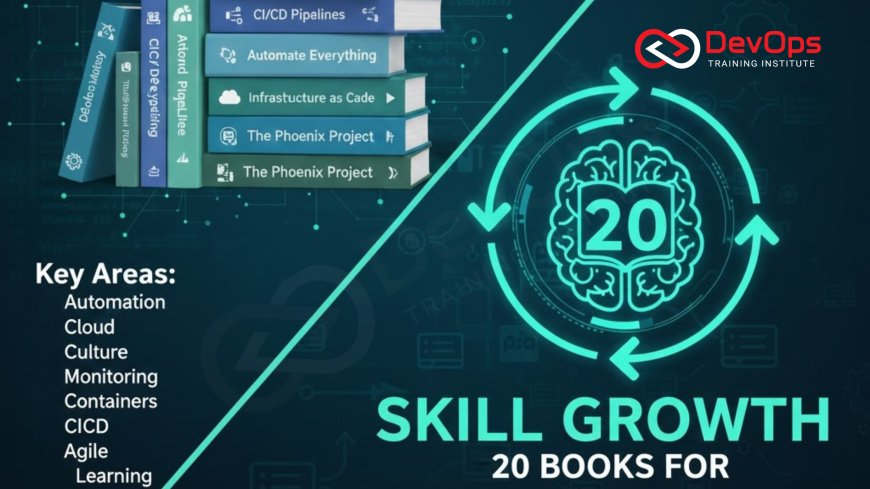
20 DevOps Books to Read for Skill Growth
Dive into the essential reading list for every aspiring and current DevOps professional, featuring 20 foundational books across the cultural, automation, measurement, and SRE pillars. From the narrative insights of The Phoenix Project and The Unicorn Project to the technical depth of Site Reliability Engineering and Designing Data-Intensive Applications, this list provides a structured path for skill growth. We categorize must-reads covering CI/CD pipelines, Infrastructure as Code, resilient architecture, and advanced observability practices, ensuring you gain expertise in both the philosophical foundations and the technical execution required for modern operations. This curated selection will help you master automated validation, security best practices, advanced log management, and efficient file system management techniques, transforming your approach to software delivery and infrastructure management, ensuring all practitioners adhere to a high standard of operational excellence.
Introduction
The world of DevOps is not defined by a single tool or language; it is a convergence of cultural philosophies, practices, and tooling that aims to shorten the systems development life cycle and provide continuous delivery with high quality. To truly excel in this field, one must master technical automation alongside the crucial social and organizational principles that govern effective team collaboration and rapid feedback loops. Reading widely is arguably the most efficient way to acquire this holistic understanding, learning from the decades of operational experience distilled by industry leaders. The following 20 books are categorized to guide your learning journey, covering everything from the narrative context of IT transformation to the deep technical mechanics required for building resilient, scalable systems. Whether you are focused on optimizing your CI/CD pipeline, implementing robust SRE practices, or designing complex distributed systems, this reading list provides the necessary breadth and depth to accelerate your skill growth from an intermediate practitioner to a strategic automation engineer. We recommend starting with the cultural books to frame your technical learning within the appropriate operational context.
1. The Phoenix Project: A Novel About IT, DevOps, and Helping Your Business Win
The Phoenix Project is often the first book recommended to anyone entering the DevOps space, offering a crucial cultural foundation disguised as an engaging novel. Set within the fictional Parts Unlimited company, the story follows IT Manager Bill Palmer as he is suddenly tasked with fixing a catastrophic IT department that is on the verge of collapsing the entire business. Through this narrative, authors Gene Kim, Kevin Behr, and George Spafford introduce the core concepts of DevOps, most notably the Three Ways of DevOps: Flow, Feedback, and Continual Learning. The book excels because it clearly illustrates the destructive organizational silos and anti-patterns that plague traditional IT operations, such as "throw it over the wall" deployments and constant, disruptive emergency fixes. By placing these abstract concepts into a relatable, high-stakes scenario, the book makes the philosophical arguments for collaboration and automation tangible, showing how every technical decision impacts the entire value stream. It serves as an excellent introduction for both technical practitioners and business stakeholders, providing a common vocabulary and understanding of the necessary organizational changes required for successful transformation.
2. The DevOps Handbook: How to Create World-Class Agility, Reliability, & Security in Technology Organizations
Serving as the practical sequel and technical blueprint to The Phoenix Project, The DevOps Handbook details actionable steps and organizational patterns required to apply the Three Ways of DevOps in real-world scenarios.
- Value Stream Mapping: The book heavily emphasizes value stream mapping, instructing readers on how to visualize, measure, and optimize the flow of work from idea conception to deployment and production. This ensures that bottlenecks are systematically identified and eliminated.
- Feedback Loops: It provides specific techniques for creating fast and frequent feedback loops across the value stream, such as integrating monitoring and testing directly into the deployment pipeline, ensuring issues are caught as close to the source as possible.
- Automation Pillars: The book establishes the essential automation practices, focusing on Infrastructure as Code (IaC), Continuous Integration, and Continuous Delivery, detailing the technical tools and processes necessary to achieve continuous flow.
- Culture of Experimentation: It reinforces the cultural aspect by detailing how to establish a blameless culture that focuses on learning from failures rather than assigning blame, promoting continuous improvement and necessary risk-taking.
- Security and Compliance: The handbook integrates security practices directly into the pipeline ("DevSecOps"), treating security requirements as testable features that are automated and verified in every stage, shifting security left in the process.
- Practical Implementation: Unlike the narrative-driven Phoenix Project, this book provides case studies and specific practices, making it an indispensable guide for engineers looking to implement DevOps principles immediately within their teams.
- Operational Excellence: It connects operational practices with the efficiency of basic commands and advanced automation, emphasizing that mastering the fundamentals is necessary before scaling infrastructure management.
3. Accelerate: The Science Behind DevOps
Accelerate, authored by Nicole Forsgren, Jez Humble, and Gene Kim, provides the empirical evidence underpinning the success of DevOps. Based on years of research and data from the State of DevOps Reports, the book identifies the four key metrics (the DORA metrics: Lead Time for Changes, Deployment Frequency, Mean Time to Recovery, and Change Failure Rate) that scientifically correlate with high organizational performance. This book is vital because it moves the DevOps conversation away from subjective arguments and into the realm of data science, proving that continuous delivery and cultural factors are directly linked to faster innovation, higher profitability, and increased employee morale. The research clearly demonstrates that focusing on these four metrics—which quantify both speed and stability—is the most reliable way to measure the efficacy of any DevOps transformation initiative. By providing a clear, evidence-based measurement system, Accelerate gives engineers and leaders the tools needed to justify investments in automation and cultural change with objective, quantifiable results that resonate with business executives.
4. Site Reliability Engineering: How Google Runs Production Systems
Written by the team that invented the discipline, this book is the definitive guide to the SRE methodology, detailing Google's specific approach to managing massive-scale, highly reliable production systems.
- Error Budgets and SLOs: It defines the foundational SRE concepts of Service Level Objectives (SLOs) and Error Budgets, explaining how these metrics are used to mathematically balance the trade-off between release velocity and system stability.
- Toil Management: The book dedicates significant attention to identifying, measuring, and aggressively automating away operational toil (manual, repetitive, tactical work), mandating that SREs spend at least 50% of their time on engineering tasks.
- Incident Response: It details the precise organizational structures and technical procedures Google uses for incident management, including structured, blameless post-mortems focused on systemic improvement.
- Automation Mandates: It establishes the engineering discipline required for operations, emphasizing the need for SREs to be software engineers who use code to manage infrastructure, making automation a non-negotiable mandate.
- System Design: It covers technical aspects of scaling, monitoring, and load balancing, detailing Google's practices for building large, distributed, and highly resilient architecture capable of handling billions of user requests.
- Organizational Structure: The book defines how SRE teams should interface with development and product teams, including the crucial authority SRE has to halt feature development when the Error Budget is depleted.
- Operational Validation: The concepts detailed provide a strategic framework for transforming manual verification into automated checks, fundamentally changing how teams approach their daily post-installation checklist procedures.
5. The Practice of Cloud System Administration: Designing and Operating Large Distributed Systems
This book is a comprehensive reference guide for system administrators transitioning to cloud and large-scale distributed environments, covering everything from core philosophy to practical implementation.
Modern Operations Focus
It provides excellent organizational advice on building resilient, high-volume production environments, detailing everything from disaster recovery planning to capacity estimation and automated server provisioning techniques.
The emphasis is on managing infrastructure as a fleet, applying consistent policies and automation to large numbers of servers rather than treating each machine as a unique snowflake, which is vital for scaling.
Security and Access
The book delves deeply into access control and security patterns for modern environments, covering the transition from simple user accounts to managing identity across complex environments.
It provides strong guidance on implementing centralized user management and securing privileged access, which are critical administrative challenges in any large-scale, automated infrastructure landscape.
System Resilience
Covers critical infrastructure concepts like data center design, network topologies, and the principles of non-functional requirements that drive system resilience in cloud-based architectures.
It provides practical, actionable advice for operations engineers on managing change, handling incidents, and utilizing monitoring to predict and prevent failures across complex, highly virtualized systems.
6. Continuous Delivery: Reliable Software Releases Through Build, Test, and Deployment Automation
Authored by Jez Humble and David Farley, Continuous Delivery is the foundational text that predates the popularization of the term DevOps, providing the technical and process blueprint for releasing software rapidly and reliably. The central thesis is that every change, regardless of how small, should be ready for deployment to production at any given time, achieved through the concept of the Deployment Pipeline. The book meticulously details the steps needed to build and maintain this pipeline: automated configuration management, comprehensive automated testing (unit, integration, acceptance), and the creation of deployment scripts that are universal across all environments. It places heavy emphasis on the practice of configuration management and version control, ensuring that not only the application code but also the entire environment definition is managed as code. Reading this book provides the necessary technical depth for implementing sophisticated CI/CD pipelines, focusing on maintaining a single source of truth (the application artifact) that flows through the pipeline stages without ever being modified, which is a key concept for release confidence.
7. Infrastructure as Code: Managing Servers in the Cloud
Kief Morris's Infrastructure as Code provides a comprehensive exploration of the practices, principles, and technical mechanisms needed to manage infrastructure using code and automation tools (Terraform, Ansible, Chef).
- Declarative vs. Imperative: It clearly defines the difference between the declarative approach (defining the desired end-state, e.g., Terraform) and the imperative approach (defining the steps to reach that state, e.g., Ansible/shell scripts) and when to use each in the orchestration stack.
- Idempotence and Mutability: The book stresses the importance of idempotence in automation scripts and discusses patterns like immutable infrastructure, where servers are never modified after creation but are replaced entirely upon update, eliminating configuration drift.
- Managing Drift: It provides practical strategies for detecting and remediating configuration drift—the silent divergence of servers from their intended state—using continuous configuration enforcement mechanisms.
- Tooling Ecosystem: It compares and contrasts the major categories of IaC tools, helping readers understand the trade-offs between orchestration tools, configuration management tools, and service provisioning tools.
- Testing IaC: A crucial focus is placed on the necessity of testing infrastructure code just like application code, using techniques like unit testing for Terraform modules and integration testing for configuration management playbooks.
- Security and Compliance: It details how to embed security policies and compliance requirements directly into the infrastructure code, creating automated guardrails that prevent the provisioning of insecure resources.
- Access Control: The concepts apply directly to implementing secure remote access, providing context on how access controls should be codified, such as when and how to provision and manage SSH keys for non-human deployment agents.
8. Cloud Native Patterns: Designing Change-Tolerant Systems
Cloud Native Patterns, by Cornelia Davis, moves beyond basic deployment automation to explore the architectural principles necessary to build systems that thrive in the fluid, highly distributed environment of the cloud. The book systematically explores the patterns that underpin resilience and scalability, such as containerization, microservices architecture, and twelve-factor app principles. It guides the reader through refactoring traditional applications into cloud-native structures that are inherently fault-tolerant and easy to deploy and manage via orchestration tools like Kubernetes. A major theme is the concept of change tolerance, designing systems so that failures, updates, and scaling events are routine and non-disruptive, achieved through patterns like externalized configuration, service discovery, and circuit breakers. This reading provides the architectural "why" behind much of the technical automation used in modern DevOps, ensuring engineers don't just automate bad processes, but automate robust, well-designed systems.
9. Building Microservices: Designing Fine-Grained Systems
Sam Newman's Building Microservices is the essential technical guide for understanding the architectural shift away from monolithic applications towards smaller, independently deployable services, a cornerstone of cloud-native development.
- Service Decomposition: The book provides practical techniques for decomposing a monolith into effective microservices, focusing on Bounded Contexts and identifying appropriate service boundaries based on business capability.
- Communication Styles: It thoroughly compares different inter-service communication patterns, including synchronous (REST/gRPC) and asynchronous (message queues), and the trade-offs associated with each choice in a distributed environment.
- Data Consistency: It addresses the complex challenge of managing data and transaction consistency across multiple independent services, detailing patterns like the Saga pattern to handle distributed transactions.
- Testing Strategies: It defines the necessary testing strategies for microservices, advocating for consumer-driven contract testing to ensure services can communicate reliably without requiring massive end-to-end test suites.
- Deployment and Monitoring: It covers the specific challenges of deploying and monitoring a microservices environment, emphasizing the need for robust log management aggregation, distributed tracing, and specialized monitoring tools due to the increased complexity of the network graph.
- Organizational Impact: It dedicates a section to the organizational impact of microservices, noting that successful adoption often requires restructuring teams along service lines to maintain autonomy and clear ownership.
- Versioning and Governance: The book details best practices for service versioning and governance, ensuring smooth evolution of services without breaking compatibility for downstream consumers.
10. The Unicorn Project: A Novel about Developers, Digital Disruption, and Thriving in the Age of Data
The Unicorn Project is Gene Kim's narrative companion to The Phoenix Project, viewed this time from the perspective of a senior developer, Maxine, highlighting the challenges faced by engineering teams in dysfunctional IT organizations.
The Five Ideals
The book introduces the Five Ideals: Locality and Simplicity, Focus, Flow, Joy, and Customer Focus, serving as the cultural benchmarks necessary for developers to thrive in a high-velocity, high-trust environment.
It focuses on eliminating the internal friction and technical debt that slow down developers, championing architectural changes that enable small, independent teams to release features quickly and safely.
Developer Flow and Architecture
The narrative emphasizes the need for modern, modular architectures that facilitate flow, contrasting severely coupled monolithic systems with decoupled microservices that empower developers with autonomy.
It connects the ability of developers to easily provision, manage, and tear down their own environments (often facilitated by IaC) directly to productivity and job satisfaction, linking automation to joy.
Business Value
The book links technical excellence directly to business outcomes, showing how technical debt and poor release processes create existential threats to the organization's ability to compete and deliver value to customers.
It strongly advocates for open communication and cross-functional teams, showing how overcoming organizational inertia and silos is necessary before technical automation can truly succeed and scale across the enterprise.
11. Effective DevOps: Building a Culture of Collaboration, Affinity, and Tooling at Scale
Effective DevOps, by Jennifer Davis and Katherine Daniels, focuses heavily on the often-overlooked cultural aspects, arguing that successful DevOps is fundamentally about relationships and communication.
- The Four Pillars: It structures the DevOps approach around four pillars: Culture, Automation, Measurement, and Sharing, emphasizing that the first and last pillars are the most crucial for long-term success.
- Affinity and Collaboration: The book provides practical frameworks for fostering collaboration, trust, and affinity between development, operations, and security teams, actively teaching how to dismantle organizational silos.
- Blameless Culture: It offers detailed guidance on implementing blameless post-mortems effectively, turning failures into organizational learning opportunities rather than punitive exercises, which is key to continuous improvement.
- DevOps Anti-Patterns: The book identifies and dissects common anti-patterns (e.g., creating a "DevOps Team" that simply operates in a silo) and suggests remedies to ensure the philosophy is adopted throughout the organization.
- Tooling in Context: It places tool choices within the context of team processes, ensuring that automation supports the cultural goals of visibility and communication rather than just masking organizational inefficiencies.
- On-Call and Burnout: It addresses the human cost of poor operational practices, providing strategies for managing on-call rotations, measuring team stress, and preventing burnout among engineers.
- Skill Sharing: The book strongly encourages the sharing of operational knowledge and tools across teams, breaking down barriers and ensuring that critical expertise is not siloed within specific departments.
12. Team Topologies: Organizing Business and Technology Teams for Fast Flow
Team Topologies, by Matthew Skelton and Manuel Pais, offers a pragmatic, pattern-based approach to structuring teams to maximize flow, directly impacting software delivery speed and reliability.
- Four Fundamental Team Types: It defines four core team types: Stream-aligned, Enabling, Platform, and Complicated Subsystem, explaining the purpose and interaction model for each.
- Three Interaction Modes: It outlines three essential modes of interaction between teams: Collaboration, X-as-a-Service, and Facilitating, guiding leaders on how to choose the correct interaction for maximum efficiency.
- Cognitive Load: The book emphasizes minimizing the cognitive load on stream-aligned teams (those building customer-facing features) by utilizing platform teams to provide simplified infrastructure as a service.
- Conway's Law: It leverages Conway's Law (architecture mirrors communication structure) to show how intentional team design directly enables a modular, microservices architecture, aligning organizational structure with technical goals.
- Platform as a Product: It advocates for treating the infrastructure platform as a genuine product, complete with internal users (developers) and product roadmaps, ensuring the platform meets developer needs.
- Organizational Flow: By structuring teams intentionally, organizations can eliminate the handoffs and dependencies that typically slow down delivery, accelerating the entire value stream from idea to production.
- Team Access Security: The concepts of team autonomy and defined boundaries have direct implications for managing access, providing a strategic context for implementing role-based access control and codifying SSH keys for specific roles.
13. Designing Data-Intensive Applications: The Big Ideas Behind Reliable, Scalable, and Maintainable Systems
Martin Kleppmann's book is the definitive technical deep dive into the fundamentals of databases, storage, and distributed systems, providing the critical knowledge needed for DBREs and advanced SREs.
- Data Systems Fundamentals: It covers core concepts of data storage and retrieval, including indexing, transactional consistency, durability, and the trade-offs between different database models (SQL, NoSQL, graph).
- Replication and Partitioning: The book provides a deep technical understanding of data replication mechanisms (single-leader, multi-leader, leaderless) and data partitioning (sharding) strategies for massive-scale systems.
- Distributed Transactions: It demystifies the complexity of distributed transactions, concurrency control, consensus algorithms (e.g., Paxos, Raft), and the CAP theorem, which are foundational to distributed architecture.
- Batch and Stream Processing: It explores different data processing models, including batch processing (MapReduce, Hadoop) and real-time stream processing (Kafka, Flink), and how to choose the right model for specific workloads.
- Storage Engine Architectures: It dissects the internal workings of storage engines, explaining how LSM-trees and B-trees manage data on disk, which is vital for performance tuning and understanding file system management impact.
- Data Evolution: It addresses the complexity of evolving data schemas and managing backward and forward compatibility across different versions of data and services, a key challenge in microservices.
- Reliability Context: This book provides the essential knowledge required to build robust and reliable data pipelines and infrastructure that can withstand failures while maintaining data integrity.
14. Database Reliability Engineering: Designing, Deploying, and Maintaining Disk Space
Database Reliability Engineering, by Laine Campbell and Charity Majors, bridges the gap between traditional database administration and the modern SRE/DevOps paradigm, applying SRE principles specifically to data systems. The book argues that databases, traditionally managed manually and separately, must be treated as integrated, codified services. It provides actionable practices for automating database lifecycle management, including automated patching, provisioning, and configuration changes, moving away from high-risk manual interventions. It heavily emphasizes the importance of immutability and version control for database schema migrations, treating migrations as code that is reviewed and tested before being applied in production. A central theme is the concept of observability for databases, detailing how to monitor query performance, connection pooling, and replication lag with the same rigor applied to application performance monitoring, ensuring the database contributes positively to overall SLO attainment. This resource is essential for any engineer tasked with managing high-stakes, highly transactional data stores, providing a framework to reduce the inherent operational risk associated with critical data.
15. Testing in DevOps: Shifting Quality Left
Katrina Clokie's Testing in DevOps shifts the focus from Quality Assurance as a final gate to quality engineering integrated throughout the entire development pipeline, providing a practical guide for implementing continuous testing.
- Continuous Testing Pyramid: It advocates for a comprehensive test strategy, emphasizing the value of the testing pyramid (more unit tests, fewer end-to-end tests) to achieve high test coverage and fast feedback cycles.
- Test Automation Strategy: The book details techniques for automating all levels of testing, including integration, component, and acceptance testing, making automated validation a mandatory stage in the CI/CD pipeline.
- Non-Functional Testing: It covers essential non-functional testing, such as performance, load, security, and accessibility testing, integrating these specialized checks early into the development lifecycle.
- Testing Environments: It emphasizes the need for ephemeral, realistic test environments, provisioned and destroyed automatically via IaC, ensuring tests run against infrastructure that closely mimics production.
- In-Production Testing: It introduces advanced concepts like canary releases, dark launching, and A/B testing, treating testing as a continuous process that extends into the live production environment.
- Test Data Management: It addresses the complexity of managing realistic, secure, and representative test data for development and testing environments, a frequent blocker in CI/CD.
- Quality Gates: The book guides readers on setting up effective quality gates in the pipeline, automatically failing builds if code coverage drops or if critical tests fail, enforcing quality as code.
16. Security Chaos Engineering: Sustaining Resilience in the Age of Constant Change
This book is a modern guide for integrating security testing into the chaos engineering practice, moving from reactive patching to proactive, continuous validation of security controls in production.
Proactive Security Validation
It advocates for the continuous testing of security hypotheses (e.g., "If an attacker bypasses the firewall, our access controls will prevent lateral movement") to verify the effectiveness of existing security defenses.
The practice involves deliberately introducing security failure scenarios (like revoked credentials or simulating unauthorized access) in a controlled manner to observe and fix security weaknesses before an attacker exploits them.
Access Control Resilience
The principles directly apply to testing the resilience of access controls. This includes automated validation that simulating an attack on an endpoint is correctly blocked by policies created using Firewalld commands or cloud security groups.
The goal is to increase confidence in the security of the running system and ensure that security failures are gracefully handled, minimizing their impact rather than just hoping defenses hold up.
Observability Integration
Security Chaos Engineering heavily relies on robust observability, requiring teams to monitor and alert not just on application failure but also on security control failures, ensuring security visibility is as comprehensive as operational visibility.
This moves security from a compliance checklist mindset to an engineering discipline, requiring teams to measure the resilience of their security posture continuously and make data-driven improvements rapidly.
17. Monolith to Microservices: Evolutionary Patterns to Transform Your Organization
Sam Newman's second essential book details the pragmatic, step-by-step process of safely migrating large, monolithic applications to a more flexible microservices architecture without introducing massive business risk.
- Strangler Fig Pattern: It details the widely adopted Strangler Fig pattern, a safe, incremental strategy for replacing monolithic functionality piece-by-piece with new services, mitigating the risk of a "big bang" rewrite.
- Vertical vs. Horizontal Slicing: The book guides readers on how to choose the right approach for breaking up a monolith, comparing vertical slicing (by business domain) against horizontal slicing (by technical layers).
- Refactoring Techniques: It provides specific code refactoring techniques necessary to decouple services, such as splitting large databases, extracting services via APIs, and breaking down monolithic application codebases.
- Migration Safety: A large focus is placed on the technical safety mechanisms needed during the transition, including feature toggles, branch by abstraction, and proxy routing to safely direct traffic between old and new services.
- Organizational Alignment: It reinforces that technical migration must be accompanied by organizational change, aligning team boundaries with the new service boundaries to maintain autonomy.
- Testing during Transition: It emphasizes the need for robust end-to-end testing and integration contract testing to ensure that the new services communicate correctly with the remaining parts of the monolith.
- Incremental Value: The core message is to deliver continuous, incremental value throughout the transformation, ensuring the business sees a return on investment at every stage of the migration.
18. Release It! Design and Deploy Production-Ready Software
Michael T. Nygard's Release It! is the classic text focused on resilience engineering, detailing patterns and practices for designing software that remains stable and available despite failures in its dependencies or environment. The book shifts the mindset from anticipating success to anticipating and mitigating failure. It meticulously explores resilience patterns like Circuit Breakers, which prevent cascading failures by quickly stopping calls to failing services; Bulkheads, which partition system resources to isolate failure; and Timeouts and Retries, specifying how to handle temporary network issues gracefully without overwhelming a struggling dependency. It goes beyond code by offering indispensable advice on the operational environment, including fail-over strategies, load shedding (gracefully degrading service under extreme load), and effective monitoring and alerting strategies that minimize false positives and wake up engineers only when necessary. This book is invaluable for any engineer responsible for the production health of distributed systems, providing a practical lexicon of defense mechanisms to ensure applications survive in the real world.
19. Practical Monitoring: Effective Strategies for the Real World
Practical Monitoring, by Mike Julian, moves monitoring from simple system checks to actionable, user-centric observability, providing a realistic framework for what to monitor and how to alert effectively.
- Monitoring vs. Observability: It clearly distinguishes between traditional monitoring (checking known failure modes) and observability (being able to ask arbitrary questions about the system's state).
- Alerting Philosophy: The book advocates for the "Alert on symptoms, not causes" philosophy, ensuring alerts are tied directly to user-impacting problems (symptoms) rather than internal resource exhaustion (causes).
- Business Metrics Integration: It stresses the importance of integrating business metrics (e.g., shopping cart abandonment rate, sign-up conversions) into monitoring to directly link operational health with business value.
- Dashboard Design: It offers practical advice on designing effective, high-signal dashboards that reduce cognitive load during an incident, providing operators with the most crucial information instantly.
- Testing Monitors: A key takeaway is the need to test monitoring and alerting systems regularly to ensure they work when needed, especially when combined with automated remediation tools.
- Metrics, Logs, and Traces: It explains the relationship between the three pillars of observability and how to leverage each (metrics for alerting, logs for context, traces for pathfinding) during incident response.
- Noise Reduction: The book provides actionable strategies for reducing alert fatigue—the number one cause of ignored alerts—by refining alert thresholds and utilizing effective alert routing and suppression.
20. Learning Terraform: Automate Your Infrastructure Provisioning
This book is a highly technical, hands-on guide to mastering Terraform, the industry-leading Infrastructure as Code (IaC) tool, providing practical steps for provisioning and managing cloud resources.
HCL and State Management
It thoroughly teaches the HashiCorp Configuration Language (HCL) syntax and the core IaC lifecycle: init, plan, apply, and destroy, which are the fundamental operations for managing infrastructure resources declaratively.
A large focus is placed on secure remote state management (e.g., using S3 or Azure Blob Storage) and understanding the dangers of state drift, which is critical for collaborative infrastructure management.
Modules and Providers
The guide details how to create reusable modules to structure code and minimize repetition, and how to utilize different cloud and service providers (AWS, Azure, Kubernetes) to manage diverse infrastructure components from a single tool.
It covers advanced topics like dynamic block generation, data sources for querying existing infrastructure, and securing sensitive variables within the IaC code using tools like HashiCorp Vault.
Testing and Collaboration
The book introduces techniques for testing Terraform code, using tools like Terratest, to ensure that infrastructure deployments are validated before being applied to production environments.
It guides teams on setting up collaborative workflows, including using version control (Git) for infrastructure code and implementing pull request review processes for all proposed infrastructure changes.
20 Books Summary Matrix: Focus Area and Skill Growth
| # | Book Title | Primary DevOps Pillar | Key Technical Takeaway |
|---|---|---|---|
| 1 | The Phoenix Project | Culture & Flow | The Three Ways, Value Stream Mapping |
| 3 | Accelerate | Measurement | The DORA Metrics (Lead Time, MTTR, CFR) |
| 4 | Site Reliability Engineering | SRE & Reliability | Error Budgets, SLOs, Toil Reduction |
| 6 | Continuous Delivery | Automation & Process | Deployment Pipeline Theory, CI/CD |
| 7 | Infrastructure as Code | Automation | Idempotence, Declarative vs. Imperative |
| 9 | Building Microservices | Architecture | Service Decomposition, Contract Testing |
| 13 | Designing Data-Intensive Apps | Data & Systems | Replication, Consensus, CAP Theorem |
| 18 | Release It! | Resilience Engineering | Circuit Breakers, Bulkheads, Load Shedding |
Conclusion
Mastering DevOps is a continuous educational journey that requires dedication to both the cultural and technical domains. This reading list provides the intellectual foundation for that journey, moving you from understanding basic automation to designing highly available, resilient, and secure distributed systems. The most successful DevOps practitioners understand that books like The Phoenix Project and Accelerate must inform the implementation of technical patterns found in Infrastructure as Code and Site Reliability Engineering. By reading these books, you are not just learning tools; you are internalizing the principles of flow, fast feedback, and continuous experimentation that define high-performing organizations. Whether your focus is on hardening your Linux servers using codified Firewalld commands, refining your user management policies, or strategically optimizing your delivery pipeline based on DORA metrics, this curated selection provides the theoretical backing to execute your technical work with strategic clarity and demonstrable business impact. Commit to reading even a quarter of these books, and you will undoubtedly accelerate your career trajectory and transform the operational effectiveness of your team.
Frequently Asked Questions
Which book should a beginner read first?
A beginner should start with The Phoenix Project. It provides the essential narrative context and vocabulary for DevOps, making the cultural and process-based problems easy to understand before delving into the technical solutions. Following it up with The DevOps Handbook provides the necessary transition to practical, actionable steps.
Is the SRE book relevant if my company doesn't use Google-scale infrastructure?
Yes, absolutely. While the scale described is massive, the principles of SRE—defining SLOs, managing Error Budgets, and systematically eliminating toil—are universally applicable to any size organization and are crucial for improving reliability and operational discipline. The book's focus on measurement is essential.
Which books are best for learning about security practices in DevOps?
The DevOps Handbook provides a general framework for DevSecOps, emphasizing security integration. For deeper dives, look to Security Chaos Engineering, which focuses on proactive security validation, and Testing in DevOps, which covers security testing within the CI/CD pipeline.
Does reading about Firewalld commands relate to cloud-native development?
Yes, while most orchestration uses cloud security groups, the underlying hosts (VMs or Kubernetes nodes) still use Linux firewalls. Understanding Firewalld commands and how to automate their configuration (IaC) ensures the host layer is secured consistently, preventing security policy gaps that cloud-level configurations might miss.
What is the best book to learn IaC and automation tools?
Infrastructure as Code by Kief Morris is the best conceptual guide, detailing the philosophy and patterns. For direct, practical learning on a tool, Learning Terraform provides the hands-on instruction needed to start coding infrastructure immediately.
How does The Unicorn Project differ from The Phoenix Project?
The Phoenix Project focuses on the Operations side and the struggle for stability. The Unicorn Project focuses on the Developer side, highlighting the frustration caused by technical debt, slow release cycles, and organizational friction, introducing the "Five Ideals" for developer empowerment.
Are these books too focused on the technical side for leaders?
No. The Phoenix Project, The DevOps Handbook, Accelerate, and Team Topologies are essential reads for all leaders, as they focus primarily on cultural change, organizational structure, and quantifiable business outcomes. They provide the necessary vocabulary and framework for leading a technical transformation.
Which book addresses database-specific operational challenges?
Database Reliability Engineering (DBRE) is the definitive book focused on applying SRE principles (SLOs, automation) directly to databases. It is highly recommended alongside Designing Data-Intensive Applications for deep technical understanding of data systems.
Why is managing user management covered in DevOps literature?
DevOps requires fast, self-service access to environments. Literature emphasizes codifying user management policies to ensure access is automated, role-based, and consistently secured (e.g., automated provisioning and revocation), eliminating slow manual processes that act as bottlenecks and security risks.
How can Release It! improve my CI/CD pipeline?
Release It! improves the resilience of the application deployed by the pipeline. By teaching patterns like Circuit Breakers and Timeouts, the book ensures that even if a service dependency fails during deployment, the application itself will degrade gracefully rather than crashing completely, making your entire system more resilient.
What is the purpose of the post-installation checklist mentioned in some operational books?
The post-installation checklist ensures that a newly provisioned server or environment adheres to all security, configuration, and compliance standards before it accepts production traffic. In a mature DevOps environment, this checklist is automated and executed via configuration management tools, serving as a non-negotiable quality gate.
Which book is best for learning about observability and monitoring strategies?
Practical Monitoring offers a modern, pragmatic approach to building effective monitoring and alerting strategies, while Site Reliability Engineering provides the foundational SRE philosophy on how to measure and alert on service reliability (SLOs).
Why is good log management critical for resilience?
Good log management (centralized aggregation, structured parsing, retention) is critical because when a system fails, logs are the primary source of diagnostic data. Without logs, root cause analysis (RCA) is impossible, leading to repeat failures. The books advocate for automation that ensures logs are instantly available for analysis.
Is there a book that focuses on microservices architecture itself?
Yes, Building Microservices and Monolith to Microservices are both excellent resources. The former covers the design principles and challenges, while the latter focuses on the practical, step-by-step process of safely migrating existing systems.
Why are SSH keys discussed in DevOps automation books?
SSH keys are the most common secure mechanism for non-human deployment agents to access infrastructure. The books emphasize that managing, rotating, and securely storing these keys must be automated using tools like Vault or cloud key management systems, treating them as critical security secrets.
What's Your Reaction?
 Like
0
Like
0
 Dislike
0
Dislike
0
 Love
0
Love
0
 Funny
0
Funny
0
 Angry
0
Angry
0
 Sad
0
Sad
0
 Wow
0
Wow
0


![100+ Azure DevOps Interview Questions and Answers [Updated 2025]](https://www.devopstraininginstitute.com/blog/uploads/images/202509/image_140x98_68c40aa9a3834.jpg)



![Future Scope of DevOps Careers in Pune [Updated 2025]](https://www.devopstraininginstitute.com/blog/uploads/images/202510/image_140x98_68e3a84652312.jpg)