









![Kong Interview Preparation Guide [2025]](https://www.devopstraininginstitute.com/blog/uploads/images/202509/image_430x256_68dbb95326997.jpg)






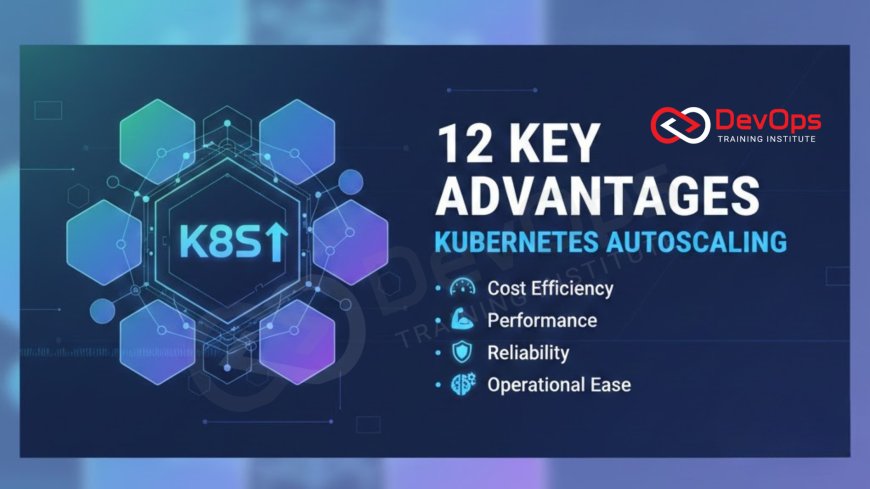
12 Key Advantages of Kubernetes Autoscaling
Discover the transformative power of Kubernetes autoscaling and how it revolutionizes modern infrastructure management. This detailed guide explores the essential benefits of automated scaling, from significant cost savings and improved resource utilization to enhanced application availability and seamless user experiences. Learn how Horizontal Pod Autoscaling, Vertical Pod Autoscaling, and Cluster Autoscaling work together to create a resilient, efficient, and highly responsive cloud environment for your critical business applications today.
Introduction to Kubernetes Autoscaling
In the dynamic world of modern software development, applications must be able to handle fluctuating user demand gracefully. From sudden traffic surges to quiet overnight periods, the ability for your infrastructure to adapt is paramount. This is where Kubernetes autoscaling steps in as a game-changer. It is a powerful feature within the Kubernetes ecosystem that intelligently adjusts the number of resources allocated to your applications, ensuring optimal performance and cost-efficiency without requiring constant manual intervention from engineers.
Kubernetes autoscaling fundamentally transforms how applications consume computational resources. Instead of developers and operations teams having to predict demand and manually provision servers, Kubernetes automates this process entirely. This means that as user load increases, your applications automatically gain more capacity; when demand drops, resources are scaled down. This intelligent adaptation ensures that your services remain responsive and available, providing a seamless experience for your users while keeping your operational costs in check. Understanding its various mechanisms and benefits is crucial for anyone managing modern cloud-native applications.
Improved Resource Efficiency and Utilization
One of the most compelling advantages of Kubernetes autoscaling is its ability to dramatically improve resource efficiency. In traditional infrastructure setups, organizations often overprovision resources to comfortably handle peak loads. This approach, while safe, leads to substantial waste during periods of low demand, with expensive CPU and memory sitting idle. Autoscaling eliminates this inefficiency by ensuring that your clusters only consume the resources they actually need at any given moment.
The system constantly monitors the resource usage of your pods and nodes. When CPU or memory utilization rises above a predefined threshold, Kubernetes automatically scales up. Conversely, when resource consumption drops, it scales down, releasing unused capacity. This dynamic adjustment means you are no longer paying for resources that are not actively contributing to your application's performance. It’s an intelligent way to maximize your infrastructure investment, ensuring that every allocated resource is actively working, thus enhancing overall system utilization and reducing waste.
Significant Cost Reduction Strategies
Directly linked to improved resource efficiency is the substantial cost reduction that Kubernetes autoscaling enables. Cloud providers typically charge based on resource consumption, such as the number of virtual machines running or the amount of CPU and memory used over time. By scaling down during off-peak hours, autoscaling directly translates into lower cloud bills, as you pay less for idle or underutilized infrastructure.
For organizations adopting a cloud-first strategy, this can lead to considerable savings, especially for applications with highly variable traffic patterns. Furthermore, the principles of FinOps are perfectly aligned with Kubernetes autoscaling, allowing engineering and finance teams to collaborate on managing cloud spend effectively. Automating scaling decisions removes the need for expensive manual oversight and helps prevent budget overruns, making cloud infrastructure a more predictable and financially accountable variable expense that scales proportionally with business demand.
Enhanced Application Availability and Uptime
Maintaining high availability is a top priority for any critical application, and Kubernetes autoscaling is a cornerstone of achieving this goal. When an unexpected surge in traffic hits an application, components can become overwhelmed, leading to slow response times or even service outages. Autoscaling acts as a protective shield by automatically increasing the number of replicas for an overloaded service, distributing the incoming load across more instances.
This proactive approach prevents individual components from becoming bottlenecks and ensures that your application remains responsive and accessible to users. The speed at which Kubernetes can scale up new pods means that potential service degradation is mitigated almost instantly, often before users even notice an issue. Coupled with Kubernetes' self-healing capabilities, autoscaling provides a robust framework that significantly boosts overall system uptime, making your applications more resilient to unforeseen spikes in demand or component failures.
Table: Types of Kubernetes Autoscaling
| Autoscaler Type | What it Scales | Primary Trigger | Core Benefit |
|---|---|---|---|
| Horizontal Pod Autoscaler (HPA) | Number of Pod replicas | CPU/Memory or Custom Metrics | Handles traffic spikes by adding more Pods to distribute load. |
| Vertical Pod Autoscaler (VPA) | CPU and Memory limits per Pod | Historical usage data and current workload requirements. | Optimizes individual Pod resource sizing for efficiency. |
| Cluster Autoscaler (CA) | Number of Worker Nodes | Pending Pods due to lack of space on existing nodes. | Adds hardware capacity to the entire cluster to host more pods. |
| KEDA (Kubernetes Event-driven Autoscaling) | Number of Pod replicas | External event sources (e.g., message queues, stream processors). | Scales workloads based on event volume, perfect for microservices. |
Seamless User Experience During Spikes
A crucial outcome of effective autoscaling is the delivery of a consistently positive user experience, regardless of load. In a world where milliseconds can impact user satisfaction and retention, slow loading times or unresponsive applications during peak usage can quickly lead to customer frustration and lost business. Kubernetes autoscaling ensures that your applications remain snappy and performant, even when faced with sudden and massive increases in user traffic.
By automatically allocating more resources to meet demand, autoscaling prevents performance degradation. Users will experience consistent speed and responsiveness, unaware of the dynamic scaling actions happening behind the scenes. This seamless adaptability is not just about avoiding complaints; it is about building trust and loyalty with your user base. The ability to maintain high performance under pressure means your services are always reliable, fostering an environment where users can engage with your application without interruption or frustration, aligning with the goals of production deployments.
Operational Simplicity and Reduced Toil
For operations and DevOps teams, managing infrastructure capacity can be a significant source of "toil," which refers to the manual, repetitive, and often unrewarding tasks that consume valuable engineering time. Manually monitoring metrics, predicting future demand, and then provisioning or de-provisioning servers is a time-consuming and error-prone process. Kubernetes autoscaling fundamentally reduces this operational burden by automating these tasks entirely.
With autoscaling in place, engineers are freed from the constant need to babysit infrastructure. They can focus on more strategic initiatives, such as developing new features, improving system architecture, or implementing advanced monitoring solutions. This shift not only makes operations more efficient but also reduces human error, leading to a more stable and reliable environment. By integrating autoscaling as part of a comprehensive GitOps strategy, teams can manage their infrastructure as code, further enhancing automation, consistency, and reducing the potential for manual mistakes that can impact overall system health.
Improved Fault Tolerance and Resilience
Beyond simply handling increased load, Kubernetes autoscaling significantly contributes to the overall fault tolerance and resilience of your applications. If a node fails or an application pod crashes, autoscaling mechanisms can work in conjunction with Kubernetes' self-healing capabilities to quickly re-establish desired capacity. When a node becomes unavailable, its pods are rescheduled to other available nodes; if there are not enough resources on existing nodes, the Cluster Autoscaler can provision new ones.
This automated recovery ensures that your services can withstand unexpected failures without manual intervention, leading to greater system stability. By continuously monitoring and adjusting resources, Kubernetes minimizes the impact of localized issues, preventing them from escalating into widespread outages. This robust resilience is a cornerstone of modern reliability engineering, enabling applications to maintain their functionality even in the face of underlying infrastructure problems. Tools like chaos engineering can further test and validate these resilience capabilities.
Faster Development Cycles and Agility
Kubernetes autoscaling empowers development teams by providing a dynamic and agile infrastructure. Developers can deploy new features and applications without worrying about provisioning the exact amount of infrastructure beforehand. The system will automatically adapt to the workload, allowing teams to focus on writing code and delivering value rather than getting bogged down in infrastructure planning.
This agility directly translates into faster development cycles. When developers know that the infrastructure will scale to meet their application's needs, they can innovate more rapidly, experiment with new services, and iterate quickly. This capability is vital for continuous integration and continuous delivery (CI/CD) pipelines, as it allows for rapid testing and deployment of new code without concerns about resource constraints. Ultimately, autoscaling fosters a culture of speed and responsiveness, enabling businesses to bring products to market faster and adapt to changing requirements with ease.
Optimized Capacity Planning and Forecasting
Traditionally, capacity planning was a complex and often imprecise exercise, requiring significant effort to forecast future demand and provision infrastructure accordingly. Over-provisioning led to wasted resources, while under-provisioning led to performance issues and outages. Kubernetes autoscaling simplifies this challenge by providing real-time adaptation and valuable data for future planning.
By observing how autoscalers react to different workloads, organizations gain precise insights into their application's resource consumption patterns. This data is invaluable for refining resource requests and limits, making more accurate long-term capacity forecasts, and improving budget allocation. While autoscaling handles the day-to-day fluctuations, the rich metrics it generates are essential for strategic decisions, allowing teams to move from reactive guessing to data-driven optimization, thereby improving overall infrastructure management.
Support for Microservices Architectures
Microservices architectures, characterized by many small, independent services, thrive on dynamic resource allocation. Each microservice might have its own unique traffic pattern and resource requirements. Manually scaling each of these services would be an impossible task. Kubernetes autoscaling is perfectly suited for this paradigm, as it can scale individual microservices independently based on their specific needs.
This granular control ensures that resources are allocated precisely where they are needed most within the complex web of a microservices application. A service experiencing high load can scale out without impacting other services, while idle services can scale down to zero, further enhancing efficiency. This capability is fundamental to realizing the full benefits of a microservices approach, enabling greater agility, resilience, and operational efficiency for large-scale distributed applications. This is why it's a key component of modern DevOps strategies.
Increased Developer Productivity
When developers do not have to worry about infrastructure capacity, they can focus entirely on writing and optimizing their code. The assurance that Kubernetes will handle the underlying scaling empowers them to innovate more freely and quickly. This dramatically increases developer productivity, as less time is spent on environment setup, resource allocation, and troubleshooting capacity-related issues.
This allows for more rapid iteration, quicker feedback loops, and a greater focus on core business logic. Furthermore, with automated scaling, developers can deploy and test their applications in environments that mirror production, knowing that performance issues related to resource constraints will be automatically managed. This seamless operational support allows development teams to be more agile, efficient, and ultimately deliver higher quality software faster, improving the entire continuous deployment pipeline.
Better Security Posture and Compliance
While not immediately obvious, Kubernetes autoscaling can contribute to a stronger security posture and easier compliance. By ensuring that your applications always have sufficient resources, autoscaling helps prevent denial-of-service (DoS) attacks or performance degradation that could be exploited by malicious actors. When systems are consistently stable and performant, it reduces the attack surface and minimizes vulnerabilities that arise from overloaded or unstable environments.
Furthermore, consistent infrastructure through automation, which autoscaling is a part of, makes it easier to achieve and maintain compliance. Automated scaling policies can ensure that new pods are always provisioned with the correct security configurations, without manual intervention that could introduce errors. This consistency is vital for meeting regulatory requirements and demonstrating a controlled, secure environment, which is a key tenet of DevSecOps practices. Automated resource management ensures that security scanning and monitoring tools always have the capacity to run effectively.
Conclusion
Kubernetes autoscaling stands as a cornerstone of modern cloud-native application management, offering a multitude of advantages that extend far beyond simple resource adjustment. From the foundational benefits of optimized resource efficiency and significant cost reductions to the critical aspects of enhanced application availability and a consistently seamless user experience, autoscaling empowers organizations to build and operate highly resilient and performant systems. It simplifies operational complexities, boosts developer productivity, and provides invaluable data for precise capacity planning. By understanding and implementing the various forms of autoscaling, businesses can adapt to unpredictable demands, future-proof their infrastructure, and ensure their applications remain responsive, cost-effective, and always available. Embracing this intelligent automation is not merely a technical choice; it is a strategic imperative for sustained success in the digital age.
Frequently Asked Questions
What is Horizontal Pod Autoscaling (HPA)?
HPA automatically adjusts the number of pod replicas in a deployment or replica set based on metrics like CPU utilization or custom metrics.
How does Vertical Pod Autoscaling (VPA) work?
VPA observes historical and current resource usage to recommend or automatically set optimal CPU and memory limits for individual pods.
What is the purpose of the Cluster Autoscaler?
The Cluster Autoscaler automatically adds or removes nodes in your Kubernetes cluster to accommodate changing workload demands effectively.
Can autoscaling save cloud costs?
Yes, by scaling down resources during low demand periods, autoscaling significantly reduces unnecessary cloud expenditure and optimizes budget.
Does autoscaling improve application performance?
Absolutely, it ensures applications always have sufficient resources, preventing performance bottlenecks during traffic surges and maintaining responsiveness.
Is autoscaling easy to configure in Kubernetes?
While it requires some initial setup and understanding of metrics, Kubernetes provides robust configurations and good documentation for implementation.
What metrics can trigger autoscaling?
Common triggers include CPU usage, memory utilization, and custom application metrics like queue length or network I/O.
How does autoscaling contribute to high availability?
By quickly adding resources as needed, autoscaling prevents overloads and failures, ensuring continuous service availability even during peak times.
Can autoscaling be used with stateful applications?
Yes, but it requires careful planning and often custom operators to manage persistent storage and data consistency during scaling events.
What is predictive autoscaling?
Predictive autoscaling uses historical data and machine learning to forecast future demand, proactively scaling resources before traffic actually arrives.
How does autoscaling benefit DevOps teams?
It reduces manual operational toil, allows teams to focus on innovation, and provides a more stable and agile infrastructure environment.
Are there any drawbacks to using autoscaling?
Potential drawbacks include the need for careful configuration, possible cost increases if not managed well, and ensuring proper metric selection.
Can autoscaling help with security?
Yes, by maintaining stable performance and ensuring resources for security tools, it can indirectly contribute to a stronger overall security posture.
What is KEDA in Kubernetes autoscaling?
KEDA (Kubernetes Event-driven Autoscaling) allows you to scale workloads based on various event sources from outside the Kubernetes cluster.
How does autoscaling support microservices?
It enables individual microservices to scale independently based on their unique demands, optimizing resource allocation for complex distributed architectures.
What's Your Reaction?
 Like
0
Like
0
 Dislike
1
Dislike
1
 Love
0
Love
0
 Funny
0
Funny
0
 Angry
0
Angry
0
 Sad
0
Sad
0
 Wow
0
Wow
0




![100+ Azure DevOps Interview Questions and Answers [Updated 2025]](https://www.devopstraininginstitute.com/blog/uploads/images/202509/image_140x98_68c40aa9a3834.jpg)






![Future Scope of DevOps Careers in Pune [Updated 2025]](https://www.devopstraininginstitute.com/blog/uploads/images/202510/image_140x98_68e3a84652312.jpg)