




![Kong Interview Preparation Guide [2025]](https://www.devopstraininginstitute.com/blog/uploads/images/202509/image_430x256_68dbb95326997.jpg)




12 Kubernetes Storage Options Explained
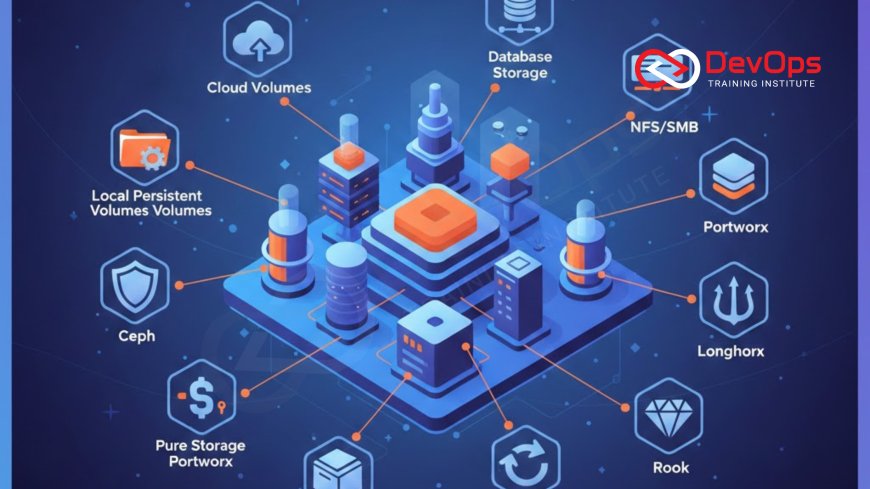
Dive deep into 12 essential Kubernetes storage options, from ephemeral local storage to highly durable persistent volumes and distributed file systems. This guide demystifies concepts like Persistent Volume Claims (PVCs), Storage Classes, and the crucial role of the Container Storage Interface (CSI) in connecting your applications to cloud-native storage like EBS, Azure Disk, and Ceph. Learn why state is complex in Kubernetes, how to choose between Block, File, and Object storage, and the best practices for managing data for stateful applications like databases and message queues in a highly scalable and resilient container orchestration environment.
Introduction: Why Stateful Storage is Hard in Kubernetes
Kubernetes is a platform designed around the philosophy of immutability and disposability. The core unit of deployment, the Pod, is intended to be ephemeral—meaning it can be terminated and recreated at any time, anywhere in the cluster, without warning. This design is excellent for stateless applications like web servers or APIs, where data loss is acceptable upon restart. However, the moment an application needs to store persistent data—such as a database, a message queue, or a user file upload system—it becomes stateful, and managing this data reliably introduces one of the most significant complexities in the entire Kubernetes ecosystem. The challenge lies in ensuring that when a Pod dies and is automatically rescheduled to a different machine, the new Pod can seamlessly reconnect to its original, unchanged data storage location with full integrity, a task that requires abstracting the physical storage layer from the application that consumes it.
The entire Kubernetes storage framework is built to solve this challenge by providing standardized abstraction layers that hide the underlying physical hardware and network storage complexity from the application developer. By decoupling the Pod's lifecycle from the data's lifecycle, Kubernetes allows applications to achieve high availability and mobility without compromising data integrity or resilience. This system of abstractions relies on a standardized interface and various types of volumes, each suited to different application needs, such as high-performance database access versus highly scalable shared file storage. Mastering these core concepts and understanding the 12 primary storage options available is essential for any DevOps professional managing enterprise-grade workloads on a cloud-native platform, as storage is the key to running mission-critical applications successfully and reliably.
The Core Abstractions: PVCs, PVs, and CSI
To provide a uniform interface for diverse storage technologies—ranging from simple local disks to complex, distributed cloud storage arrays—Kubernetes introduces three critical abstraction concepts. These concepts are what enable the platform to be storage-agnostic, allowing the same application definition to seamlessly request and consume storage, regardless of whether the cluster is running on AWS, Azure, GCP, or a private data center. Understanding this decoupled model is the key to successfully deploying any stateful application.
- Persistent Volume (PV): This is the physical piece of storage in the cluster, provisioned either manually by the cluster administrator or dynamically by a storage provider. It represents the actual storage medium, such as a cloud disk (EBS) or a network file share, with a specific capacity and access mode. The PV's lifecycle is independent of any Pod or Node.
- Persistent Volume Claim (PVC): This is the request made by a user or an application developer for a specific type and amount of storage. The PVC acts as a contract, abstracting the PV details. A Pod requests a PVC, and Kubernetes automatically binds that PVC to an available PV that meets the requested specifications (capacity, access mode, etc.).
- Container Storage Interface (CSI): This industry standard defines a common interface that volume plugins must adhere to. The CSI driver acts as a translator, enabling Kubernetes to communicate seamlessly with any third-party storage system (like cloud providers' disk services or open-source distributed file systems). The CSI is what allows for storage portability, simplifying the management of external storage and enhancing the deployment capabilities across different types of cloud infrastructure.
This layered approach ensures that developers request storage via the PVC, allowing the cluster to handle the complex underlying work of provisioning the actual Persistent Volume (PV) through the appropriate CSI driver, thereby maintaining the principle of separation of concerns and simplifying application configuration. This process allows developers to focus purely on the application's data needs, rather than the intricacies of managing physical storage resources.
The Foundation of Kubernetes Storage Options (Volume Types)
Kubernetes offers a variety of volume types, each with specific characteristics related to durability, access, and lifecycle. The choice of volume type is dictated by the application's data persistence and sharing needs. These options can be broadly categorized into ephemeral and persistent storage solutions, representing the two major ways applications interact with the storage resources available within the cluster environment.
1. emptyDir (Ephemeral): This is the simplest volume type and is entirely temporary. An emptyDir volume is created when a Pod is first assigned to a Node and exists as long as that Pod is running on that Node. If the Pod crashes, the volume remains, but if the Pod is terminated, moved, or deleted, the data in the emptyDir is permanently erased. It is ideal for temporary scratch space, caching, or intermediate data processing where data loss upon Pod deletion is acceptable. It is important to note that this storage is backed by the host machine's local disk.
2. hostPath (Ephemeral/Risky): This volume type mounts a file or directory from the host Node’s local filesystem into the Pod. While it appears to offer persistence, it is tightly coupled to the host Node, meaning the Pod cannot be reliably moved, violating the core mobility principle of Kubernetes. It is generally discouraged for production use due to security risks and the potential for configuration drift between nodes, but it can be useful for system-level tools that need access to host data or specific Node configuration files, often used in infrastructure or monitoring Pods, following stringent security protocols.
3. Local Persistent Volume (Local PV): This represents a local disk, partition, or directory on a specific Node that is explicitly managed as a persistent resource. Unlike hostPath, Local PVs are managed by Kubernetes PV objects and are intended for high-performance, low-latency workloads like database caches where network storage latency is unacceptable. However, binding a Pod to a Local PV requires Pod scheduling affinity to that specific Node, meaning data remains local, which complicates automatic failover and recovery procedures. It is a trade-off between performance and high availability, requiring careful planning by the SRE team to ensure acceptable failover times.
4. ConfigMap & Secret (Configuration/Ephemeral): These are special, small volume types used to inject configuration data, credentials, and sensitive information directly into the Pod filesystem, which are crucial for configuring the application at runtime. They are backed by the API Server's data store (etcd) and are excellent for simple configuration files, but they are not intended for large-scale application data storage. The data they store is read-only for the Pod, which is an important security and immutability feature.
Cloud-Native Block and File Storage Options
The vast majority of persistent stateful workloads in Kubernetes rely on external storage provisioned directly from the cloud provider via a CSI driver. These solutions are durable, highly available, and easily managed via the Kubernetes abstraction layer, forming the backbone of all persistent state in cloud-based clusters. Choosing between Block and File storage depends heavily on the application's needs for concurrent access and performance characteristics.
| # | Storage Type | Access Mode | Persistence & Durability | Primary Use Case |
|---|---|---|---|---|
| 1 | emptyDir | RWO (ReadWriteOnce) | Ephemeral (Lost on Pod deletion) | Temporary scratch space, caching, build process data. |
| 5 | AWS EBS / Azure Disk | RWO | Persistent, High Durable (Zone-level) | High-performance databases (MySQL, PostgreSQL), single-node workloads. |
| 6 | AWS EFS / Azure Files | RWX (ReadWriteMany) | Persistent, High Durable (Regional-level) | Shared logging, web server content, centralized file repositories for multiple Pods. |
| 9 | Ceph / Rook | RWO, ROX, RWX | Persistent, Highly Distributed and Resilient | Unified storage layer for Block, File, and Object data on-premise or in the cloud. |
| 12 | Storage Class | N/A (Defines Policy) | N/A (Defines provisioner) | Enabling dynamic provisioning based on performance tiers and retention policies. |
5. AWS Elastic Block Store (EBS) / Azure Disk / GCP Persistent Disk (Block Storage): These are the default block storage options provided by the major cloud vendors, typically managed by a native CSI driver within the Kubernetes service (EKS, AKS, GKE). Block storage is treated like a virtual hard drive attached to a single Pod (Node) at a time, providing very high I/O performance and low latency, making it ideal for high-performance single-instance databases (like MySQL or Elasticsearch nodes). However, Block storage has a limitation: it typically only supports the ReadWriteOnce (RWO) access mode, meaning the volume can only be mounted by a single Node at a time, which is a major constraint on scalability for shared file access.
6. AWS Elastic File System (EFS) / Azure Files (File Storage): File storage solutions solve the multi-access problem inherent in block storage. These services support the ReadWriteMany (RWX) access mode, allowing the same volume to be mounted and accessed concurrently by multiple Pods, even across different Nodes. This makes them ideal for shared resources like centralized log archives, network file shares, and web application content that must be served consistently by multiple instances of the same service. While file storage offers superior flexibility for scalability and concurrency, it generally provides slightly higher latency than block storage, making it unsuitable for extremely high-transactional database workloads but excellent for stateless web tiers and shared data repositories.
Distributed and On-Premise Storage Solutions
For organizations operating hybrid clouds, multi-cloud architectures, or running Kubernetes on-premise, relying solely on a single cloud vendor's storage is not feasible. This necessitates the use of open-source or commercial distributed storage solutions that can provide consistent, vendor-agnostic block, file, and object storage capabilities. These systems are often complex to set up but offer unparalleled flexibility and control over data placement, resilience, and data management policy enforcement.
7. NFS (Network File System): NFS is a mature, long-standing protocol for shared network file access. Kubernetes supports mounting existing NFS shares as volumes, which supports the RWX access mode needed for shared content. It is a highly cost-effective and common solution for on-premise Kubernetes clusters, but it suffers from single-point-of-failure vulnerabilities if the central NFS server fails and lacks the native resilience features of cloud-managed storage. Managing file shares securely requires careful consideration of network protocols and ports, reinforcing the need for engineers to understand how protocols and layers communicate for effective configuration.
8. GlusterFS / Ceph (Distributed File Systems): These are open-source, highly scalable, and distributed storage systems that are commonly deployed within Kubernetes clusters themselves (sometimes referred to as hyper-converged storage). They turn the local disks of the worker Nodes into a unified, shared storage pool, providing Block, File, and Object storage access. While complex to maintain, they offer superior resilience and vendor neutrality, making them ideal for large-scale, on-premise private clouds or multi-cloud strategies where a centralized, software-defined storage layer is required to ensure data integrity and availability across disparate physical locations.
9. Rook (Storage Orchestrator): Rook is not a storage system itself but an open-source storage orchestrator for Kubernetes that automatically deploys, manages, and scales distributed storage systems like Ceph and CockroachDB. Rook runs the storage system components as containers within the Kubernetes cluster, leveraging the cluster's own orchestration capabilities to manage the storage itself. It simplifies the operational complexity of distributed storage, providing a seamless way to deploy enterprise-grade, highly resilient storage into any Kubernetes cluster, whether it is running on-premise or in any public cloud environment.
Advanced Abstractions and Management
Beyond the fundamental volume types, Kubernetes provides advanced mechanisms for automating the provisioning and defining the quality-of-service parameters of storage, which are essential for managing large-scale environments with varied application requirements. These tools transform storage management from a series of manual tasks into a dynamic, code-defined service.
10. Storage Class: A Storage Class is an administrative abstraction used to define "classes" of storage with specific characteristics, such as performance tier (e.g., standard, premium, ultra-fast SSD) and retention policies. Developers request storage via a PVC and specify the desired Storage Class name. The Storage Class object contains the provisioner (CSI driver) and parameters necessary for dynamic provisioning, allowing Kubernetes to automatically create a new PV on-demand when a PVC requests it. This dynamic provisioning is the core feature that simplifies storage management in highly dynamic cloud environments, promoting developer autonomy by allowing them to define the resources they require.
11. Volume Snapshots: Volume Snapshots are crucial for backup, recovery, and data protection strategies in stateful applications. Kubernetes provides a native Volume Snapshot API that leverages the underlying CSI driver to create point-in-time copies of a Persistent Volume. This capability enables rapid creation of new environments from existing data for testing purposes or for quickly restoring a production database to a known-good state following a deployment failure or data corruption incident, greatly enhancing the resilience and operational agility of the application ecosystem.
12. SubPath Volume Mounts: While SubPath allows mounting a specific directory within a volume to a Pod, it can often be used incorrectly. A common anti-pattern is using SubPath to share a single PV among multiple Pods that are not designed for concurrent write access, potentially leading to data corruption and race conditions. A proper approach is to use solutions that inherently support multi-access, like File Storage (EFS/Azure Files), or to use tools that manage concurrent access explicitly, ensuring data integrity is never compromised.
Security Considerations for Persistent Storage
Given that persistent volumes often hold the most sensitive data—passwords, customer records, and intellectual property—security is paramount and must be handled at multiple layers within the Kubernetes storage architecture. Simply using a cloud-provided volume is not enough; policies must be enforced through code, reinforcing the need for engineers to understand best practices for securing communication, including knowing best practices for securing TCP and UDP services that might be exposed via storage protocols like NFS.
The primary security concerns involve encryption, access control, and network isolation. All Persistent Volumes, regardless of their type or location, must be provisioned with encryption enabled, ensuring data is encrypted at rest using keys managed by services like AWS KMS or Azure Key Vault. Access control is managed primarily through IAM roles assigned to the CSI driver, following the principle of least privilege, ensuring the Kubernetes control plane can only provision and manage storage resources for which it has explicit permission. Finally, Kubernetes security contexts and network policies must be used to restrict which Pods can access which storage resources, ensuring sensitive data is protected from unauthorized applications, providing a robust security posture.
Conclusion: State Management as the Apex of Kubernetes Mastery
Mastering the 12 Kubernetes storage options and the abstractions that govern them is arguably the most critical skill set for any professional managing production workloads. Running stateful applications reliably requires a deep understanding of the decoupled model that separates the application's request (PVC) from the physical resource (PV), all orchestrated through the CSI driver. The right choice—whether it's high-performance Block storage for a single database node, scalable File storage for shared web content, or a resilient, vendor-agnostic distributed file system like Ceph—is determined by the application's unique access, performance, and durability requirements, directly impacting the overall operational success of the microservices architecture.
Ultimately, Kubernetes storage is about transforming complex, low-level resource management into a dynamic, code-defined service. By leveraging abstractions like Storage Classes for automated provisioning and implementing rigorous security policies for encryption and access control, organizations can ensure their data is highly available, resilient, and protected. This mastery allows the DevOps team to focus on application logic and delivery speed, confident that the underlying data persistence layer is reliable and scalable, transforming one of the biggest challenges of container orchestration into a predictable and robust service.
Frequently Asked Questions
What is the difference between a PV and a PVC?
A PV is the physical storage resource itself, while a PVC is the user's request for storage, which Kubernetes attempts to bind to an available PV.
What is the primary function of the CSI driver?
The CSI driver acts as a standardized interface, allowing Kubernetes to communicate with and manage external storage systems like cloud provider disks or network file systems.
What is the best use case for emptyDir?
The best use case for emptyDir is for temporary scratch space, caching, or intermediate data processing where data loss upon Pod termination is acceptable.
Why is hostPath discouraged for production?
hostPath is discouraged because it is tied to a specific Node, which violates Pod mobility and introduces severe security and reliability risks to the overall cluster.
What is the difference between Block and File storage in Kubernetes?
Block storage (EBS) is high-performance and single-mount (RWO), while File storage (EFS) supports multi-access (RWX) for shared data across multiple Pods.
What is a Storage Class?
A Storage Class defines a "class" of storage with specific performance, provisioner, and policy parameters, enabling Kubernetes to dynamically provision storage on demand.
What is the access mode ReadWriteMany (RWX) used for?
RWX is used for scenarios where multiple Pods need to read and write to the same volume concurrently, such as a centralized log directory or shared web content.
How are ConfigMaps and Secrets used for storage?
They are used to inject small, non-sensitive configuration data (ConfigMaps) or sensitive data (Secrets) into the Pod's file system as read-only volumes.
What are Volume Snapshots used for?
Volume Snapshots are used to create point-in-time, immutable copies of a Persistent Volume, which is essential for backup, recovery, and data cloning for testing environments.
What is a key security best practice for Persistent Volumes?
A key practice is to ensure that all Persistent Volumes are provisioned with encryption enabled at rest using cloud key management services.
What is the purpose of the Rook orchestrator?
Rook is an orchestrator that automates the deployment and management of distributed storage systems like Ceph as containers within the Kubernetes cluster itself.
Why do DevOps engineers need to understand the OSI model for storage networking?
Understanding the OSI model is crucial for troubleshooting issues related to storage protocols (like NFS) and firewall rules that control data access over the network.
What access mode is required for a single-instance database?
A single-instance database typically only requires the ReadWriteOnce (RWO) access mode because only one Pod needs exclusive read/write access to the block storage at a time.
How does subnetting impact storage resilience in the cloud?
Understanding subnetting is vital because cloud block storage is typically constrained to a single availability zone, requiring careful placement of the Pods to ensure data access.
Why is storage encryption at rest necessary?
Storage encryption at rest is necessary to protect sensitive data on the physical disk from unauthorized access or theft, ensuring compliance with privacy regulations and security policies.
What's Your Reaction?
 Like
0
Like
0
 Dislike
0
Dislike
0
 Love
0
Love
0
 Funny
0
Funny
0
 Angry
0
Angry
0
 Sad
0
Sad
0
 Wow
0
Wow
0

![100+ Azure DevOps Interview Questions and Answers [Updated 2025]](https://www.devopstraininginstitute.com/blog/uploads/images/202509/image_140x98_68c40aa9a3834.jpg)






![Future Scope of DevOps Careers in Pune [Updated 2025]](https://www.devopstraininginstitute.com/blog/uploads/images/202510/image_140x98_68e3a84652312.jpg)