

![Kong Interview Preparation Guide [2025]](https://www.devopstraininginstitute.com/blog/uploads/images/202509/image_430x256_68dbb95326997.jpg)
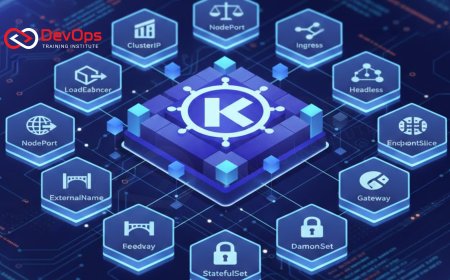

12 Scaling Strategies for Kubernetes Applications
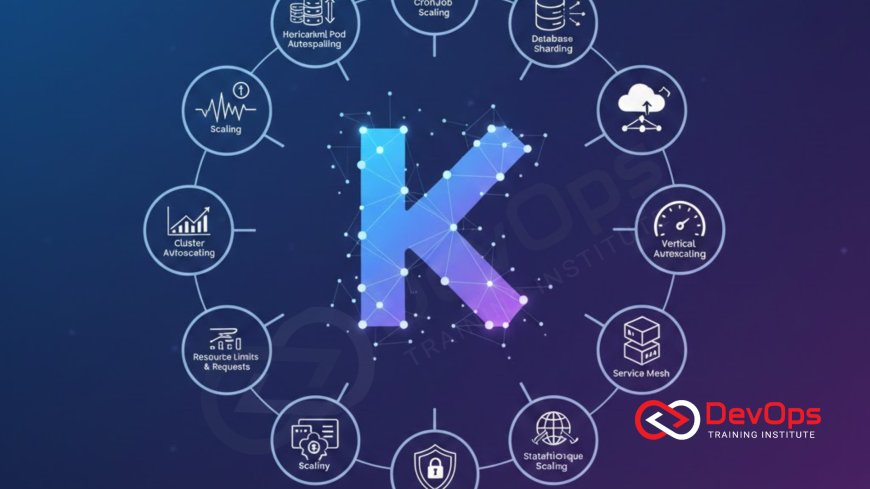
Unlock the secrets to building hyper-scalable and resilient applications by mastering the 12 essential scaling strategies for Kubernetes. This guide delves into automatic scaling layers—Horizontal Pod Autoscalers (HPA) and Cluster Autoscalers (CA)—along with advanced techniques like vertical scaling, optimizing resource requests, managing stateful applications, and implementing custom metrics for efficient auto-scaling. Learn how these strategies, from stateless design to cloud-native storage, ensure your application handles massive traffic spikes, minimizes costs, and maintains high availability, making Kubernetes the ultimate platform for enterprise-level resilience.
Introduction
The ability to scale applications rapidly and reliably is the defining characteristic of modern cloud infrastructure, and Kubernetes (K8s) is the undisputed engine driving this capability. K8s is designed from the ground up to automate deployment, management, and, crucially, the dynamic scaling of containerized applications. However, effective scaling is not a single setting you flip; it is a holistic strategy involving multiple layers of automation, architectural choices, and resource optimization techniques. Simply adding more nodes or pods without an intelligent strategy often leads to wasted cloud spend and unpredictable performance during peak load.
Mastering Kubernetes scaling means understanding its various autoscaling mechanisms and how they interact, ensuring that resource allocation matches real-time demand. This involves configuring application-level scaling, cluster-level scaling, and foundational resource management. For an organization transitioning to cloud-native platforms, applying these 12 strategies is essential for achieving the promised elasticity of the cloud—handling massive traffic spikes smoothly while minimizing costs during low-usage periods. By embracing these best practices, DevOps Engineers can transform their applications into resilient, self-healing systems that adapt instantaneously to the unpredictable demands of the digital marketplace, maximizing system stability and operational excellence.
Phase 1: Foundational Scaling Principles
Before implementing any autoscaling tool, the underlying application and the cluster infrastructure must adhere to specific architectural and resource management principles. These foundational steps ensure that when K8s scales a workload, it does so efficiently, predictably, and without introducing resource contention or unpredictable behavior that can undermine the entire deployment strategy. These are the non-negotiable prerequisites for achieving true elasticity in any K8s environment, as they ensure stability.
The first two steps focus on architectural design:
1. Design for Statelessness: The most fundamental rule of scalable architecture is to design application layers (especially web servers and microservices) as stateless. This means that no session or user data should be stored locally within the application container; all data must reside in external, scalable services like managed databases (AWS RDS) or distributed caches (Redis). Statelessness ensures that any running pod can be terminated or replicated at any moment without affecting the user's experience, making horizontal scaling simple and safe.
2. Utilize the Deployment Resource: Never manage Pods directly; instead, utilize higher-level controllers like the Deployment resource. The Deployment object provides declarative management over ReplicaSets and Pods, automatically managing rolling updates, rollbacks, and self-healing. It ensures that the cluster always maintains the desired number of replicas (the "desired state") and is the resource targeted by the Horizontal Pod Autoscaler, making it the essential entry point for application scaling within the K8s ecosystem.
The third step focuses on resource governance:
3. Configure Accurate Resource Requests and Limits: This is the most crucial step for performance and cost. Requests define the minimum guaranteed resources (CPU, memory) a container needs to run, ensuring the scheduler places it only on nodes with sufficient free capacity. Limits define the maximum resources a container can consume. Properly setting these parameters is vital: Requests enable efficient scheduling and guarantee performance, while Limits prevent runaway containers from consuming all node resources and causing unpredictable failures in neighboring Pods, minimizing the "noisy neighbor" problem in shared environments and ensuring cost control.
Phase 2: Horizontal and Vertical Scaling Strategies
Kubernetes provides powerful built-in controllers designed to manage the number of application instances (horizontal scaling) and optimize the resource allocation of those instances (vertical scaling). These components work automatically based on declarative metrics, eliminating the need for manual intervention during traffic fluctuations, which is the cornerstone of K8s automation and resilience. They represent the first and second layers of intelligence in the scaling stack.
4. Implement the Horizontal Pod Autoscaler (HPA): The HPA is the primary mechanism for scaling applications. It automatically adjusts the number of Pod replicas (the horizontal dimension) in a Deployment or ReplicaSet based on observed resource utilization (CPU, memory) or other custom metrics. Configuring the HPA involves setting target metrics (e.g., maintain 70% average CPU utilization) and defining the minimum and maximum number of replicas allowed, ensuring your application seamlessly handles sudden increases in incoming user traffic.
5. Utilize the Vertical Pod Autoscaler (VPA): While HPA scales horizontally, the VPA optimizes resource usage vertically by automatically recommending (or enforcing) adjustments to the CPU and memory Requests and Limits for individual containers. The VPA observes the actual resource consumption of a running container over time and provides optimal values, correcting misconfigurations and ensuring that applications receive the right amount of resources without waste. This is particularly valuable for applications with constantly fluctuating or hard-to-predict usage profiles, maximizing cost efficiency.
6. Scale with Custom and External Metrics (HPA v2): For complex, modern microservices, basic CPU or memory utilization is often insufficient to trigger intelligent scaling. The HPA can be configured to scale based on Custom Metrics (e.g., queue length from Prometheus, requests per second) or External Metrics (e.g., latency from an external API or queue size from AWS SQS). Scaling based on custom business metrics provides much more accurate and proactive scaling logic, ensuring resources are added before the system becomes overloaded, improving the overall user experience and application stability.
Phase 3: Cluster-Level Elasticity
When the Horizontal Pod Autoscaler (HPA) requests more Pods than the current cluster capacity can support, the cluster itself must scale up its underlying infrastructure. This capability, known as cluster-level elasticity, relies on intelligent infrastructure management to provision new compute resources on demand, ensuring that the scaling efforts of the application layer are never constrained by a lack of host capacity in the cloud. This step links the K8s control plane directly to the underlying cloud provider's resource management APIs, enabling true cloud networking elasticity.
7. Implement the Cluster Autoscaler (CA): The CA is a dedicated component that monitors the cluster for unschedulable Pods (i.e., pods waiting for a node with enough capacity). When it detects such a bottleneck, the CA automatically requests a new node from the cloud provider (e.g., EC2, Azure VM) and adds it to the cluster's worker pool. Conversely, it monitors nodes that are underutilized and gracefully removes them, ensuring cost efficiency. The CA is crucial for dynamic capacity management, providing the necessary compute resources to meet scaling demands and preventing resource contention.
8. Configure Node Auto-Provisioning (NAP): In large-scale, multi-architecture environments, it is impractical to pre-define every node group size. NAP (a feature often combined with the CA) automatically provisions new node pools with the appropriate machine type, operating system, and configurations based on the resource requirements of the waiting Pods. This eliminates the need for DevOps Engineers to manually manage different node pool sizes and types, simplifying cluster operations and maximizing resource matching efficiency for diverse workloads like CPU-bound and memory-bound applications.
9. Embrace Pod Disruption Budgets (PDBs): The Cluster Autoscaler and cluster maintenance operations often require removing nodes for scaling down or upgrades. PDBs are Kubernetes objects that limit the number of concurrently available Pods of a specific application that can be voluntarily evicted at any time. By defining a minimum acceptable number of running replicas, PDBs ensure that scaling down or performing maintenance does not accidentally cause service outages, protecting the application's availability and resilience during cluster lifecycle management events.
| # | Strategy & Component | Scaling Dimension | Primary Goal | Metric or Trigger |
|---|---|---|---|---|
| 4 | Horizontal Pod Autoscaler (HPA) | Pods (In/Out) | Match application replicas to real-time load. | CPU/Memory Utilization, Requests per Second (RPS) |
| 5 | Vertical Pod Autoscaler (VPA) | Resource Allocation | Optimize CPU/Memory requests to reduce cost and resource waste. | Observed historical resource usage. |
| 7 | Cluster Autoscaler (CA) | Nodes (Up/Down) | Dynamically adjust cluster size to match HPA demand. | Existence of unschedulable Pods. |
| 1 | Stateless Design | Architecture | Enable safe, rapid horizontal scaling and node termination. | N/A (Architectural Pre-requisite) |
| 10 | Headless Services | Network | Enable predictable peer discovery for distributed, stateful workloads. | N/A (DNS Configuration) |
Phase 4: Scaling Stateful Workloads
While stateless microservices are easy to scale horizontally, applications that require persistent identity, predictable network addresses, and consistent storage (such as databases, queues, or distributed caches) present unique scaling challenges. Kubernetes provides specialized resources to manage these stateful applications reliably, ensuring their ordered deployment, unique identity, and consistent storage persistence even as the underlying pods are scaled up, down, or moved, bridging the application and infrastructure complexities.
10. Utilize StatefulSets and Headless Services: For workloads like databases (e.g., PostgreSQL, MongoDB) that require stable, persistent identifiers, the StatefulSet resource is essential. Unlike a Deployment, a StatefulSet ensures that pods are created and destroyed in a specific, predictable order and maintains a sticky, unique identity for each replica. This resource is paired with a Headless Service, which exposes individual pod IPs directly via DNS rather than a single, load-balanced cluster IP, enabling peer-to-peer communication and reliable service discovery for distributed data stores.
11. Employ Persistent Volumes and Claims: To ensure that data persists independently of the ephemeral Pods, StatefulSets must leverage Persistent Volumes (PVs) and Persistent Volume Claims (PVCs). These resources abstract the underlying cloud storage (like AWS EBS or Azure Disk) and ensure that when a pod is rescheduled, its data volume automatically follows it to the new node. This is crucial for data durability and scalability in stateful applications, ensuring that no data is lost during scaling or node failures.
Phase 5: Advanced Optimization and FinOps
The most advanced scaling strategies focus on cost management (FinOps), efficiency, and leveraging modern serverless principles to optimize resource usage entirely. These techniques ensure that the complex machinery of Kubernetes not only scales effectively but does so in the most financially responsible manner, guaranteeing business viability and maximum return on investment in cloud infrastructure by automatically matching expenditure to actual usage patterns.
12. Implement Scale to Zero (KEDA): For applications with sporadic or low usage (like internal tools or batch jobs), scaling to zero replicas when idle is the ultimate cost-saving measure. The Kubernetes Event-Driven Autoscaler (KEDA) is a specialized component that allows scaling Deployments to zero and back up to the required count based on metrics from external event sources, such as message queue depth (e.g., Kafka, Redis). This strategy leverages the serverless principle of paying only for execution time, optimizing cloud spend dramatically by eliminating idle compute costs and providing true elasticity for intermittent workloads.
This final phase integrates directly into the continuous improvement cycle of DevOps, where observability tools collect data on resource consumption, and the VPA and KEDA utilize that data to drive intelligent, cost-aware scaling decisions. By continuously monitoring and optimizing the resources allocated to each container and the node capacity of the cluster, the enterprise ensures that their scaling strategy is resilient, predictable, and maximally cost-efficient, maintaining high service quality while guaranteeing financial accountability within the entire cloud environment.
The Role of Linux and Container Internals
While Kubernetes abstracts much of the underlying operating system complexity, deep scaling strategies still rely on core Linux knowledge. For instance, the performance of a pod's container is fundamentally governed by Linux features like Control Groups (cgroups), which enforce the CPU and memory limits set in the resource definitions. An engineer with a background in Linux administration understands how these limits impact process scheduling and resource contention on the underlying host, which is essential when configuring resource requests accurately and diagnosing subtle performance issues during scaling events.
Furthermore, managing container images and their base operating systems is crucial for scaling speed. The underlying foundation of Kubernetes, as reflected by its reliance on containerization principles, originates from core components and concepts in the Linux operating system, which is why understanding the history of Linux and its evolution is insightful for cloud engineers. Optimization techniques, such as using smaller base images or tuning kernel network parameters, directly influence container startup time and resource consumption. These deep-level Linux skills empower the engineer to maximize the density of Pods on each node and minimize application latency, ensuring that the Cluster Autoscaler and Horizontal Pod Autoscaler operate at peak efficiency and financial viability.
Conclusion
Achieving hyper-scalability and resilience in a dynamic cloud environment requires a multi-layered, automated strategy that leverages the full power of Kubernetes. By implementing these 12 strategies—from the foundational architectural choice of designing stateless applications and defining precise resource requests to the advanced, automated mechanisms of HPA, VPA, and Cluster Autoscaler—organizations can build systems that adapt instantaneously to user demand. This strategic approach ensures that resources are always precisely matched to workload, maximizing performance while simultaneously achieving granular control over cloud costs through techniques like Scale to Zero (KEDA).
Ultimately, the successful scaling strategy is one that is holistic, integrating application design (statelessness), resource governance (requests/limits), automated workload scaling (HPA), and automated infrastructure scaling (CA) into a cohesive, self-healing system. Mastering this comprehensive approach to Kubernetes scaling is essential for any DevOps Engineer aiming to deliver high-quality, resilient services in the demanding environment of enterprise-level cloud computing.
Frequently Asked Questions
What is the primary difference between HPA and VPA?
HPA scales the number of Pods horizontally (replicas), while VPA optimizes the CPU and memory resources vertically (requests/limits) of those Pods.
Why must applications be stateless to scale effectively?
Statelessness ensures that any pod can be replicated or terminated instantly without data loss or session disruption, which is crucial for safe horizontal scaling.
What triggers the Cluster Autoscaler (CA) to add a new node?
The CA is triggered when the Kubernetes scheduler cannot place a new Pod because no existing node has enough available CPU or memory resources.
What are resource Requests and Limits used for?
Requests define the minimum guaranteed resources for scheduling; Limits define the maximum resources a container can consume to prevent it from starving other Pods.
How does KEDA enable FinOps automation?
KEDA enables FinOps automation by scaling low-usage workloads to zero replicas based on event queues, eliminating cloud compute costs during idle periods.
What is a StatefulSet used for?
A StatefulSet is used for stateful applications (like databases) that require stable, persistent storage, and predictable network identity during scaling and rescheduling.
What is a custom metric in the context of HPA?
A custom metric is any application-specific, non-CPU metric (e.g., queue length, processing time) used by the HPA to trigger more intelligent, proactive scaling decisions.
Why are Pod Disruption Budgets (PDBs) important?
PDBs protect the application's availability by limiting the number of Pods that can be voluntarily terminated concurrently during scaling down or maintenance operations.
How does a Headless Service support scaling stateful apps?
A Headless Service exposes the individual pod IPs directly via DNS, enabling predictable peer discovery and communication for distributed, stateful workloads.
Why is understanding Linux kernel Cgroups relevant to scaling?
Cgroups are the underlying mechanism that enforces Requests and Limits, making deep Linux knowledge essential for diagnosing resource contention and performance issues in containers.
What is Node Auto-Provisioning (NAP)?
NAP automatically provisions new node pools with the correct machine types and configurations required by waiting Pods, simplifying cluster management for diverse workloads.
What is the difference between a Deployment and a StatefulSet?
A Deployment manages stateless applications and uses random identities; a StatefulSet manages stateful apps, ensuring ordered scaling and persistent identity for each replica.
How do Persistent Volumes (PVs) support resilience?
PVs ensure that application data persists independently of the ephemeral Pods, guaranteeing that data is not lost during scaling, termination, or node failures.
Where does the concept of K8s architecture originate?
The underlying architecture of Kubernetes, utilizing containers and orchestration, is deeply rooted in concepts found in the Linux operating system, building upon decades of its history and evolution.
What is the scaling strategy for applications with intermittent load?
The best strategy for intermittent load is to use KEDA to implement Scale to Zero, saving costs during idle times and scaling up quickly when events occur.
What's Your Reaction?
 Like
0
Like
0
 Dislike
0
Dislike
0
 Love
0
Love
0
 Funny
0
Funny
0
 Angry
0
Angry
0
 Sad
0
Sad
0
 Wow
0
Wow
0

![100+ Azure DevOps Interview Questions and Answers [Updated 2025]](https://www.devopstraininginstitute.com/blog/uploads/images/202509/image_140x98_68c40aa9a3834.jpg)






![Future Scope of DevOps Careers in Pune [Updated 2025]](https://www.devopstraininginstitute.com/blog/uploads/images/202510/image_140x98_68e3a84652312.jpg)