

![Kong Interview Preparation Guide [2025]](https://www.devopstraininginstitute.com/blog/uploads/images/202509/image_430x256_68dbb95326997.jpg)


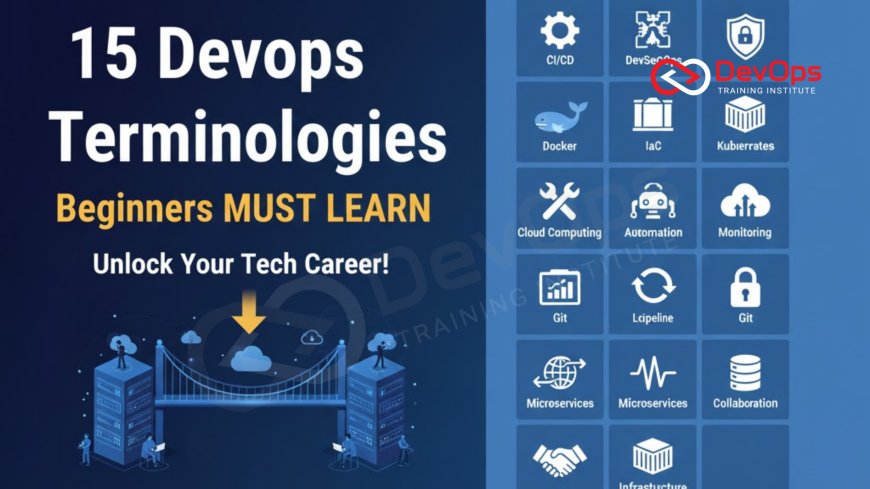
15 DevOps Terminologies Beginners Must Learn
Embarking on a career in technology requires a solid understanding of the core concepts that drive modern software delivery. This guide introduces beginners to the fifteen most essential DevOps terminologies for twenty twenty six, providing clear and professional definitions for terms like CI CD, infrastructure as code, and observability. By mastering these fundamental concepts, you will build a strong technical foundation that allows you to participate effectively in collaborative engineering teams and navigate the complex landscape of cloud automation. Stay ahead of the curve and gain the confidence needed to excel in the rapidly evolving world of DevOps and site reliability engineering starting today.
Introduction to the Language of DevOps
Entering the world of DevOps can feel like learning a completely new language filled with acronyms and abstract concepts. However, understanding this terminology is the first and most important step toward mastering the culture and tools that power modern software companies. DevOps is not just a single job title but a set of practices that combine software development and IT operations to shorten the systems development life cycle. By learning these terms, you gain insight into how teams work together to provide continuous value to their customers while maintaining high standards of stability and security.
In twenty twenty six, the vocabulary of DevOps has expanded to include advanced topics like artificial intelligence and platform engineering. For a beginner, it is crucial to focus on the core pillars that remain constant despite the changing toolsets. These terms describe the "how" and "why" behind every successful deployment and system update. As you move through this guide, you will see how each term fits into a larger ecosystem of collaboration and automation. This foundational knowledge will empower you to communicate effectively with senior engineers and contribute meaningfully to your team's technical goals from day one.
The Foundation of Continuous Pipelines
At the heart of DevOps lies the concept of the pipeline, which is a series of automated steps that code must pass through to reach production. Two of the most critical terms within this pipeline are Continuous Integration and Continuous Delivery, often abbreviated as CI CD. Continuous Integration refers to the practice of frequently merging code changes into a central repository where automated builds and tests are run. This helps identify bugs early in the process, ensuring that the main codebase remains healthy and functional. It is the engine that keeps the development process moving forward without the friction of manual testing.
Continuous Delivery takes this a step further by ensuring that every change that passes the automated tests is ready to be released to users at any time. While some teams use Continuous Deployment to automatically push every change to production, Continuous Delivery provides a manual trigger for the final release, giving the business control over the timing of new features. Together, these practices form the backbone of a high performing engineering team. They allow for a faster time to market by eliminating the long, manual release cycles of the past and replacing them with a streamlined, automated process.
Managing Infrastructure as Code and Containers
The way we manage servers has fundamentally changed with the introduction of Infrastructure as Code or IaC. In the past, system administrators had to manually configure every server, a process that was slow and prone to human error. With IaC, engineers write code to define their infrastructure, allowing them to version, test, and deploy servers just like application code. This ensures that every environment, from development to production, is identical and can be recreated in minutes if a failure occurs. This consistency is vital for maintaining a reliable system that can scale alongside the needs of the business.
Containerization is another essential concept that works alongside IaC to provide portability and efficiency. Tools like Docker allow developers to package an application with all its dependencies into a single "container" that can run on any machine. This eliminates the common "it works on my machine" problem, as the container behaves the same way regardless of the underlying hardware. For managing these containers at a large scale, teams use orchestration tools like Kubernetes to handle deployment, scaling, and networking. Understanding the relationship between these tools is key to mastering modern cloud architecture patterns and ensuring your applications are always available to users.
Observability and Security in the Lifecycle
Once an application is running in production, the focus shifts to understanding its behavior and keeping it secure. Observability is a modern term that goes beyond traditional monitoring; it involves collecting logs, metrics, and traces to gain a deep understanding of why a system is behaving in a certain way. This allows engineers to troubleshoot complex issues in distributed systems that would be impossible to find with simple alerts. By focusing on observability, teams can move from reacting to outages to proactively identifying and fixing performance bottlenecks before they impact the end user experience in any significant way.
Security must also be integrated into every stage of the DevOps lifecycle, a practice known as DevSecOps. This involves using secret scanning tools to prevent sensitive information from being accidentally committed to code repositories and using admission controllers to enforce security policies in container clusters. By shifting security to the left, or earlier in the development process, teams can catch vulnerabilities when they are easiest and cheapest to fix. This holistic approach ensures that speed does not come at the expense of safety, creating a resilient and trustworthy digital product for the organization and its many clients.
Core DevOps Terminology Reference Table
| Term | Simple Definition | Key Benefit | Common Tool |
|---|---|---|---|
| Artifact | A compiled version of your code ready for use | Consistency across environments | JFrog Artifactory |
| Microservices | Breaking apps into small, independent parts | Easier scaling and maintenance | Spring Boot |
| GitOps | Using Git as the source for infrastructure | Auditability and easy rollbacks | ArgoCD |
| SRE | Applying engineering to operations tasks | Higher system reliability | Prometheus |
| Technical Debt | The cost of choosing a quick, easy fix now | Understanding long term impact | SonarQube |
The Role of Automation and Orchestration
Automation is the engine that drives DevOps, and understanding the difference between automation and orchestration is vital for any beginner. Automation refers to a single task performed without human intervention, such as running a script to back up a database. Orchestration, on the other hand, is the coordination of multiple automated tasks into a complex workflow. Think of it like a conductor leading an orchestra; the conductor ensures that every instrument plays at the right time to create a harmonious piece of music. In DevOps, orchestration tools manage the entire lifecycle of an application from build to deployment.
Using GitOps practices allows teams to manage these complex orchestrations using version control systems like Git. This ensures that every change to the automation is tracked and can be easily undone if something goes wrong. This level of control is what allows modern companies to deploy code hundreds of times a day with very little risk. By automating the "toil" or repetitive manual work, engineers can focus on creative problem solving and building new features that provide value to the business. It is a fundamental shift in how we approach technical work in a fast paced digital economy.
Cultural Terms for Collaborative Teams
While technical terms are important, DevOps is also about a cultural change within an organization. One of the most common cultural terms is "Blameless Post Mortem." This is a meeting held after a system failure to understand what went wrong without pointing fingers at any individual. The goal is to identify systemic issues and prevent them from happening again, rather than finding someone to punish. This fosters a culture of trust and transparency, where engineers feel safe to experiment and learn from their mistakes. It is a key reason why DevOps teams are often much more innovative and productive than traditional siloed departments.
Another important concept is "Shift Left," which refers to moving tasks like testing and security earlier in the development process. By catching errors at the beginning of the cycle, teams can avoid the expensive and time consuming work of fixing them right before a release. This requires close collaboration between developers, testers, and security professionals from the very start of a project. Utilizing ChatOps techniques can help facilitate this communication by bringing relevant data and alerts into shared chat channels. This ensures that everyone is on the same page and can react quickly to new information or changing priorities.
Essential Vocabulary for Every DevOps Newbie
- Agile: A methodology focused on iterative development and regular feedback to deliver software in small, manageable pieces.
- Scalability: The ability of a system to handle increased load by adding resources without a decrease in overall performance.
- High Availability: Designing systems to remain operational and accessible even in the event of hardware or software failures.
- Idempotency: A property of automation tools where running a command multiple times has the same result as running it once.
- Rollback: The process of returning a software application to a previous stable state after a failed deployment in production.
- Mean Time to Recovery: A metric that measures how quickly a team can restore service after a system failure occurs.
- Continuous Verification: The practice of using continuous verification to monitor system health and validate changes in real time throughout the entire lifecycle.
As you encounter these terms in your daily work, try to look beyond the definitions and see how they apply to the real world challenges your team faces. For example, understanding the emerging AI augmented devops trends will help you see how automation is becoming even more intelligent and predictive. Learning these terms is not just about memorizing words; it is about adopting a mindset of continuous improvement and collaboration. The more you use this vocabulary, the more natural it will become, and soon you will be speaking the language of modern engineering like a pro.
Conclusion: Your Path to DevOps Mastery
In conclusion, mastering the fifteen essential DevOps terminologies is your ticket to a successful and rewarding career in the tech industry. From the technical mechanics of CI CD pipelines to the cultural values of blameless post mortems, these concepts provide a comprehensive framework for modern software delivery. By understanding the "why" behind these practices, you can go beyond just following instructions and start thinking like a true DevOps engineer. Remember that the goal of all these terms and tools is to make the process of building and running software more efficient, reliable, and enjoyable for everyone involved.
As you continue your learning journey, don't be afraid to ask questions and experiment with the tools that implement these concepts. The transition to a DevOps mindset is a cultural change that takes time and practice to fully embrace. Stay curious about new trends like platform engineering and AI driven operations, but always keep your foundation solid in the core principles we have discussed here. With a clear understanding of these terminologies, you are well on your way to becoming an invaluable member of any high performing technical team. The future of software is collaborative, automated, and continuous, and you are now ready to be a part of it.
Frequently Asked Questions
What does the term DevOps actually stand for in simple words?
DevOps is a combination of development and operations, representing a culture and set of practices that help teams work together more effectively.
Why is CI CD considered the heart of modern DevOps?
It automates the entire process of building, testing, and releasing software, which allows teams to deliver new features to users much faster.
What is the difference between a container and a virtual machine?
Containers are more lightweight and share the host operating system, whereas virtual machines include a full operating system for every single instance.
What does it mean to shift security to the left?
It means integrating security checks and tools early in the development process rather than waiting until the software is finished to test it.
Why is Infrastructure as Code better than manual configuration?
It is faster, reduces human error, and allows you to keep a versioned history of every change made to your server environments.
What is the main goal of a site reliability engineer?
The goal is to use software engineering practices to solve operations problems and ensure that systems are highly available and reliable for users.
How do microservices differ from traditional monolithic applications?
Microservices break an application into small, independent pieces, while a monolith is a single, large, and tightly coupled piece of software code.
What is a deployment pipeline in a DevOps context?
It is an automated sequence of steps that a piece of code must go through to move from development into the production environment.
Why is observability more than just simple system monitoring?
Observability provides a deeper understanding of internal system states based on external data like logs and traces, rather than just simple alerts.
What is the purpose of a blameless post mortem?
It is a meeting focused on finding the root cause of a failure to prevent it from happening again without blaming individuals.
What does idempotency mean in the context of automation?
It means that running an automation script multiple times will always result in the same state without causing unintended side effects or errors.
How does GitOps help with infrastructure management tasks?
It uses Git as the single source of truth for infrastructure, making it easy to track changes, collaborate, and roll back failed configurations.
What is technical debt and why should I care?
It is the long term cost of choosing an easy solution now that will require more work to fix or maintain in the future.
What is an artifact in the software delivery process?
An artifact is a file produced by the build process, such as a container image or a binary, that is ready for deployment.
How does Kubernetes relate to the concept of containerization?
Kubernetes is an orchestration tool that manages the deployment and scaling of containers, making it easier to run them at a large scale.
What's Your Reaction?
 Like
0
Like
0
 Dislike
0
Dislike
0
 Love
0
Love
0
 Funny
0
Funny
0
 Angry
0
Angry
0
 Sad
0
Sad
0
 Wow
0
Wow
0


![100+ Azure DevOps Interview Questions and Answers [Updated 2025]](https://www.devopstraininginstitute.com/blog/uploads/images/202509/image_140x98_68c40aa9a3834.jpg)






![Future Scope of DevOps Careers in Pune [Updated 2025]](https://www.devopstraininginstitute.com/blog/uploads/images/202510/image_140x98_68e3a84652312.jpg)