


![Kong Interview Preparation Guide [2025]](https://www.devopstraininginstitute.com/blog/uploads/images/202509/image_430x256_68dbb95326997.jpg)




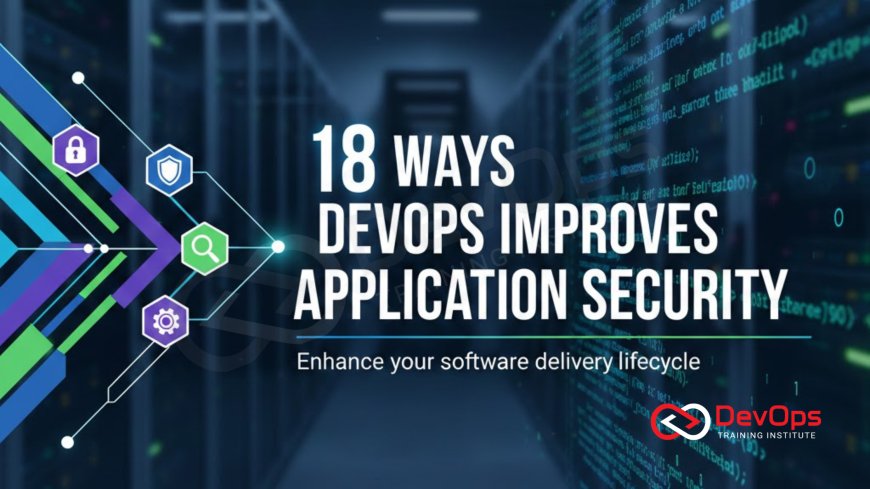
18 Ways DevOps Improves Application Security
Discover the comprehensive impact of integrating DevOps practices with security, known as DevSecOps, and explore 18 fundamental ways this collaboration strengthens your application defenses. Learn how shifting security left into the software development lifecycle, from initial code commitment to production deployment, dramatically reduces vulnerabilities, accelerates threat response, and fosters a culture of shared security ownership. This detailed guide is perfect for developers, operations teams, and security professionals looking to understand the essential methodologies, tools, and cultural changes needed to build robust, secure, and compliance-driven modern applications in a fast-paced technology landscape.
Introduction to DevSecOps
In the modern digital landscape, the speed of application deployment is non-negotiable. However, this velocity must never come at the expense of security. Traditionally, security was a bottleneck, often relegated to a final, stressful audit just before an application went live. This old method, known as "security at the end," frequently resulted in costly delays, last-minute fixes, and ultimately, vulnerable software. The DevOps movement, with its focus on collaboration, automation, and rapid feedback, laid the perfect groundwork for a transformative approach to application security, which we now call DevSecOps.
DevSecOps is not merely a toolset; it is a cultural shift that integrates security practices and tools seamlessly into every stage of the software development lifecycle. It breaks down the silos between Development, Operations, and Security teams, making security a shared responsibility. By "shifting left," meaning moving security checks and controls earlier into the process, organizations can catch flaws when they are cheapest and easiest to fix. This proactive stance ensures that security is built in, not bolted on, accelerating deployment while simultaneously enhancing the overall integrity of the application. The benefits are profound, touching every aspect of software delivery, from code creation to final deployment.
The philosophy is simple yet powerful: automate everything possible, collaborate continuously, and make security checks an invisible part of the developer workflow. Embracing this methodology allows teams to maintain their high-speed release cycles while significantly improving their security posture. Below, we explore eighteen specific ways the adoption of DevOps principles and tools fundamentally improves the operating system security of any application.
Shifting Security Left with Automated Testing
One of the core tenets of DevSecOps is the practice of shifting left, which involves incorporating security checks and processes from the very beginning of the development cycle. This is a crucial move away from reactive security measures to a preventive model. When vulnerabilities are detected early, they are significantly less complex and costly to remediate compared to finding them during the staging or production phases. The early introduction of security tools ensures that developers are immediately aware of potential risks as they write code, fostering a secure-by-default mindset and saving valuable time later in the process.
The integration of automated security testing tools directly into the Continuous Integration and Continuous Delivery (CI/CD) pipeline is key to this shift. Tools for Static Application Security Testing (SAST) and Dynamic Application Security Testing (DAST) run automatically on every code commit, providing immediate feedback. This instant visibility into security flaws prevents insecure code from ever making it to production. By making these tests mandatory gates in the pipeline, the team ensures that security quality is consistently maintained without slowing down the development pace. This automation is a powerful force multiplier for small security teams.
Beyond code analysis, shifting left also includes implementing early practices like automated threat modeling and security-focused code reviews. Threat modeling encourages development teams to think like an attacker from the design phase, proactively identifying potential risks and designing defenses before a single line of vulnerable code is written. Coupled with peer code reviews that specifically look for common security mistakes, this integrated approach ensures that security is not just a checkbox item, but an active consideration throughout the entire development process, leading to a fundamentally more secure product.
Mandatory Automated Vulnerability and Dependency Scanning
Modern applications rely heavily on open-source libraries and third-party components, which introduce significant, often hidden, security risks. A single outdated library with a known vulnerability can compromise an entire application, making continuous dependency scanning an absolute necessity. DevOps improves security by mandating the automatic scanning of all code repositories for outdated or vulnerable third-party components as part of the CI/CD pipeline. These scans provide an inventory of all dependencies and alert developers instantly when a component with a Common Vulnerabilities and Exposures (CVE) score is detected.
Integrating these dependency scanners directly into the build process prevents the deployment of code packages that rely on risky components. If a high-severity vulnerability is found, the pipeline is configured to fail the build automatically, forcing remediation before the application can proceed to the next stage. This immediate feedback loop is critical for maintaining security hygiene in a rapidly changing environment. Furthermore, the use of automated tools ensures that dependency checks are performed consistently and reliably, which is virtually impossible to achieve manually.
Beyond dependencies, the security policies of the entire application stack, including the operating system and container images, must be continuously scanned for vulnerabilities. Container security tools automatically scan Docker images for known vulnerabilities and misconfigurations before they are pushed to a registry. This multi-layered approach to automated scanning ensures that every layer of the application stack, from the foundational infrastructure to the application code and its dependencies, is scrutinized for potential weaknesses, significantly hardening the application against attack.
Infrastructure as Code and Immutable Infrastructure
DevOps promotes the use of Infrastructure as Code (IaC) tools like Terraform and Ansible, which define and provision infrastructure (such as servers, networks, and databases) using machine-readable configuration files. IaC is a massive security improvement because it eliminates the security risks associated with manual, ad-hoc configuration changes, which are often inconsistent and prone to human error. By defining the infrastructure in code, teams can treat the infrastructure itself as an artifact that can be version-controlled, reviewed, and subjected to the same security testing as application code.
The practice of GitOps, where infrastructure configuration is managed via Git repositories, provides an auditable history of every change to the environment, including who made it and when. Security teams can review IaC templates for misconfigurations before they are deployed, using tools that check for compliance with security best practices, such as ensuring all network ports are closed by default or that encryption is enabled on storage volumes. This preventative security check stops insecure infrastructure from ever being provisioned, addressing foundational security risks early.
Complementary to IaC is the concept of immutable infrastructure. Instead of making changes or patches to existing running servers, a new, securely configured server image is built and deployed, replacing the old one entirely. This process prevents configuration drift, where manual, unauthorized, or security-compromising changes accumulate over time on a long-lived machine. By guaranteeing that every running instance is derived from a known, clean, and tested image, immutable infrastructure dramatically simplifies patching and remediation, ensuring that only trusted components are ever running in the production cloud environment.
A Comparison of Traditional and DevSecOps Security Approaches
Understanding the fundamental difference between the traditional security model and the modern DevSecOps model is essential for appreciating the full scope of security improvements. The traditional approach is slow, costly, and reactive, while the DevSecOps approach is fast, integrated, and proactive. This table outlines the stark contrast in approach, timing, and ownership.
| Security Aspect | Traditional (Waterfall) Model | DevSecOps (Agile/CI/CD) Model |
|---|---|---|
| Security Timing | Security is a final gate, done at the end before deployment. | Security is continuous and integrated at every stage (Shift Left). |
| Vulnerability Discovery | Manual, expensive, and time-consuming penetration testing. | Automated SAST, DAST, and dependency scanning in the pipeline. |
| Cost of Fix | Extremely high; requires costly rework of completed code. | Low; developer fixes the issue immediately upon discovery. |
| Team Responsibility | Solely the responsibility of the dedicated Security Team. | Shared responsibility among Development, Operations, and Security. |
| Audit Trail | Often weak, relying on meeting minutes and documentation. | Strong, automated, and centralized logging of all security checks and changes. |
Continuous Monitoring and Feedback Loops
A deployed application is not a finished product; it is a running system that requires continuous attention and monitoring, especially concerning security. DevOps principles extend beyond deployment to cover the operational phase with robust and automated monitoring tools. These tools are designed to detect security-related events, such as unauthorized access attempts, unusual traffic patterns, or deviations from established baselines, in real time. Continuous monitoring provides the visibility needed to respond to emerging threats immediately.
Effective monitoring relies on establishing tight feedback loops that connect operational insights back to the development team. If a security anomaly is detected in production, the DevOps pipeline should be capable of generating an automated alert and potentially even triggering a rollback or automatic mitigation. This is a critical departure from traditional operations, where security incidents often went unnoticed for long periods. By feeding security data directly back to the developers, they gain empirical evidence of how their code performs in a live, hostile environment, allowing them to adjust their coding practices and security protocols for future iterations.
Logging and centralized security information and event management (SIEM) systems are foundational to this process. Every action within the application and its infrastructure must be logged and aggregated. The SIEM system then applies sophisticated analytics and rules to this data to identify patterns that suggest a potential breach or attack. This proactive analysis, constantly being improved by machine learning and human security expertise, ensures that the team can detect and react to zero-day vulnerabilities and advanced persistent threats before they cause significant damage.
Secure Secrets Management and Configuration
Hard-coding sensitive information like API keys, database passwords, and cryptographic keys directly into application code is a major security risk that is aggressively addressed by DevOps. The practice of centralized and secure secrets management is a non-negotiable step in the CI/CD pipeline. Tools like HashiCorp Vault or AWS Secrets Manager are integrated to securely store, manage, and dynamically provision these credentials at runtime, ensuring that sensitive data is never exposed in code repositories or system configuration files.
Secure configuration is vital because even perfectly written code can be vulnerable if deployed into a poorly configured environment. DevOps emphasizes the use of configuration management tools to enforce security policies and baselines across all environments. These tools ensure that settings like firewall rules, user permissions, and least-privilege access are consistently applied and maintained across development, staging, and production. Any deviation from the established, secure baseline is automatically detected and flagged, preventing configuration drift from introducing a security weakness.
Furthermore, the principle of least privilege is rigorously applied across both users and automated processes. For example, CI/CD pipelines should only have the minimum permissions necessary to perform their specific tasks. This segmentation and strict control over access greatly minimizes the blast radius of any potential compromise. By combining centralized secrets management with automated configuration management, DevOps teams eliminate two of the most common causes of application security breaches: exposed credentials and misconfigured environments.
Containers, Orchestration, and Sandboxing
The rise of containerization technologies like Docker and Kubernetes has been closely tied to the DevOps movement, and they offer inherent security advantages. Containers provide a form of isolation or sandboxing, ensuring that the application and its dependencies are separated from the host operating system and other containers. This isolation limits the potential spread of an attack, making containers a key security control.
However, containers also introduce new security considerations, which DevOps addresses through rigorous process and tooling. The first step is container image security, which involves scanning base images for vulnerabilities and minimizing the attack surface by ensuring images contain only the essential components needed to run the application. Security checks are integrated to inspect for proper user separation and to ensure that sensitive files are not included in the final image. These checks happen automatically before the image is even pushed to the container registry.
Orchestration tools like Kubernetes improve security by managing network policies, resource limits, and role-based access control (RBAC) at scale. Kubernetes network policies can enforce least-privilege networking, defining exactly which containers can communicate with each other. This micro-segmentation prevents an attacker from moving laterally through the infrastructure after compromising a single container. The ability to manage these complex security rules through code, coupled with the strong isolation provided by virtualization technologies and container runtimes, represents a major security uplift over traditional monolithic deployments.
Improved Incident Response and Remediation
In a world where security breaches are a question of when, not if, the speed and efficiency of incident response become paramount. DevOps practices dramatically improve an organization's ability to respond to and recover from security incidents. Because the entire infrastructure and application environment is defined as code and managed via automated pipelines, the time required for disaster recovery and remediation is drastically reduced.
The combination of immutable infrastructure and automated deployment means that a compromised component can be destroyed and replaced with a clean, known-good version in minutes, rather than hours or days of manual forensic work and patching. This is often referred to as "kill and replace" and is far more secure than attempting to patch a running, potentially compromised system. Furthermore, detailed logging and monitoring provide the security team with rich, timely data necessary for root cause analysis, enabling them to identify the source of the breach quickly and develop a targeted fix that is then tested and deployed rapidly through the CI/CD pipeline.
The continuous learning and feedback loop that defines DevOps is also applied to security incidents. After every incident, a blameless post-mortem is conducted to understand what failed in the process or toolchain. The findings are immediately used to update the automated security checks, policies, and pipeline configurations. This constant, iterative improvement means that the organization becomes more resilient with every security event, effectively converting a failure into a permanent security enhancement. This level of rapid, automated incident management is unattainable with manual processes.
Conclusion and Summary of Security Gains
The integration of DevOps principles into application security, resulting in the DevSecOps methodology, is a fundamental and necessary evolution for any organization operating modern software. It shifts the burden of security from a single, overwhelmed team at the end of the lifecycle to a shared, continuous responsibility across all teams from the very first line of code. By embedding security practices directly into the automated CI/CD pipeline, organizations can achieve both the speed required for modern business and the resilience necessary to combat an increasingly sophisticated threat landscape.
The 18 ways DevOps improves application security—spanning automated testing, secure infrastructure coding, dependency management, continuous monitoring, and rapid incident response—collectively create a security posture that is preventative, integrated, and scalable. Security is no longer an obstacle but an accelerator. Tools perform tasks that are simply too time-consuming and error-prone for human teams, leading to consistent application of security policies and faster remediation of flaws. The cultural changes, particularly the focus on collaboration and shared ownership, are just as important as the technological shifts.
Ultimately, DevSecOps ensures that applications are "born secure." This modern approach reduces risks, lowers the long-term cost of security, and builds a powerful competitive advantage based on trust and reliability. Organizations that embrace this shift are better prepared to meet compliance requirements, withstand attacks, and deliver value to their customers with confidence. The transition requires commitment to new tools and processes, but the payoff is a robust, resilient, and inherently more secure software delivery machine.
Bonus Content The Importance of Compliance as Code
Regulatory compliance is often viewed as a major impediment to speed, leading to manual checks and audit preparation that slow down releases. DevOps tackles this head-on with the concept of "Compliance as Code." This approach involves translating regulatory requirements and internal security standards into automated, executable tests and configurations that are embedded directly into the CI/CD pipeline. For example, rules requiring data encryption at rest or specific logging formats are written as code and verified on every deployment.
By automating compliance checks, the organization gains continuous, real-time assurance that all deployed artifacts and infrastructure meet legal and industry standards, such as GDPR, HIPAA, or SOC 2. The pipeline itself acts as the enforcement mechanism and documentation engine. If an infrastructure change violates a compliance rule—perhaps by disabling encryption on a storage volume—the pipeline automatically fails the build and provides instant feedback to the developer. This eliminates the frantic, last-minute manual audit, replacing it with an always-on, verifiable compliance status.
The benefits are immense: reduced audit preparation time, minimized risk of non-compliance fines, and the creation of an unforgeable audit trail that documents every security and compliance check performed. This shift turns compliance from a slow, periodic roadblock into an integrated, automated quality gate, fully supporting the high velocity of a true DevOps environment. This integration proves that security, speed, and regulatory adherence are not mutually exclusive, but can be achieved simultaneously through automation and integration.
Frequently Asked Questions
What is the primary goal of DevSecOps?
The primary goal is to integrate security practices seamlessly into the entire DevOps lifecycle, making security a shared, continuous effort.
How does "Shift Left" benefit security?
Shift Left detects and remediates vulnerabilities earlier in development, when they are significantly easier and cheaper to fix.
What is SAST and where is it used?
SAST (Static Application Security Testing) analyzes source code without executing it, typically used in the CI/CD pipeline for rapid feedback.
What is DAST and when should it run?
DAST (Dynamic Application Security Testing) tests a running application for vulnerabilities, often run against staging or pre-production environments.
Why is Infrastructure as Code important for security?
IaC ensures infrastructure is consistently and securely configured, eliminating manual errors and providing a version-controlled audit trail.
What is the benefit of immutable infrastructure?
It prevents configuration drift and allows for rapid, secure replacement of compromised or outdated servers with a known-good base image.
How do containers improve application isolation?
Containers sandbox applications from the host operating system and each other, limiting the blast radius of a successful attack.
What are secrets management tools used for?
They securely store and manage sensitive credentials like API keys and passwords, preventing them from being hard-coded into the application.
What is the role of continuous monitoring in DevSecOps?
It provides real-time detection of security events and anomalies in the production environment, allowing for rapid response.
What is the principle of least privilege in this context?
It ensures users, applications, and automated processes only have the minimum permissions necessary to perform their required tasks.
How does automation help with compliance?
Automation enables Compliance as Code, turning regulatory rules into executable tests that provide continuous, verifiable assurance.
Does DevSecOps slow down the release process?
No, by automating security checks, DevSecOps speeds up releases by preventing major security delays at the end.
What is a security gate in a CI/CD pipeline?
A security gate is a mandatory check that must pass before the code can move to the next stage, such as a vulnerability scan.
Who is responsible for security in a DevSecOps model?
Security is a shared responsibility among all team members: Development, Operations, and Security personnel.
How does DevSecOps handle patching and updates?
Patching is automated; new, secure base images are created and deployed to replace old ones through the CI/CD pipeline.
What's Your Reaction?
 Like
0
Like
0
 Dislike
0
Dislike
0
 Love
0
Love
0
 Funny
0
Funny
0
 Angry
0
Angry
0
 Sad
0
Sad
0
 Wow
0
Wow
0

![100+ Azure DevOps Interview Questions and Answers [Updated 2025]](https://www.devopstraininginstitute.com/blog/uploads/images/202509/image_140x98_68c40aa9a3834.jpg)






![Future Scope of DevOps Careers in Pune [Updated 2025]](https://www.devopstraininginstitute.com/blog/uploads/images/202510/image_140x98_68e3a84652312.jpg)