How to Compare DevOps Institutes in Bangalore
A checklist to compare DevOps institutes in Bangalore yourself: syllabus, labs, trainer, projects, placement claims, fees and refund terms.
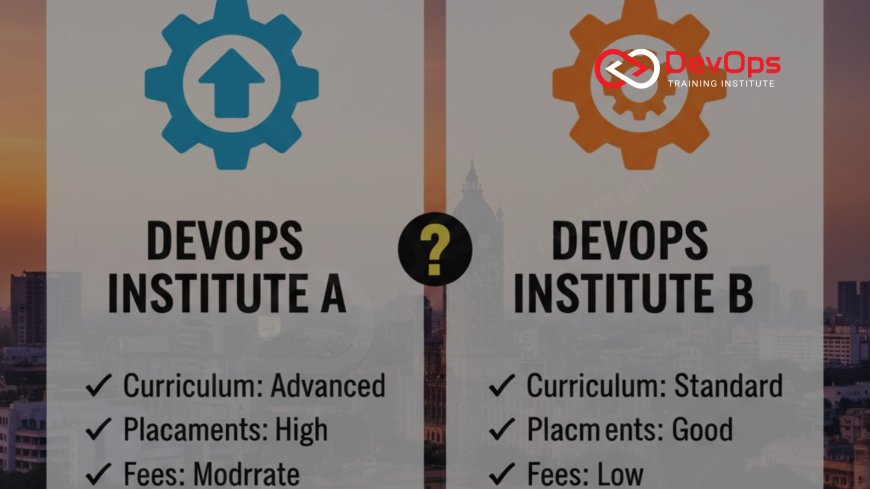
The best way to compare DevOps institutes in Bangalore is to score each one yourself on the same checklist: a published syllabus mapped to real tools, how much lab time you get, who teaches and whether you can meet them first, what the project and assessment look like, how placement claims are backed, and the full cost in writing. This page gives you that checklist and the questions to ask.
We deliberately do not name, rank or rate any institute here, including ourselves. Rankings online are often paid placements or are written by institutes about their own competitors, and fees, trainers and batch quality change every few months. A framework you apply yourself stays useful. A short disclosure: we are a training provider. For learners in Bangalore we teach live online only; our classroom batches run in Kharadi, Pune. If you are comparing options in Pune, the same method is explained in how to compare DevOps training institutes in Pune.
Key takeaways
- Compare institutes on evidence you can check, not on ranking lists or star ratings.
- Ask for the session-by-session syllabus, a sample lab, and a trial class before you pay.
- Treat "100% placement" and salary figures as claims to verify, not facts. Ask for proof you can check yourself.
- Get fees, refund rules, batch size and lab access period in writing.
- Decide on mode first (online, classroom or hybrid), because it changes which institutes are realistic for you.
Step 1: decide what you need before you compare
Comparisons go wrong when you compare institutes on things that do not matter to you. Write down four things first.
- Your starting point. A fresher with no Linux experience needs a longer course with fundamentals. A developer or system administrator moving into DevOps can skip basics and needs depth in Kubernetes, Terraform and pipelines.
- Your goal. A first DevOps job, a certification such as CKA or an AWS exam, or a specific skill for your current role. Each goal points to a different course length and focus.
- Your schedule. Weekday evenings, weekends, or full-time. Bangalore commutes make this a real constraint for classroom courses.
- Your budget. Including exam fees and cloud costs, which are often extra.
Step 2: the comparison checklist
Copy this table into a spreadsheet, add one column per institute you are considering, and fill it in from what each one shows you, not from its website headlines.
| Criterion | What good looks like | How to check |
|---|---|---|
| Syllabus | Session-by-session plan covering Linux, Git, a CI/CD tool, Docker, Kubernetes, Terraform, a cloud platform and monitoring | Ask for the full document, not a brochure list of logos |
| Tool versions | Current, supported versions | Ask which Kubernetes and Terraform versions labs use and compare with the official release pages |
| Lab time | Most of the course spent at a terminal | Ask for hours of lab work per week and how labs are provided |
| Lab environment | Real cloud accounts or clusters you can break and rebuild | Ask whether you use your own cloud account and who pays usage |
| Trainer | Someone who has run these tools in production and can answer follow-up questions | Attend a trial class taught by the person who will teach your batch |
| Batch size | Small enough that the trainer can look at your screen | Ask for the maximum, in writing |
| Projects | An end-to-end project you build and can explain, in your own Git repository | Ask to see a past project's repository with the student's permission |
| Assessment | Practical tasks, not only multiple choice | Ask how progress is checked and what happens if you fall behind |
| Recordings and access | Recordings available for revision; lab access for a stated period | Get access duration in writing |
| Career support | Resume reviews, mock interviews, clear description of what is and is not provided | Ask for the process, not percentages |
| Fees and refunds | One total price with exam fees and taxes listed separately; written refund policy | Get a written quote |
Step 3: questions to ask in the counselling call
Counselling calls are sales calls. That is fine, but steer them with specific questions and write the answers down.
- Can you send me the session-by-session syllabus and the lab guide for one session?
- Who will teach my batch, and can I attend one of their live classes before paying?
- How many students are in a batch, at most?
- How are labs provided: your servers, my own cloud account, or a lab platform? Who pays cloud usage?
- What will I have built by the end, and where will the code live?
- What happens if I miss classes: recordings, a later batch, or extra sessions?
- What exactly does career support include, and what does it not include?
- What is the total cost, and what is the refund policy in writing?
Notice which answers are specific and which stay vague. "Our trainers have 15 years of experience" says less than "here is the trainer, come to Thursday's class".
Step 4: check claims you cannot see
Placement claims
Placement percentages and average salary numbers are the hardest claims to verify and the easiest to inflate. Ask how the number was calculated: which batches, how many students, what counted as "placed", and whether students who stopped attending were excluded. Ask whether you can speak to two recent learners, chosen by you from a list, not by the institute. Our guide on how to verify DevOps placement claims goes through this in detail, and the same checks apply in Bangalore.
Reviews
Read reviews on more than one platform and look for detail: a reviewer who names the tools, the project and the trainer is more credible than a five-star line with no detail. A sudden cluster of reviews in one week is a warning sign.
Certification claims
Institutes can prepare you for exams such as CKA, Terraform Associate or AWS certifications, but the exams are run by the certifying bodies. Check exam details, prices and validity on the certifying body's own site, not the institute's page.
"Job guarantee" offers
Read the conditions. Guarantees often depend on attendance, test scores and accepting any offer within a set time. If a guarantee is offered, get the full terms in writing before paying.
Step 5: online, classroom or hybrid in Bangalore
| Mode | Works well when | Watch for |
|---|---|---|
| Live online | You have a stable connection and want to avoid commuting; you can share your screen for help | Batches too large for the trainer to see your work; cameras-off passive sessions |
| Classroom | You learn better with people around you and the centre is close to home or work | Commute time eating into practice time; lab machines you cannot use at home |
| Hybrid | You want online classes with some in-person sessions | Unclear schedule for the in-person part |
| Self-paced video | You are disciplined and already have some experience | No one to unblock you when a lab breaks |
For DevOps, the mode matters less than lab time and feedback. Kubernetes and Terraform run in the cloud either way, so a well-run online class with screen sharing can give you the same hands-on practice as a classroom.
Step 6: score and decide
Give each criterion a weight that reflects your priorities, then score each institute from 1 to 5 on the evidence you collected. A simple version:
| Criterion | Suggested weight |
|---|---|
| Trainer quality (from the trial class) | 25% |
| Lab time and environment | 25% |
| Syllabus depth and currency | 15% |
| Project quality | 15% |
| Career support process | 10% |
| Cost, refund and access terms | 10% |
These weights are a starting point; change them to suit your situation. If two institutes score close, choose the one whose trial class you understood better.
Red flags
- No syllabus beyond a list of tool logos.
- Pressure to pay today for a "last seat" or a discount that expires tonight.
- No trial class, or a trial taught by someone other than your trainer.
- Placement or salary numbers with no explanation of how they were counted.
- Vague answers about batch size and lab access.
- Refund policy only given verbally.
How to prepare so any course works better
Whichever institute you pick, you will learn faster if you arrive with Linux command-line basics and Git. Spend two weeks on those first. During the course, keep every lab in your own Git repository and write a short README for each. That repository becomes your portfolio. For a sense of what employers ask, read how to choose a DevOps training institute and our DevOps interview questions guide. If you want to see how we run our course, the DevOps course page lists the syllabus; Bangalore learners join live online.
A worked example of using the checklist
Suppose you are a support engineer in Bangalore with two years of Linux experience, aiming for a first DevOps role, available on weekday evenings. Your starting point means you can skip a long Linux module, so a syllabus that spends a third of its time on Linux basics is a poor fit. Your schedule rules out daytime classroom batches across the city, so live online evening batches are realistic. Your goal means project quality and interview preparation matter more than a certificate.
You shortlist three providers from searches and recommendations. For each, you ask for the syllabus, attend one trial class, and get a written quote. Provider A sends a detailed session plan but the trial class is a recorded video. Provider B has a strong trial class with a trainer who answers your Kubernetes questions in detail, but its batch size is vague until you ask twice. Provider C is the cheapest but cannot tell you who will teach. Scoring with the weights above, B likely comes out ahead on trainer and labs, provided it puts the batch size in writing. That is the kind of reasoning this method is for: the decision rests on what you saw, not on what a ranking page said.
Questions to ask yourself after the trial class
- Did I understand what the trainer explained, and did they check that the class understood?
- Did we type commands, or only watch slides?
- When someone hit an error, did the trainer debug it live?
- Were questions answered specifically or deferred?
- Would I be comfortable asking this trainer a basic question?
FAQ
Which is the best DevOps institute in Bangalore?
There is no single answer that holds for every learner. Use the checklist on this page to score the institutes you are considering on syllabus, labs, trainer, projects, support and cost.
Should I trust online rankings of DevOps institutes?
Treat them with caution. Many are paid placements or written by competitors. Check evidence such as the syllabus and a trial class yourself.
How can I verify placement claims?
Ask how the figure was calculated, which batches it covers, and whether you can speak to recent learners you choose from a list.
Is online DevOps training as good as classroom training?
It can be, if the batch is small and you get real lab time with screen-sharing support. Lab practice matters more than mode.
Do you have a classroom in Bangalore?
No. We teach Bangalore learners live online. Our classroom batches are only in Kharadi, Pune.
What should a DevOps syllabus include?
Linux, Git, a CI/CD tool, Docker, Kubernetes, Terraform or another IaC tool, a cloud platform, and monitoring, with labs for each.
What questions should I ask before paying?
Ask for the full syllabus, a trial class with your trainer, maximum batch size, lab setup, project details, career support scope, and written fees and refund terms.
References
What's Your Reaction?
 Like
0
 Dislike
0
 Love
0
 Funny
0
 Angry
0
 Sad
0
 Wow
0