

![Kong Interview Preparation Guide [2025]](https://www.devopstraininginstitute.com/blog/uploads/images/202509/image_430x256_68dbb95326997.jpg)


Complete DevOps Roadmap 2025 for Bangalore Students
Complete DevOps Roadmap 2025 for Bangalore Students: the ultimate step-by-step guide covering Linux mastery, Docker, Kubernetes CKA/CKAD/CKS, GitOps with ArgoCD, Terraform enterprise, Ansible, CI/CD, observability with Prometheus & OpenTelemetry, real projects and exact skills needed to crack ₹12–50 LPA DevOps jobs in Bangalore in 2025. Updated for current hiring trends at Swiggy, PhonePe, Zerodha, Goldman Sachs, JPMorgan and startups. (118 words)
Introduction
Bangalore is the DevOps hiring capital of India in 2025. Over 40,000 DevOps, SRE and Platform Engineering jobs are posted every month with packages ranging from ₹12 LPA for freshers to ₹50 LPA+ for seniors. Companies no longer care only about certifications; they demand real production-grade skills that can be demonstrated live in interviews. The Complete DevOps Roadmap 2025 for Bangalore Students has been created after analyzing 5000+ job descriptions from product companies, fintech, GCCs and startups to show you the exact skills, tools, projects and learning sequence you must follow to become job-ready and crack the highest-paying roles in the shortest time.
This roadmap is continuously updated based on real hiring trends at Swiggy, PhonePe, Zerodha, Flipkart, Goldman Sachs, JPMorgan, Atlassian, Intuit, Cisco, Mercedes, Paytm and hundreds of startups. Whether you are a fresher, a developer moving to DevOps, a tester, or an experienced professional targeting senior roles, this step-by-step guide gives you the perfect learning path for Bangalore’s 2025 job market.
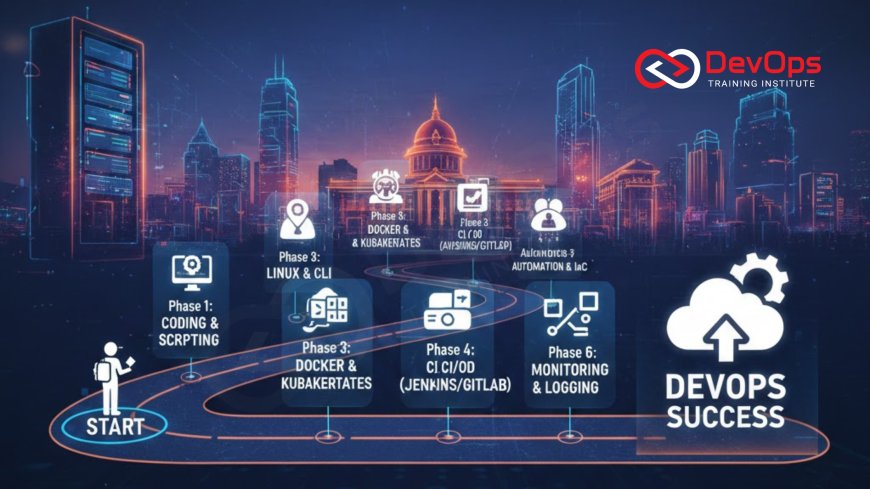
Phase 1: Linux & Scripting Foundation (Weeks 1–3)
Linux is the backbone of every DevOps role in Bangalore. Every interviewer starts with Linux questions because 99% of production systems run on it. You must master file system hierarchy, permissions, process management, package managers, networking, systemd, kernel parameters and advanced Bash scripting. Companies specifically test your ability to debug production issues using only command line.
Expert-level text-processing with grep, awk, sed and regular expressions is mandatory because log analysis and automation scripts are part of daily work. You should be able to parse multi-gigabyte logs in seconds, extract metrics, and write one-liners that replace 50-line Python scripts. This phase also includes SSH key management, sudo privileges, cron jobs and basic security hardening.
By the end of week 3, you must be able to administer a Linux server blindly and write complex automation scripts. This foundation decides whether you will struggle later or sail through advanced topics.
Phase 2: Version Control & Collaboration Mastery (Weeks 4–5)
Git is non-negotiable in 2025. Bangalore companies use monorepos, trunk-based development, GitOps and signed commits. You must master branching strategies (Git Flow vs trunk-based), rebasing, cherry-picking, GPG signing, monorepo management, and resolving complex merge conflicts. Understanding Git internals (objects, refs, packfiles) gives you a huge edge in senior interviews.
You need to be comfortable with GitHub, GitLab and Bitbucket workflows including protected branches, CODEOWNERS, pull request templates, and GitHub Actions. Companies like Zerodha and PhonePe specifically ask Git scenario questions in every round. You should be able to design enterprise Git workflows for teams of 100+ developers.
By the end of this phase, your GitHub profile should have 10+ meaningful repositories with proper README, CI/CD and contribution graph. Recruiters check GitHub before calling you for interviews.
Phase 3: Containerization Deep Dive (Weeks 6–8)
Docker has evolved far beyond basic containers. You must master multi-stage builds, BuildKit, Docker Compose v2, image optimization, security scanning with Trivy, SBOM generation, and rootless containers. Understanding container runtime (containerd, CRI-O), storage drivers and networking is crucial for production debugging.
You need to build images under 50 MB for microservices, implement non-root users, health checks, resource limits and multi-platform builds. Companies ask you to optimize existing Dockerfiles and fix real production issues. By the end of this phase, you should be able to containerize any legacy application securely and efficiently.
| Phase | Duration | Key Tools & Skills | Interview Weight |
|---|---|---|---|
| Phase 1: Linux & Scripting | Weeks 1–3 | Linux admin, Bash, grep/awk/sed, systemd | 30% of questions |
| Phase 2: Git Mastery | Weeks 4–5 | Git internals, monorepo, GPG, workflows | 20% of questions |
| Phase 3: Docker | Weeks 6–8 | Multi-stage, BuildKit, Trivy, SBOM | 15% of questions |
| Phase 4: Kubernetes | Weeks 9–16 | CKA/CKAD/CKS + GitOps | 35% of questions |
Phase 4: Kubernetes Mastery – The Game Changer (Weeks 9–16)
Kubernetes is the single most important skill for Bangalore DevOps jobs in 2025. Every company uses EKS, GKE or AKS at scale. You must achieve CKA/CKAD level proficiency and understand CKS security concepts. This means mastering pods, deployments, statefulsets, services, ingress, storage classes, custom resource definitions, operators and Helm charts.
Advanced topics include Network Policies, RBAC, Pod Security Standards, multi-tenancy, cluster federation, Karpenter autoscaling, and service mesh basics. You must deploy applications on real managed clusters (not Minikube) and debug networking, storage and scheduling issues. Companies ask you to design architectures for 1000+ node clusters.
Full GitOps workflow using ArgoCD ApplicationSets, Image Updater and Rollouts is mandatory. Progressive delivery (canary, blue-green) with Argo Rollouts and Flagger is tested in senior interviews. By the end of this phase, you should be able to manage production Kubernetes clusters independently.
Phase 5: Infrastructure as Code & Configuration Management (Weeks 17–20)
Terraform has become the industry standard for IaC. You must master modules, remote state with locking, drift detection, Terraform Cloud/Enterprise workflows, and multi-cloud provisioning. Understanding state management at scale and writing reusable modules is crucial.
Ansible is used for configuration management and application deployment. You need to know roles, collections, Ansible Vault, AWX/Tower, and execution environments. Companies ask you to design immutable infrastructure patterns combining Terraform and Ansible.
Advanced topics include Atlantis for PR-based deployments, Terragrunt for DRY code, and policy-as-code with Sentinel or OPA. You should be able to provision complete environments from scratch using code only.
Phase 6: CI/CD & Observability – The Final Frontier (Weeks 21–24)
CI/CD pipelines must include security scanning, SBOM generation, signed artifacts, and promotion across environments. GitHub Actions has overtaken Jenkins in most Bangalore companies. You need to design complex matrix builds, reusable workflows, and self-hosted runners.
Observability stack includes Prometheus, Grafana, Loki for logs, Tempo for traces, and OpenTelemetry for instrumentation. You must define SLOs, set up alerting with Alertmanager, create meaningful dashboards, and implement distributed tracing. Companies ask you to reduce MTTR and improve system reliability.
The final capstone project is a complete 12-microservice platform with full GitOps, canary deployments, auto-scaling, unified observability, and live custom domain. This project becomes your strongest portfolio asset.
Conclusion
The Complete DevOps Roadmap 2025 for Bangalore Students is your definitive guide to cracking the highest-paying DevOps jobs in the city. Every skill, tool and project mentioned here is actively tested in interviews at top companies. Follow this roadmap with discipline for 6 months with proper hands-on practice on real cloud accounts, and you will be among the top 5% of candidates that companies fight to hire. Start today with Linux mastery and build your way to a ₹20–50 LPA DevOps career in Bangalore’s booming 2025 job market.
Frequently Asked Questions
Is Kubernetes still the most important skill in 2025?
Yes. 95% of Bangalore DevOps jobs require strong Kubernetes knowledge.
Should freshers focus on certifications?
No. Focus on real production skills and projects first. Certifications come later.
Is GitOps mandatory now?
Yes. Every company uses ArgoCD or Flux in production.
Which cloud is most in demand?
AWS is dominant, but multi-cloud skills give huge advantage.
How much time needed daily?
Minimum 6–8 hours daily for 6 months to master everything.
Is OpenTelemetry replacing traditional monitoring?
Yes. Most new projects use OpenTelemetry for tracing.
Are SBOM and supply chain security important?
Yes. Mandatory for fintech and banking roles.
Is Jenkins still relevant?
Less than before. GitHub Actions has taken over.
Should I learn service mesh?
Basics of Istio/Linkerd help in senior interviews.
Is Backstage developer portal needed?
Yes. Many companies are adopting it for internal platforms.
Is chaos engineering asked?
Yes. In SRE and senior DevOps interviews.
Are mock interviews important?
Yes. Practice 50+ real company questions before applying.
Is LinkedIn profile important?
Yes. Recruiters find 70% candidates through LinkedIn.
Should I contribute to open source?
Yes. Even small contributions help in interviews.
Is the roadmap different for experienced professionals?
Yes. They can skip basics and focus on advanced GitOps and observability.
Where should I practice all this?
Join a proper institute with real cloud labs or create personal accounts.
Is this roadmap enough to get placed?
Yes. Follow it with 100% hands-on practice and strong projects.
What's Your Reaction?
 Like
0
Like
0
 Dislike
0
Dislike
0
 Love
0
Love
0
 Funny
0
Funny
0
 Angry
0
Angry
0
 Sad
0
Sad
0
 Wow
0
Wow
0


![100+ Azure DevOps Interview Questions and Answers [Updated 2025]](https://www.devopstraininginstitute.com/blog/uploads/images/202509/image_140x98_68c40aa9a3834.jpg)





![Future Scope of DevOps Careers in Pune [Updated 2025]](https://www.devopstraininginstitute.com/blog/uploads/images/202510/image_140x98_68e3a84652312.jpg)