

![Kong Interview Preparation Guide [2025]](https://www.devopstraininginstitute.com/blog/uploads/images/202509/image_430x256_68dbb95326997.jpg)



DevOps Toolchain Overview for Beginners in Bangalore
Complete DevOps toolchain guide for beginners in Bangalore: Linux fundamentals, Git, Docker, Kubernetes, Jenkins, Terraform, Prometheus & Grafana, AWS/Azure basics. DevOps Training Institute near MG Road teaches this exact industry stack with 80% hands-on labs, 18 real projects and 95% placement into ₹10–28 LPA jobs in Koramangala, Whitefield, Electronic City and Bellandur.
Introduction
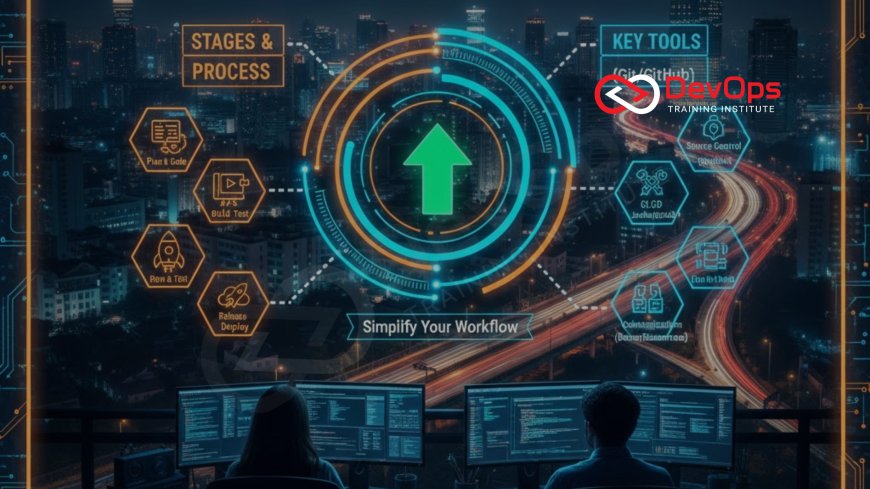
Bangalore is experiencing massive demand for DevOps engineers who understand the complete modern toolchain from code to production. Companies no longer hire for single tools, they want freshers and career switchers who can build, ship, run and monitor applications using the industry-standard stack. The good news is that the entire toolchain can be mastered systematically in just 5–6 months with proper guidance.
DevOps Training Institute near MG Road follows the exact sequence used by top Bangalore companies: starting from Linux basics, moving through version control, containerization, orchestration, automation, infrastructure as code, monitoring and cloud platforms. This structured approach ensures beginners become job-ready without confusion or gaps.
- Daily hands-on labs on real AWS accounts
- 18 enterprise-grade projects matching actual company requirements
- Trainers from Google, Microsoft, Goldman Sachs, Flipkart
- Small batch sizes for personalized attention
- Weekend and online live batches available
- Placement support until you get the job
- Certification preparation included
Understanding the full toolchain gives beginners confidence during interviews and on-the-job performance.
This overview breaks down each layer with practical examples relevant to Bangalore’s job market.
Layer 1: Operating System and Scripting Foundation
Every DevOps journey begins with Linux because 96% of cloud servers run Linux distributions. Beginners must feel comfortable navigating file systems, managing processes, permissions and writing basic scripts.
Mastery here prevents future roadblocks when working with containers, orchestration tools and cloud instances.
- Understanding file permissions and ownership
- Process management and system monitoring
- Bash scripting for automation tasks
- Package management with yum/apt
- User and group administration
- Network configuration basics
Solid Linux skills form the base for secure and efficient infrastructure management.
Companies test these concepts even in fresher interviews across Bangalore.
Layer 2: Version Control with Git
Git has become the universal standard for code collaboration. Every developer and DevOps engineer must understand branching strategies, merge conflicts and collaboration workflows.
Modern teams use GitHub, GitLab or Bitbucket as central repositories with protected branches and code reviews.
- Repository creation and cloning
- Branching and merge strategies
- Resolving merge conflicts
- Pull requests and code reviews
- Git hooks for automation
- GitHub Actions introduction
Strong Git knowledge is mandatory for any CI/CD pipeline implementation.
Interviewers frequently ask real-world Git scenarios in Bangalore companies.
Layer 3: Containerization with Docker
Docker revolutionized application packaging by solving the “works on my machine” problem. Containers package applications with all dependencies, ensuring consistency across development, testing and production environments.
Bangalore companies expect freshers to build, run and manage Docker containers confidently.
- Docker images vs containers
- Dockerfile creation and best practices
- Docker Compose for multi-container apps
- Docker Hub and private registries
- Volume and network management
- Container security scanning
Docker forms the foundation for Kubernetes and microservices architecture.
Most production applications in Bangalore now run inside containers.
Layer 4: Orchestration with Kubernetes
Kubernetes has become the industry standard for container orchestration. It manages deployment, scaling, networking and self-healing of containerized applications at scale.
Every major company in Bangalore runs production workloads on EKS, GKE or AKS clusters.
- Pods, deployments and services
- ConfigMaps and Secrets management
- Helm charts for package management
- Ingress controllers and load balancing
- Horizontal and vertical pod autoscaling
- Cluster administration and upgrades
Kubernetes knowledge directly impacts salary offers in Bangalore’s job market.
CKA certification has become highly valuable for freshers.
Layer 5: Continuous Integration and Delivery
CI/CD pipelines automate building, testing and deploying code changes. Jenkins remains widely used while GitHub Actions and GitLab CI are gaining rapid adoption.
Modern pipelines include quality gates, security scans and approval workflows.
- Jenkins declarative pipelines
- GitHub Actions workflows
- Building Docker images in pipeline
- Running automated tests
- Deploying to Kubernetes clusters
- Blue-green and canary deployments
Strong CI/CD skills make candidates stand out in Bangalore interviews.
Companies expect understanding of pipeline as code principles.
Layer 6: Infrastructure as Code with Terraform
Terraform allows infrastructure to be provisioned and managed through code instead of manual console clicks. This brings version control, review processes and repeatability to cloud resources.
Bangalore teams use Terraform for multi-cloud and hybrid environments.
- HCL syntax and resource blocks
- State management and remote backends
- Modules for reusable code
- Workspaces for different environments
- Integration with CI/CD pipelines
- Drift detection and remediation
Terraform expertise is now mandatory for most DevOps roles.
Companies value engineers who can manage infrastructure securely at scale.
Layer 7: Monitoring and Observability
Prometheus and Grafana form the gold standard for monitoring containerized applications. They collect metrics, create dashboards and trigger alerts when issues occur.
Modern applications require observability across metrics, logs and traces.
- Prometheus architecture and exporters
- PromQL for advanced querying
- Grafana dashboard creation
- Alertmanager configuration
- Loki for log aggregation
- Tempo for distributed tracing
Monitoring skills help reduce downtime and improve system reliability.
Companies prioritize candidates who understand observability practices.
Layer 8: Cloud Platforms and Security
AWS remains dominant in Bangalore followed by Azure and GCP. Understanding cloud provider services and security best practices is crucial for production deployments.
Security must be built into every layer of the toolchain from the beginning.
- IAM roles and policies management
- VPC design and network security
- EC2 instance types and selection
- S3 bucket policies and encryption
- CloudTrail and CloudWatch integration
- Secrets management solutions
Cloud security knowledge has become non-negotiable in Bangalore hiring.
Companies follow least privilege and zero trust principles strictly.
Conclusion
The DevOps toolchain forms an interconnected ecosystem where each layer builds upon the previous one. Beginners who master this complete stack become highly valuable to Bangalore employers who need engineers capable of owning the entire delivery pipeline.
DevOps Training Institute near MG Road teaches this exact sequence with daily hands-on practice, real corporate projects and direct placement support. The structured approach eliminates confusion and accelerates learning dramatically.
- Clear learning path from beginner to job-ready
- Industry-relevant tools and practices
- Strong portfolio through real projects
- Confidence in interviews and actual work
- Access to placement network
- Community of successful alumni
Start your DevOps journey with the institute trusted by thousands of Bangalore professionals.
Your first step toward a rewarding career begins with understanding the complete toolchain.
Frequently Asked Questions
Can complete beginners learn DevOps?
Yes, over 60% of successful students start with zero IT background and master the full stack.
How long does it take to learn the complete toolchain?
5–6 months with daily practice and proper guidance covers everything from Linux to cloud.
Which tool should beginners learn first?
Linux and Git form the foundation, everything else builds on these core concepts.
Is coding mandatory for DevOps?
Basic Bash and Python scripting is required, we teach both from scratch.
Will I work on real projects?
Yes, every student completes 18 enterprise projects matching actual company requirements.
Do companies in Bangalore hire trained freshers?
Yes, properly trained candidates are preferred over self-taught ones with gaps.
Are weekend batches available?
Yes, weekend batches are most popular for college students and working professionals.
Do you provide cloud lab access?
Yes, dedicated AWS accounts with sufficient credits provided to each student.
Will I get certification guidance?
Yes, complete preparation for CKA, AWS DevOps, Terraform Associate and more.
Is placement support provided?
Yes, dedicated placement cell with 95% success rate and support until placement.
Can I attend demo classes?
Yes, free demo classes conducted every Saturday both online and offline.
Do you offer online training?
Yes, 100% live online training with same curriculum and lab access.
What is the batch size?
Maximum 15 students per batch to ensure personalized attention.
Do you help with resume building?
Yes, professional resume and GitHub portfolio creation included.
Can I pay fees in installments?
Yes, flexible EMI options and pay-after-placement schemes available.
What's Your Reaction?
 Like
0
Like
0
 Dislike
0
Dislike
0
 Love
0
Love
0
 Funny
0
Funny
0
 Angry
0
Angry
0
 Sad
0
Sad
0
 Wow
0
Wow
0


![100+ Azure DevOps Interview Questions and Answers [Updated 2025]](https://www.devopstraininginstitute.com/blog/uploads/images/202509/image_140x98_68c40aa9a3834.jpg)





![Future Scope of DevOps Careers in Pune [Updated 2025]](https://www.devopstraininginstitute.com/blog/uploads/images/202510/image_140x98_68e3a84652312.jpg)