
















![Kong Interview Preparation Guide [2025]](https://www.devopstraininginstitute.com/blog/uploads/images/202509/image_430x256_68dbb95326997.jpg)








10 Kubernetes Use Cases That Prove Its Power
Discover 10 real-world Kubernetes use cases in 2025 that showcase why global enterprises, startups, and cloud-native leaders rely on K8s for microservices, AI workloads, edge computing, CI/CD, and cost optimization. From Netflix to NASA, see how Kubernetes solves the toughest scaling and reliability challenges.
Introduction
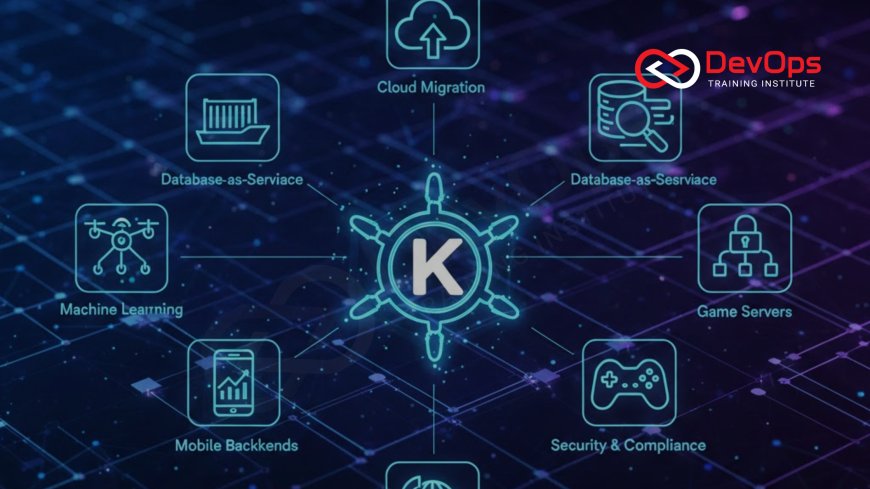
Kubernetes has moved far beyond being just a container orchestrator. In 2025, it is the de facto platform for running everything from stateless web apps to stateful databases, machine learning training clusters, and even edge devices. These 10 proven use cases demonstrate why over 80% of Fortune 500 companies now run Kubernetes in production, often starting with Multi-AZ deployments for maximum resilience.
1. Microservices at Global Scale – Netflix
- Runs over 150,000 containers across thousands of nodes
- Deploys hundreds of times per day with zero downtime
- Uses Titus + Kubernetes for batch and streaming workloads
- Achieves sub-second auto-scaling during traffic spikes
- Proves Kubernetes can handle planet-scale traffic reliably
2. Machine Learning & AI Workloads – OpenAI
OpenAI trains massive models like GPT on thousands of GPUs orchestrated by Kubernetes. Custom operators manage GPU scheduling, data pipelines, and distributed training, while Kubeflow simplifies the entire ML lifecycle from experiment to serving.
3. Edge Computing – Pokémon GO & Retail
Niantic runs Pokémon GO on Kubernetes at the edge using K3s and Anthos. Retail giants deploy lightweight clusters in stores for real-time inventory, facial recognition, and personalized offers with sub-100ms latency.
4. Stateful Applications & Databases
- Cloud-native PostgreSQL, Cassandra, MongoDB using operators
- Automated backups, failover, and scaling
- Consistent performance even during node failures
- Used by Shopify, Zalando, and Booking.com for core databases, often secured via private subnet strategies
5. GitOps & Progressive Delivery – Adobe, Intuit
ArgoCD and Flux synchronize entire clusters from Git. Feature flags, canary releases, and blue-green deployments become declarative and auditable. Teams reduce deployment risk by 90% while increasing release frequency.
6. Multi-Cloud & Hybrid Cloud – Goldman Sachs, Spotify
- Run identical workloads on AWS, GCP, Azure, and on-prem
- Avoid vendor lock-in with Cluster API and Anthos
- Migrate workloads between clouds in minutes
- Achieve true disaster recovery across continents, enhanced by read replicas for global low-latency access
7. Serverless Containers – Knative + Cloud Functions
Run functions and containers that scale to zero. Pay only for actual usage. Companies save 60-80% on idle resources while maintaining instant cold-start performance.
8. High-Performance Computing – CERN & NASA
CERN processes petabytes of Large Hadron Collider data using Kubernetes. NASA runs satellite image processing and Mars rover simulations on K8s clusters in the cloud and on-prem.
9. Gaming Backends – Supercell, Ubisoft
- Handles millions of concurrent players
- Auto-scale game servers based on real-time demand
- Rapidly roll out new regions and events
- Reduce infrastructure costs by 40% using spot instances and Karpenter
10. Cost Optimization & FinOps – Booking.com, Babylon Health
Tools like Kubecost, Stormforge, and Fairwinds provide visibility and automated rightsizing. Companies cut Kubernetes bills by 30-60% while improving performance, often monitoring everything with advanced observability.
Conclusion
Kubernetes is no longer optional; it’s the foundation for any organization that needs resilience, scale, and velocity in 2025. From planet-scale microservices and AI training to edge devices and cost-sensitive startups, these 10 use cases prove that Kubernetes delivers unmatched flexibility and reliability across every industry and workload type.
Frequently Asked Questions
Is Kubernetes only for microservices?
No. It excels at microservices but also runs monolithic apps, databases, ML training, batch jobs, and edge workloads.
Can Kubernetes run stateful applications safely?
Yes. Operators and StatefulSets make databases like PostgreSQL and Cassandra production-ready on K8s.
Is Kubernetes expensive?
When properly optimized with tools like Karpenter and Kubecost, it often reduces costs compared to traditional infrastructure.
Do I need Kubernetes for small applications?
Not always. Start with managed services (ECS, Cloud Run), but Kubernetes becomes valuable as complexity and scale grow.
Which companies run the largest Kubernetes clusters?
Netflix, Google, Microsoft, and Alibaba operate clusters with hundreds of thousands of nodes.
Can Kubernetes work on edge devices?
Yes. Lightweight distributions like K3s and MicroK8s run on Raspberry Pi and retail store servers.
Is multi-cloud Kubernetes realistic?
Absolutely. Cluster API, Anthos, and Open Cluster Management make it production-ready today.
Does Kubernetes replace CI/CD tools?
No, but it integrates perfectly with Tekton, Argo Workflows, and GitHub Actions for cloud-native pipelines.
Can Kubernetes scale to zero?
Yes with Knative or KEDA, making serverless containers cost-effective.
Is Kubernetes secure enough for regulated industries?
Yes. Banking, healthcare, and government agencies run compliant workloads using hardened images and policy engines.
What's Your Reaction?
 Like
0
Like
0
 Dislike
0
Dislike
0
 Love
0
Love
0
 Funny
0
Funny
0
 Angry
0
Angry
0
 Sad
0
Sad
0
 Wow
0
Wow
0



![100+ Azure DevOps Interview Questions and Answers [Updated 2025]](https://www.devopstraininginstitute.com/blog/uploads/images/202509/image_140x98_68c40aa9a3834.jpg)






![Future Scope of DevOps Careers in Pune [Updated 2025]](https://www.devopstraininginstitute.com/blog/uploads/images/202510/image_140x98_68e3a84652312.jpg)