




![Kong Interview Preparation Guide [2025]](https://www.devopstraininginstitute.com/blog/uploads/images/202509/image_430x256_68dbb95326997.jpg)






10 Most Common Kubernetes Vulnerabilities
In twenty twenty six, securing containerized environments is a primary concern for engineering teams worldwide. This detailed guide identifies the ten most common Kubernetes vulnerabilities, ranging from over-permissive role-based access control and exposed API servers to vulnerable container images and insecure secrets management. By understanding these critical security risks, DevOps professionals can implement advanced mitigation strategies such as zero-trust networking, automated image scanning, and robust policy enforcement through admission controllers. Learn how to protect your infrastructure from lateral movement, privilege escalation, and runtime attacks to ensure your production clusters remain resilient and compliant in the face of increasingly sophisticated cyber threats in the modern cloud landscape.
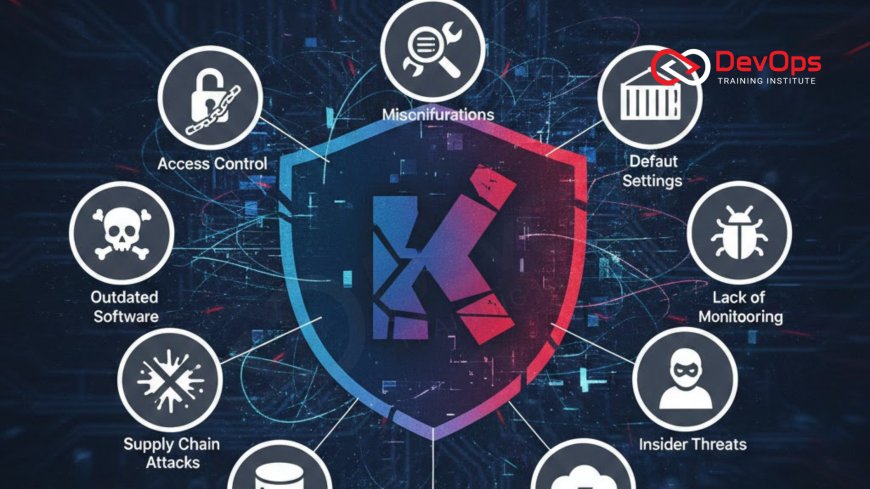
Introduction to Kubernetes Security Risks
Kubernetes has revolutionized the way we manage applications at scale, but its complexity introduces a significant attack surface that can be difficult to secure. While the platform offers powerful built-in security features, they are rarely enabled or optimized by default, leaving many clusters open to exploitation. As we navigate the technical landscape of twenty twenty six, understanding the most common Kubernetes vulnerabilities is essential for any team looking to maintain a stable and secure production environment. These risks often stem from a combination of software bugs, default settings, and human error during the configuration process.
The goal of a robust security strategy is not just to build a perimeter but to assume that breaches will occur and design the system to minimize the impact. This involves adopting a multi-layered approach that addresses risks at the container, node, and cluster levels simultaneously. By identifying and patching these common vulnerabilities, you can prevent attackers from gaining a foothold in your infrastructure or moving laterally to access sensitive customer data. This guide provides a deep dive into the top ten threats currently facing Kubernetes users, offering professional insights and practical fixes to help you harden your clusters against modern cyber attacks.
Misconfigured Role-Based Access Control (RBAC)
Role-Based Access Control is the primary mechanism for managing authorization in Kubernetes, but it is also one of the most frequently misconfigured components. Over-permissive roles, such as granting cluster-admin privileges to a service account or a developer who doesn't need them, create a massive security loophole. If an attacker compromises a pod with such high privileges, they can essentially take over the entire cluster, creating new resources or exfiltrating secrets at will. This failure to follow the principle of least privilege is a leading cause of major cloud breaches in the industry.
To fix this, teams must perform regular audits of their RBAC policies to ensure that every user and service account has only the minimum permissions required for their specific task. You should avoid using wildcards in your role definitions and instead list the exact resources and verbs allowed. Disabling the automounting of service account tokens for pods that do not need to interact with the Kubernetes API is another critical step in reducing the attack surface. By tightening your access controls, you ensure that your cultural change toward a more secure organization is backed by technical enforcement that protects your most sensitive cluster states from unauthorized access.
Exposed Kubernetes API Servers and Dashboards
The Kubernetes API server is the "front door" to your cluster, and leaving it exposed to the public internet without strong authentication is akin to leaving your data center's door wide open. Similarly, the Kubernetes Dashboard, while useful for visualization, can become a powerful attack vector if it is left unauthenticated or publicly accessible. Attackers constantly scan the internet for these open ports, looking for entry points to deploy crypto-mining malware or steal infrastructure credentials. These exposed components are often the first thing a malicious actor will look for when targeting a specific organization.
Mitigation involves strictly limiting access to these management interfaces. You should never run the API server or the dashboard on a public IP address without a VPN or an IP allowlist. Enforcing multi-factor authentication and utilizing OIDC integration for the API server provides a much stronger layer of defense than simple tokens or certificates. Furthermore, many high-security teams choose to disable the dashboard entirely in production, relying instead on command-line tools or specialized ChatOps techniques for monitoring and management. This ensures that the control plane remains invisible to the outside world, significantly reducing the likelihood of a remote takeover.
Vulnerable or Untrusted Container Images
A Kubernetes cluster is only as secure as the code running inside its containers. Using images from untrusted registries or those containing unpatched vulnerabilities is a significant risk that can lead to application compromise or container escapes. Many public images contain critical vulnerabilities in their base OS libraries or third-party dependencies, which can be exploited once the pod is running. Furthermore, supply chain attacks, where an attacker "poisons" a popular image with a backdoor, are becoming an increasingly common threat in twenty twenty six for teams that do not verify image provenance.
The fix for this pitfall is to implement a strict image scanning policy within your CI/CD pipeline. Every image must be scanned for known CVEs before it is allowed to be deployed into the cluster. You should also use minimal base images, such as Alpine or Distroless, to reduce the overall attack surface and eliminate unnecessary tools that an attacker could use after a compromise. Enforcing image signing ensures that only trusted, verified images from your internal registry can be executed. This proactive approach to security ensures that your continuous synchronization process only delivers hardened and safe artifacts to your production environment, protecting your users and your business from hidden software flaws.
Kubernetes Vulnerability & Risk Summary
| Vulnerability Name | Primary Risk | Technical Impact | Urgency |
|---|---|---|---|
| Over-permissive RBAC | Privilege Escalation | Full cluster takeover | Critical |
| Insecure Secrets | Credential Theft | Data & API compromise | High |
| Privileged Containers | Container Escape | Host system access | Critical |
| Unrestricted Network | Lateral Movement | Cross-pod exploitation | High |
| Outdated Components | Known CVE Exploits | System instability | Medium |
Privileged Containers and Host Access
Running containers in privileged mode is a dangerous practice that effectively removes the isolation between the container and the host operating system. A privileged container has access to almost all of the host's devices and kernel features, making a container escape trivial for an attacker. This is often used by system-level tools, but application developers sometimes enable it to bypass permission errors without understanding the severe security implications. It is a common vulnerability that can turn a minor application bug into a total compromise of the physical or virtual machine running the pod.
To secure your cluster, you must strictly prohibit the use of privileged containers unless they are absolutely necessary for infrastructure management. You should use Pod Security Admission to enforce the "Restricted" or "Baseline" standards across your namespaces, which automatically blocks pods that request dangerous capabilities. Furthermore, you should utilize admission controllers to validate every pod specification before it is accepted by the API server. This ensures that no developer can accidentally or intentionally introduce a privileged workload into the environment. Combining this with a read-only root filesystem for your containers further limits what an attacker can do if they manage to gain unauthorized access to a pod.
Insecure Secrets Management and etcd Exposure
Kubernetes Secrets are intended to store sensitive data, but by default, they are only base64 encoded and stored in plain text within the etcd database. If an attacker gains access to etcd or can read secret objects through a misconfigured RBAC role, your API keys and database passwords are essentially public. Furthermore, many teams accidentally store secrets in ConfigMaps or hardcode them into environment variables, making them even easier for an attacker to find. Protecting these "keys to the kingdom" is a fundamental requirement for any secure cloud native deployment strategy.
The solution is to enable encryption at rest for secrets in etcd and to move toward an external secret management model. Integrating your cluster with a tool like HashiCorp Vault or a cloud-native secret manager ensures that your sensitive data is encrypted with enterprise-grade keys. You should also use secret scanning tools to detect any credentials that might have been accidentally committed to your Git repositories. Restricting access to the etcd pods using network policies and ensuring that only the API server can communicate with them is another critical layer of defense. This comprehensive approach to identity and data protection is a key part of choosing architecture patterns that prioritize security over convenience.
Best Practices for Mitigating Kubernetes Threats
- Enable Network Policies: Block all pod-to-pod communication by default and only allow specific traffic that is necessary for the application to function correctly.
- Use Non-Root Users: Ensure all containers run as non-root users by setting the securityContext to runAsNonRoot: true in your pod manifests.
- Automate Updates: Regularly update your Kubernetes version and node operating systems to patch known incident handling issues and security vulnerabilities.
- Monitor Runtime Behavior: Use tools like Falco or Sysdig to detect suspicious activity inside your containers, such as unexpected process execution or file modifications.
- Harden the Kubelet: Disable anonymous access to the kubelet and ensure that only authorized control plane components can communicate with it.
- Enforce Resource Limits: Use containerd or other runtimes to enforce CPU and memory limits, preventing a compromised pod from causing a denial of service.
- Verify Configuration with GitOps: Use GitOps to manage your cluster state, providing a clear audit trail of all security-related changes and configurations.
Developing a secure Kubernetes environment is an iterative process that requires ongoing vigilance and a commitment to technical excellence. By integrating these best practices into your daily operations, you can build a resilient platform that protects your organization's digital assets. It is also important to conduct regular penetration testing and red-teaming exercises to identify any hidden weaknesses in your defenses. As you move toward a more mature security posture, you can explore continuous verification strategies that automatically test your security assumptions in real time, ensuring that your cluster remains hardened against the latest exploits and attack methodologies.
Conclusion: Securing the Future of Orchestration
In conclusion, the ten most common Kubernetes vulnerabilities represent a significant challenge for modern DevOps teams, but they are not insurmountable. By moving beyond default settings and embracing a security-first mindset, you can transform your cluster from a potential liability into a robust and secure foundation for your business. The key is to focus on automation, least privilege, and continuous monitoring throughout the entire container lifecycle. As systems become more complex, the role of the security professional is to simplify the management of these risks through intelligent tools and well-defined policies.
Looking ahead, the integration of AI augmented devops will likely provide even more sophisticated ways to detect and remediate these vulnerabilities automatically. Staying informed about AI augmented devops trends will help you stay ahead of the curve as the technology evolves. Ultimately, Kubernetes security is about creating a culture of shared responsibility where every engineer understands the importance of protecting the cluster. By addressing these ten critical vulnerabilities today, you are building a more secure and stable future for your organization's cloud native applications and your valuable customer data.
Frequently Asked Questions
What is the most dangerous Kubernetes vulnerability?
Misconfigured RBAC is often considered the most dangerous because it can lead to a full cluster takeover if a single pod is compromised.
How can I prevent container escape in Kubernetes?
Avoid running privileged containers and use Pod Security Admission to restrict dangerous capabilities and host access for all your workloads and applications.
Are Kubernetes Secrets secure by default?
No, they are only base64 encoded and stored in plain text; you must enable encryption at rest in etcd for true security.
Why is the Kubernetes API server a primary target?
It is the central control point of the cluster; gaining access to it allows an attacker to manage every resource in the environment.
What role do network policies play in security?
Network policies prevent lateral movement by restricting which pods can talk to each other, creating a zero-trust environment inside the cluster network.
Should I run my containers as root?
No, you should always run containers as a non-privileged user to minimize the impact if the container's main process is compromised by an attacker.
How often should I scan my container images?
Images should be scanned during the build process, before deployment, and continuously while running in production to catch new vulnerabilities as they are found.
What is Pod Security Admission (PSA)?
PSA is a built-in Kubernetes controller that allows you to enforce predefined security standards, like privileged, baseline, or restricted, at the namespace level.
Is the Kubernetes Dashboard safe to use in production?
It can be risky if not properly secured with authentication and restricted to internal networks; many teams prefer to disable it entirely for better security.
What is the risk of an exposed etcd database?
An exposed etcd allows an attacker to read all cluster data, including all secrets and configuration details, leading to a complete system-wide compromise.
How do admission controllers improve security?
They intercept requests to the API server and can reject any pod that doesn't meet your organization's security and compliance policies and standards.
What is a supply chain attack in Kubernetes?
It involves an attacker compromising a component of the delivery pipeline, such as a base image or a third-party plugin, to inject malicious code.
Can I use AI to find Kubernetes vulnerabilities?
Yes, modern security tools use AI to analyze configuration and runtime data to identify anomalies and potential vulnerabilities that humans might miss in large clusters.
How does GitOps help with security audits?
GitOps provides a versioned, immutable history of every change made to the cluster configuration, making it easy to audit and identify exactly when a misconfiguration occurred.
What is the first security step for a new cluster?
The first step is to enable RBAC with a least-privilege approach and restrict access to the API server to a trusted network or location.
What's Your Reaction?
 Like
0
Like
0
 Dislike
0
Dislike
0
 Love
0
Love
0
 Funny
0
Funny
0
 Angry
0
Angry
0
 Sad
0
Sad
0
 Wow
0
Wow
0


![100+ Azure DevOps Interview Questions and Answers [Updated 2025]](https://www.devopstraininginstitute.com/blog/uploads/images/202509/image_140x98_68c40aa9a3834.jpg)






![Future Scope of DevOps Careers in Pune [Updated 2025]](https://www.devopstraininginstitute.com/blog/uploads/images/202510/image_140x98_68e3a84652312.jpg)