




![Kong Interview Preparation Guide [2025]](https://www.devopstraininginstitute.com/blog/uploads/images/202509/image_430x256_68dbb95326997.jpg)





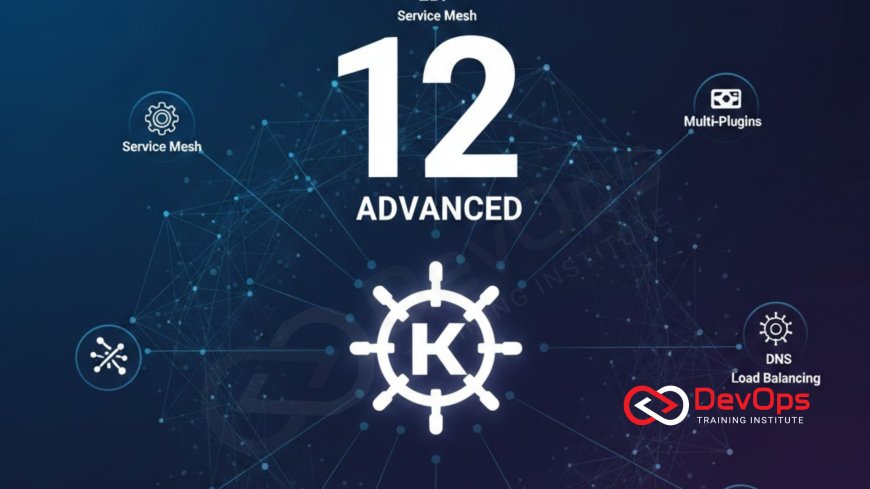
12 Advanced Kubernetes Networking Concepts
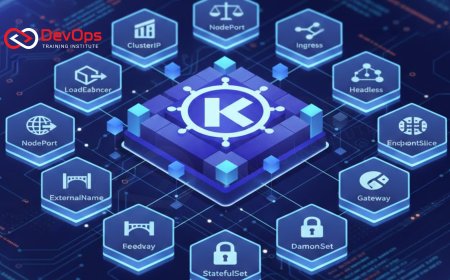
Unlock deep expertise in cloud-native operations with these 12 advanced Kubernetes networking concepts. This guide delves into the complexities of the Container Network Interface (CNI), exploring CNI plugins like Calico and Cilium, the role of kube-proxy, and the advanced capabilities of Service Mesh technologies like Istio. Learn how to implement microsegmentation using Network Policies, manage complex cluster ingress with the Gateway API, and master the differences between overlay and underlay networks to build secure, high-performance, and scalable production clusters for any cloud environment.
Introduction: Beyond the Basics of Services
Kubernetes is the undisputed operating system of the cloud, but its networking layer remains one of the most complex and least understood components. While most engineers grasp the foundational concepts of Pods, Services, and basic Ingress, managing a truly scalable, secure, and high-performance production cluster requires mastery of advanced networking concepts that operate beneath the surface of the Kubernetes API. The complexity arises from Kubernetes's fundamental networking model: every Pod gets its own unique IP address, and all Pods must be able to communicate directly with all other Pods, a requirement that challenges traditional network topologies and demands sophisticated routing solutions.
For DevOps engineers and SREs, a deep dive into these advanced concepts is essential for solving real-world operational challenges, such as troubleshooting intermittent connectivity issues, optimizing network performance, and enforcing strict security controls using microsegmentation. It involves understanding the differences between various third-party network implementations (CNIs), configuring complex traffic routing for external access, and leveraging service mesh technologies to enhance security and observability within a cluster. This guide breaks down 12 advanced Kubernetes networking concepts that move beyond introductory knowledge, equipping you with the expertise needed to manage enterprise-grade containerized infrastructure in any cloud environment.
The Core Network Engine: CNI Deep Dive
The Container Network Interface (CNI) is a critical, pluggable component that handles the complex reality of Kubernetes's network model. Kubernetes does not ship with a built-in Pod network solution; instead, it relies entirely on a CNI plugin to allocate IP addresses to Pods and establish the necessary routing on each worker node to ensure full Pod-to-Pod connectivity across the entire cluster. Choosing the correct CNI is a fundamental architectural decision that profoundly impacts performance, scalability, and security capabilities.
1. CNI Principles (Pod IP Address Management): The CNI plugin is responsible for two primary tasks: IP Address Management (IPAM), ensuring every Pod receives a unique, non-conflicting IP address from the cluster's CIDR range, and configuring the network routes on the node. This process must account for Pod mobility, ensuring that when a Pod is rescheduled to a different node, its communication path is correctly re-established without manual intervention.
2. Overlay vs. Underlay Networks: CNIs employ different strategies to handle Pod-to-Pod communication. Overlay Networks (like Flannel VXLAN) encapsulate Pod packets into tunnels, making setup simple but potentially adding latency. Underlay Networks (like Calico BGP or AWS VPC CNI) use the underlying physical network's routing capabilities, offering lower latency but requiring deeper integration with the cloud's cloud networking architecture. Understanding this tradeoff is crucial for performance optimization.
3. eBPF Dataplane (Cilium): This revolutionary approach leverages the Linux kernel's eBPF technology to handle network and security policy enforcement directly in the kernel, bypassing traditional Linux mechanisms like iptables. CNIs like Cilium use eBPF for best-in-class performance, superior observability (via Hubble), and advanced security features, making it a leading choice for high-throughput, cloud-native environments.
4. Cloud-Specific CNIs (AWS VPC CNI, Azure CNI): Managed Kubernetes services often use specialized CNIs that deeply integrate with the host cloud’s network fabric. For example, the AWS VPC CNI assigns Pods IP addresses directly from the VPC subnet, enabling high performance but requiring careful IP address planning to prevent exhaustion, especially in clusters designed for massive scale. Azure offers an Overlay CNI to address IP exhaustion limitations.
Service Isolation and Security Controls
While Kubernetes defaults to an "all-allow" network model, production environments mandate a Zero-Trust approach where all communication is denied by default, and only explicitly authorized traffic is permitted. This microsegmentation is achieved through specialized security resources and traffic enforcement mechanisms, providing the granular control necessary to isolate sensitive workloads like databases and authentication services from the wider cluster network.
5. Kubernetes Network Policies: These are Kubernetes API objects that allow you to define ingress (inbound) and egress (outbound) firewall rules for specific Pods based on labels or IP ranges. Effective security requires implementing a default deny-all policy first, and then gradually adding explicit "allow" rules only for necessary traffic paths, ensuring that isolation is enforced between different application tiers and namespaces. This granular control prevents unrestricted lateral movement within the cluster, mitigating the damage caused by a compromised container.
6. Service Mesh (Istio/Linkerd): A service mesh is a dedicated infrastructure layer that handles service-to-service communication, security, and observability. It works by deploying a small proxy (sidecar) next to every application Pod. Advanced features include Mutual TLS (mTLS) for automatic, encrypted communication between all services, fine-grained L7 routing (e.g., routing based on HTTP headers), and transparent traffic splitting for advanced deployment strategies like canary releases, significantly enhancing both security and resilience.
7. Pod Security and Egress Filtering: Beyond ingress control, limiting a Pod's outbound (egress) traffic is crucial for preventing data exfiltration or communication with unauthorized external command-and-control servers. Egress Network Policies can restrict a Pod's external communication to only approved IP ranges or FQDNs (Fully Qualified Domain Names), providing a powerful layer of defense for highly sensitive applications and preventing unauthorized access to external resources.
Advanced Traffic Management and Ingress
Exposing applications to the outside world requires sophisticated traffic management to handle advanced routing, TLS termination, and policy enforcement at the cluster edge. While the basic Ingress resource is simple, enterprise requirements often demand the flexibility and control provided by dedicated controllers and newer APIs, enabling complex edge security and routing logic.
8. Ingress Controllers (Nginx, Envoy, Traefik): The standard Kubernetes Ingress resource is just a set of rules; it requires a specialized Ingress Controller (like Nginx, Contour, or an Application Gateway) to implement and enforce those rules. Advanced usage involves configuring these controllers for specific tasks like HTTP-to-HTTPS redirection, centralized certificate management (TLS termination), and integrating with cloud-native load balancers to ensure robust external access to your cluster's services.
9. Gateway API (The Future of Ingress): The Gateway API is the modern, more expressive successor to the traditional Ingress API. It is designed to provide better role separation between cluster operators and application developers and supports a richer feature set, including native traffic splitting, weighted load balancing, and advanced policy attachment. Its adoption simplifies complex service mesh integrations and multi-cluster routing, enabling safer and more feature-rich management of north-south traffic (traffic entering/leaving the cluster) at scale.
10. ExternalName Service: This advanced Service type provides a way to map a Kubernetes Service to an external DNS name (e.g., an external database or third-party API) instead of a cluster IP. This allows Pods within the cluster to use the familiar Kubernetes Service naming convention (e.g., my-external-db.default.svc.cluster.local) to communicate with external resources. It is invaluable for abstracting and managing access to external services and simplifying application configuration and testing environments.
| # | Concept | Primary Function / Tool | Advanced Use Case |
|---|---|---|---|
| 1 | CNI Principles | IPAM and Pod Routing | Optimizing IP address utilization and Pod density per node. |
| 5 | Network Policies | Microsegmentation (L3/L4) | Enforcing Zero-Trust and HIPAA/PCI compliance segmentation between services. |
| 6 | Service Mesh | Istio / Linkerd | Automating Mutual TLS (mTLS), L7 routing, and traffic observation. |
| 9 | Gateway API | Next-Gen Ingress | Unified API for ingress/egress, traffic splitting, and advanced policy enforcement. |
| 11 | Kube-proxy Modes | iptables vs. IPVS vs. eBPF | Optimizing Service load balancing performance, especially for clusters with 1000s of services. |
Advanced Service Proxies and Load Balancing
The kube-proxy component is the workhorse of Kubernetes networking, responsible for implementing the Service abstraction on every node. While its function is fundamental, the way it operates can be configured in different modes, each with significant performance implications for large-scale, high-throughput clusters. Understanding these underlying mechanisms is crucial for performance tuning and choosing the right combination of CNI and proxy modes for a production workload that is highly dependent on fast, reliable, and efficient load balancing.
11. Kube-proxy Modes (iptables vs. IPVS vs. eBPF): Historically, kube-proxy used iptables to program network rules for load balancing Service traffic, but this approach introduces significant latency and overhead in clusters with thousands of services. The IPVS (IP Virtual Server) mode is a modern alternative, using kernel-level load balancing for vastly superior performance and scalability. Further pushing the boundary, CNIs like Cilium can replace kube-proxy entirely by implementing the service functionality using high-performance eBPF, demonstrating the continuous evolution of Kubernetes networking to meet modern performance demands. Choosing the right mode directly impacts the performance of every microservice in the cluster.
12. EndpointSlices: As clusters scale to support thousands of Pods behind a single Service, the original Endpoints resource becomes a performance bottleneck for the API server and the kube-proxy. EndpointSlices are a more scalable, streamlined mechanism that Kubernetes uses to track the network endpoints of the Pods backing a Service. By dividing the service endpoints into smaller chunks, EndpointSlices ensure that updates to the list of healthy Pods are much more efficient, significantly reducing API server load and minimizing the time required for load balancers to register new or failed Pods, which is essential for massive scale and resilience.
Advanced Security and Compliance: Best Practices
The complexity of advanced Kubernetes networking means that security requires a multi-layered approach, combining CNI features, Kubernetes APIs, and service mesh controls to achieve comprehensive defense. Engineers must ensure security policies adhere to the principle of least privilege, preventing unauthorized communication and data exposure, often referencing established best practices for securing network services across the OSI and TCP/IP models.
Advanced security practices within Kubernetes should prioritize policy automation and consistent enforcement. This includes using CNI features like Calico’s L3/L4 policies for microsegmentation and utilizing Cilium’s advanced L7 policies for application-aware security (e.g., limiting HTTP methods or paths). This layered defense ensures that traffic is inspected and controlled at multiple levels, preventing both external threats from exploiting common vulnerabilities and internal threats from performing lateral movement. The declarative nature of these policies means they can be version-controlled, audited, and automatically enforced via CI/CD pipelines, making security management at scale achievable.
Conclusion: Mastery of the Cloud-Native Fabric
Mastery of these 12 advanced Kubernetes networking concepts is what differentiates a basic operator from a high-performing Cloud or DevOps Engineer capable of running large-scale, resilient, and secure containerized environments. The journey requires a deep understanding of the CNI's role in establishing Pod connectivity, the strategic implementation of Network Policies and Service Mesh for microsegmentation and encryption, and the ongoing optimization of traffic management via the Gateway API and advanced kube-proxy modes.
By treating the Kubernetes network as a highly programmable, software-defined fabric, engineers can move beyond simply troubleshooting basic connectivity problems to proactively designing systems that are inherently faster, more secure, and infinitely more scalable. This expertise ensures that the underlying network infrastructure is an accelerator of application delivery, not a constraint, guaranteeing the seamless performance and reliability required to meet the high demands of modern cloud-native systems.
Frequently Asked Questions
What is the role of a CNI plugin like Calico?
A CNI plugin like Calico is responsible for allocating Pod IP addresses and setting up network routing and policy enforcement across the cluster for Pod-to-Pod communication.
What is the difference between an overlay and underlay network?
Overlay networks use encapsulation (tunneling) between nodes, while underlay networks use the physical network’s native routing capabilities for Pod traffic.
How does Network Policy enforce Zero-Trust?
Network Policies enforce Zero-Trust by implementing a default "deny-all" rule, requiring explicit "allow" rules for any necessary communication between Pods.
What is the key advantage of the Gateway API over Ingress?
The Gateway API offers richer features like native traffic splitting and better role separation, making it the more flexible and modern successor to the traditional Ingress API.
What is a service mesh (Istio) primarily used for?
A service mesh is primarily used for automating L7 communication, securing service-to-service traffic with mTLS, and providing advanced observability and traffic routing controls.
What performance improvement does IPVS offer over iptables?
IPVS uses kernel-level load balancing for Services, offering significantly superior performance and scalability compared to the linear rule processing of iptables in large clusters.
What is the purpose of the eBPF technology in Cilium?
eBPF allows Cilium to bypass the traditional iptables stack, processing network packets directly in the kernel for enhanced performance, security, and observability.
How does Kubernetes manage DNS resolution?
Kubernetes uses a cluster DNS service (typically CoreDNS) that maps Service names (e.g., my-service.default.svc.cluster.local) to the Service's cluster IP address for internal resolution.
What is Pod Egress Filtering used for?
Pod Egress Filtering is used to restrict a Pod’s outbound network traffic, preventing unauthorized connections to external IPs or domains, which helps prevent data exfiltration and external attacks.
How does the externalName Service type function?
It maps an internal Kubernetes Service name to an external, fully qualified DNS name, allowing Pods to consume external services using a familiar internal Service name.
Why must DevOps Engineers understand the OSI and TCP/IP models?
Understanding these models is crucial for troubleshooting issues like network latency, firewall configuration problems, and microservice communication failures at various layers of the stack.
What are EndpointSlices used for?
EndpointSlices are a scalable mechanism used by Kubernetes to manage and efficiently track the endpoints of Pods backing a Service, reducing API server load in large clusters.
What is the core networking requirement in Kubernetes?
The core requirement is that every Pod must have its own unique IP address and be able to communicate directly with all other Pods in the cluster without Network Address Translation (NAT).
What is the main security benefit of mutual TLS (mTLS) in a service mesh?
mTLS automatically encrypts all service-to-service communication within the cluster and verifies the identity of the communicating workloads, ensuring secure transport and authentication.
Which CNI is often used for its simplicity but lacks Network Policy support?
Flannel is often used for its simplicity and ease of setup, but it typically lacks native support for enforcing Kubernetes Network Policies, requiring a security add-on like Calico to manage policy.
What's Your Reaction?
 Like
0
Like
0
 Dislike
0
Dislike
0
 Love
0
Love
0
 Funny
0
Funny
0
 Angry
0
Angry
0
 Sad
0
Sad
0
 Wow
0
Wow
0

![100+ Azure DevOps Interview Questions and Answers [Updated 2025]](https://www.devopstraininginstitute.com/blog/uploads/images/202509/image_140x98_68c40aa9a3834.jpg)






![Future Scope of DevOps Careers in Pune [Updated 2025]](https://www.devopstraininginstitute.com/blog/uploads/images/202510/image_140x98_68e3a84652312.jpg)