








![Kong Interview Preparation Guide [2025]](https://www.devopstraininginstitute.com/blog/uploads/images/202509/image_430x256_68dbb95326997.jpg)






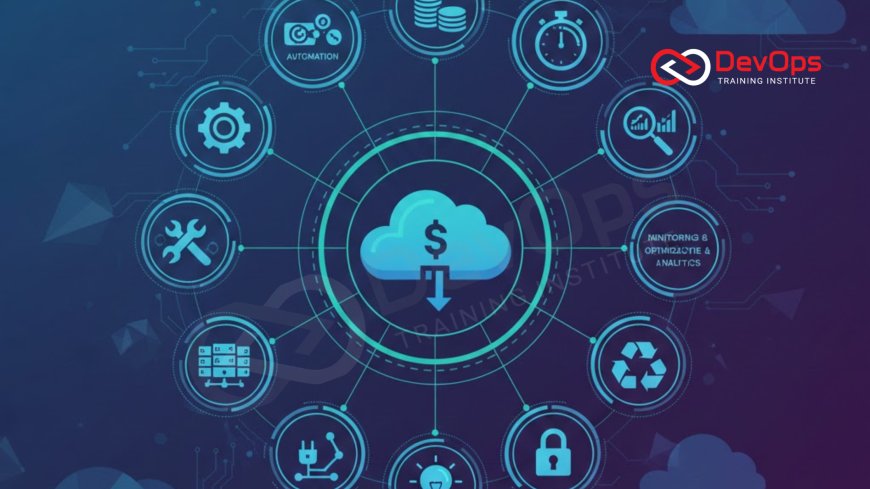
12 Cost Optimization Strategies for Cloud DevOps
Master the 12 most effective cost optimization strategies for cloud DevOps environments, transforming your spending from a liability into a strategic asset. This in-depth guide covers essential techniques, including reserved instances, autoscaling, serverless computing, and efficient storage management. Learn how to implement FinOps principles to reduce wasteful cloud expenditure while maintaining the speed and agility inherent to DevOps practices. Crucial reading for cloud architects, SREs, and DevOps leaders seeking to maximize return on investment, enhance financial accountability, and build a sustainable, cost-aware culture across their entire engineering organization.
Introduction
The rise of cloud computing has granted organizations unprecedented agility, scalability, and speed, forming the technical backbone of the DevOps movement. However, this pay-as-you-go model, while flexible, comes with a significant challenge: cost management. Without discipline and proactive strategies, cloud bills can quickly spiral out of control, eroding the financial benefits of digital transformation. For DevOps teams, the mandate is clear: maintain velocity and resilience while minimizing wasteful spending. This dual responsibility requires shifting from a purely technical mindset to one that incorporates financial accountability, a practice often referred to as FinOps.
Effective cloud cost optimization is not about cutting corners or sacrificing performance; it is about maximizing the value derived from every dollar spent on cloud resources. It involves implementing automated governance, optimizing infrastructure configurations, and fostering a culture where every engineer is cost-aware. This guide delves into 12 essential strategies that leaders and technical teams can implement today to systematically reduce unnecessary cloud expenditure. These strategies ensure that your infrastructure is right-sized, properly provisioned, and efficiently utilized, transforming cloud spending from an opaque burden into a measurable, strategic advantage that fuels further innovation and sustainable growth.
Strategy One: Right-Sizing and Cleaning Up Idle Resources
One of the easiest and most immediate ways to realize substantial cloud savings is by addressing the problem of oversized and underutilized resources. Due to initial over-provisioning or a "set it and forget it" mentality, many cloud instances run with far more CPU, memory, or storage than they actually require. This practice leads to direct waste, as the organization pays for capacity that is never used. Right-sizing involves continuously monitoring resource utilization metrics (CPU, RAM, network I/O) and adjusting the instance size down to meet actual workload demands, ensuring that the infrastructure precisely matches the application's needs, often resulting in savings of 30% or more on compute alone.
Furthermore, identifying and terminating idle resources is paramount. Development, staging, and testing environments are frequently left running 24/7, even when engineers are not actively using them during evenings or weekends. Implementing an automated schedule to stop or terminate these non-production resources outside of business hours is a straightforward, highly effective cost-saving measure. Automated scripts or native cloud scheduling tools should manage this cleanup, ensuring that temporary resources like snapshot volumes or old load balancers are also periodically reviewed and decommissioned if they are no longer actively serving a purpose. This process not only saves money but also minimizes the attack surface by reducing the number of running systems.
Strategy Two: Leveraging Commitment-Based Discounts (Reserved Instances)
For applications with predictable, sustained compute requirements, commitment-based pricing models offer one of the most significant levers for cost reduction. Cloud providers offer substantial discounts in exchange for a one- or three-year commitment to a specific level of usage. This commitment is often structured through Reserved Instances (RIs) or Savings Plans, which are essential tools in any comprehensive cost optimization strategy. The key is analyzing historical usage data to determine the baseline level of infrastructure that is always running, regardless of daily load spikes, and purchasing coverage for that fixed core capacity.
Reserved Instances provide a discount, typically ranging from 30% to 70%, for committing to a specific instance family, region, and term. Savings Plans, a more flexible alternative, offer a discount on compute usage (e.g., $10/hour for three years) across various instance types and often even across different compute services (e.g., VMs and FaaS). This flexibility makes them a strategic tool for minimizing long-term costs without fully locking the infrastructure into a single type. Effective management of these commitments requires a centralized approach, ensuring coverage is maintained and that purchased RIs are fully utilized across the entire organization, preventing costly underutilization of these prepaid resources.
Strategy Three: Utilizing Spot Instances and Serverless Compute
Optimizing costs for variable or interruptible workloads requires leveraging alternative pricing models that exploit the cloud's vast, unused capacity. Spot Instances, offered by major cloud providers, allow users to bid for unused compute capacity at steeply discounted rates, often 70% to 90% below standard on-demand prices. The catch is that these instances can be terminated with little warning when the capacity is needed elsewhere. This makes them unsuitable for stateful or mission-critical workloads, but they are perfect for batch processing, continuous integration (CI) builds, non-critical testing, and rendering tasks, which can be easily restarted or checkpointed.
The movement toward Serverless Compute, such as AWS Lambda or Azure Functions, offers another powerful path to optimization. Serverless services charge only for the exact amount of time the code is running, measured in milliseconds, and the memory consumed. This eliminates the cost associated with idle time, which is a major source of waste in traditional VMs. By refactoring suitable microservices to run as serverless functions, organizations can achieve true utilization-based pricing. This strategy often requires a change in development patterns but results in extremely efficient operations where teams no longer pay for underlying infrastructure capacity, maximizing the cost-benefit of compute resources.
Strategy Four: Implementing a Granular Tagging and Cost Allocation Strategy
You cannot optimize what you cannot measure. A granular tagging strategy is the foundation of any successful FinOps initiative, providing the necessary visibility for accurate cost allocation and accountability. Tags are metadata labels applied to cloud resources (VMs, databases, storage buckets) that identify their purpose, owner, environment, and cost center. Without consistent tagging, cloud bills are monolithic and impossible to dissect, obscuring where spending is actually occurring and preventing accurate chargebacks to specific teams or projects.
A well-defined tagging policy should be mandatory, enforced via Infrastructure as Code (IaC) tools and continuous auditing. Essential tags typically include: Environment (Dev, QA, Prod), Project, Owner/Team, and Application. By applying these tags consistently, leaders can break down the total cloud bill into granular, meaningful segments. This allocation makes individual teams responsible for their infrastructure spending, fostering a sense of ownership and directly incentivizing engineers to implement cost-saving measures within their domain. This accountability shift is a crucial cultural element of FinOps, turning abstract spending into actionable, team-specific performance data that drives behavior change across the organization.
Cost Optimization Pillars Summary
| Strategy Category | Key Strategy | Technical Implementation | Targeted Savings |
|---|---|---|---|
| Utilization | Right-Sizing & Decommissioning | Automated scripts to downscale underutilized VMs; scheduled shutdown for Dev/QA environments. | High (Up to 30% of compute) |
| Pricing Model | Reserved Instances / Savings Plans | Analysis of baseline consumption; committing to 1 or 3-year term agreements. | High (30% - 70% off on-demand) |
| Architecture | Serverless & FaaS Adoption | Refactoring suitable microservices to run on Lambda, Azure Functions, etc. | High (Eliminates idle time cost) |
| Data & Storage | Storage Tiering & Lifecycle Management | Automating migration of old data from hot block storage to cold object storage. | Significant (Up to 90% on archival data) |
| Governance | Mandatory Granular Tagging | Enforcing tags via IaC; using cloud billing tools for granular chargeback reports. | Indirect (Enables all other savings) |
| Compute Efficiency | Autoscaling and Scheduling | Implementing dynamic scaling groups and scheduled scaling based on predictable load. | Moderate-High (Matches provisioned capacity to demand) |
| Network | Minimizing Cross-Region Data Transfer | Co-locating services that communicate frequently; caching and compression for public traffic. | Moderate (Network costs can be surprisingly high) |
Strategy Five: Optimizing Storage and Data Archival
Data storage costs are a deceptively large component of the cloud bill, often growing unchecked as applications produce more logs, backups, and artifacts. The key cost-saving secret here is recognizing that not all data requires the same level of performance, availability, or immediate accessibility. Cloud providers offer tiered storage classes that vary wildly in price, from high-speed block storage used by databases to extremely low-cost, long-term archival storage suitable for regulatory backups.
Implementing a strict storage tiering and lifecycle management policy is critical. For instance, frequently accessed production data belongs on the "Hot" tier. Data that is needed occasionally for analytics can be moved automatically to the "Cool" or "Infrequent Access" tier, offering significant savings. Finally, regulatory or long-term backup data should be moved to the cheapest "Archive" tier, where retrieval times are slow but costs are extremely low. Automated policies should govern this movement, ensuring, for instance, that logs older than 90 days are automatically transitioned to cheaper storage classes. Furthermore, ensuring that old compressed files and unused snapshots are deleted or moved to archival storage prevents unnecessary consumption of expensive primary disk space, which is a common source of hidden costs.
Strategy Six: Automating Scaling and Scheduling
Static provisioning—setting capacity based on the absolute peak traffic expected—is a major source of waste. DevOps efficiency demands that infrastructure capacity dynamically matches current demand, scaling up during load spikes and scaling down or pausing completely during periods of low activity. This dynamic adjustment is managed through two primary mechanisms: autoscaling and scheduled scaling, both of which work to maximize resource utilization and prevent paying for unused capacity.
Autoscaling groups automatically adjust the number of running instances in real-time based on metrics such as CPU utilization or request queue length. This ensures that the application has the resources it needs during a traffic surge while allowing it to shed capacity when demand drops. Scheduled scaling is used for predictable traffic patterns, such as scaling up for the weekday business hours and scaling down sharply every evening or weekend. Combining these two—using scheduled scaling for baseline changes and autoscaling for dynamic spikes—creates a highly efficient system. This approach prevents manual intervention, reduces operational risk, and ensures that the infrastructure costs perfectly align with the actual service load, maximizing resource utility and minimizing idle costs throughout the infrastructure.
Strategy Seven: Optimizing Container and Orchestration Efficiency
The widespread adoption of containers (Docker) and orchestrators (Kubernetes) has opened up new avenues for cost optimization by drastically improving density. Running multiple application workloads on fewer underlying VMs maximizes the return on compute investment. However, this efficiency is only realized with discipline; poorly configured containers can introduce new forms of waste, such as oversized resource requests or container sprawl.
Key optimization strategies include right-sizing containers by setting appropriate CPU and memory requests and limits within Kubernetes deployment manifests. Oversized requests lead to underutilized nodes, forcing Kubernetes to schedule new pods inefficiently. Furthermore, leveraging managed services like AWS Fargate, which eliminates the need to manage the underlying compute plane entirely, can reduce operational toil and the associated costs of maintaining the Kubernetes control plane. Continuous monitoring of container density and node utilization is essential; if nodes are consistently underutilized, the underlying VM fleet should be right-sized or consolidated to fewer, more powerful instances, allowing the organization to fully leverage the dense packaging advantage that containerization provides.
Strategy Eight: Mastering Network and Data Transfer Costs
Network costs, particularly for cross-region data transfer, are often overlooked and can become a significant, unexpected expenditure. Cloud providers charge little for data entering a region (ingress) but charge substantial fees for data leaving a region (egress) or for transfer between different availability zones (AZs) or services.
The primary secret here is co-location and caching. Whenever possible, ensure that services that communicate frequently are deployed within the same region and, ideally, the same Availability Zone, eliminating cross-AZ transfer fees which can quickly add up. For global applications, utilize Content Delivery Networks (CDNs) like CloudFront to cache static content near end-users, reducing the volume of data that needs to leave the origin region. For internal transfers, evaluate if data compression techniques, using highly efficient algorithms like those offered by gzip, bzip2, and xz compression formats, can reduce the total volume of data being moved between services, thereby lowering the cumulative transfer costs, which is crucial for organizations dealing with massive datasets or high-traffic APIs.
Strategy Nine: Embracing FinOps Culture and Governance
Ultimately, cost optimization is a cultural challenge, not just a technical one. FinOps, or Cloud Financial Management, is the practice that brings financial accountability to the variable spending model of the cloud. It requires collaboration between Finance, Technology, and Business teams, ensuring that spending decisions are shared and transparent. A robust FinOps culture empowers engineers with the necessary cost visibility and tools to make cost-efficient choices every day, embedding financial efficiency into the DevOps feedback loop.
A key element of FinOps governance is establishing a "Cost Guardrail" strategy. This involves setting up automated alerts and policies that prevent the provisioning of overly expensive resources or ensure the mandatory application of required access control permissions and resource tags before deployment. For example, a policy could automatically deny the creation of an overly large VM instance type in a development environment or trigger an alert if a team's monthly spending budget is projected to be exceeded. These guardrails prevent waste before it happens, ensuring that compliance with cost policies is automated and enforced via IaC tools, turning optimization from a reactive cleanup task into a proactive, continuous governance practice.
Another crucial cultural shift is the prioritization of reducing technical debt related to waste. Teams should routinely dedicate time in their sprint cycles to address cost-saving tasks, treating them as high-priority features. By incorporating cost monitoring dashboards alongside performance metrics (Latency, Error Rates), teams are continuously reminded of the financial implications of their design choices, ensuring that the pursuit of speed and stability is always balanced against the goal of financial efficiency. This holistic approach, where user management and financial accountability are intertwined, ensures that every engineer becomes a steward of the cloud budget, driving sustainable, long-term savings across the entire organization, aligning engineering efficiency with business success.
Conclusion
Effective cloud cost optimization is an ongoing journey that requires continuous effort, automation, and, most importantly, a cultural commitment to financial accountability. The 12 strategies outlined—from foundational steps like right-sizing and implementing mandatory tagging to advanced techniques like leveraging Spot Instances and embracing FinOps culture—provide a comprehensive roadmap for transforming cloud spending. By prioritizing commitment-based discounts, optimizing storage tiers, and utilizing serverless and autoscaling capabilities, organizations can systematically eliminate cloud waste and ensure that their infrastructure spending perfectly aligns with their business value.
The future of DevOps is inextricably linked to FinOps. Leaders must empower their engineering teams with the necessary tools and visibility, enforcing cost-aware governance through automated guardrails and treating optimization as a feature. Mastering these strategies ensures not only lower cloud bills but also greater operational efficiency, as poorly managed resources are often poorly performing resources. By implementing these data-driven, systematic approaches, organizations can maximize the financial benefits of their cloud adoption, turning cost optimization into a competitive differentiator that fuels innovation and sustains rapid growth in the ever-evolving digital landscape, all while maintaining rigorous control over file system security and operational stability throughout the entire environment.
Frequently Asked Questions
What is the concept of "right-sizing" in cloud optimization?
Right-sizing means adjusting computing capacity (CPU, memory) to match the application's actual resource needs, avoiding paying for unused resources and reducing waste.
How do Reserved Instances (RIs) save money?
RIs save money by offering significant discounts (up to 70%) in exchange for a one- or three-year commitment to a specific level of compute usage.
What kind of workloads are suitable for Spot Instances?
Spot Instances are ideal for stateless, fault-tolerant workloads like CI/CD builds, batch processing, or non-critical testing, as they can be interrupted.
What is the main goal of FinOps?
The main goal of FinOps is to bring financial accountability to cloud spending, fostering collaboration between finance, business, and technology teams.
Why is a tagging strategy crucial for cost allocation?
Tagging is crucial because it allows the monolithic cloud bill to be accurately broken down and allocated to specific teams, projects, or environments for accountability.
How does Serverless Compute contribute to cost savings?
Serverless saves money by eliminating the cost of idle time, charging only for the exact milliseconds the code is actively running and processing requests.
What is storage tiering and why is it important?
Storage tiering is moving older, less frequently accessed data to cheaper storage classes, which significantly reduces the overall data retention cost.
How can Autoscaling help optimize costs?
Autoscaling dynamically adjusts capacity to meet real-time demand, ensuring you only pay for the resources required during peak usage, minimizing idle time waste.
Why are cross-region data transfer fees often surprising?
They are surprising because cloud providers charge for data leaving a region (egress) or moving between zones, which can accumulate rapidly in distributed architectures.
What is a cost guardrail in FinOps governance?
A cost guardrail is an automated policy or alert that prevents the provisioning of overly expensive resources or blocks deployments that violate cost rules.
What role does Infrastructure as Code (IaC) play in cost management?
IaC enforces mandatory tagging and prevents the creation of shadow IT or oversized resources, automating compliance with cost optimization policies.
How does Linux backup automation contribute to cost savings?
Automated backup schedules and lifecycle management ensure that old backups are moved to cheaper archival storage tiers, reducing expensive primary storage consumption.
How does resource usage monitoring help with cost optimization?
Monitoring identifies underutilized resources (low CPU/RAM usage), enabling teams to perform right-sizing and decommission completely idle instances for savings.
What is the operational benefit of using security auditing for cloud costs?
Security auditing ensures that only authorized personnel and processes with correct privileged access can create or manage resources, preventing malicious or accidental costly over-provisioning.
What should teams do with non-production environments during off-hours?
Teams should use automated scheduling tools to automatically stop or terminate non-production environments during evenings and weekends to save on compute costs.
What's Your Reaction?
 Like
0
Like
0
 Dislike
0
Dislike
0
 Love
0
Love
0
 Funny
0
Funny
0
 Angry
0
Angry
0
 Sad
0
Sad
0
 Wow
0
Wow
0

![100+ Azure DevOps Interview Questions and Answers [Updated 2025]](https://www.devopstraininginstitute.com/blog/uploads/images/202509/image_140x98_68c40aa9a3834.jpg)






![Future Scope of DevOps Careers in Pune [Updated 2025]](https://www.devopstraininginstitute.com/blog/uploads/images/202510/image_140x98_68e3a84652312.jpg)