


































![Kong Interview Preparation Guide [2025]](https://www.devopstraininginstitute.com/blog/uploads/images/202509/image_430x256_68dbb95326997.jpg)
















12 DevOps Coding Practices to Improve Reliability
Discover 12 essential DevOps coding practices that significantly enhance the reliability of your software, from robust error handling and comprehensive logging to implementing immutable infrastructure and continuous testing. Learn how to write code that's not just functional, but resilient, maintainable, and observable, directly supporting stable deployments and quicker recovery from incidents. This guide covers best practices in areas like defensive programming, idempotency, chaos engineering, and feature flagging, empowering developers to build more dependable applications within a DevOps framework, leading to a more reliable software delivery lifecycle.
Introduction
In the world of DevOps, speed and agility are paramount, but they should never come at the expense of reliability. Delivering software faster only truly benefits the business if that software is stable, performs well, and recovers gracefully from failures. Reliability is not an afterthought; it's a fundamental quality attribute that must be woven into the fabric of your code from the very beginning. It's about building systems that can withstand unexpected conditions, minimize downtime, and provide consistent service to users.
The shift from traditional development to DevOps emphasizes collaboration between development and operations teams, making developers more accountable for how their code performs in production. This increased ownership means adopting coding practices that proactively address potential issues, simplify debugging, and enable rapid recovery. It's no longer enough for code to just "work"; it must work reliably, predictably, and with clear insight into its operational state.
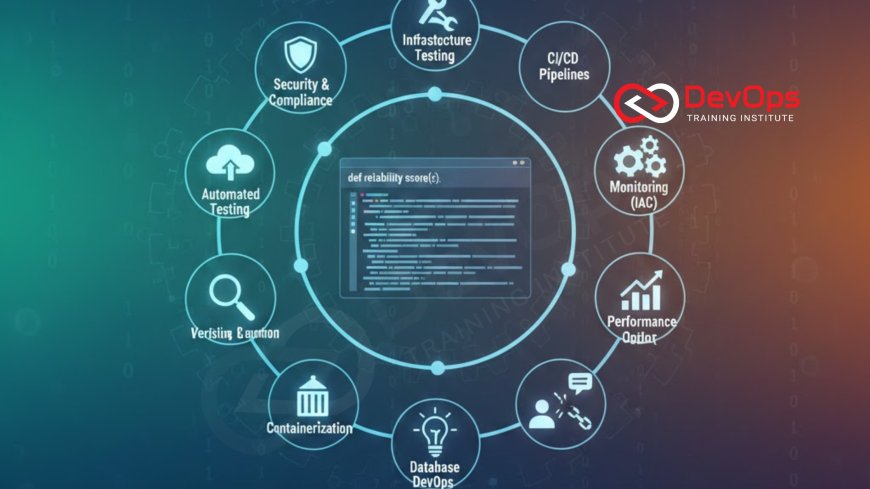
This blog post will explore 12 essential DevOps coding practices that significantly contribute to improving software reliability. These practices range from fundamental coding techniques like robust error handling and comprehensive logging to more advanced concepts such as immutable infrastructure and chaos engineering. By integrating these principles into your daily development workflow, you can build applications that are not only efficient and scalable but also exceptionally resilient and dependable, ultimately leading to higher customer satisfaction and a more stable production environment. Embracing these practices is a crucial step in maturing your DevOps lifecycle.
1. Robust Error Handling and Exception Management
One of the most fundamental aspects of reliable code is how it deals with errors. Simply crashing or returning generic errors is unacceptable. Robust error handling involves anticipating potential failure points (network issues, invalid input, resource exhaustion) and gracefully managing them. This means using structured exception handling, providing meaningful error messages, and logging sufficient context to diagnose issues quickly. Avoid "swallowing" exceptions without logging them, as this creates silent failures that are difficult to track down.
Practice: Implement comprehensive try-catch blocks, use specific exception types, and always log errors with relevant context (e.g., function name, input parameters, stack trace). Prioritize handling expected errors explicitly, allowing unexpected errors to propagate for global handling or crash reporting.
try:
    # Potentially failing operation
    result = fetch_data_from_api(user_id)
except ConnectionError as e:
    logger.error(f"API connection failed for user {user_id}: {e}")
    raise CustomAPIConnectionError("Could not connect to external API.")
except ValueError as e:
    logger.warning(f"Invalid input provided for user {user_id}: {e}")
    return {"error": "Invalid input"}
except Exception as e:
    logger.critical(f"An unexpected error occurred for user {user_id}: {e}", exc_info=True)
    raise
2. Comprehensive, Structured Logging
Logs are the eyes and ears of your application in production. Without adequate logging, debugging becomes a costly guessing game. Comprehensive logging involves capturing relevant events, while structured logging ensures these events are easily machine-readable and searchable by tools like Splunk, ELK Stack, or Grafana Loki. This is critical for post-incident analysis and proactive monitoring.
Practice: Use a logging framework that supports structured output (JSON, key-value pairs). Log at appropriate levels (DEBUG, INFO, WARN, ERROR, CRITICAL) and include correlation IDs for tracing requests across multiple services. Always log the context of the operation, not just the message. This practice is vital for effective RHEL 10 log management, ensuring centralized visibility.
import logging
import json

logger = logging.getLogger(__name__)
# Configure logger for structured output (example with basic JSON)

def process_order(order_id, user_id):
    logger.info(json.dumps({
        "event": "order_processing_started",
        "order_id": order_id,
        "user_id": user_id,
        "stage": "validation"
    }))
    # ... processing logic ...
    logger.info(json.dumps({
        "event": "order_processed_successfully",
        "order_id": order_id,
        "user_id": user_id,
        "duration_ms": 120
    }))
3. Monitoring and Observability Hooks
Reliable code is observable code. This means instrumenting your application to expose metrics (e.g., request latency, error rates, resource usage), traces (for distributed request flow), and logs. These "observability hooks" allow operations teams to understand the system's internal state without deploying new code. Metrics can trigger alerts, while traces help pinpoint performance bottlenecks in microservices architectures.
Practice: Integrate with an observability framework (e.g., OpenTelemetry, Prometheus client libraries). Add metrics to key operations (counters for requests, histograms for latency). Ensure traces are propagated across service boundaries using correlation IDs. Expose `/metrics` endpoints. This is key for understanding the system's health and aligns with the goals of which observability pillar is best for incident insight.
from prometheus_client import Counter, Histogram

requests_total = Counter('http_requests_total', 'Total HTTP Requests')
request_latency = Histogram('http_request_latency_seconds', 'HTTP Request Latency')

@app.route('/api/data')
def get_data():
    requests_total.inc()
    with request_latency.time():
        # ... application logic ...
        return "Data"
4. Idempotent Operations
An operation is idempotent if applying it multiple times produces the same result as applying it once. This is crucial for reliable distributed systems, especially in scenarios involving retries, message queues, or eventual consistency. If a network request times out, a client might retry, and if the original request eventually succeeded, a non-idempotent operation could lead to duplicate processing (e.g., charging a customer twice).
Practice: Design APIs and business logic to be idempotent. For state-changing operations, use unique identifiers (e.g., transaction IDs, idempotency keys) to detect and prevent duplicate processing. Ensure database operations can handle re-execution without adverse effects (e.g., `INSERT OR UPDATE`).
def process_payment(transaction_id, amount):
    # Check if transaction_id has already been processed
    if db.transaction_exists(transaction_id):
        logger.warning(f"Duplicate transaction_id received: {transaction_id}. Skipping.")
        return {"status": "already_processed", "transaction_id": transaction_id}

    # Process payment if new
    db.save_transaction(transaction_id, amount, status="completed")
    return {"status": "processed", "transaction_id": transaction_id}
5. Defensive Programming
Defensive programming is about writing code that anticipates potential misuses, invalid inputs, and unexpected conditions. It involves validating all inputs, guarding against null or empty values, and explicitly checking assumptions. This reduces the likelihood of bugs and security vulnerabilities, preventing errors from cascading through the system.
Practice: Validate all external inputs at the service boundary. Use assertions for internal assumptions that should never be false. Always check return values from functions that might fail. Implement sensible defaults where appropriate, but be explicit about expected data types and ranges.
def calculate_discount(price, discount_percentage):
    if not isinstance(price, (int, float)) or price < 0:
        raise ValueError("Price must be a non-negative number.")
    if not isinstance(discount_percentage, (int, float)) or not (0 <= discount_percentage <= 100):
        raise ValueError("Discount percentage must be between 0 and 100.")

    return price * (1 - discount_percentage / 100)
6. Immutable Infrastructure (Code for Immutability)
While often associated with infrastructure provisioning (e.g., Docker, Kubernetes), the concept of immutability also influences application code. Applications designed for immutable infrastructure expect their environment not to change after deployment. This means applications should be stateless where possible, store persistent data externally, and be robust to restarts/redeployments. Code should not attempt to modify its own deployment environment at runtime.
Practice: Design services to be stateless and store data in external databases, object storage, or message queues. Assume your container or VM can be terminated and replaced at any moment. Your application should start quickly and correctly every time, pulling configurations from environment variables or external configuration services, not local mutable files. This aligns well with the principles of RHEL 10 post-installation checklist for automated and consistent setup.
# Bad practice: Writing temporary files to local container storage
# during runtime and expecting them to persist across restarts.

# Good practice: Storing session data in Redis,
# configuration in environment variables or a config service.
REDIS_HOST = os.getenv("REDIS_HOST", "localhost")
redis_client = redis.Redis(host=REDIS_HOST)

def get_session_data(session_id):
    return redis_client.get(session_id)
7. Automated Testing (Unit, Integration, E2E)
Reliable code is thoroughly tested code. Automated testing at multiple levels (unit, integration, end-to-end) catches bugs early in the development cycle, before they reach production. It provides a safety net for refactoring and ensures new features don't break existing functionality. This is a cornerstone of any robust CI/CD pipeline.
Practice: Write unit tests for individual functions/components, integration tests for interactions between components (e.g., service and database), and end-to-end tests for critical user flows. Automate these tests in your CI/CD pipeline, requiring them to pass before deployment. Aim for high test coverage and use realistic test data. This is integral to a strong release cadence.
# Example: Unit test for calculate_discount function
import unittest

class TestDiscountCalculator(unittest.TestCase):
    def test_basic_discount(self):
        self.assertEqual(calculate_discount(100, 10), 90)

    def test_zero_discount(self):
        self.assertEqual(calculate_discount(50, 0), 50)

    def test_full_discount(self):
        self.assertEqual(calculate_discount(200, 100), 0)

    def test_invalid_price(self):
        with self.assertRaises(ValueError):
            calculate_discount(-10, 10)
8. Circuit Breakers and Retries
In distributed systems, one service's failure can cascade and bring down others. Circuit breakers prevent this by rapidly failing requests to an unhealthy service, giving it time to recover, instead of hammering it with requests. Retries, with exponential backoff and jitter, allow a service to recover from transient failures without immediate user impact. These are crucial resilience patterns.
Practice: Implement circuit breaker patterns (e.g., using libraries like Hystrix or resilience4j) when making calls to external services or databases. For non-critical operations, implement retry mechanisms with proper backoff strategies to avoid overwhelming the failing dependency. Always set reasonable timeouts for external calls.
# Pseudocode for a retry mechanism
import time
import random

def reliable_api_call(service_url, max_retries=3):
    for i in range(max_retries):
        try:
            response = http.get(service_url, timeout=5)
            response.raise_for_status() # Raise an exception for bad status codes
            return response.json()
        except (requests.exceptions.RequestException, http.HTTPStatusError) as e:
            logger.warning(f"Attempt {i+1} failed for {service_url}: {e}")
            if i < max_retries - 1:
                sleep_time = (2 ** i) + random.uniform(0, 1) # Exponential backoff with jitter
                time.sleep(sleep_time)
            else:
                logger.error(f"Max retries reached for {service_url}. Failing.")
                raise
9. Graceful Degradation and Fallbacks
Not every failure needs to halt your entire application. Graceful degradation means your application can continue to function, albeit with reduced functionality or performance, even when some components are unavailable. Fallbacks provide alternative ways to deliver value when the primary method fails. For example, if a recommendation engine is down, the e-commerce site might show popular items instead of personalized ones.
Practice: Identify non-critical components and design fallback mechanisms. Use default values, cached responses, or simpler logic if an external dependency is unavailable. Communicate degraded functionality to users if necessary, but prioritize core functionality remaining accessible. This is a key aspect of building resilient user experiences.
def get_recommendations(user_id):
    try:
        recommendations = recommendation_service.fetch(user_id)
        if not recommendations:
            return default_popular_items() # Fallback to popular if service returns empty
        return recommendations
    except Exception as e:
        logger.error(f"Recommendation service failed: {e}. Falling back to popular items.")
        return default_popular_items() # Fallback if service is down
10. Feature Flags and Canary Releases
Deploying new features directly to all users can be risky. Feature flags (or toggles) allow you to enable or disable features dynamically without redeploying code. This enables "dark launches" and phased rollouts. When combined with canary releases (deploying new code to a small subset of users), feature flags enable controlled experimentation and rapid rollback if issues are detected, significantly improving deployment reliability and minimizing blast radius.
Practice: Implement a feature flagging system (internal or third-party). Wrap new or risky code paths behind feature flags. Use these flags to control phased rollouts (e.g., 1% of users, then 10%, etc.) or enable/disable features in response to production issues. This allows for quick remediation without a full redeploy.
def render_new_checkout_experience(user_id):
    if feature_flag_service.is_enabled("new-checkout-experience", user_id):
        return render_template("new_checkout.html")
    else:
        return render_template("old_checkout.html")
11. Chaos Engineering Principles
Chaos engineering is the discipline of experimenting on a system in production in order to build confidence in the system's capability to withstand turbulent conditions. Instead of just reacting to failures, you proactively inject them to find weaknesses before they impact users. While full-scale chaos engineering is an Ops responsibility, developers can contribute by designing their code to be "chaos-aware."
Practice: Design your services to be resilient to common failure modes (e.g., latency, network partitions, resource exhaustion). Think about how your service would behave if a dependency returned an error 10% of the time. Introduce testing hooks that can simulate failures (e.g., configurable latency or error rates for API calls in test environments) to validate resilience patterns. This is key for robust DevOps lifecycle management, as it pushes for proactive resilience rather than reactive fixes.
import os

def call_external_service(data):
    # Simulate failure for testing/chaos engineering
    if os.getenv("SIMULATE_FAILURE", "false").lower() == "true":
        if random.random() < 0.2: # 20% chance of failure
            raise ConnectionError("Simulated external service connection error.")

    # ... actual service call ...
12. Post-Mortem Driven Improvement
Reliability is not just about preventing failures, but also about learning from them. Post-mortems (or incident reviews) are critical opportunities to identify the root causes of incidents, not to assign blame, but to derive actionable improvements. Developers play a crucial role in these, understanding the code paths that led to the incident and suggesting code-level changes to prevent recurrence. This continuous learning loop is at the heart of DevOps and SRE (Site Reliability Engineering).
Practice: Actively participate in post-mortem discussions. Focus on system-level vulnerabilities, not individual mistakes. Translate incident findings into concrete code changes (e.g., adding more logging, improving error handling, implementing a circuit breaker, enhancing testing). Prioritize these reliability improvements in your backlog to continuously harden your systems. This practice is essential for defining the **release cadence** in high-velocity environments, ensuring that lessons learned translate into more stable releases.
For example, a post-mortem might reveal that a specific API call consistently times out under load. The development team's action item could be to implement a circuit breaker for that API, add exponential backoff to its retries, and ensure the metrics around that API call are more granular for better future monitoring. This iterative process of learning and adapting directly contributes to long-term reliability.
Conclusion
Software reliability is a shared responsibility within a DevOps culture, and developers are at the forefront of building resilient systems. By adopting these 12 coding practices, you move beyond merely delivering functional code to delivering code that is robust, observable, maintainable, and capable of gracefully handling the inevitable complexities of production environments. These practices are not just about preventing failures; they are about building confidence in your systems, enabling faster iteration, and providing a superior experience for your users.
Integrating robust error handling, comprehensive logging, and monitoring hooks ensures that you have visibility into your application's health. Designing for idempotency and applying defensive programming principles fortifies your code against unexpected inputs and race conditions. Automated testing provides a critical safety net, while resilience patterns like circuit breakers and graceful degradation protect against cascading failures. Finally, leveraging feature flags, chaos engineering principles, and post-mortem driven improvements ensures a continuous loop of learning and hardening.
Embracing these DevOps coding practices transforms the way you approach software development. It fosters a mindset where reliability is a continuous, proactive effort, rather than a reactive response to incidents. As organizations strive for higher availability and faster deployments, the ability to write reliable code becomes an increasingly valuable skill. By making these practices part of your everyday development, you contribute significantly to the overall success and stability of your applications and the entire DevOps ecosystem, ultimately leading to a more consistent and predictable software delivery lifecycle. Investing in these practices is an investment in your application's future success and the health of your team.
Frequently Asked Questions
What is the primary goal of DevOps coding practices for reliability?
The primary goal is to build software that is stable, performs well, recovers gracefully from failures, and provides consistent service to users, even under turbulent conditions.
Why is robust error handling crucial for reliability?
Robust error handling prevents application crashes, provides meaningful diagnostics, and allows the system to recover gracefully or degrade predictably when unexpected conditions arise.
What is structured logging, and why is it important in DevOps?
Structured logging uses machine-readable formats (like JSON) to capture events, making logs easily searchable, analyzable, and correlatable across distributed systems for quicker debugging and incident response.
How do observability hooks improve reliability?
Observability hooks expose metrics, logs, and traces from the application, providing deep insights into its internal state, performance, and behavior without redeploying code, enabling proactive monitoring and faster incident resolution.
What does it mean for an operation to be "idempotent"?
An operation is idempotent if executing it multiple times produces the same result as executing it once, which is vital for preventing duplicate processing in distributed systems with retries or eventual consistency.
How does defensive programming contribute to reliable code?
Defensive programming anticipates potential misuses, invalid inputs, and unexpected conditions by validating inputs, checking assumptions, and guarding against null values, reducing bugs and vulnerabilities.
What is immutable infrastructure, and how does it affect coding?
Immutable infrastructure means a server or container is never modified after deployment. Code must be stateless where possible, store persistent data externally, and be robust to frequent restarts/replacements, pulling configuration from environment variables.
Why is automated testing (Unit, Integration, E2E) a DevOps coding practice for reliability?
Automated testing catches bugs early, provides a safety net for refactoring, and ensures new features don't break existing functionality, leading to more stable and trustworthy deployments and faster **release cadence**.
What are circuit breakers and retries, and why are they used?
Circuit breakers prevent cascading failures by stopping requests to an unhealthy service, giving it time to recover. Retries with exponential backoff allow services to recover from transient failures without immediate user impact, improving system resilience.
How does graceful degradation improve user experience during failures?
Graceful degradation ensures that an application can continue to function, albeit with reduced functionality, even when some components are unavailable, prioritizing core functionality and user access over complete feature sets.
What are feature flags, and how do they enhance deployment reliability?
Feature flags allow dynamic enabling/disabling of features without code redeployment, facilitating dark launches, phased rollouts, and rapid rollback in case of production issues, significantly reducing deployment risk.
How can developers incorporate Chaos Engineering principles into their coding?
Developers can design services to be resilient to common failure modes and introduce testing hooks to simulate failures in non-production environments, validating their resilience patterns proactively to enhance **DevOps lifecycle** stability.
What is the role of post-mortems in improving reliability?
Post-mortems (incident reviews) identify root causes of incidents and translate findings into concrete, actionable code changes, fostering a continuous learning loop that hardens systems and prevents recurrence.
How do these practices align with the broader goals of DevOps?
These coding practices align with DevOps goals by fostering collaboration (developers building for operations), automation (testing, observability), and continuous improvement, leading to faster, more reliable, and more secure software delivery, ultimately impacting how DevOps tools impact the SDLC.
Are there specific tools recommended for implementing these practices?
Yes, examples include Prometheus and Grafana for monitoring, OpenTelemetry for tracing, logging frameworks like Logback/Log4j (Java) or Python's `logging` module, and various circuit breaker libraries specific to different programming languages, and tools like Kubernetes and Docker for immutable infrastructure, which can be further hardened with RHEL 10 hardening best practices.
What's Your Reaction?
 Like
0
Like
0
 Dislike
0
Dislike
0
 Love
0
Love
0
 Funny
0
Funny
0
 Angry
0
Angry
0
 Sad
0
Sad
0
 Wow
0
Wow
0


![100+ Azure DevOps Interview Questions and Answers [Updated 2025]](https://www.devopstraininginstitute.com/blog/uploads/images/202509/image_140x98_68c40aa9a3834.jpg)






![Future Scope of DevOps Careers in Pune [Updated 2025]](https://www.devopstraininginstitute.com/blog/uploads/images/202510/image_140x98_68e3a84652312.jpg)


