















![Kong Interview Preparation Guide [2025]](https://www.devopstraininginstitute.com/blog/uploads/images/202509/image_430x256_68dbb95326997.jpg)
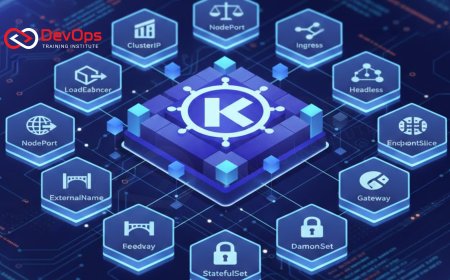










12 Kubernetes Load Balancing Techniques
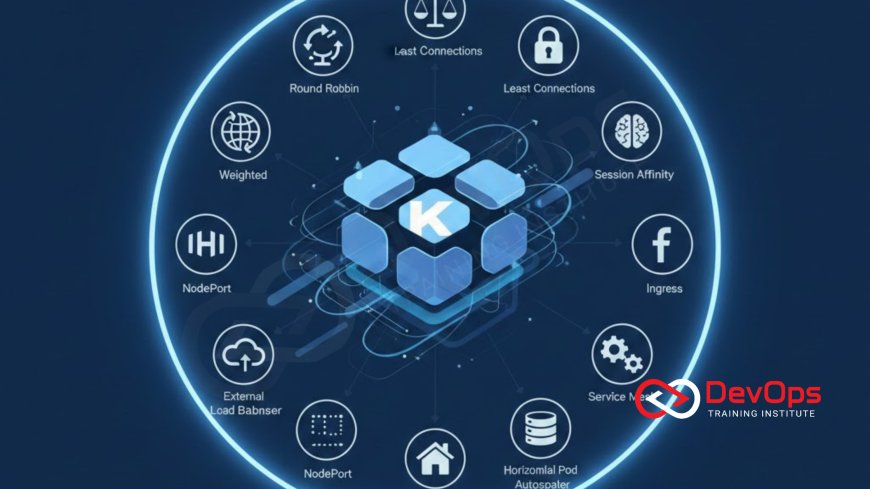
Master 12 essential Kubernetes load balancing techniques to ensure high availability, optimal performance, and fault tolerance for your microservices. This comprehensive guide covers both internal (Service, kube-proxy, CoreDNS) and external (NodePort, LoadBalancer, Ingress Controllers) methods. Learn how to manage L4 and L7 traffic, implement advanced routing with Service Mesh, and leverage modern cloud-native practices to distribute client requests efficiently across your Pods, ensuring zero downtime and resilient applications in a high-velocity DevOps environment.
Introduction
Kubernetes is the de facto standard for container orchestration, but the key to its power and resilience lies in its networking model, particularly its ability to handle load balancing. In a microservices architecture running on Kubernetes, dozens of application replicas (Pods) may start, stop, and scale dynamically. Load balancing is the mechanism that ensures incoming traffic—whether from external clients or internal services—is distributed efficiently and reliably across all these available Pods, preventing bottlenecks and guaranteeing high availability. Without effective load balancing, your scalable applications would quickly become single points of failure, undermining the entire premise of cloud-native resilience.
The complexity of Kubernetes load balancing stems from its layered approach. It doesn't rely on a single component; rather, it uses a combination of internal mechanisms (like the Service object and `kube-proxy`) and external resources (like Cloud Load Balancers and Ingress Controllers) to manage traffic at different levels of the network stack (Layer 4/TCP and Layer 7/HTTP). An effective DevOps strategy requires mastering these distinct layers to optimize performance, control costs, and implement advanced routing logic, such as Canary or Blue/Green deployments.
This comprehensive guide breaks down 12 essential techniques for managing traffic and load balancing in Kubernetes. We'll explore core Service types, internal DNS-based solutions, and sophisticated external methods. By understanding how these techniques interact, you can design a robust networking layer for your microservices, ensuring optimal traffic flow and maximum resilience, enabling a rapid release cadence without compromising stability. Mastering these concepts is fundamental to operationalizing any containerized application at scale.
Internal Load Balancing (Within the Cluster)
Internal load balancing handles traffic between services and applications running inside the Kubernetes cluster. This is crucial for microservices to communicate efficiently and reliably without exposing their internal endpoints to the outside world. This process is managed primarily by two foundational components: the Service object and CoreDNS.
1. ClusterIP Service (L4 Load Balancing)
The ClusterIP is the default and most common Service type. It exposes the Service on a cluster-internal IP address, making the Service reachable only from within the cluster. When another Pod or Service sends a request to the ClusterIP, `kube-proxy` (via iptables or IPVS) performs Layer 4 (TCP/UDP) load balancing to distribute the traffic across the healthy backend Pods selected by the Service's selector. This is the simplest and most efficient way to achieve service-to-service communication load balancing.
2. Kube-proxy (The Load Balancing Enforcer)
The `kube-proxy` component runs on every Node in the cluster. It is not a traditional proxy; rather, it uses network rules (usually iptables or IPVS) to intercept traffic directed at a Service's IP and port, and randomly selects a backend Pod endpoint to receive the connection. It acts as the key enforcer of the load balancing rules defined by the Service objects, providing the necessary translation from the fixed Service IP to the dynamic set of Pod IPs. This mechanism ensures that internal services can reliably find and connect to their dependencies even as Pods are created and destroyed.
3. CoreDNS (Service Discovery and Load Balancing)
CoreDNS (or the cluster's DNS service) provides service discovery by resolving a Service name (e.g., `my-service.my-namespace.svc.cluster.local`) into its ClusterIP. However, for headless Services (those without a ClusterIP), CoreDNS can directly resolve the Service name into the list of individual Pod IPs. When a client requests the headless Service name, the client receives all Pod IPs and performs the load balancing client-side, typically via round-robin DNS lookups. This method is often used for stateful applications or for those where the client needs to connect directly to a specific Pod, often to ensure optimal performance when RHEL 10 log management is used for critical diagnostics.
4. Internal Application Load Balancer (Cloud-Specific)
In managed Kubernetes services (like AWS EKS or Azure AKS), you can provision an Internal Load Balancer (ILB). This creates a dedicated cloud load balancer that is reachable only from within your Virtual Private Cloud (VPC). This is typically used to expose a set of internal Services securely to other applications or compute resources within the same private network, providing highly scalable L4/L7 load balancing controlled by the cloud provider's infrastructure.
External Load Balancing (Exposing Services)
External load balancing manages client traffic originating from outside the cluster, such as web users or external APIs. Kubernetes provides different Service types to expose applications to the public Internet or a dedicated network edge, each with varying levels of control and associated costs.
5. NodePort Service (Basic External Access)
The NodePort Service exposes the application on a specific port across every Node in the cluster. External traffic accessing `
6. LoadBalancer Service (Cloud Integration)
The LoadBalancer Service type automatically provisions a standard Layer 4 (TCP/UDP) cloud load balancer (e.g., AWS ELB, Azure Load Balancer) and routes external traffic to the backend Nodes. This is the most common way to expose critical applications that require high availability and robust traffic distribution, and is directly controlled by the cloud provider, offering auto-scaling and resilience out-of-the-box. The cloud provider's load balancer handles external traffic balancing, simplifying setup.
7. Ingress Controllers (L7 Routing)
An Ingress Controller (e.g., Nginx Ingress, Traefik, HAProxy) is essential for Layer 7 (HTTP/HTTPS) load balancing. It provides a single entry point for external traffic, allowing you to define advanced routing rules (based on hostnames, paths, or headers) to direct requests to different backend Services. Ingress Controllers are far more cost-effective and flexible than using multiple Layer 4 LoadBalancer Services, enabling multi-service hosting on a single IP address. This is the primary mechanism for managing external access to complex applications.
8. External Traffic Policy (Preserving Source IP)
When using a NodePort or LoadBalancer Service, traffic often passes through NAT, losing the original client source IP address. Setting the Service's `externalTrafficPolicy` to `Local` ensures that traffic is only routed to Pods on the same Node where the request arrived. While this reduces load balancing efficiency, it preserves the client's source IP, which is vital for security, analytics, and ensuring that firewall management rules can be applied based on the original request source, rather than the internal Node IP.
Advanced Load Balancing and Traffic Management
Advanced techniques leverage Layer 7 context and additional cluster components to implement fine-grained traffic control, security enforcement, and progressive delivery strategies like Canary rollouts. These practices are the hallmark of mature, high-velocity DevOps environments that prioritize safety and continuous experimentation, ensuring that new code is deployed to users safely and gradually.
9. Service Mesh (Istio/Linkerd)
A Service Mesh (like Istio or Linkerd) provides a dedicated infrastructure layer for service-to-service communication. It automatically injects proxy sidecars into every Pod, enabling sophisticated Layer 7 load balancing features such as weighted routing (for Canary Deployments), traffic splitting, circuit breaking, and automatic mutual TLS (mTLS) encryption. The service mesh gives you programmatic control over the network without changing application code, greatly enhancing observability and resilience.
10. Layer 7 Weighted Routing (Canary Deployments)
Weighted routing, typically implemented via a Service Mesh or advanced Ingress Controller, allows you to split traffic between two versions of a Service based on a percentage (e.g., 90% to V1 and 10% to V2). This is the foundation of Canary Deployments, allowing a new version of a microservice to be exposed to a small group of users first. The load balancing decision is based on request headers or percentages, offering fine-grained control over the rollout risk. This progressive delivery minimizes the blast radius of any potential failure.
11. API Gateways (Centralized L7 Control)
API Gateways (e.g., Kong, Ambassador, or a custom deployment of Nginx or Envoy) often sit in front of Ingress Controllers or LoadBalancers. They provide advanced L7 traffic management, centralized authentication, rate limiting, and request transformation before traffic reaches the microservices. They are a critical point for simplifying service interaction and external exposure, centralizing complex policies and ensuring a streamlined deployment process for individual services. Mastering the configuration of API Gateways is essential for high-velocity teams, as it abstracts many complex networking and security concerns away from the development teams, making the deployment process easier.
12. ExternalName Service (Client-Side Load Balancing)
The ExternalName Service is a non-proxy Service that maps a Service name to an arbitrary CNAME record in DNS. This is used when you want a Service within your cluster to talk to an external service (like a legacy database outside the cluster) using a familiar Kubernetes Service name. The load balancing, in this case, is entirely handled by the external system, and Kubernetes simply provides the convenient internal DNS alias for resolution, abstracting the external dependency from the internal applications.
Conclusion
Effective load balancing is the bedrock of resilience and scalability in Kubernetes. The 12 techniques explored—from the foundational internal routing managed by ClusterIP and `kube-proxy` to the sophisticated external traffic control provided by Ingress Controllers and Service Meshes—demonstrate the complexity and power of the Kubernetes networking model. Mastering these layers ensures that you can design a system that is not only highly available but also optimized for both performance and cost. The shift from basic L4 load balancing to advanced L7 techniques, coupled with Service Mesh capabilities, allows organizations to safely implement advanced deployment strategies like Canary releases, minimizing risk with every code change, which is vital for sustained high-velocity delivery.
The most successful Kubernetes implementations use a combination of these techniques: ClusterIP for secure internal communication, Ingress for efficient external L7 routing, and a Service Mesh for advanced features like mTLS and weighted traffic management. By applying the principle of Least Privilege to networking, enforcing External Traffic Policy when needed, and always ensuring that your underlying host systems are securely configured (referencing RHEL 10 hardening best practices, for instance), you create a robust, layered defense.
Ultimately, the ability to control and observe traffic flow across a distributed system is what separates successful DevOps operations from chaotic ones. Utilize these 12 techniques to design a network fabric that supports rapid iteration, automatic recovery, and unparalleled resilience, ensuring your microservices can handle any load while maintaining optimal performance and security. Understanding how these tools and techniques interact is the key to achieving operational excellence in the modern cloud-native world.
Frequently Asked Questions
What is the primary role of the Kubernetes Service object in load balancing?
The Service object provides a stable internal IP address and DNS name (ClusterIP) that acts as a consistent virtual endpoint, distributing traffic to dynamic Pods.
How does kube-proxy perform load balancing?
Kube-proxy programs network rules (usually iptables or IPVS) on each Node to intercept traffic destined for the Service IP and randomly route it to a healthy backend Pod.
What is a headless Service, and how does it relate to load balancing?
A headless Service resolves directly to the list of Pod IPs via DNS, allowing the client to perform client-side load balancing, often used for stateful services.
When should I choose an Ingress Controller over a LoadBalancer Service?
Choose an Ingress Controller for Layer 7 (HTTP/HTTPS) routing based on hostnames or paths, offering more features and cost savings compared to using multiple Layer 4 LoadBalancer Services.
How does a Service Mesh (e.g., Istio) improve load balancing?
A Service Mesh enables advanced Layer 7 features like weighted routing, traffic splitting, and circuit breaking via proxy sidecars, offering fine-grained control without changing application code.
What is the purpose of the External Traffic Policy?
It is used to preserve the original client source IP address when traffic is routed via a NodePort or LoadBalancer Service, which is critical for security and firewall rules.
How do API Gateways simplify deployment of microservices?
API Gateways centralize authentication, rate limiting, and traffic control at the edge, abstracting complexity and simplifying the external exposure of individual microservices.
What is the main goal of Layer 7 Weighted Routing?
Layer 7 Weighted Routing splits traffic between old and new application versions based on percentages, enabling safe, progressive rollouts like Canary Deployments to minimize risk.
Why is RHEL 10 post-installation checklist compliance relevant to load balancing?
The underlying host OS nodes that run the Pods must be securely configured and monitored for stability, ensuring the foundation of the load balancing system is reliable and compliant.
How does an ExternalName Service handle load balancing?
It does not perform load balancing itself; it returns a CNAME record, relying on the external target system to handle the load balancing for the resolved service endpoint.
Why should I use an Internal Application Load Balancer instead of a regular LoadBalancer Service?
An ILB exposes services only within the private network (VPC), providing internal, highly scalable L4/L7 load balancing without public internet exposure, enhancing security.
How does Kubernetes Service discovery integrate with load balancing?
CoreDNS resolves the Service name to an IP, which is then used by kube-proxy to look up the dynamic list of backend Pods and distribute the load among them, linking name resolution to traffic distribution.
What is the security advantage of using the SELinux security context on Nodes?
SELinux provides mandatory access controls, restricting what processes (including container runtimes) can access on the host OS, adding a critical layer of defense against container breakouts that could affect the load balancer's functionality.
What is the highest-level technique for managing external traffic in a large cluster?
The highest level is often a combination of a central Cloud Load Balancer pointing to an Ingress Controller, which then handles L7 routing rules for all microservices in the cluster, offering maximum control and efficiency.
How does firewall management relate to the NodePort Service type?
NodePort exposes the application on a specific port on every Node. Firewall management is critical to ensure that only authorized external IPs can access this exposed NodePort, maintaining network security at the cluster edge.
What's Your Reaction?
 Like
0
Like
0
 Dislike
0
Dislike
0
 Love
0
Love
0
 Funny
0
Funny
0
 Angry
0
Angry
0
 Sad
0
Sad
0
 Wow
0
Wow
0




![100+ Azure DevOps Interview Questions and Answers [Updated 2025]](https://www.devopstraininginstitute.com/blog/uploads/images/202509/image_140x98_68c40aa9a3834.jpg)






![Future Scope of DevOps Careers in Pune [Updated 2025]](https://www.devopstraininginstitute.com/blog/uploads/images/202510/image_140x98_68e3a84652312.jpg)