

![Kong Interview Preparation Guide [2025]](https://www.devopstraininginstitute.com/blog/uploads/images/202509/image_430x256_68dbb95326997.jpg)

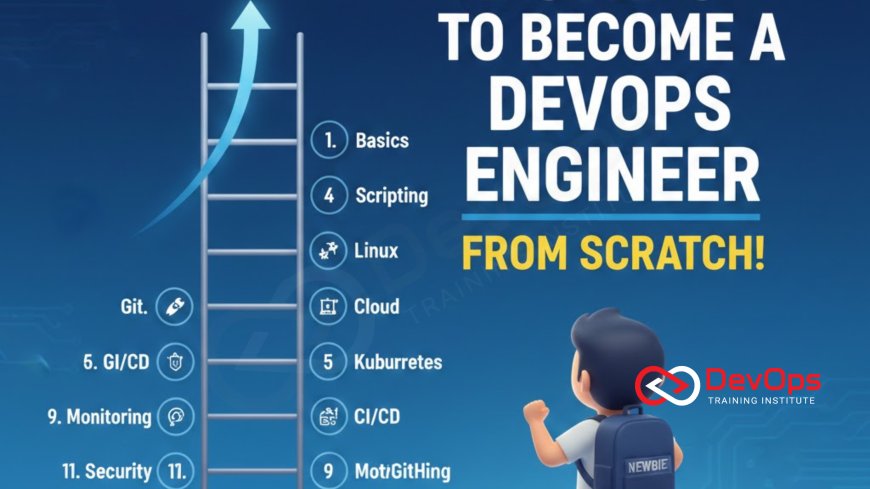
12 Steps to Become a DevOps Engineer from Scratch
Embark on your journey to become a highly sought-after DevOps Engineer with this structured, step-by-step roadmap designed for absolute beginners. This guide covers the 12 essential phases, from mastering Linux and scripting to conquering cloud platforms, Infrastructure as Code (IaC) with Terraform, and container orchestration with Kubernetes. Learn how to build production-ready CI/CD pipelines, integrate DevSecOps practices, and measure reliability using SRE principles. Following this clear path, emphasizing hands-on project work and automation skills, will equip you with the technical expertise and cultural mindset required to succeed in one of the fastest-growing and best-paying roles in the modern IT industry today.
Introduction
The role of a DevOps Engineer is one of the most dynamic, rewarding, and challenging careers in modern technology. It represents the crucial link between software development and IT operations, focusing on automating every possible process to ensure faster, more reliable, and higher-quality software delivery. Successfully making the transition to this role requires more than just learning a few tools; it demands a fundamental shift in mindset, embracing the cultural principles of collaboration, continuous learning, and end-to-end ownership. For those starting their journey from scratch—perhaps coming from a traditional administration, testing, or non-technical background—the sheer volume of tools and concepts can seem overwhelming and daunting.
However, the path to becoming a proficient DevOps Engineer is structured, logical, and achievable with dedicated effort and a clear learning plan. This guide provides a 12-step roadmap that simplifies the journey, breaking down the complex landscape into manageable phases, each building upon the last. By focusing on fundamental concepts first, mastering the essential tool categories (like cloud, IaC, and containers), and prioritizing hands-on practice, you can build a robust, production-ready skill set that is highly valued in the industry. Follow this structured approach to transform your career and acquire the expertise necessary to build scalable, resilient systems for the modern digital economy.
Phase 1: Mastering the Operating System and Version Control
The foundation of all DevOps work lies in understanding the environment where software is built, runs, and is managed. Before touching any cloud service or CI/CD tool, you must establish mastery over the operating system that runs most of the world's production infrastructure, and the core tool that enables team collaboration on code and configurations. Skipping this phase will lead to confusion and significant roadblocks later when debugging pipelines and automation scripts, ensuring that your foundation is weak and unstable, ultimately impacting your career growth in the long run.
The essential skills in this foundational phase are:
- Step 1: Master Linux Fundamentals: Proficiency in the Linux command line is non-negotiable, as the vast majority of cloud servers, containers, and core DevOps tools run on Linux-based systems. You must learn common shell commands (Bash/Shell scripting), understand file systems, manage users and permissions, troubleshoot basic networking, and perform package management (apt/yum). This mastery is crucial for writing effective automation scripts later on.
- Step 2: Conquer Git and Version Control: Git is the absolute backbone of collaborative software development and Infrastructure as Code (IaC). You must deeply understand how to use Git for version control, including basic commands (commit, push, pull), managing branches, resolving merge conflicts, and the fundamental concepts of GitHub/GitLab/Bitbucket platforms. Every change you make, whether application code or infrastructure definition, must be managed through Git, making this a daily, critical tool for all DevOps roles.
Phase 2: Programming and Automation Basics
A DevOps Engineer is fundamentally an automation specialist who uses code to solve operational problems. While you do not need to be an expert application developer, you must be proficient in a high-level scripting language and understand how to apply it to automate repetitive tasks, manage system configurations, and build custom tooling. This skill set is the bridge between the development and operations world, allowing you to write the glue code that holds complex pipelines together, moving beyond mere manual scripting into scalable, structured automation.
Step 3: Learn Python (or Go) for Automation: Python is the most popular language in the DevOps world due to its simplicity, readability, and extensive library support for cloud APIs, networking, and system administration. You should learn enough Python to write automated maintenance scripts, process log files, and interact with cloud provider SDKs (Software Development Kits). Alternatively, Go (Golang) is highly valued, especially for roles focusing on container orchestration and high-performance system engineering (SRE), as many core cloud-native tools are written in it.
Step 4: Understand Networking and Security Fundamentals: Before deploying applications, you must understand how they communicate securely. Key networking concepts include DNS, TCP/IP, HTTP/HTTPS, load balancing, firewalls, and subnets. On the security front, grasp the basics of encryption (SSL/TLS), Identity and Access Management (IAM), and the principle of least privilege, which will be crucial later when integrating DevSecOps practices into the pipeline and configuring secure cloud infrastructure.
Phase 3: The Cloud Foundation
The majority of modern software is deployed to the public cloud, making proficiency in at least one major cloud platform an absolute requirement for entry into a DevOps career. Cloud knowledge is the single most valuable skill, as it dictates the entire technology stack and architecture of your deployments. You should dedicate significant time to hands-on learning within a cloud environment to move beyond theoretical knowledge and build practical, production-ready skills that employers demand.
Step 5: Choose and Master a Major Cloud Platform: Select one of the Big Three (AWS, Azure, or GCP) and gain deep, hands-on experience with its core services. AWS remains the market leader and a popular starting point. You must understand the fundamental building blocks: compute (EC2, Lambda, EKS), storage (S3, RDS), and networking (VPC, Security Groups, Load Balancers). Focus on practical exercises, building a few applications end-to-end within the platform. Achieving an entry-level certification (like AWS Certified Cloud Practitioner or Azure Fundamentals) is highly recommended for validating your foundational knowledge and boosting your resume.
Step 6: Master Infrastructure as Code (IaC) with Terraform: IaC is the practice of managing and provisioning infrastructure through machine-readable definition files, guaranteeing environment consistency and repeatability. Terraform is the leading cloud-agnostic IaC tool, allowing you to define infrastructure across all major clouds using the same language (HCL). You must master Terraform syntax, modules, state management (especially remote state with locking for collaboration), and integrating it into your CI/CD pipeline. This is critical for reliable cloud infrastructure management and automation.
| Phase | Step & Focus | Core Tools/Concepts | Primary Goal |
|---|---|---|---|
| 1: Foundation | 1. Linux Mastery / 2. Version Control | Bash, Shell Scripting, Git, GitHub/GitLab | Understand server environment and code collaboration. |
| 2: Automation | 3. Python/Go / 4. Networking & Security | Python Libraries, TCP/IP, DNS, IAM, Least Privilege | Write scalable automation scripts and secure deployments. |
| 3: Cloud | 5. Cloud Platform / 6. Infrastructure as Code | AWS/Azure/GCP Core Services, Terraform, CloudFormation | Provision consistent, version-controlled cloud environments. |
| 4: Containers | 7. Docker / 8. Kubernetes Orchestration | Dockerfiles, Docker Compose, K8s Pods, Deployments, Services, Helm | Package, deploy, and scale microservices reliably. |
| 5: Delivery | 9. CI/CD Pipelines / 10. Observability & SRE | Jenkins, GitLab CI, GitHub Actions, Prometheus, Grafana, SLOs | Automate releases and ensure high system reliability and performance. |
Phase 4: Containerization and Orchestration
In modern software architecture, applications are almost universally packaged and deployed as containers. Containerization provides environment consistency and portability, eliminating the classic "it works on my machine" problem. Kubernetes then steps in as the orchestration layer, managing the complexity of running thousands of containers across a cluster of machines. This phase is critical for dealing with microservices and large-scale, high-availability application deployment.
Step 7: Learn Docker for Containerization: You must master Docker: writing efficient Dockerfiles to package applications, understanding concepts like images and layers, and using Docker Compose for local multi-container development environments. Containerization is the prerequisite for all cloud-native deployment patterns, as it creates the standardized, immutable package that moves through your CI/CD pipeline, guaranteeing consistency from development to production.
Step 8: Master Kubernetes for Orchestration: Kubernetes (K8s) is the industry standard for managing containers at scale. You must understand the core architecture (Control Plane and Worker Nodes) and the fundamental resources: Pods, Deployments, Services, and ConfigMaps. Aim for the Certified Kubernetes Administrator (CKA) or Certified Kubernetes Application Developer (CKAD) certifications to validate your skills. Hands-on practice deploying multi-service applications using Helm (the package manager for K8s) is essential for demonstrating real-world competence in managing scalable, production-ready systems.
Phase 5: Continuous Delivery, Observability, and Culture
The final and most defining phase of the DevOps Engineer journey is bringing everything together: automating the delivery pipeline, ensuring system health, and embracing the cultural principles that make the entire system sustainable. This is where the true value of DevOps is realized, allowing teams to deploy code multiple times a day with confidence and minimal risk, which directly impacts business outcomes.
Step 9: Build a Comprehensive CI/CD Pipeline: This is the synthesis of all previous steps. You need to build a pipeline from scratch using a tool like Jenkins, GitLab CI, or GitHub Actions. The pipeline must: trigger upon a code commit, automatically build the application, run unit/integration tests, perform security scans (DevSecOps), build the Docker image, push the image to a container registry, execute a Terraform plan to prepare infrastructure, and finally, deploy the application to Kubernetes or serverless targets. This end-to-end project is your ultimate portfolio piece.
Step 10: Implement Monitoring and Observability: Reliability cannot be managed without data. You must learn how to configure monitoring and logging tools to collect key metrics and data (Prometheus/Grafana), logs (ELK Stack/Splunk), and traces (Jaeger). Focus on defining actionable alerts based on business-critical performance indicators (SLIs) to ensure you have fast feedback loops that allow you to detect and respond to issues immediately. Understanding the "why" behind system performance is critical for continuous improvement and maximizing system stability in production.
Phase 6: Specialization and Career Launch
Once the technical foundation is solid, the final steps focus on layering in advanced, high-value specializations and strategically positioning yourself for the job market. This refinement of skills often leads to the highest-paying roles, differentiating you from other candidates who only possess basic tool knowledge.
Step 11: Integrate DevSecOps and SRE Practices: Security must be embedded into the pipeline ("Shift Left"). Learn to use security scanning tools like Trivy or SonarQube in your CI process and master secrets management using tools like HashiCorp Vault. Additionally, integrate SRE principles by learning to define Service Level Objectives (SLOs) and managing incident response, focusing on automating the reduction of operational toil to improve overall system reliability. This holistic approach makes you a much more valuable and well-rounded engineer in the modern landscape.
Step 12: Build a Portfolio and Get Certified: Your resume must demonstrate practical results. Consolidate all your work—the Python automation scripts, the Terraform code, the full CI/CD pipeline running to Kubernetes, and the monitoring dashboard configuration—into three or four comprehensive projects on GitHub. Pair this with strategic certifications (e.g., CKA, AWS DevOps Pro) to validate your expertise. Actively contribute to open-source projects or write technical blogs to demonstrate your commitment to collaboration and knowledge sharing, which aligns perfectly with the DevOps culture that companies actively seek in new hires.
The Critical Importance of the DevOps Mindset
Beyond the tools and the certifications, the most important element for long-term success is internalizing the DevOps mindset. This is the understanding that technology is secondary to the culture and process. The core of this mindset involves breaking down silos between teams, promoting shared responsibility for the entire application lifecycle, and maintaining a non-blaming culture focused on continuous learning from failures. Organizations are not just looking for individuals who can run commands, but people who can champion these cultural values and drive iterative improvements within the engineering organization. This mindset ensures that technology is used to foster better collaboration, leading to faster business outcomes and a reduction in organizational friction, which is the ultimate goal of the movement.
The successful DevOps Engineer treats system failures not as individual errors, but as opportunities to improve systemic processes, feeding insights from production observability back into the development cycle immediately. This dedication to the complete feedback loop, combined with a relentless focus on eliminating manual toil through automation, is what separates a proficient engineer from a true leader in the field. Understanding that DevOps is more than just a buzzword, but a transformative methodology for modern software delivery, will be your biggest asset in interviews and on the job.
Conclusion
Becoming a DevOps Engineer from scratch is a rigorous but rewarding career transition that requires commitment, structure, and a deep focus on hands-on practice. By following these 12 strategic steps, you will systematically build the core skills required: mastering the Linux foundation, achieving fluency in Python and Terraform, conquering the complexity of Kubernetes, and finally, assembling an end-to-end, production-ready CI/CD pipeline complete with monitoring and security checks. This holistic skill set, combined with the essential DevOps mindset of automation and collaboration, will position you as a highly competitive and valuable candidate in the high-growth IT industry. Start small, build frequently, and always remember that every tool you learn is ultimately a means to the single goal of delivering software faster, safer, and more reliably to the end user.
Frequently Asked Questions
Is a computer science degree required to become a DevOps Engineer?
No, a degree is not strictly required. Practical experience, certifications, and a strong project portfolio demonstrating hands-on skills are valued more highly by employers.
Which cloud platform is best to start learning?
AWS is generally recommended as the best starting point due to its market dominance, extensive resources, and comprehensive set of managed cloud services.
How long does this entire DevOps roadmap take to complete?
With consistent, dedicated effort, a motivated beginner can achieve job readiness and complete these steps within 6 to 12 months, depending on prior technical knowledge.
What is "toil" in SRE practices?
Toil refers to manual, repetitive, tactical work that scales linearly with service growth; SREs focus on reducing it through automation.
Should I learn Chef or Puppet for configuration management?
While valuable, Ansible or Terraform (for IaC) are generally higher-priority starting points, as the complexity of Chef/Puppet is often abstracted away by modern cloud services.
What is the purpose of a Dockerfile?
A Dockerfile is a text file containing instructions for assembling and packaging an application and all its dependencies into a standardized, executable Docker image for deployment.
What is the difference between Continuous Delivery and Continuous Deployment?
Continuous Delivery means the code is ready to deploy but requires manual approval. Continuous Deployment means the code is automatically released to production after passing tests.
Do I need to learn coding to be a DevOps Engineer?
Yes, proficiency in a scripting language like Python is mandatory for automating tasks, interacting with APIs, and maintaining the operational health of the system.
How do I demonstrate my skills without job experience?
Build real-world projects, host them on GitHub, write accompanying blog posts detailing your technical decisions, and get relevant cloud and tool certifications.
What are the DORA metrics?
DORA metrics (Deployment Frequency, Lead Time, Change Failure Rate, MTTR) are the four key metrics used to measure the performance and stability of a software delivery team.
What is the "principle of least privilege" in security?
It is the practice of granting any user, service, or resource only the minimal permissions and access levels necessary to perform its intended function, reducing the potential blast radius.
What is the role of Prometheus and Grafana?
Prometheus collects time-series metrics and data from applications and infrastructure, while Grafana is used to visualize that data in dashboards and configure actionable alerts.
Why is collaboration a key skill in DevOps?
Collaboration is key because the role inherently requires close, continuous communication and joint ownership of the application lifecycle between development, operations, and security teams.
What is GitOps?
GitOps is an operational framework that uses Git as the single source of truth for declarative infrastructure and applications, automating deployment and reconciliation to reflect the state defined in the repository.
Is a certification like CKA better than a general cloud cert?
CKA is highly valuable if you plan to specialize in Kubernetes and cloud-native architecture, while a general cloud certification (AWS/Azure) is better for demonstrating broad foundational cloud knowledge.
What's Your Reaction?
 Like
0
Like
0
 Dislike
0
Dislike
0
 Love
0
Love
0
 Funny
0
Funny
0
 Angry
0
Angry
0
 Sad
0
Sad
0
 Wow
0
Wow
0


![100+ Azure DevOps Interview Questions and Answers [Updated 2025]](https://www.devopstraininginstitute.com/blog/uploads/images/202509/image_140x98_68c40aa9a3834.jpg)





![Future Scope of DevOps Careers in Pune [Updated 2025]](https://www.devopstraininginstitute.com/blog/uploads/images/202510/image_140x98_68e3a84652312.jpg)