








![Kong Interview Preparation Guide [2025]](https://www.devopstraininginstitute.com/blog/uploads/images/202509/image_430x256_68dbb95326997.jpg)






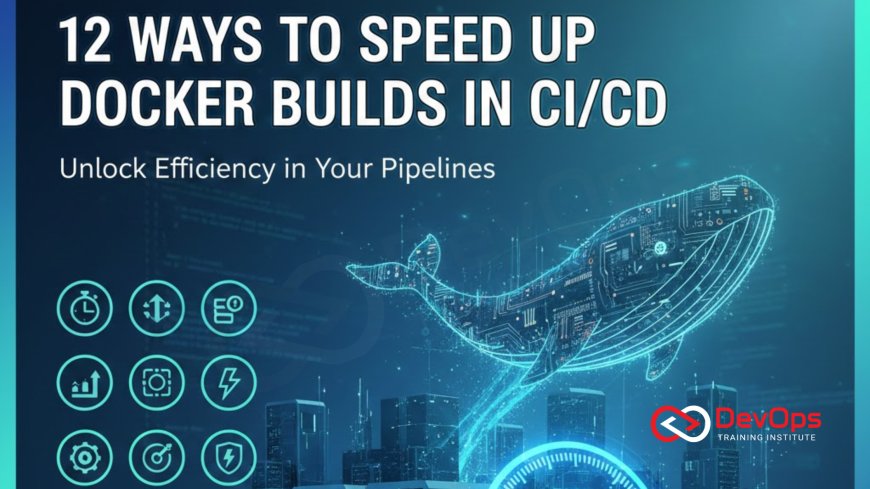
12 Ways to Speed Up Docker Builds in CI/CD
Accelerate your software delivery by mastering twelve essential techniques to speed up Docker builds within your CI/CD pipelines in 2026. This comprehensive guide covers advanced Docker layer caching, multi-stage builds, and the latest BuildKit features to eliminate bottlenecks and reduce lead times. Learn how to optimize Dockerfile instructions, manage build contexts with precision, and leverage remote cache backends to ensure high-performance container orchestration. Whether you are using GitHub Actions, GitLab CI, or Jenkins, these proven strategies will help your DevOps team achieve faster feedback loops, lower cloud infrastructure costs, and a more resilient technical foundation for your digital growth today.
Introduction to High-Performance Docker Pipelines
In the competitive technical landscape of 2026, the speed of your Docker builds is often the pulse of your entire engineering organization. Slow builds act as a massive drag on productivity, forcing developers into long periods of "idle time" while they wait for pipelines to complete. Speeding up these builds is not merely about finding a faster server; it is about applying intelligent architectural patterns to how images are constructed and managed. A fast CI/CD pipeline enables rapid experimentation, quicker incident handling, and a more agile response to market changes, directly impacting the business's bottom line.
Optimizing Docker builds requires a deep understanding of how the Docker engine handles layers, contexts, and caching. As systems become more complex and microservices multiply, the overhead of inefficient Dockerfiles grows exponentially. This guide outlines twelve high-impact strategies to streamline your build process. By mastering these techniques, you can transform your CI/CD from a bottleneck into a high-speed engine for growth, ensuring that your continuous synchronization between development and production is as frictionless as possible. Let’s explore how to shave minutes off every build and deliver high-quality software at scale.
Mastering Docker Layer Caching (DLC)
Docker layer caching is the most fundamental tool for accelerating builds. Each instruction in a Dockerfile creates a new layer, and Docker attempts to reuse these layers in subsequent builds if the instruction and its inputs remain unchanged. The key to maximizing deployment quality is to order your Dockerfile instructions from least-frequently changed to most-frequently changed. For instance, installing system utilities should happen before copying your application source code. This ensures that a simple change in a Python or Node.js file doesn't force Docker to reinstall every system-level dependency from scratch.
In a CI/CD environment, local caching is often lost because each job runs on a fresh, ephemeral runner. To solve this, you must use remote cache backends. Modern builders like BuildKit allow you to export your cache to a registry or a specialized storage service. By using the --cache-from and --cache-to flags with Docker Buildx, your runners can pull existing layers directly from a remote source. This technique is a cornerstone of platform engineering, providing a shared memory across your entire CI fleet and ensuring that no work is repeated across different branches or pull requests.
Leveraging Multi-Stage Builds for Efficiency
Multi-stage builds are a powerful pattern that allows you to use multiple FROM statements in a single Dockerfile. You can use a heavy, tool-rich image for the build and test stages, and then copy only the final, compiled artifacts into a lightweight runtime image. This not only significantly reduces the final image size but also allows for better parallel execution of build stages. BuildKit can identify which stages are independent and run them simultaneously, dramatically cutting down the total wall-clock time required for complex builds that involve multiple compilation steps.
Using named stages (e.g., FROM golang:1.24 AS builder) makes your Dockerfile more readable and allows you to selectively build specific targets during debugging. It also prevents "leakage" of build-time secrets or temporary files into the production image, which is essential for maintaining cloud native security. By separating the build environment from the execution environment, you ensure that your production containers are lean, secure, and start up rapidly in your Kubernetes clusters. This technique is a standard best practice for any team aiming for operational excellence in 2026.
Optimizing the Build Context with .dockerignore
When you run a docker build command, the first step is the transfer of the "build context"—the files in your directory—to the Docker daemon. If your directory contains large, unnecessary files like .git folders, local binaries, or node_modules, this transfer can take a significant amount of time, especially in cloud-based runners. The .dockerignore file is your primary tool for excluding these files. By being explicit about what should not be sent to the builder, you reduce the network overhead and prevent unnecessary cache invalidation caused by changes in ignored files.
A well-structured .dockerignore file should mirror your .gitignore but also include build-specific exclusions. For example, excluding local logs and temporary directories ensures that these environment-specific files don't accidentally bloat your image or break your layers. This practice is vital for maintaining a clean and fast developer experience. By keeping the context small, you ensure that the builder only receives the essential files needed for the current build, allowing the process to start almost instantly and reducing the overall resource consumption of your CI/CD infrastructure.
Top Docker Build Speed Optimization Comparison
| Optimization Strategy | Primary Focus | Speed Impact | Implementation Effort |
|---|---|---|---|
| Layer Ordering | Cache Reuse | High | Low |
| Multi-Stage Builds | Parallelism & Size | Very High | Medium |
| Remote Cache (Buildx) | Distributed CI Speed | Extreme | Medium |
| Minimal Base Images | Reduced Transfers | Medium | Low |
| BuildKit Cache Mounts | Package Manager Speed | High | Medium |
Selecting Minimal and Reliable Base Images
The base image you choose in your FROM instruction has a direct impact on the initial download time and the final image size. Using heavy, full-OS images like the standard Ubuntu or Debian images introduces hundreds of megabytes of unnecessary tools and potential vulnerabilities. Instead, high-performing teams in 2026 prioritize minimal images such as Alpine, Distroless, or "slim" variants of popular language runtimes. These smaller images result in faster continuous synchronization across the network and reduce the "attack surface" of your production containers.
While minimal images are faster, you must ensure they contain the necessary libraries (e.g., glibc vs. musl) for your application to run correctly. Using verified images from trusted publishers also ensures that you aren't building on a foundation with known technical debt or security flaws. By pinning your base images to specific versions (e.g., node:22-alpine instead of node:latest), you ensure that your builds are reproducible and won't break due to upstream changes. This level of discipline in image selection is a key component of building a resilient infrastructure that performs consistently across all environments.
Utilizing BuildKit’s Advanced Cache Mounts
One of the most exciting features of BuildKit is the ability to use persistent cache mounts for package managers like npm, pip, or go modules. In a standard Docker build, every RUN command starts with a clean slate. With cache mounts (using RUN --mount=type=cache), you can specify a directory to persist across builds. This allows your package manager to "remember" downloaded files, even if the layer itself needs to be rebuilt because of a change in your dependencies file. This technique provides a massive speed boost for projects with large numbers of external libraries.
Cache mounts act as a "fast-track" for the most time-consuming parts of the build process. Unlike standard layer caching, which is an all-or-nothing approach, cache mounts are cumulative and granular. They ensure that you only download new or updated packages, rather than re-downloading everything whenever a single dependency changes. Integrating these mounts into your Dockerfiles is a sophisticated way to manage resource utilization and provide your developers with near-instant build times for their daily code changes. It is an essential strategy for any large-scale monorepo or high-velocity development team.
Summary Checklist for Docker Build Speed
- Enable BuildKit: Set DOCKER_BUILDKIT=1 to unlock parallel execution and advanced caching features by default.
- Pin Base Images: Use specific tags to ensure build reproducibility and prevent unexpected slowdowns from large upstream updates.
- Combine RUN Commands: Group related commands (e.g., apt-get update && apt-get install) to reduce the number of layers and overall image metadata.
- Clean Up Layers: Remove temporary files and package manager caches in the same RUN command where they were created to keep layers small.
- Use .dockerignore: Explicitly exclude heavy files like .git and local build artifacts from the context to speed up context transfer.
- Optimize COPY/ADD: Only copy the specific files needed for each step to prevent unnecessary cache invalidation across the build.
- Monitor Build Times: Use continuous verification to track build durations and identify which stages are the primary bottlenecks.
By following these best practices, you create a technical environment where the build process is a "self-optimizing" engine. As you refine your Dockerfiles, you should also look into cross-compilation strategies for multi-platform builds, which can be significantly faster than using emulation. By staying informed about AI augmented devops trends, you can ensure that your build infrastructure remains modern and capable of handling the challenges of 2026. Ultimately, the goal is to make the build process "invisible" to the developer, providing a seamless and high-speed path from code commit to production-ready artifact.
Conclusion: Closing the Build Performance Gap
In conclusion, the twelve ways to speed up Docker builds discussed in this guide provide a robust framework for achieving engineering excellence in 2026. From the precision of layer ordering and multi-stage builds to the advanced power of BuildKit cache mounts and remote caching, these strategies offer a roadmap for eliminating waste in your CI/CD. By treating your Dockerfiles as critical infrastructure code, you ensure that your software delivery is as fast, secure, and reliable as the applications themselves. The move toward autonomous and high-speed pipelines is essential for success in today's demanding digital landscape.
As you move forward, remember that who drives cultural change in your team will determine the long-term impact of these performance optimizations. Encouraging a "speed-first" mindset and providing the team with the right tools is just as important as the code itself. By prioritizing continuous verification and staying informed about release strategies, you can ensure that your organization remains a leader in digital innovation. Start by identifying the biggest bottleneck in your current Docker builds today, and build your way toward a world-class CI/CD operation for your business.
Frequently Asked Questions
What is the fastest way to improve Docker build speed?
The fastest way is typically to optimize the order of your Dockerfile instructions to maximize layer caching and use a proper .dockerignore file.
Why is my Docker build slow in CI/CD but fast locally?
In CI/CD, you often start with an empty cache; using remote cache backends with Buildx can help synchronize the cache across distributed runners.
How do multi-stage builds reduce build time?
They allow parallel execution of stages and ensure the final runtime image is as small as possible, speeding up both building and pushing to registries.
What is BuildKit and why should I use it in 2026?
BuildKit is the modern Docker builder that supports parallel builds, better caching, build secrets, and advanced cache mounts for faster performance.
Does the size of the build context matter for speed?
Yes, the entire context is sent to the builder first; a large context can add significant delay to the start of every build operation.
What is a cache mount in Docker BuildKit?
It is a feature that allows directories like package manager caches to persist between builds, even when the underlying layers are rebuilt.
Can I use remote caching with GitHub Actions?
Yes, the docker/build-push-action supports GitHub-hosted caching (type=gha) which allows sharing layers across different workflow runs and branches.
Should I always use Alpine-based images for speed?
While small, Alpine uses musl which can have compatibility issues with some software; "slim" Debian/Ubuntu images are often a safer, fast alternative.
How do I combine RUN commands to improve speed?
By using the && operator to chain related commands, you reduce the number of image layers and avoid storing temporary files in the history.
What is "cache invalidation" and how do I avoid it?
Invalidation occurs when a layer changes, forcing all following layers to rebuild; avoid it by putting high-change commands at the end of the Dockerfile.
Does pinning image versions affect build speed?
It ensures reproducibility and prevents unexpected slowdowns that occur when "latest" tags pull down large, updated base images without warning.
What role does an Ingress controller play in Docker builds?
Ingress is for runtime traffic; for builds, the focus is on registry connectivity and the performance of your internal CI/CD runner network.
Can AI tools help me optimize my Dockerfiles?
Yes, modern AI-augmented tools can analyze your build logs and Dockerfile structure to suggest specific optimizations for speed and security.
How does GitOps relate to Docker build performance?
GitOps ensures your build configurations are version-controlled and synchronized, allowing for automated and predictable build performance across all environments.
What is the first step in starting a build optimization program?
The first step is to measure your current build times using docker buildx build with the --progress=plain flag to identify the slowest stages.
What's Your Reaction?
 Like
0
Like
0
 Dislike
0
Dislike
0
 Love
0
Love
0
 Funny
0
Funny
0
 Angry
0
Angry
0
 Sad
0
Sad
0
 Wow
0
Wow
0





![100+ Azure DevOps Interview Questions and Answers [Updated 2025]](https://www.devopstraininginstitute.com/blog/uploads/images/202509/image_140x98_68c40aa9a3834.jpg)






![Future Scope of DevOps Careers in Pune [Updated 2025]](https://www.devopstraininginstitute.com/blog/uploads/images/202510/image_140x98_68e3a84652312.jpg)