FluxCD Interview Preparation Guide: Study Plan (2027)
A five-week FluxCD interview study plan with labs: bootstrap, Kustomizations, HelmRelease, image automation, SOPS, alerts, troubleshooting. 28 questions.
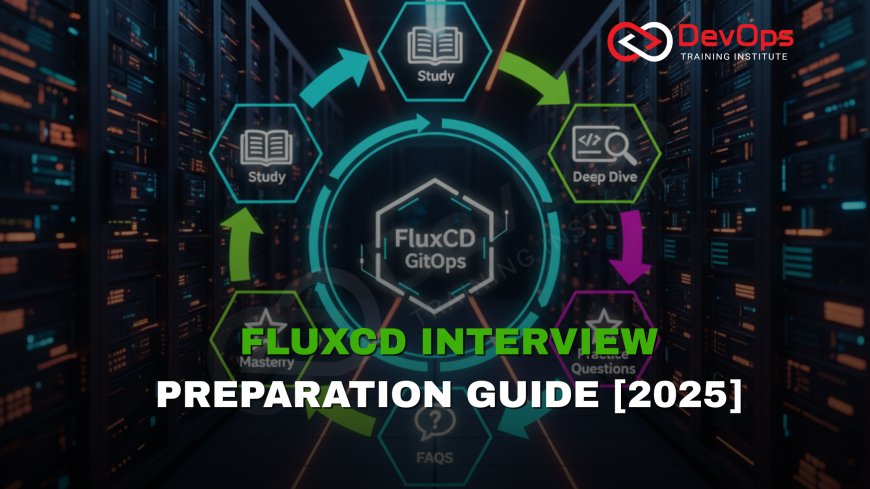
To prepare for a FluxCD interview, follow a five-week plan: learn GitOps and the Flux controllers, bootstrap Flux on a local cluster, deploy apps with Kustomizations and HelmReleases, add image automation, secrets and notifications, then practise troubleshooting and multi-cluster design. Use the flux CLI daily so you can explain reconcile, suspend and trace from experience.
This page is a study plan with labs and self-checks, followed by 28 practice questions grouped by level. For the main question bank, go to top FluxCD GitOps interview questions. If GitOps itself is new to you, read what GitOps is before week 1. Version details were checked on fluxcd.io in November 2026, when the newest release was Flux 2.10, announced as GA on 26 October 2026.
Key takeaways
- Flux is a set of Kubernetes controllers. The ones you must know are source-controller, kustomize-controller, helm-controller, notification-controller, and the image reflector and image automation controllers.
- Flux docs recommend installing with
flux bootstrap, which commits Flux's own manifests to Git and then reconciles them. The Flux Operator and the Terraform provider are the other documented production paths. - Learn the current API versions: Kustomization and GitRepository are v1, HelmRelease is v2, and the image APIs are v1 since image automation went GA in Flux 2.7.
- Know the upgrade rule from Flux 2.7: unless you deploy Flux with the Flux Operator, run
flux migrateon clusters before upgrading. - Interviews at 2+ years focus on troubleshooting with
flux get,flux events,flux logs,flux traceandflux tree.
Who this plan is for and what you need
The plan assumes you know basic Kubernetes objects (Deployments, Services, namespaces) and Git. If not, spend a week on Kubernetes first; our Kubernetes architecture components guide is a good start. You need a laptop with Docker and kind or k3d, the flux CLI, kubectl, a GitHub or GitLab account and a personal access token. Budget an hour on weekdays and two to three hours at weekends.
| Week | Topic | Lab outcome |
|---|---|---|
| 1 | GitOps principles, Flux architecture, CLI basics | Flux bootstrapped on a kind cluster from your own repo |
| 2 | Sources, Kustomizations, dependencies, pruning | Two apps deployed from Git with ordering and health checks |
| 3 | Helm, OCI artifacts, image automation | A HelmRelease and an image policy that updates Git |
| 4 | Secrets, notifications, multi-tenancy, multi-cluster layout | SOPS-encrypted secret, Slack or webhook alerts, staging and production overlays |
| 5 | Troubleshooting, upgrades, mock interviews | Five broken scenarios fixed and explained aloud |
The five-week plan
Week 1: Architecture and bootstrap
- Read the Flux concepts page and draw how a commit becomes a running Pod: source-controller fetches an artifact, kustomize-controller or helm-controller applies it, and notification-controller reports events.
- Run
flux check --preto confirm the cluster meets the prerequisites. - Bootstrap Flux into a new repository.
export GITHUB_TOKEN=<your-token>
flux bootstrap github \
  --token-auth \
  --owner=my-github-username \
  --repository=fleet-infra \
  --branch=main \
  --path=clusters/dev \
  --personal
flux check
flux get all -A
Self-check: open the repository and explain what each file under clusters/dev/flux-system does, and why Flux now manages its own upgrade.
Week 2: Sources and Kustomizations
- Create a
GitRepositoryfor an app repo and aKustomizationthat applies its./deploypath. - Turn on
prune: true, delete a manifest from Git and watch Flux remove the object. - Add
dependsOnso an app waits for an infrastructure Kustomization, and add health checks withwait: true. - Change a Deployment by hand with kubectl and watch Flux revert it on the next reconcile.
apiVersion: kustomize.toolkit.fluxcd.io/v1
kind: Kustomization
metadata:
  name: podinfo
  namespace: flux-system
spec:
  interval: 10m
  path: ./kustomize
  prune: true
  wait: true
  timeout: 5m
  sourceRef:
    kind: GitRepository
    name: podinfo
  dependsOn:
    - name: infra-controllers
Self-check: explain the difference between the GitRepository interval and the Kustomization interval.
Week 3: Helm, OCI and image automation
- Create a
HelmRepository(or anOCIRepositoryfor an OCI chart) and aHelmReleasewith values from a ConfigMap. - Break the chart values on purpose and read the failure with
flux get helmreleasesandflux debug helmrelease. - Push manifests as an OCI artifact with
flux push artifactand deploy from anOCIRepository. - Set up
ImageRepository,ImagePolicywith a semver range andImageUpdateAutomationthat commits new tags to Git.
Self-check: say why image automation commits to Git instead of patching the Deployment directly.
Week 4: Secrets, alerts, tenants and clusters
- Encrypt a Secret with SOPS and age, commit it, and configure
spec.decryptionon the Kustomization. - Create a
Providerand anAlertthat send failed reconciliations to Slack, Microsoft Teams or a generic webhook. Add aReceiverso a Git push triggers reconciliation without waiting for the interval. - Lay out a repository for two clusters with shared base and per-cluster overlays, and give one tenant a namespace and service account with limited rights.
Self-check: explain how a tenant is stopped from deploying into another tenant's namespace.
Week 5: Troubleshooting, upgrades and mock interviews
- Practise the debugging commands until they are automatic.
- Read the Flux 2.7 upgrade notes and the 2.10 release notes, and run
flux migratein your lab. - Answer the practice questions below aloud with a timer, then do scenario drills where a friend breaks your repo.
flux get kustomizations -A
flux events -A
flux logs --level=error --all-namespaces
flux trace podinfo --kind=deployment --api-version=apps/v1 --namespace=default
flux tree kustomization flux-system
flux diff kustomization podinfo --path ./kustomize
flux reconcile kustomization podinfo --with-source
flux suspend kustomization podinfo
flux resume kustomization podinfo
Practice questions: freshers
1. What is Flux?
Flux is a set of GitOps controllers for Kubernetes. It keeps a cluster in sync with configuration stored in Git, OCI registries or buckets, and it is a CNCF graduated project.
2. What are the four GitOps principles?
The OpenGitOps principles say the desired state is declarative, versioned and immutable, pulled automatically, and continuously reconciled. Flux implements all four with its pull-based controllers.
3. What does source-controller do?
It fetches sources such as GitRepository, OCIRepository, HelmRepository, HelmChart and Bucket, and packages them as artifacts for other controllers.
4. What does kustomize-controller do?
It builds the manifests from a source path with Kustomize, applies them with server-side apply, prunes removed objects when asked, and runs health checks.
5. What does flux bootstrap do?
It installs the Flux controllers, commits their manifests to your repository, and creates a GitRepository and Kustomization that point at that path, so Flux manages itself from Git.
6. How do you force Flux to apply a change now?
flux reconcile kustomization <name> --with-source, which fetches the source first and then applies.
7. What does prune: true do?
It deletes objects from the cluster that were applied by this Kustomization and have since been removed from Git.
8. How is Flux different from a CI pipeline running kubectl apply?
Flux runs inside the cluster and pulls changes, so CI does not need cluster credentials, and it keeps correcting drift instead of applying once.
Practice questions: 2 to 5 years
9. How do you order deployments?
Use dependsOn between Kustomizations or HelmReleases, together with health checks, so CRDs and controllers are ready before the apps that need them.
10. How does a HelmRelease work?
helm-controller reads the chart reference and values, runs Helm install or upgrade, and records the release. It can run tests and remediate failed installs or upgrades with retries or rollback.
11. How do you keep secrets out of Git in plain text?
Encrypt them with SOPS (with age or a cloud KMS) and let kustomize-controller decrypt during apply, or reference an external secret store through an operator such as External Secrets.
12. How does image automation work?
image-reflector-controller scans a registry and ImagePolicy selects the newest tag that matches a rule. image-automation-controller writes the tag into marked fields in Git and commits, and Flux then deploys it.
13. How do you get alerts on failures?
Create a Provider for the destination and an Alert that selects event sources and severity. Failed reconciliations then post to Slack, Teams, a webhook or other supported providers.
14. What is a Receiver?
A webhook endpoint served by notification-controller. A Git host calls it on push, and Flux reconciles the matching sources immediately.
15. What is the difference between suspend and deleting a Kustomization?
Suspend pauses reconciliation and leaves applied objects running. Deleting a Kustomization with prune enabled removes the objects it manages.
16. How do you see what a change will do before merging?
Run flux diff kustomization against the local path, or flux build kustomization to render the manifests, in CI on the pull request.
17. What changed in Flux 2.7 that affects upgrades?
Image automation APIs went GA, and the release notes say to run flux migrate before upgrading unless Flux is deployed by the Flux Operator, so stored objects move to current API versions.
Practice questions: senior
18. How would you lay out a repository for many clusters?
Keep a clusters/<name> entry per cluster that points to shared infrastructure and apps bases with per-environment overlays. Some teams split platform and app repos so each team owns its own changes.
19. How do you implement multi-tenancy?
Give each tenant a namespace, a service account with limited RBAC and their own sources. Use serviceAccountName on their Kustomizations so Flux applies with tenant rights, and lock down cross-namespace references.
20. How do you promote a release from staging to production?
Change the version in the production overlay through a pull request, or let image policies with different rules handle each environment. Keep production changes reviewed and traceable in Git.
21. How do you install Flux in a regulated environment?
Use bootstrap or the Flux Operator with images mirrored to an internal registry, sign and verify OCI artifacts, restrict controller network access, and keep all changes in Git with review.
22. Flux or Argo CD?
Both are CNCF graduated GitOps tools. Flux is controller-first and CLI-driven, with no built-in web UI. Argo CD has a UI and an application-centric model. Choose by team workflow and integration needs, and compare with GitOps tools for Kubernetes.
23. What is new in Flux 2.10 that you might be asked about?
The Flux blog describes mutual TLS between Flux controllers and support for short-lived SPIFFE credentials when Flux objects access registries and secret stores. Read the release notes for breaking changes before upgrading.
Practice questions: scenarios
24. A Kustomization is stuck "not ready".
Run flux get kustomizations and flux events for the message, check whether a dependency is not ready, and use kubectl describe on failing objects. Health check timeouts usually point to a Pod that never becomes ready.
25. A HelmRelease failed upgrade and keeps retrying.
Read the status with flux debug helmrelease, fix the values or chart version in Git, and check the remediation settings. Suspend it if the retries are causing harm while you fix it.
26. Someone changed production by hand and Flux reverted it during an incident.
Suspend the Kustomization during the incident, commit the fix to Git, then resume. Afterwards, agree on a runbook so emergency changes go through Git or a documented suspend step.
27. Bootstrap fails with an authentication error.
Check that the token is exported in GITHUB_TOKEN and has the repository permissions the bootstrap guide lists, and that the owner and repository flags are correct. For private Git servers, check the deploy key and known hosts.
28. An image update commit was made but the new version is not running.
Check that the Kustomization reconciled the new commit (flux get sources git shows the revision), that the policy marker is on the field the Deployment uses, and that the new Pod is not failing its readiness probe.
Mock interview checklist
- Can you bootstrap Flux from memory and explain each file it creates?
- Can you write a Kustomization and a HelmRelease without looking?
- Can you explain drift correction, pruning and dependencies with an example from your lab?
- Can you debug a failing reconcile with flux CLI commands in under five minutes?
- Can you sketch a multi-cluster, multi-tenant repository layout and defend it?
Next, test yourself with GitOps deployment best practices and the CKA-level Kubernetes skills that Flux work depends on in our CKA training in Pune, run in Kharadi and live online.
FAQ
How long does it take to prepare for a FluxCD interview?
About five weeks at an hour a day plus weekend labs if you already know Kubernetes basics. Engineers who use Flux at work can usually focus on weeks 4 and 5 and finish in two weeks.
What is the latest version of Flux?
Flux 2.10 was announced as generally available on 26 October 2026. Check the Flux blog and release notes for newer patch releases before an interview.
Do I need to know Helm for Flux interviews?
Yes. Many teams deploy charts with HelmRelease, and interviewers ask about values, upgrades, remediation and debugging failed releases.
Is there an official Flux certification?
The CNCF lists Flux as a graduated project, but this plan does not rely on any Flux-specific certification. Interviewers mostly test hands-on GitOps skills and Kubernetes knowledge.
Which flux commands should I memorise?
flux bootstrap, flux check, flux get, flux reconcile with --with-source, flux suspend and resume, flux events, flux logs, flux trace, flux tree and flux diff.
How do I install Flux without the CLI bootstrap?
Flux docs describe the Flux Operator with a FluxInstance resource and the Terraform provider's flux_bootstrap_git resource as alternatives. flux install and plain manifests are documented for development and testing.
Official references
What's Your Reaction?
 Like
0
 Dislike
0
 Love
0
 Funny
0
 Angry
0
 Sad
0
 Wow
0