









![Kong Interview Preparation Guide [2025]](https://www.devopstraininginstitute.com/blog/uploads/images/202509/image_430x256_68dbb95326997.jpg)





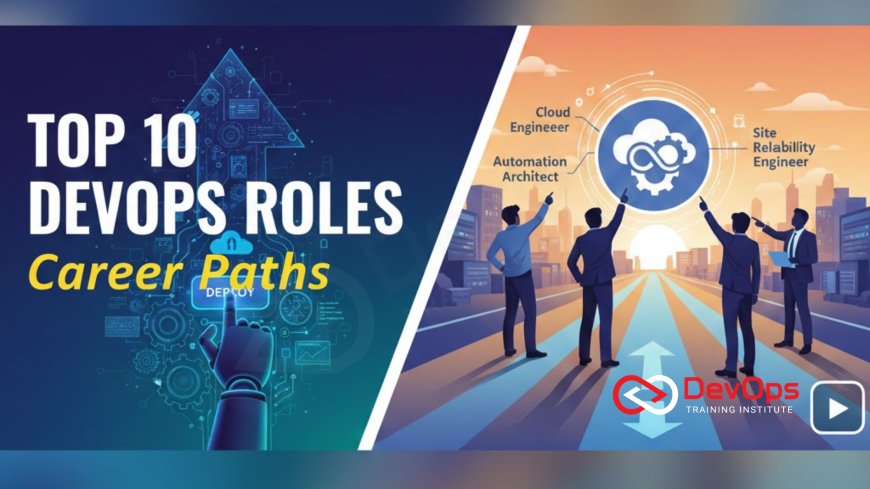
Top 10 DevOps Roles & Career Paths in 2025
Explore the top 10 DevOps roles in 2025, from DevOps Engineer to Platform Engineering Lead. Discover salaries, key skills, career progression paths, and emerging trends shaping the future of DevOps jobs in cloud-native, AI-driven, and security-focused environments.
Introduction
The DevOps movement has evolved far beyond simple automation scripts and CI/CD pipelines. In 2025, organizations treat infrastructure as software, security as code, and reliability as a core product feature. This shift has created a diverse ecosystem of specialized DevOps roles that blend software engineering, operations, security, data, and platform thinking. Whether you are starting your career or planning your next move, understanding these top 10 roles will help you navigate the fastest-growing segment of tech hiring today, especially when mastering serverless architecture becomes a key differentiator.
1. DevOps Engineer
- Builds and maintains CI/CD pipelines using Jenkins, GitHub Actions, ArgoCD, or CircleCI
- Writes Infrastructure as Code with Terraform, Pulumi, or AWS CDK
- Automates everything from provisioning to monitoring
- Collaborates daily with development teams to improve deployment frequency
- Troubleshoots production incidents and participates in on-call rotations
- Focuses on velocity while maintaining system stability
- Average salary range in 2025: $130K–$180K (US)
2. Site Reliability Engineer (SRE)
Site Reliability Engineers apply software engineering principles to operations problems. They own the reliability of services at scale, defining Service Level Objectives (SLOs) and error budgets. SREs write code to make systems self-healing and spend significant time reducing toil through automation.
Google pioneered this role, and today every major tech company has SRE teams. In 2025, SRE remains one of the highest-paid and most respected paths in DevOps.
3. Platform Engineer
- Builds internal developer platforms (IDPs) that abstract away cloud complexity
- Creates golden paths and paved roads for faster feature delivery
- Manages tools like Backstage, Crossplane, and Humanitec
- Focuses on developer experience and self-service capabilities
- Defines standards for security, compliance, and cost governance
- Enables hundreds of developers to ship code without waiting for ops tickets, often leveraging Multi-AZ RDS deployments for high availability
4. Cloud Engineer
Cloud Engineers specialize in one or more major cloud providers (AWS, Azure, GCP). They design scalable, resilient architectures and optimize costs.
With multi-cloud and hybrid environments growing, certified cloud engineers who understand FinOps principles are in extremely high demand throughout 2025.
5. DevSecOps Engineer
- Shifts security left by integrating checks into every stage of the pipeline
- Deploys SAST, DAST, SCA, and container scanning tools
- Writes policy-as-code using Open Policy Agent or Sentinel
- Manages secrets with HashiCorp Vault or cloud-native solutions
- Conducts threat modeling and compliance automation
- Bridges the gap between security teams and developers, often securing databases using private subnet RDS strategies
6. GitOps Engineer
GitOps Engineers treat Git as the single source of truth for infrastructure and application deployments. They champion tools like ArgoCD and Flux.
This role has exploded with Kubernetes adoption and is now considered a must-have specialization in cloud-native organizations.
7. MLOps Engineer
- Builds reproducible pipelines for training, validation, and deployment of ML models
- Manages feature stores, model registries, and experiment tracking
- Implements monitoring for data drift and model degradation
- Works with Kubeflow, MLflow, or cloud services like SageMaker
- Ensures models move safely from notebook to production
- Collaborates closely with data scientists and platform teams, frequently using Lambda functions for inference at scale
8. AIOps Engineer
AIOps Engineers use artificial intelligence to enhance IT operations. They implement anomaly detection, root cause analysis, and predictive incident management.
As systems generate massive telemetry data, AIOps specialists who can reduce alert fatigue are becoming essential in enterprise environments.
9. Observability Engineer
- Designs end-to-end tracing, metrics, and logging strategies
- Deploys OpenTelemetry, Prometheus, Grafana, and Jaeger
- Creates meaningful dashboards and SLO-based alerts
- Helps teams understand distributed system behavior
- Champions correlation IDs and context propagation
- Turns raw telemetry into actionable insights, often monitoring RDS performance with advanced observability tools
10. Release Manager / Release Engineer
Release Managers orchestrate complex deployments across multiple environments and teams. They own feature flags, canary releases, and rollback strategies.
In regulated industries like finance and healthcare, this role combines deep technical knowledge with compliance expertise, making it both critical and well-compensated.
Conclusion
The DevOps landscape in 2025 offers diverse, high-impact career paths that go far beyond basic automation. From building self-service platforms to securing AI-driven deployments, these top 10 roles represent the future of how modern software is built, shipped, and operated. Choose a specialization that matches your strengths, master the associated tools, and continuously focus on delivering value, and you’ll find yourself in one of the most rewarding and future-proof areas of technology.
Frequently Asked Questions
What is the highest-paying DevOps role in 2025?
Site Reliability Engineers and Platform Engineering Leads at top tech companies often exceed $250K total compensation, followed closely by DevSecOps and MLOps specialists.
Do I need a degree to get into DevOps?
No. Certifications, hands-on projects, and contributions to open-source tools matter more than formal education in today’s hiring market.
Which certification is most valuable in 2025?
CKA/CKAD (Kubernetes), AWS/GCP/Azure professional certifications, and HashiCorp Terraform Associate remain the most sought-after.
Is DevOps still in demand in 2025?
Yes, demand is stronger than ever as companies accelerate cloud-native transformation and adopt AI/ML workloads.
Should I learn Kubernetes in 2025?
Absolutely. Kubernetes skills appear in over 80% of senior DevOps and platform engineering job descriptions.
What is the difference between DevOps Engineer and SRE?
DevOps Engineers focus on speed and automation; SREs focus on reliability, error budgets, and applying software engineering to operations.
Which tools should every DevOps professional know?
Git, Docker, Kubernetes, Terraform, CI/CD systems (GitHub Actions, GitLab, Argo), and basic cloud provider services are non-negotiable.
Can I transition from developer to DevOps?
Yes, many developers successfully move into DevOps by learning infrastructure as code, cloud platforms, and observability practices.
Is Platform Engineering replacing DevOps?
No, Platform Engineering is an evolution that builds on DevOps principles to improve developer productivity at scale.
What salary can I expect as a mid-level DevOps Engineer in 2025?
In the US, mid-level roles typically range from $140K to $190K base salary, plus bonus and equity.
What's Your Reaction?
 Like
0
Like
0
 Dislike
0
Dislike
0
 Love
0
Love
0
 Funny
0
Funny
0
 Angry
0
Angry
0
 Sad
0
Sad
0
 Wow
0
Wow
0


![100+ Azure DevOps Interview Questions and Answers [Updated 2025]](https://www.devopstraininginstitute.com/blog/uploads/images/202509/image_140x98_68c40aa9a3834.jpg)






![Future Scope of DevOps Careers in Pune [Updated 2025]](https://www.devopstraininginstitute.com/blog/uploads/images/202510/image_140x98_68e3a84652312.jpg)