


![Kong Interview Preparation Guide [2025]](https://www.devopstraininginstitute.com/blog/uploads/images/202509/image_430x256_68dbb95326997.jpg)

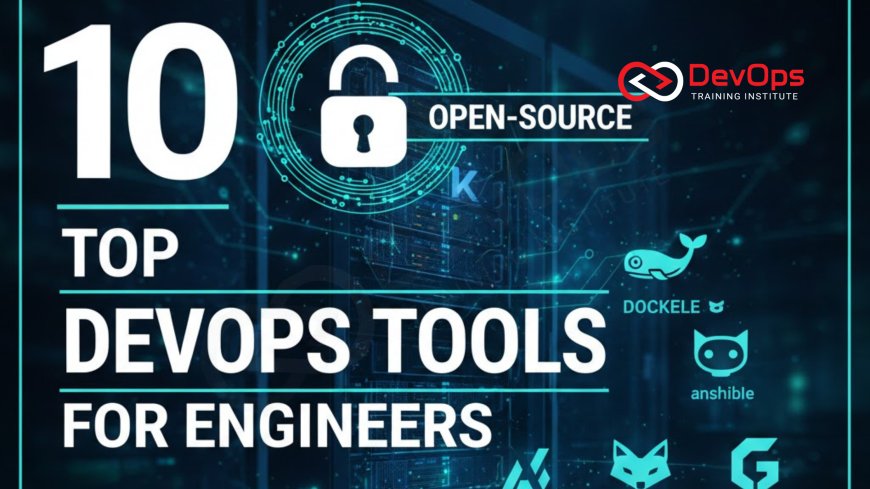
Top 10 Open-Source Tools for DevOps Engineers in 2025
Discover the 10 most powerful open-source DevOps tools dominating 2025. From GitOps controllers and policy engines to observability platforms, image scanners, and runtime security. All free, community-driven, and used daily by Netflix, Google, and thousands of enterprises.
Introduction
Open-source tools are the beating heart of modern DevOps. In 2025, the best teams run almost their entire stack on battle-tested, community-driven projects that are often more innovative and secure than commercial alternatives. These tools are free, transparent, and backed by massive ecosystems of contributors from Google, Microsoft, Netflix, and beyond. This carefully curated list of the top 10 open-source DevOps tools gives you everything you need to build secure, observable, automated, and GitOps-driven pipelines without spending a single dollar on licenses. Each entry includes real-world use cases, key features, and why it belongs in every engineer's toolkit.
1. ArgoCD – The Gold Standard for GitOps
ArgoCD is the most widely adopted GitOps controller for Kubernetes. It continuously reconciles your cluster state with declarations in Git, providing visibility, audit trails, and automatic healing.
- Declarative, pull-based deployments with full rollback history
- Beautiful UI showing sync status and health at a glance
- Multi-cluster and multi-tenant support out of the box
- Integrates perfectly with Helm, Kustomize, Jsonnet
- Used by Intuit, Adobe, and thousands of others
2. Flux CD – Lightweight GitOps from CNCF
The official CNCF GitOps project. Flux is agentless, lightweight, and designed for simplicity and security.
- Runs entirely within the cluster, no external controllers
- Excellent Helm and Kustomize support
- Image automation: automatically updates container tags
- Strong integration with Microsoft, Weaveworks, and GitHub
- Perfect for teams who want minimal overhead
3. Kyverno – Kubernetes-Native Policy Engine
Kyverno lets you enforce security and operational policies using simple YAML, no Rego required. The fastest-growing policy tool in 2025.
- Validate, mutate, and generate resources on the fly
- Built-in policies for Pod Security Standards, NSA hardening
- Audit mode catches violations without blocking
- Used by Adobe, T-Mobile, and the US Department of Defense
4. Prometheus + Grafana – The Observability Standard
The combination that powers monitoring at virtually every cloud-native company. Prometheus scrapes metrics, Grafana visualizes them beautifully.
- PromQL for powerful querying and alerting
- Thousands of exporters for every technology
- Grafana Loki for logs, Tempo for traces
- Used by 90% of Kubernetes clusters in production
5. Trivy – All-in-One Vulnerability Scanner
The most popular open-source scanner for containers, Git repos, IaC, and SBOMs. Maintained by Aqua Security.
- Scans container images, Terraform, CloudFormation, Kubernetes manifests
- Zero false positives with built-in misconfiguration checks
- Integrates into CI/CD with simple CLI
- Generates SBOMs and signs them with cosign
6. Falco – Runtime Security & Threat Detection
The CNCF incubation project that watches system calls and Kubernetes events in real time to detect anomalies.
- Detects crypto mining, privilege escalation, shell in container
- Pre-built rules for MITRE ATT&CK framework
- Runs as eBPF probe or kernel module
- Used by Shopify, DigitalOcean, and Sysdig customers
7. Cilium – eBPF-Based Networking & Security
The future of Kubernetes networking. Cilium replaces kube-proxy and adds L3-L7 policy enforcement, encryption, and observability.
- Network policies with identity awareness (not just IP)
- Built-in Hubble UI for traffic visualization
- Transparent encryption with WireGuard or IPsec
- Powers clusters at Google, Adobe, and Capital One
8. OpenTelemetry – Unified Observability Framework
The CNCF standard for collecting traces, metrics, and logs. Vendor-agnostic and rapidly replacing proprietary agents.
- Single instrumentation for multiple backends (Jaeger, Prometheus, etc.)
- Auto-instrumentation for Java, .NET, Python, Go
- Adopted by AWS, Google, Microsoft, Splunk
9. Terraform – Infrastructure as Code Leader
The original IaC tool from HashiCorp. Still the most widely used despite commercial offerings.
- Works across AWS, Azure, GCP, Kubernetes, and hundreds more
- Modules and state management for large teams
- Integrates perfectly with DevOps pipelines
10. Jenkins – The Classic Automation Server
Still the most popular open-source CI/CD engine in enterprises. With Jenkins X and modern plugins, it remains relevant.
- Thousands of plugins for every tool imaginable
- Jenkins Pipeline as code with Jenkinsfile
- Blue Ocean UI for modern experience
Open-Source DevOps Tools Comparison Table
| Tool | Category | CNCF Status | Notable Users |
|---|---|---|---|
| ArgoCD | GitOps | Graduated | Intuit, Adobe |
| Flux CD | GitOps | Graduated | Microsoft, Weaveworks |
| Kyverno | Policy | Incubating | T-Mobile, DoD |
| Prometheus | Monitoring | Graduated | 90% of K8s clusters |
| Cilium | Networking/Security | Graduated | Google, Adobe |
Conclusion
The beauty of open-source DevOps tools in 2025 is that you can run a world-class, enterprise-grade stack completely for free. ArgoCD or Flux for GitOps, Kyverno for policy, Prometheus and Grafana for observability, Trivy and Falco for security, Cilium for networking. These ten projects are not just popular; they are the actual tools that power Netflix, Google, and the world’s largest financial institutions. Start with one or two that solve your immediate pain (most teams begin with GitOps and observability), then gradually adopt the rest. The future of DevOps is open, transparent, and community-driven. These tools put that future in your hands today.
Frequently Asked Questions
Are these tools truly free for enterprise use?
Yes. All are Apache 2.0 or similar licenses with no paid tiers required.
Which GitOps tool should I choose: ArgoCD or Flux?
ArgoCD for rich UI and multi-cluster, Flux for minimal footprint and image automation.
Do I need both Kyverno and OPA/Gatekeeper?
No. Choose one. Kyverno is easier for most teams.
Is Prometheus still the best monitoring choice?
Yes for metrics. Pair with Loki/Tempo for full observability.
Which tool has the best vulnerability scanning?
Trivy is fastest and most accurate in 2025.
Can Falco detect crypto mining?
Yes, out of the box with default ruleset.
Is Cilium ready for production?
Absolutely. Google, Adobe, and Bell Canada run it at massive scale.
Do I need commercial support for these tools?
Not required, but companies like Isovalent, Aqua, and Sysdig offer enterprise versions.
Which tool is easiest for beginners?
Kyverno and Trivy have the gentlest learning curves.
Can I run all these tools together?
Yes. This exact stack is common in high-performing organizations.
Are there good Helm charts for these tools?
Yes. Most have official, well-maintained charts.
How do I stay updated on new releases?
Follow their GitHub repos and CNCF YouTube channel.
Is Jenkins still relevant in 2025?
Yes, especially in large enterprises with complex pipelines.
Which tool has the strongest community?
Prometheus and Kubernetes-related projects have millions of users.
What is the future of open-source DevOps tools?
eBPF everywhere, policy-as-code by default, and AI-assisted operations.
What's Your Reaction?
 Like
0
Like
0
 Dislike
0
Dislike
0
 Love
0
Love
0
 Funny
0
Funny
0
 Angry
0
Angry
0
 Sad
0
Sad
0
 Wow
0
Wow
0

![100+ Azure DevOps Interview Questions and Answers [Updated 2025]](https://www.devopstraininginstitute.com/blog/uploads/images/202509/image_140x98_68c40aa9a3834.jpg)



![Future Scope of DevOps Careers in Pune [Updated 2025]](https://www.devopstraininginstitute.com/blog/uploads/images/202510/image_140x98_68e3a84652312.jpg)