




![Kong Interview Preparation Guide [2025]](https://www.devopstraininginstitute.com/blog/uploads/images/202509/image_430x256_68dbb95326997.jpg)




10 Container Orchestration Tools Other than Kubernetes
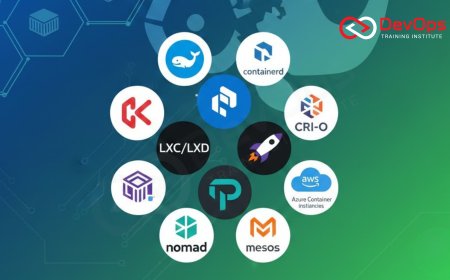
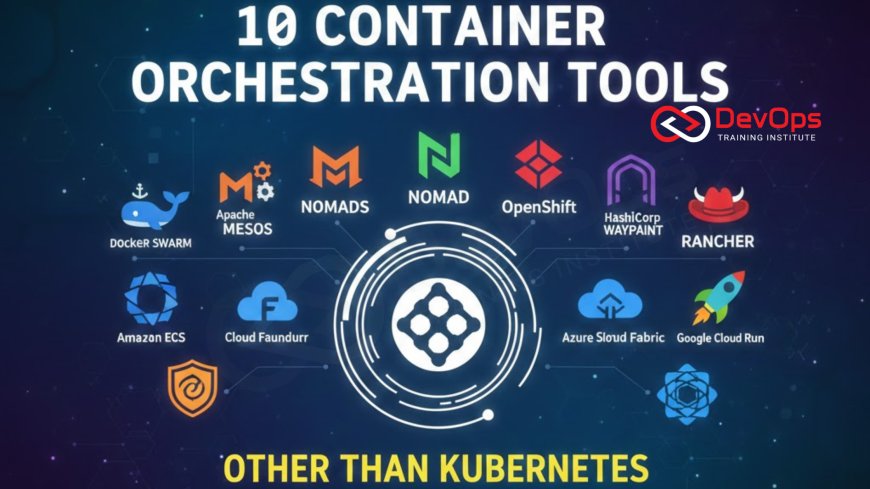
While Kubernetes dominates the market, several powerful alternatives offer unique advantages for specific use cases in twenty twenty six. This guide explores ten container orchestration tools other than Kubernetes, ranging from lightweight developer friendly platforms like Docker Swarm to enterprise grade solutions like Nomad and Amazon ECS. Learn how to choose the right orchestrator based on your team's size, technical expertise, and cloud architecture requirements. Discover how these platforms handle automated scaling, service discovery, and high availability to ensure your microservices remain resilient and performant in today's diverse and rapidly evolving digital infrastructure landscape.
Introduction to the Orchestration Landscape
Kubernetes has undoubtedly become the industry standard for container orchestration, but it is not the only solution available for modern engineering teams. In twenty twenty six, many organizations are finding that the sheer complexity of Kubernetes can sometimes outweigh its benefits, leading them to seek simpler or more specialized alternatives. Container orchestration tools are essential for managing the lifecycle of containers, handling tasks such as deployment, scaling, networking, and health monitoring. Choosing the right tool depends on your specific infrastructure needs and the technical maturity of your DevOps team.
Alternative orchestrators often focus on ease of use, lower operational overhead, or deep integration with specific cloud providers. Whether you are running a small startup or managing a massive enterprise fleet, understanding the broader ecosystem allows you to make more informed architectural decisions. This guide dives into ten powerful platforms that provide robust container management without the steep learning curve often associated with the Kubernetes ecosystem. By exploring these options, you can find the perfect balance between power and simplicity for your next software delivery project.
Docker Swarm: The Native Alternative
Docker Swarm is the most straightforward alternative for teams already comfortable with the Docker ecosystem. As Docker's native orchestration tool, it is built directly into the Docker Engine, meaning there is no additional software to install. It uses a declarative model to define the desired state of your services and handles the heavy lifting of load balancing and scaling across a cluster of nodes. Its primary advantage is simplicity; if you can write a docker-compose.yml file, you can manage a Swarm cluster with very little additional training.
While it may lack some of the advanced scheduling features found in more complex systems, Docker Swarm is incredibly efficient for smaller to medium sized workloads. It provides a "just works" experience for service discovery and rolling updates, ensuring that your continuous synchronization efforts remain smooth. For many developers, Swarm offers the perfect "paved road" to production without the cognitive load of managing pods, ingress controllers, or complex network policies. It remains a popular choice for internal tools and applications that require rapid iteration and low maintenance.
HashiCorp Nomad: Flexibility and Scale
HashiCorp Nomad has emerged as a favorite among site reliability engineers who value simplicity and flexibility. Unlike Kubernetes, which is strictly focused on containers, Nomad is a general purpose orchestrator that can manage containers, virtual machines, and standalone binary applications. This makes it an ideal choice for organizations transitioning to the cloud who still have legacy workloads to maintain. Nomad follows the HashiCorp philosophy of being a single binary that is easy to deploy and operate across multiple data centers or cloud regions.
Nomad's architecture is significantly less complex than that of Kubernetes, focusing strictly on cluster management and scheduling while delegating tasks like service discovery to other tools like Consul. This modular approach allows for a highly customized devops toolchain that can scale to thousands of nodes with ease. By utilizing architecture patterns that prioritize simplicity, Nomad provides a high performance environment that is much easier to secure and troubleshoot. It is a powerful contender for teams that need massive scale without the operational tax of a full Kubernetes distribution.
Amazon ECS: Deep AWS Integration
Amazon Elastic Container Service (ECS) is a highly scalable, high performance container management service provided by AWS. It is deeply integrated with the rest of the AWS ecosystem, including IAM for security, CloudWatch for monitoring, and Route 53 for service discovery. For teams already heavily invested in AWS, ECS offers a seamless experience that eliminates the need to manage the underlying orchestration control plane. It supports both EC2 instances and AWS Fargate, a serverless compute engine for containers that removes the need to manage servers entirely.
The main draw of Amazon ECS is its reliability and ease of setup within the AWS console. It allows engineers to focus on building their applications while AWS handles the operational availability of the orchestrator. By utilizing who drives cultural change strategies, teams can quickly migrate to ECS to achieve faster time to market. Its robust support for blue-green deployments and automated scaling makes it a top tier choice for enterprise grade applications that require high uptime and consistent performance across a global user base.
Comparison of Kubernetes Alternatives
| Tool Name | Primary Focus | Cloud Model | Best For |
|---|---|---|---|
| Docker Swarm | Simplicity | Hybrid | Small to Medium Teams |
| Amazon ECS | AWS Integration | AWS Only | AWS native workloads |
| Nomad | Multi-Workload | Multi-Cloud | Complex, Large Scale |
| Google Cloud Run | Serverless | GCP Only | Stateless APIs |
| Azure Container Apps | Managed Serverless | Azure Only | Azure microservices |
Apache Mesos and Marathon: The Big Data Choice
Apache Mesos is a distributed systems kernel that abstracts CPU, memory, and storage away from machines, enabling entire data centers to be managed as a single pool of resources. While Mesos provides the resource management layer, Marathon acts as the "init" system for long running services. This combination was one of the first true competitors to Kubernetes and remains highly effective for organizations running a mix of containerized microservices and massive data processing frameworks like Apache Spark or Hadoop.
The strength of Mesos lies in its maturity and its ability to handle extremely diverse workloads at an enormous scale. It provides fine grained resource isolation and a highly available architecture that is proven in some of the world's largest production environments. By integrating admission controllers and advanced scheduling, Mesos can optimize resource utilization across a shared cluster. For teams focused on big data and analytics, the Mesos and Marathon stack offers a level of resource efficiency that is difficult to replicate in other general purpose orchestrators.
Serverless Orchestration: Google Cloud Run and Azure Container Apps
For many teams, the "best" orchestrator is the one they don't have to manage at all. Google Cloud Run and Azure Container Apps represent the move toward serverless container orchestration. These services allow you to deploy a containerized application and automatically scale it from zero to thousands of instances based on incoming traffic. You only pay for the exact resources your code consumes while it is running. This model is perfect for stateless microservices, background jobs, and APIs where traffic patterns are unpredictable.
These serverless platforms abstract away the complexity of managing clusters, nodes, and networking entirely. They utilize AI-augmented devops to handle autoscaling and health checks automatically. By using continuous verification, you can ensure that your serverless deployments are always meeting your performance and reliability goals. This "NoOps" approach allows your engineering team to focus 100% on writing code and delivering value to users, making it an increasingly attractive option for modern, cloud native development in twenty twenty six.
Best Practices for Choosing a Kubernetes Alternative
- Assess Complexity: Honestly evaluate your team's ability to manage a complex orchestrator versus using a managed or simpler tool.
- Check Cloud Lock-in: Determine if the benefits of a provider specific tool (like ECS) outweigh the risks of being tied to a single cloud vendor.
- Evaluate Scale Requirements: Choose an orchestrator that can handle your current workload and your projected growth for the next eighteen to twenty four months.
- Verify Security Tools: Ensure the orchestrator integrates with your existing secret scanning tools and security policies.
- Consider Multi-workload Needs: If you need to run binaries or VMs alongside containers, look toward a flexible tool like HashiCorp Nomad.
- Monitor Performance: Use ChatOps techniques to maintain visibility into your alternative cluster health and deployment status.
- Optimize Runtime: Check if your chosen orchestrator can work with lightweight runtimes like containerd for better efficiency and faster startup times.
Selecting an orchestrator is a foundational decision that will impact your engineering velocity for years. It is important to run a pilot project or a "canary" deployment on your top two choices to see how they handle your specific application logic and developer workflows. By prioritizing simplicity and automation, you can build a high-performance infrastructure that supports your business goals without overwhelming your operations team. As the landscape continues to evolve, staying flexible and open to new tools will ensure your organization remains competitive in the fast paced digital economy of the future.
Conclusion: Beyond the Kubernetes Monopoly
In conclusion, while Kubernetes is a powerful and versatile tool, it is not the only path to successful container orchestration. From the native simplicity of Docker Swarm to the multi workload flexibility of Nomad and the serverless ease of Google Cloud Run, the alternatives offer a wide range of benefits for different organizational needs. By choosing the tool that best fits your technical expertise and business requirements, you can reduce operational overhead and improve your overall deployment quality. The goal of orchestration is to empower your developers, not to burden your operations team with unnecessary complexity.
As you look toward the future, the rise of AI augmented devops will likely make managing any of these orchestrators even simpler. Integrating GitOps practices into your chosen platform will ensure your configurations are versioned and auditable. Whether you are scaling microservices on Amazon ECS or managing a hybrid data center with Mesos, these ten tools provide the robust foundation needed for a modern, agile enterprise. Embrace the diversity of the orchestration ecosystem today to build a more resilient and efficient future for your entire engineering organization.
Frequently Asked Questions
Is Docker Swarm still used in 2026?
Yes, Docker Swarm remains popular for teams seeking a simple, lightweight orchestration solution that is easy to manage without deep Kubernetes expertise.
What is the main advantage of HashiCorp Nomad over Kubernetes?
Nomad's main advantage is its simplicity and its ability to manage containers, virtual machines, and standalone binaries within a single unified orchestrator.
Can I run serverless containers on AWS?
Yes, AWS Fargate allows you to run containers in a serverless fashion without having to manage the underlying EC2 instances or cluster infrastructure.
What is the difference between Google Cloud Run and GKE?
Cloud Run is a fully managed serverless platform for stateless containers, while GKE provides a full, customizable Kubernetes environment for complex workloads.
Is Apache Mesos better for big data than Kubernetes?
Mesos is often preferred for big data because it was built specifically to handle diverse workloads like Spark and Hadoop alongside containerized microservices.
What are the benefits of using a cloud-native orchestrator like ECS?
Cloud-native orchestrators offer deep integration with the provider's security, networking, and monitoring tools, significantly reducing the manual configuration and management required.
Do Kubernetes alternatives support GitOps?
Yes, most modern orchestrators like Nomad and ECS can be integrated with GitOps tools to ensure version-controlled and automated infrastructure and application deployments.
Which tool is best for a very small startup?
Docker Swarm or a serverless option like Google Cloud Run are usually best for small teams due to their extremely low operational overhead.
What is a container kernel abstraction?
This refers to how Mesos abstracts hardware resources into a single pool, allowing the orchestrator to distribute tasks across the entire data center efficiently.
Can I migrate from Kubernetes to Nomad?
Yes, while the configuration manifests differ, the underlying container images are compatible, allowing for a strategic migration if Kubernetes becomes too complex.
How does service discovery work in Docker Swarm?
Swarm has built-in service discovery that uses internal DNS to assign each service a unique name, which is accessible by all other services.
What is the role of Marathon in the Mesos ecosystem?
Marathon acts as the orchestration layer on top of Mesos, handling the deployment and lifecycle management of long-running containerized and non-containerized applications.
Does Azure Container Apps support auto-scaling?
Yes, Azure Container Apps uses KEDA to provide powerful, event-driven auto-scaling that can scale your containers down to zero when not in use.
Is Portainer an orchestrator?
Portainer is not an orchestrator itself but a powerful management UI that allows you to manage Docker Swarm, Kubernetes, and Nomad clusters easily.
What should be my first step in evaluating these tools?
Identify your primary bottleneck with Kubernetes; if it's complexity, try Swarm; if it's multi-workload support, try Nomad; if it's management, try ECS.
What's Your Reaction?
 Like
0
Like
0
 Dislike
0
Dislike
0
 Love
0
Love
0
 Funny
0
Funny
0
 Angry
0
Angry
0
 Sad
0
Sad
0
 Wow
0
Wow
0


![100+ Azure DevOps Interview Questions and Answers [Updated 2025]](https://www.devopstraininginstitute.com/blog/uploads/images/202509/image_140x98_68c40aa9a3834.jpg)






![Future Scope of DevOps Careers in Pune [Updated 2025]](https://www.devopstraininginstitute.com/blog/uploads/images/202510/image_140x98_68e3a84652312.jpg)