DevOps Certification Courses in Bangalore: Live Online
What a DevOps certification course covers for Bangalore learners: modules, labs, projects, exam mapping, live online format and career support.

A DevOps certification course for Bangalore learners should teach Linux, Git, CI/CD with Jenkins, Docker, Kubernetes, cloud pipelines and monitoring through hands-on labs, and map those skills to official exams such as CKA, AWS DevOps Engineer Professional or AZ-400. Career support should mean resume reviews, mock interviews and project portfolios, not promises of a job.
This guide explains what such a course covers module by module, how the labs and projects work, how live online classes run for learners in Bangalore, and what general career support looks like. Our training for Bangalore is delivered live online; the only classroom we run is in Kharadi, Pune. If you are still deciding which exam to aim for, read DevOps certifications compared for Bangalore first. For an overview of the field itself, start with What is DevOps?
Key takeaways
- A useful course follows the delivery pipeline: Linux and Git, then CI with Jenkins, containers with Docker, orchestration with Kubernetes, cloud pipelines and monitoring.
- Certification is a separate step. The exam is booked and paid with the certifying body (Linux Foundation, AWS, Microsoft, HashiCorp or Red Hat), not with the training provider.
- Labs and an end-to-end project matter more than slides. Ask how much class time is hands-on.
- Career support covers resumes, mock interviews, portfolio reviews and interview preparation. No honest provider can guarantee a job or a salary.
- For Bangalore learners, live online classes with recorded sessions and remote lab access give the same syllabus as a classroom.
What the course covers, module by module
The modules below follow the syllabus on our DevOps training course page. Each one builds on the one before, so by the end you can take an application from a Git commit to a monitored deployment on Kubernetes.
| Module | Topics | Lab outcome | Related official exam |
|---|---|---|---|
| DevOps foundations | DevOps principles, Agile and Scrum, culture, tool overview | Map a team's delivery flow and its bottlenecks | None directly |
| Version control with Git | Branching, merging, GitHub and GitLab, repository management | Run a pull request workflow with reviews | None directly |
| Continuous integration with Jenkins | Installation, pipelines, Git and Maven integration, automated tests | Build and test an application on every commit | Supports AWS DevOps and AZ-400 pipeline topics |
| Containers with Docker | Images, containers, Docker Compose, Docker Hub | Containerize a multi-service application | Foundation for CKA and CKAD |
| Orchestration with Kubernetes | Architecture, Pods, Services, Ingress, scaling | Deploy and scale an app on a cluster | CKA, CKAD |
| Cloud pipelines and monitoring | AWS CodePipeline and CodeBuild, Azure DevOps Pipelines, Prometheus, Grafana, ELK Stack | Deploy through a cloud pipeline and watch it on dashboards | AWS DevOps Engineer Professional, AZ-400, Prometheus Certified Associate |
DevOps foundations
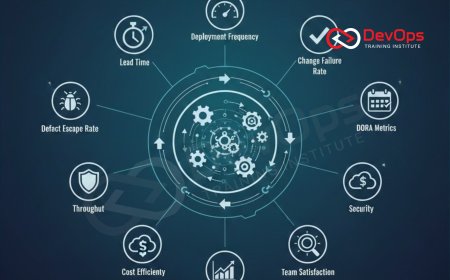
The course opens with why DevOps exists: shorter feedback loops, shared ownership and automation. You learn how Agile and Scrum teams plan work and where DevOps practices fit. This sets up the vocabulary that interviewers use, such as lead time and deployment frequency.
Git and source control
Every later module depends on Git. You practise branching, merging, resolving conflicts and working through pull requests on GitHub or GitLab. A good lab here simulates a small team so you see merge conflicts and code review in action.
Continuous integration with Jenkins
You install Jenkins, connect it to a Git repository and Maven, and write pipelines that build and test code on every push. Expect to break a build on purpose and read the logs to fix it, because troubleshooting is what employers test. Our guide to common CI/CD pipeline failures is good revision for this module.
Docker
You write Dockerfiles, build and tag images, push them to a registry and run multi-container apps with Docker Compose. This module prepares you for Kubernetes, where everything runs as containers.
Kubernetes
You learn the control plane and worker components, then deploy applications with Pods, Deployments, Services and Ingress, and scale them. This module lines up with the Certified Kubernetes Administrator (CKA) and Application Developer (CKAD) exams, both performance-based tests run by the Linux Foundation.
Cloud pipelines and monitoring
The last module moves the pipeline to the cloud with AWS CodePipeline and CodeBuild and with Azure DevOps Pipelines, then adds monitoring with Prometheus and Grafana and log analysis with the ELK Stack. You finish with an application that is built, deployed and observed end to end.
Mapping the course to certifications
A course teaches the skills; the certifying body runs the exam. The table shows which exams match which parts of the syllabus. Exam fees and rules are set by each certifying body, and our page on DevOps certification exam fees lists the official figures with links.
| Target role | Suggested first exam | Course modules that matter most |
|---|---|---|
| Kubernetes or platform operations | Certified Kubernetes Administrator (CKA) | Docker, Kubernetes, monitoring |
| Developer moving into DevOps | Certified Kubernetes Application Developer (CKAD) | Git, Docker, Kubernetes |
| AWS-focused DevOps | AWS Certified DevOps Engineer - Professional (often after Solutions Architect Associate) | Jenkins, cloud pipelines, monitoring |
| Azure-focused DevOps | Microsoft Certified: DevOps Engineer Expert (AZ-400 plus AZ-104 or AZ-204) | Git, CI/CD, Azure DevOps Pipelines |
| Infrastructure as code | HashiCorp Terraform Associate | Covered in a separate Terraform course |
How live online classes work for Bangalore learners
- Live sessions. The trainer teaches and demonstrates in real time, and you can ask questions as you go.
- Weekday or weekend batches. Working professionals often choose weekends; freshers often choose weekdays.
- Remote labs. You work on your own machine or a cloud lab, so you need a laptop that can run Docker and a stable internet connection.
- Practice between classes. Plan several hours a week outside sessions to repeat labs. Skills stick only when you type the commands yourself.
- One-to-one option. Learners who need a custom pace can ask about individual sessions.
If you are in Pune and prefer a classroom, the Kharadi centre runs the same syllabus. Bangalore learners join online.
Prerequisites and preparing before day one
You do not need to be a programmer, but the course moves faster if you arrive with a few basics. Spend the weeks before the batch starts on these:
- Linux command line. Navigating directories, editing files with a terminal editor, managing permissions, processes and packages. Most DevOps tools run on Linux servers.
- Networking basics. IP addresses, ports, DNS and HTTP. Many pipeline and Kubernetes problems turn out to be networking problems.
- One scripting language. Bash is enough to start; Python helps later for automation.
- A working laptop setup. Install Git, a code editor and Docker before the first class, and create free accounts on GitHub and a cloud provider. Set billing alerts on any cloud account.
If the Linux part feels unfamiliar, a short Linux course before DevOps saves time later. Our RHCSA on RHEL 10 guide shows the Linux skills employers expect.
A sample weekly study rhythm
| Activity | When | Purpose |
|---|---|---|
| Live class | Scheduled batch sessions | Learn the concept and watch the demo |
| Repeat the lab | Within a day of each class | Type every command yourself and fix your own errors |
| Break and fix | Once a week | Change one setting on purpose, then troubleshoot it |
| Project work | Weekend | Add the week's module to your portfolio project |
| Interview practice | Once a week | Explain what you built out loud, as you would to an interviewer |
Repeating labs soon after class and growing one project each week also gives you concrete work to describe in interviews.
Projects you should finish with
A portfolio shows employers what you can do. By the end of a DevOps course, aim to have these in a public Git repository with a short README for each:
- A Jenkins pipeline that builds, tests and packages an application on every commit.
- A Dockerized multi-service application with a Compose file.
- Kubernetes manifests that deploy the application with a Service and Ingress, plus a scaling demo.
- A cloud pipeline on AWS or Azure that deploys the same application.
- A Grafana dashboard with Prometheus metrics and at least one alert rule.
Signs you are ready to book your certification exam
- You can complete the course labs without notes, and fix errors by reading logs rather than restarting from scratch.
- You have read the official exam curriculum or study guide and can explain every listed topic in your own words.
- For performance-based exams such as CKA or CKAD, you can finish practice tasks within the time limit using only the documentation allowed in the exam.
- Your mock exam scores have been steady for at least a couple of attempts, not just one good result.
- You have run the certifier's system check if you plan to take the exam online.
What career support looks like
Career support helps you present your skills. It does not replace them, and it cannot guarantee a job, an interview count or a salary. Treat any offer that promises those with care, and read our guide on DevOps certification and career support in Bangalore for how to evaluate such claims.
In general terms, career support at a good training provider includes:
- Resume and LinkedIn reviews that put your projects and tools first.
- Mock technical interviews on Linux, Git, CI/CD, Docker and Kubernetes.
- Soft skills and communication practice for interviews.
- Guidance on booking and preparing for official certification exams.
- Advice on where to look for roles and how to prepare for each company's interview process.
Questions to ask before you enrol anywhere
- Can I see the full, current syllabus and a sample class?
- How much of each session is hands-on lab work?
- Who are the trainers, and what production experience do they have?
- Are sessions recorded, and how long can I access them?
- Is the certification exam fee included, or do I pay the certifying body directly?
- What exactly does career support include, in writing?
Related guides in this series
- DevOps certification courses for freshers in Bangalore
- DevOps training in Bangalore: live online program guide
FAQ
What does a DevOps certification course in Bangalore cover?
Linux and Git basics, CI with Jenkins, Docker, Kubernetes, cloud pipelines on AWS or Azure, and monitoring with Prometheus, Grafana and the ELK Stack, taught through hands-on labs.
Is the training online or classroom for Bangalore?
Our training for Bangalore learners is live online. The only classroom is in Kharadi, Pune.
Does a DevOps course guarantee placement?
No. Career support can include resume reviews, mock interviews and certification guidance, but no provider can honestly guarantee a job or salary.
Which certification should I take after a DevOps course?
CKA for Kubernetes operations, CKAD for developers, AWS DevOps Engineer Professional for AWS roles, or AZ-400 for Azure roles. Choose the one that matches the jobs you want.
Is the exam fee part of the course?
Exams are booked with the certifying body. Ask any provider in writing whether a voucher is included, and check the official fee on the certifier's site.
What projects should I build during the course?
A Jenkins pipeline, a Dockerized app, Kubernetes manifests, a cloud deployment pipeline and a monitoring dashboard with alerts, all in a public Git repository.
Can freshers join a DevOps certification course?
Yes, if they are comfortable with basic Linux commands and willing to practise. Some learners take a Linux course first.
References
- Linux Foundation: Certified Kubernetes Administrator (CKA)
- Linux Foundation: Certified Kubernetes Application Developer (CKAD)
- AWS Certified DevOps Engineer - Professional
- Microsoft Certified: DevOps Engineer Expert
- HashiCorp: Terraform Associate
- Linux Foundation: Prometheus Certified Associate
- DORA: Software delivery performance metrics
What's Your Reaction?
 Like
0
 Dislike
0
 Love
0
 Funny
0
 Angry
0
 Sad
0
 Wow
0