









![Kong Interview Preparation Guide [2025]](https://www.devopstraininginstitute.com/blog/uploads/images/202509/image_430x256_68dbb95326997.jpg)





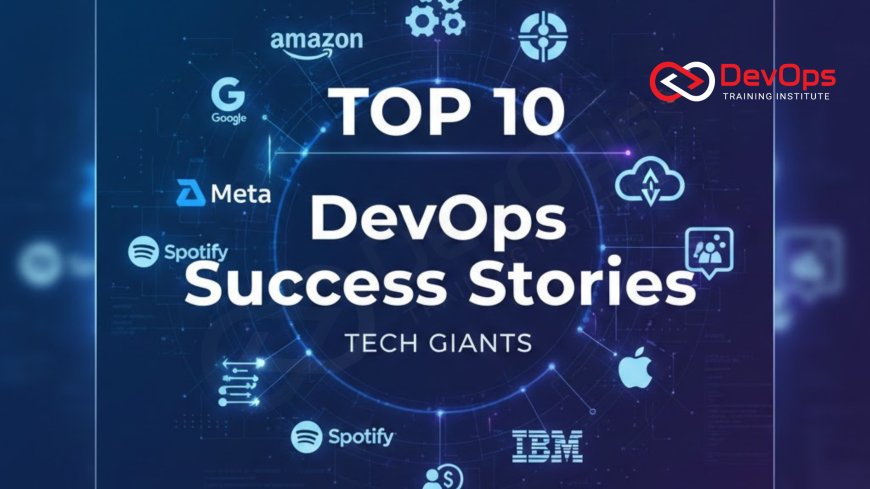
Top 10 DevOps Success Stories from Tech Giants
Dive into the most compelling DevOps success stories from global tech giants like Netflix, Amazon, Google, and Spotify. Learn how these industry leaders transformed their engineering culture and processes to achieve staggering deployment frequencies, near-zero downtime, and massive scalability. This guide breaks down the core strategies, including Site Reliability Engineering, microservices architecture, and continuous delivery tools like Spinnaker and Kubernetes. Discover the measurable results, organizational changes, and technical decisions that underpinned these transformations, providing a definitive roadmap for enterprises aiming for elite software delivery performance and resilient operational models that consistently drive business value and competitive advantage in a demanding cloud-native world.
Introduction
The movement known as DevOps has been thoroughly validated, not by academic theories or vendor promises, but by the undeniable operational excellence achieved by the world's largest and most innovative technology companies. These organizations operate at scales that were unimaginable just a decade ago, processing trillions of transactions, managing massive global cloud footprints, and delivering services to billions of users simultaneously. Their ability to remain agile, innovate rapidly, and sustain near-perfect uptime while deploying code multiple times per day is the ultimate proof that DevOps is far more than just a passing trend. It is, in fact, a proven business methodology that fundamentally reshapes how technology value is created, delivered, and sustained over the long term in any modern, competitive environment.
The transformation undertaken by these tech giants required a radical shift away from traditional, siloed structures where development and operations teams worked in isolation, relying on infrequent, high-risk "big bang" releases. Instead, they built systems and cultural transformation processes designed for collaboration, full-stack automation, immediate feedback, and shared ownership of both the code and its reliability in production. Their success stories provide invaluable blueprints, showing exactly which technical decisions—such as the adoption of microservices, Kubernetes, or Infrastructure as Code—and which cultural mandates—like blameless post-mortems and the elimination of manual toil—are required to achieve elite performance levels. By dissecting these success narratives, any company, regardless of its size or industry, can extract the core principles needed to accelerate its own journey toward operational supremacy.
This article dives into ten of the most profound and widely cited DevOps success stories from tech giants. We examine the specific tools they built or chose, the architectural shifts they implemented, the organizational models they adopted, and the quantifiable results they achieved. From Netflix's pioneering cloud resilience to Google's rigorous Site Reliability Engineering practice, these examples illustrate that the journey is challenging but the rewards—measured in unparalleled speed, stability, and innovation—are transformative for both the engineering team and the bottom line of the business.
1. Netflix: The Pioneer of Cloud Resilience and Chaos Engineering
Netflix's journey epitomizes the dramatic organizational shift required to embrace cloud-native DevOps. Faced with the technical limitations of its on-premise monolithic infrastructure during a major database corruption incident in 2008, the company made the bold decision to migrate its entire platform to AWS. This move was the catalyst for one of the most celebrated DevOps transformations in history, fundamentally changing how the world views cloud application deployment and reliability engineering. The entire strategy was built on the core assumption that failure is inevitable in a distributed cloud environment, and thus, systems must be engineered to withstand it proactively and gracefully.
The key to Netflix's success was the adoption of a microservices architecture, breaking down the monolithic application into hundreds of independent, loosely coupled services that could be developed and deployed autonomously by small, dedicated teams. This enabled extreme parallelism in development, allowing the company to deploy thousands of code changes daily without impacting the core service. To manage these rapid deployments safely, Netflix famously developed Spinnaker, an open-source, multi-cloud continuous delivery platform that enables advanced deployment strategies like canary releases and automated rollbacks, ensuring that risky changes are tested safely with small populations before a full rollout. This commitment to continuous delivery is a massive competitive advantage, enabling them to launch new features quickly and reliably across their global user base.
Perhaps their most significant contribution to the industry is Chaos Engineering. By deliberately introducing failures—such as terminating random production instances during business hours using tools like Chaos Monkey and the Simian Army—Netflix forced their engineering teams to design resilient, self-healing systems from the ground up. This proactive approach ensures that operational failures are discovered and fixed in a controlled, learning environment, rather than during a customer-impacting outage. This culture of constant stress-testing and blameless learning is the ultimate expression of DevOps maturity, embedding stability into the code rather than relying on manual intervention.
2. Amazon: The Two-Pizza Team Model and Cloud Infrastructure as Code
Amazon's success is a defining narrative of the DevOps era, largely because they are both a massive consumer and the provider of the fundamental platform, AWS. Their transformation began long before the term "DevOps" became popular, stemming from the realization that their monolithic architecture was stalling innovation. The mandate from CEO Jeff Bezos in the early 2000s required all teams to break their applications into small, independent services that communicated only via service APIs. This organizational restructuring created the famous "two-pizza team" model, where teams were kept small enough (usually 6-10 people) to be fed by two pizzas, ensuring they could operate with maximum autonomy and full stack ownership over their services.
- Autonomy and Ownership: Each two-pizza team owns its microservice entirely, from development and testing to deployment, operations, and eventual deprecation. This eliminates the "throw it over the wall" problem, enforcing a shared sense of responsibility for the service's performance and reliability in production.
- Cloud Services: The reliance on self-service cloud infrastructure (AWS) and automation tools like AWS CodePipeline and CodeDeploy allows these small teams to provision and deploy infrastructure as code without requiring manual interaction with a central operations team. This model is the engine behind Amazon's ability to deploy software changes every few seconds, a staggering metric that showcases their high-velocity operation and continuous delivery capabilities.
- Standardization through Tools: Amazon built internal tools, which later became public AWS services, to standardize the deployment pipeline, ensuring that every team follows strict security, deployment, and monitoring protocols automatically. This approach guarantees operational consistency across thousands of teams and services, making their massive scale manageable and consistently reliable.
Amazon's story proves that the combination of organizational autonomy, technological standardization via self-service cloud platforms, and the mandate for end-to-end service ownership is the most potent formula for achieving hyper-scale and unmatched agility in software delivery. Their emphasis on Infrastructure as Code and the reduction of internal dependencies are key takeaways for any large enterprise.
3. Google: The Gold Standard of Site Reliability Engineering (SRE)
Google's contribution to the DevOps world is the concept of Site Reliability Engineering (SRE), which is often described as the prescriptive implementation of DevOps philosophy. Google recognized early on that merely automating deployments was insufficient; true operational excellence required treating operations problems as engineering problems and solving them with software. The SRE team’s core tenet is that they will spend only a maximum of 50% of their time on manual operations ("toil") and the remaining 50% on engineering projects to automate away the rest of the toil, fundamentally improving the system itself.
Key to the SRE success story is the use of measurable Service Level Objectives (SLOs) and Service Level Indicators (SLIs). These quantifiable targets for service performance and reliability drive all operational decisions. The "error budget" concept grants the development team the freedom to innovate and deploy frequently, provided they do not exceed the agreed-upon failure rate threshold (the budget). If the budget is spent, the team must halt feature development and dedicate resources to improving reliability, ensuring that the development pace is always balanced against the needs of production stability. This data-driven, engineering-centric approach to reliability is one of the most rigorous and effective in the world, enabling Google to manage massive scale with exceptional consistency and stability across products like Search, Gmail, and YouTube, proving that DevOps principles are at the core of all high-scale systems.
4. Microsoft: The Transformation from Waterfall to Cloud-Native
Microsoft's DevOps transformation is particularly compelling because it was a journey from a rigid, highly siloed, and slow development model (traditional enterprise waterfall) to a fluid, cloud-native one. The scale of this internal shift, covering thousands of products and tens of thousands of developers, is monumental. The turning point was the adoption of Azure DevOps (formerly VSTS), which provided a centralized, unified platform for planning, version control, CI/CD, and testing. This provided the standardization and tooling necessary for developers to take ownership of the delivery process and reduce the massive release cycles that once defined their product line.
Microsoft's core success metric was the shift in deployment cadence. Products that once released every two years moved to monthly, weekly, and, for core cloud services, multiple times per day. The transition was enabled by embracing Infrastructure as Code (IaC), leveraging microservices for decoupling large applications like the Office suite, and aggressively adopting GitOps and containerization for consistency. By internally eating their own dog food (using Azure DevOps and Azure Cloud services to build their products), they not only validated their own tools but also streamlined their engineering process, showcasing the real-world power of their cloud platform to the enterprise world.
Table: Key CI/CD Strategies and Metrics
This table summarizes the core technical and cultural strategies adopted by the tech giants, illustrating how they leverage specialized tools and organizational models to achieve elite performance levels, measured by key metrics for DevOps success.
| Company | Core Strategy / Architectural Shift | Key Tooling / Methodology | Quantifiable Success / Differentiator |
|---|---|---|---|
| Netflix | Cloud Resilience, Microservices Architecture | Spinnaker (CD), Chaos Engineering, Asgard (Legacy CD) | Thousands of deployments per day; world-class system resilience validated in production. |
| Amazon | Two-Pizza Teams, Service Ownership | AWS CodeSuite, Microservices, Infrastructure as Code | Code deployed every few seconds; massive scale and decentralized decision-making. |
| Site Reliability Engineering (SRE) | SLOs/SLIs, Error Budgets, Monorepo, Borg/Kubernetes | Guaranteed service uptime and predictable deployment velocity driven by data. | |
| Microsoft | Waterfall to Agile/Cloud-Native Transformation | Azure DevOps, Azure Pipelines, GitOps | Shift from years-long release cycles to daily or weekly updates across thousands of products. |
| Spotify | Autonomy through Squads, Tribes, and Guilds | Feature Flags, CI/CD tools, Internal Dev Platform | High feature experimentation rate and continuous delivery across a massive code base. |
5. Spotify: The Culture of Autonomous Teams
Spotify's success story is rooted less in technology choice and more in pioneering a unique organizational structure that maximizes autonomy and collaboration. Their "Spotify Model" organizes engineers into small, self-organizing, cross-functional teams called Squads, each owning a specific feature area from end-to-end. Squads belong to larger units called Tribes, and engineers maintaining expertise across different Tribes belong to Guilds. This matrixed organizational design is the cultural bedrock that enables true continuous delivery.
This autonomy allows Squads to choose their own tools and processes, eliminating the need for complex, centralized governance and speeding up local decision-making. Spotify invested heavily in building a seamless internal developer platform (IDP) and standardizing core infrastructure components, ensuring that while teams are autonomous in what they build, they rely on consistent, high-quality central services for deployment, monitoring, and database management. The use of Feature Flags is central to their CI/CD process, allowing code to be deployed safely and continuously while features are activated only for specific user groups (A/B testing, internal testing), effectively decoupling the deployment process from the feature release moment. This cultural focus on small, independent, and fast-moving teams is a core blueprint for implementing modern organizational scaling principles that enable high-velocity development.
6. Facebook/Meta: Move Fast and Build Immutable Infrastructure
Facebook's development mantra, "Move Fast," required building a DevOps pipeline capable of supporting an enormous pace of change while maintaining stability for billions of users. Like Google, Facebook operates largely on a single, massive monorepo, but they deploy continuously and rapidly. Their success is attributed to sophisticated internal tooling—including a custom CI system (Buck) and a custom deployment gatekeeper—that manages the high-velocity flow of code from commit to production across their expansive, proprietary data centers.
A key principle in Facebook’s CI/CD pipeline is Immutable Infrastructure. They emphasize packaging the application and its environment into a deployable artifact (often containers) and replacing entire running environments rather than patching existing servers. This dramatically simplifies the deployment process and eliminates configuration drift. The high volume of automated testing and code review enforced through tools like Phabricator ensures that every small change is thoroughly vetted before it enters the deployment queue. This rigorous, automated testing and review process is what enables them to deploy safely several times a day across their core application stack, showcasing how custom internal DevOps tools can be built to handle immense scale and complexity.
7. Capital One: Pioneering DevSecOps in a Regulated Industry
Capital One is one of the most compelling DevOps success stories because it proves that transformation is achievable even in heavily regulated sectors like finance, where risk and compliance are paramount concerns. They realized that their reliance on traditional, slow release cycles and manual security gates was fundamentally inhibiting their ability to compete with agile fintech startups. Their strategic response was a complete transformation of their organizational structure, embracing cloud-native principles, and most notably, pioneering the DevSecOps model.
The company made a strategic shift to the public cloud and aggressively adopted open-source technology, notably becoming a major user of Jenkins and Kubernetes. Their success hinged on automating security and compliance directly into the CI/CD pipeline, effectively shifting toward DevSecOps. Automated scanning tools check every code commit and infrastructure template for vulnerabilities before deployment, ensuring that security policies are enforced as code, not through manual, slow gatekeepers. This culture of embedding security early allowed them to accelerate deployments while simultaneously improving their auditability and compliance posture, proving that security is an enabler of speed, not a blocker, and setting the standard for the entire financial services industry.
8. Etsy: The Continuous Deployment Vanguard
Etsy, the online marketplace, is often credited with coining the term "Continuous Deployment" and pioneering the idea of deploying code to production dozens of times a day. Their success story shows that massive scale isn't the only driver of DevOps adoption; a need for rapid feature experimentation and a cultural mandate for empowerment were also key factors. Etsy built a simple, reliable, and entirely automated release process, enabling developers to deploy their own code when ready, eliminating the need for a separate release engineering team.
Their methodology focused on:
- Trust and Empowerment: Establishing a culture where developers are trusted and empowered to release their own code, coupled with mandatory automated testing and peer review.
- Simplicity: Building simple, low-friction internal tools that made deployment a simple operation, eliminating the anxiety surrounding the release process.
- Small Batches: Enforcing small, incremental changes, which minimizes the risk of any single deployment. If a bug does occur, the small change is trivial to roll back or fix immediately.
Etsy's narrative highlights the powerful impact of adopting a strong DevOps methodology built on cultural trust and simplicity over overly complex tooling. They proved that frequent, small changes are inherently safer than infrequent, large ones, achieving high reliability and massive deployment frequency with minimal infrastructure complexity.
9. Target: Open-Source Adoption and Cloud Migration
Target's transformation from a traditional retail IT department to a cloud-native organization is another powerful enterprise success story. Facing stiff competition from online retailers, Target realized its slow, expensive infrastructure and release cycles were unsustainable. Their solution was radical: they embraced open-source tools and public cloud platforms, building a modern tech stack around Kubernetes, public cloud providers, and GitOps principles.
Target invested in building an internal platform-as-a-service (PaaS) to abstract the complexity of their multi-cloud environment, enabling thousands of developers to provision and deploy applications in a self-service manner. The move to open-source tools like Kubernetes and Terraform allowed them to standardize their deployment and infrastructure management processes, making them consistent and reliable across all business units. Their commitment to metrics and transparency, using tools to track performance against the critical DORA metrics, demonstrated measurable success in accelerating their deployment velocity and reducing change failure rates, cementing their place as a leader in retail IT modernization.
10. Salesforce: Multi-Tenant Scale and Hyperforce
Salesforce operates one of the world's largest multi-tenant cloud platforms, where millions of users rely on their service for mission-critical business operations. Their DevOps challenge is unique: how to enable continuous delivery and innovation on a single, shared, massively scaled platform while guaranteeing data isolation, security, and extreme uptime for all tenants. Their success lies in pioneering highly sophisticated release management tools that allow them to push code changes and infrastructure updates without impacting service availability across their highly complex, multi-tenant environment.
The recent initiative, Hyperforce, which migrates the entire Salesforce platform to run on public cloud infrastructure (AWS and others), represents a massive DevOps success story in progress. This transition requires the creation of entirely new, automated pipelines for provisioning multi-cloud resources at hyper-scale, relying heavily on IaC and advanced continuous delivery practices. The integration of SRE principles is essential to ensure that the move to public cloud maintains, and ideally improves, the platform's reliability standards. Salesforce’s continuous innovation in security, scalability, and release management proves that even the most complex enterprise architectures can achieve continuous delivery through relentless automation and shared operational responsibility.
Conclusion: Lessons from the Vanguard
The DevOps success stories from these ten tech giants provide irrefutable evidence that high-velocity software delivery, exceptional reliability, and enterprise-grade security are mutually achievable goals. While the specific toolsets vary—from Netflix's custom Spinnaker to Google's specialized SRE framework—the core principles remain universal: a commitment to small, autonomous teams, the mandate to automate everything ("toil reduction"), treating infrastructure and security as code, and building a blameless culture centered around fast feedback loops and continuous learning from failure. The adoption of microservices, cloud platforms, and container orchestration (Kubernetes) serves as the necessary architectural bedrock for these transformations, enabling the required independence and scale.
For any organization looking to achieve similar results, the lesson is clear: the most challenging part is the organizational and cultural transformation, not the tools themselves. Start by measuring performance against key operational metrics, empower small teams with end-to-end ownership, invest in universal automation tools, and institute the discipline of SRE principles to balance speed with reliability. By systematically adopting these proven strategies, any enterprise can follow in the footsteps of these tech giants, moving from slow, risky releases to an elite level of continuous innovation and operational excellence that drives sustained business value in the digital age.
Frequently Asked Questions
What is the greatest technical achievement of Netflix’s DevOps strategy?
The greatest technical achievement is pioneering Chaos Engineering, which proactively tests system resilience by deliberately introducing failures in the live production environment.
How does Amazon measure DevOps success in its thousands of teams?
Amazon measures success through decentralized metrics like service uptime, deployment speed, and team autonomy, enforcing accountability via the two-pizza team model.
What is the "error budget" concept used by Google SRE?
The error budget is a quantifiable limit on a service's allowed failure rate, which dictates whether the team should prioritize new features or focus on reliability fixes.
How did Microsoft solve its major problem of slow release cycles?
Microsoft solved it by consolidating tooling onto Azure DevOps and embracing cloud-native practices, reducing release cycles from years to days or weeks for most products.
What is the unique contribution of Spotify to the DevOps organizational model?
Spotify's unique contribution is the Squads, Tribes, and Guilds organizational model, which maximizes team autonomy, expertise, and cross-functional collaboration at scale.
How did Capital One implement DevSecOps in a regulated sector?
Capital One implemented DevSecOps by automating all security and compliance checks directly into the CI/CD pipeline, ensuring security policies are enforced as code before deployment.
What is the key takeaway from Etsy's pioneering Continuous Deployment?
The key takeaway is that frequent, small changes are inherently safer than infrequent, large ones, and cultural trust in developers is paramount for continuous delivery success.
What are the DORA metrics, and why are they critical to DevOps success?
The DORA metrics measure speed (deployment frequency, lead time) and stability (change failure rate, MTTR), providing a quantifiable, holistic view of elite software delivery performance.
What tool did Netflix develop to manage multi-cloud deployment?
Netflix developed Spinnaker, an open-source, multi-cloud continuous delivery platform that enables advanced deployment strategies like canary and blue/green releases.
Why did Amazon adopt the "two-pizza team" model for DevOps?
The model ensures teams are small and autonomous enough to maintain end-to-end ownership over their services, eliminating silos and accelerating decentralized decision-making.
How do Facebook and Google achieve massive scale with a monorepo strategy?
They achieve it by building custom, highly sophisticated internal tooling (like Bazel and Buck) that can manage and test the complex dependencies of the single massive code repository efficiently.
What is the primary role of an internal developer platform (IDP) in Spotify’s model?
The IDP's primary role is to standardize core infrastructure, deployment, and monitoring components, allowing autonomous teams to choose their tools while ensuring system consistency.
Why are tech giants increasingly adopting the Kubernetes orchestration platform?
They adopt Kubernetes for its ability to provide container portability, massive scale, and standardized resource management, enabling consistent deployment across any cloud platform.
How does Target’s success story apply to traditional retail enterprises?
Target's story proves that large, traditional enterprises can successfully transform by adopting open-source tools, public cloud infrastructure, and building a modern platform layer.
How does Salesforce manage continuous delivery on a shared multi-tenant platform?
Salesforce uses highly sophisticated, automated release management tools tailored for their multi-tenant architecture to push code and infrastructure updates without impacting service availability for other tenants.
What's Your Reaction?
 Like
0
Like
0
 Dislike
0
Dislike
0
 Love
0
Love
0
 Funny
0
Funny
0
 Angry
0
Angry
0
 Sad
0
Sad
0
 Wow
0
Wow
0



![100+ Azure DevOps Interview Questions and Answers [Updated 2025]](https://www.devopstraininginstitute.com/blog/uploads/images/202509/image_140x98_68c40aa9a3834.jpg)






![Future Scope of DevOps Careers in Pune [Updated 2025]](https://www.devopstraininginstitute.com/blog/uploads/images/202510/image_140x98_68e3a84652312.jpg)