

![Kong Interview Preparation Guide [2025]](https://www.devopstraininginstitute.com/blog/uploads/images/202509/image_430x256_68dbb95326997.jpg)

Top 10 DevOps Tools for Cloud Automation
Discover the top 10 DevOps tools dominating cloud automation in 2025. From Terraform and Ansible to GitHub Actions, ArgoCD, and Crossplane, these battle-tested tools power infrastructure as code, CI/CD pipelines, GitOps, and multi-cloud management at companies like Netflix, Spotify, and AWS itself.
Introduction
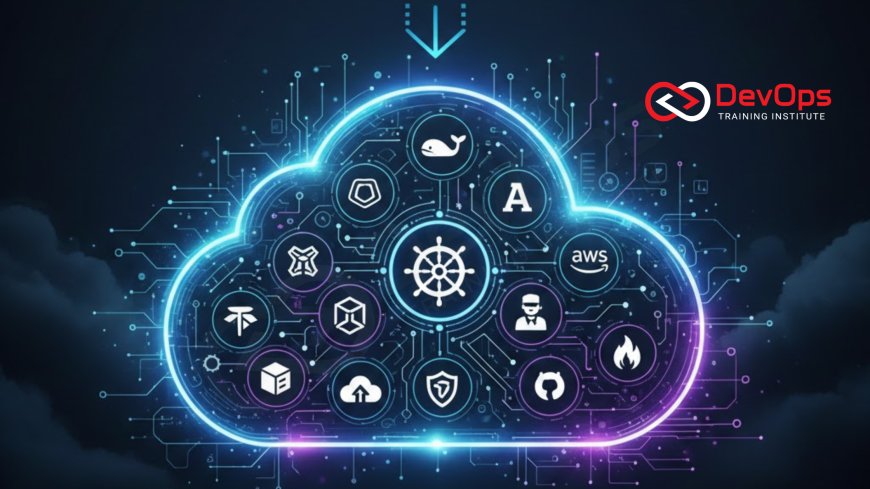
Cloud automation is the heartbeat of modern DevOps. The days of clicking in consoles are over. In 2025, the best teams treat everything as code: infrastructure, pipelines, policies, and even security. These 10 tools represent the current gold standard for automating AWS, Azure, GCP, and hybrid environments at scale, starting with rock-solid Multi-AZ foundations.
1. Terraform (by HashiCorp / OpenTofu)
- Industry-standard Infrastructure as Code tool
- Declarative syntax with 1000+ official providers
- State management and drift detection
- Terraform Cloud/Enterprise for team collaboration
- Used by 80%+ of Fortune 500 for cloud provisioning
- OpenTofu as fully open-source fork gaining traction
- Supports complex multi-cloud and hybrid setups
2. Ansible
The agentless automation king. Perfect for configuration management, application deployment, and day-2 operations. Its YAML playbooks are human-readable and idempotent, making it ideal for both Linux and Windows environments. Red Hat Ansible Automation Platform adds enterprise features like execution environments and content collections.
3. GitHub Actions
- Deeply integrated CI/CD inside GitHub
- Matrix builds, reusable workflows, and OIDC authentication
- Over 20,000 marketplace actions
- Free minutes for public repos, generous for private
- Self-hosted runners for air-gapped environments
- Powers deployments at Microsoft, Shopify, and millions more, often deploying Lambda functions in seconds
4. ArgoCD (GitOps Engine)
The de facto standard for Kubernetes GitOps. Continuously reconciles desired state from Git with live clusters. Supports declarative manifests, Helm, Kustomize, Jsonnet, and application health checks. Used by Intuit, Adobe, and Tesla for zero-trust, auditable deployments.
5. Crossplane
- Turns Kubernetes into a universal control plane
- Provision AWS RDS, GCP buckets, Azure VMs directly via CRDs
- Compositions let you create reusable infrastructure templates
- Full lifecycle management (create, update, delete)
- Backed by Upbound and adopted by T-Mobile, Alaska Airlines
- Perfect for platform engineering teams building IDPs with private subnet security
6. Pulumi
Infrastructure as real code using TypeScript, Python, Go, or C#. Brings software engineering best practices: loops, functions, classes, and package managers. State backend is cloud-hosted with secrets management and policy as code via Pulumi ESC.
7. AWS CDK (Cloud Development Kit)
- Define cloud infrastructure using familiar languages (TypeScript, Python, Java, .NET)
- Compiles to CloudFormation with higher-level constructs
- Built-in best practices and testing frameworks
- CDK for Kubernetes (cdk8s) and Terraform (cdk tf)
- Used heavily inside AWS and by startups like HashiCorp
- Fastest-growing IaC tool in the AWS ecosystem, especially when combined with RDS monitoring
8. GitLab CI/CD
All-in-one DevSecOps platform with built-in CI/CD, container registry, and security scanning. Powerful .gitlab-ci.yml syntax supports complex pipelines, review apps, and auto-devops. Preferred by Airbus, Goldman Sachs, and Deutsche Telekom.
9. Flux CD
- Lightweight GitOps operator from the CNCF
- Excellent Helm and Kustomize integration
- Image automation and policy enforcement
- Multi-tenancy and notification webhooks
- Used by Mercedes-Benz, Zalando, and thousands of teams
- Part of the official GitOps toolkit alongside ArgoCD, ideal for read-replica scaling automation
10. Spinnaker
Multi-cloud continuous delivery platform originally built by Netflix. Excels at complex deployment strategies: canary, blue-green, rolling red/black. Deep integration with Kubernetes, AWS, GCP, and Azure. Armory and OpsMx provide enterprise versions with enhanced UI and RBAC.
Conclusion
The era of manual cloud operations is over. These 10 tools represent the current state-of-the-art in cloud automation: declarative, version-controlled, secure, and scalable. Most mature organizations use a combination: Terraform/Crossplane for infrastructure, Ansible for configuration, GitHub Actions/GitLab for pipelines, and ArgoCD/Flux for GitOps delivery. Pick the right tool for each layer and build an automation stack that scales with your ambition.
Frequently Asked Questions
Terraform vs Pulumi vs CDK: which should I choose?
Terraform for maximum provider support and team adoption. Pulumi/CDK if your team prefers real programming languages and complex logic.
Is Ansible still relevant with Kubernetes?
Absolutely. Kubernetes manages containers, but nodes still need OS configuration, secrets, and day-2 operations — Ansible excels here.
ArgoCD vs Flux: which GitOps tool is better?
ArgoCD has better UI and application-centric model. Flux is lighter and better at image automation. Many teams run both.
Can I use GitHub Actions for production workloads?
Yes. Microsoft, Shopify, and HashiCorp all run production deployments with self-hosted runners and OIDC trust.
Is Crossplane replacing Terraform?
No — they complement each other. Crossplane is Kubernetes-native control plane; Terraform remains the universal IaC standard.
What's Your Reaction?
 Like
0
Like
0
 Dislike
0
Dislike
0
 Love
0
Love
0
 Funny
0
Funny
0
 Angry
0
Angry
0
 Sad
0
Sad
0
 Wow
0
Wow
0

![100+ Azure DevOps Interview Questions and Answers [Updated 2025]](https://www.devopstraininginstitute.com/blog/uploads/images/202509/image_140x98_68c40aa9a3834.jpg)




![Future Scope of DevOps Careers in Pune [Updated 2025]](https://www.devopstraininginstitute.com/blog/uploads/images/202510/image_140x98_68e3a84652312.jpg)