































![Kong Interview Preparation Guide [2025]](https://www.devopstraininginstitute.com/blog/uploads/images/202509/image_430x256_68dbb95326997.jpg)













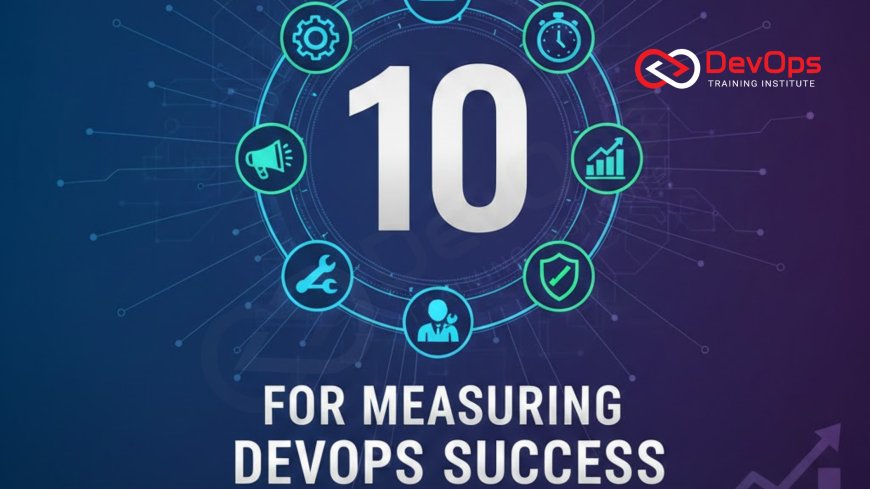
Top 10 KPIs for Measuring DevOps Success
Discover the 10 most important KPIs every DevOps team should track in 2025 to measure real progress. From deployment frequency, lead time, MTTR, change failure rate and more explained with benchmarks and practical tips.
Introduction
Measuring DevOps success goes far beyond counting how many tickets were closed this week. The best teams use data-driven KPIs to understand speed, stability, quality, and team health. These metrics, especially the four DORA metrics, help organizations move from guesswork to evidence-based improvement. In this guide, we cover the top 10 KPIs that actually matter in 2025, complete with real-world benchmarks and actionable advice.
1. Deployment Frequency
- How often you deploy code to production
- Elite performers deploy multiple times per day
- High performers: on-demand (multiple times per week)
- Tracks the speed of value delivery
- Correlates strongly with business outcomes
- Automated pipelines make this possible without chaos
2. Lead Time for Changes
The time from code commit to code running in production. Shorter lead times mean faster feedback and quicker feature delivery.
Elite teams achieve less than one hour, while low performers often take months. Reducing this KPI requires strong automation, small batch sizes, and trunk-based development practices.
3. Change Failure Rate (CFR)
- Percentage of deployments causing a failure in production
- Elite: 0-15%
- High: 16-30%
- Measures quality of releases
- Lower CFR comes from better testing and dead-letter queues for graceful error handling
- Don’t confuse with incident count – focus on deployment-related failures
4. Mean Time to Recovery (MTTR)
How quickly you recover from production incidents. This is the ultimate measure of resilience.
Elite teams recover in under one hour. Practices like chaos engineering, observability, and blameless post-mortems directly improve MTTR.
5. Cycle Time
| Stage | Typical Elite Time | What It Measures |
|---|---|---|
| Code to Build | < 5 minutes | Pipeline efficiency |
| Build to Test | < 10 minutes | Test automation speed |
| Test to Deploy | < 1 hour | Approval & environment readiness |
6. Failed Deployment Recovery Time
- Separate from general MTTR
- Measures how fast you rollback or fix a bad deployment
- Elite teams fix or rollback in minutes
- Requires feature flags, blue-green, or canary deployments
- Strong correlation with psychological safety and speed
- Tracks confidence in release process
7. Test Automation Percentage
Percentage of tests that run automatically in CI/CD. Manual testing is the biggest bottleneck in most organizations.
Elite teams have 90%+ automated tests. This KPI directly impacts deployment frequency and lead time while reducing human error.
8. Infrastructure as Code (IaC) Coverage
- Percentage of infrastructure managed through code
- Elite: 95%+ for elite performers
- Enables consistency, auditability, and fast recovery
- Critical for CloudFront cache invalidation automation and similar tasks
- Reduces configuration drift
- Improves security through peer review
9. Employee Satisfaction / Team Morale
Yes, this is a real DevOps KPI. Google’s Project Aristotle and DORA research both show team happiness predicts performance.
Measure via quarterly surveys, eNPS, or tools like Officevibe. Burnout kills velocity faster than any technical debt.
10. Business Value Delivered (Flow Efficiency)
Ultimately, DevOps exists to deliver customer value faster. Track:
- Feature usage in production
- Revenue impact from releases
- Customer satisfaction (CSAT/NPS) changes after deployments
- Time from idea to measurable business outcome
- Use SNS notifications to alert stakeholders when key features launch
Conclusion
Focus on these 10 KPIs instead of vanity metrics like story points or tickets closed. The combination of speed (deployment frequency, lead time), stability (change failure rate, MTTR), quality (test coverage, IaC), and people (morale, business value) gives you a complete picture of DevOps maturity. Start measuring today, set realistic targets, and watch your organization transform into a high-performing, customer-obsessed powerhouse.
Frequently Asked Questions
What are the 4 DORA metrics?
Deployment Frequency, Lead Time for Changes, Change Failure Rate, and Mean Time to Recovery (MTTR).
Which DevOps KPI is most important?
All four DORA metrics together provide the best predictor of performance, but Lead Time for Changes often has the strongest business correlation.
How often should we review these KPIs?
Weekly for engineering teams, monthly for leadership. Daily visibility in dashboards is ideal.
Can small teams track all 10 KPIs?
Yes. Start with the 4 DORA metrics, then gradually add the rest as maturity grows.
Is 100% test automation realistic?
Not always, but 80–95% is achievable and delivers most of the benefits.
Should we bonus engineers on these KPIs?
Never tie individual bonuses to team KPIs. Use them for learning and process improvement instead.
How do elite performers compare to low performers?
Elite teams deploy 208 times more frequently and recover 2,604 times faster than low performers (State of DevOps Report).
Do these KPIs work for non-software teams?
Yes. Platform, security, and data teams successfully use the same metrics.
Where should we display these metrics?
Real-time dashboards visible to everyone – transparency drives improvement.
What if our Change Failure Rate is high?
Focus on smaller changes, better testing, and feature flags before trying to increase deployment frequency.
What's Your Reaction?
 Like
0
Like
0
 Dislike
0
Dislike
0
 Love
0
Love
0
 Funny
0
Funny
0
 Angry
0
Angry
0
 Sad
0
Sad
0
 Wow
0
Wow
0



![100+ Azure DevOps Interview Questions and Answers [Updated 2025]](https://www.devopstraininginstitute.com/blog/uploads/images/202509/image_140x98_68c40aa9a3834.jpg)






![Future Scope of DevOps Careers in Pune [Updated 2025]](https://www.devopstraininginstitute.com/blog/uploads/images/202510/image_140x98_68e3a84652312.jpg)