

![Kong Interview Preparation Guide [2025]](https://www.devopstraininginstitute.com/blog/uploads/images/202509/image_430x256_68dbb95326997.jpg)

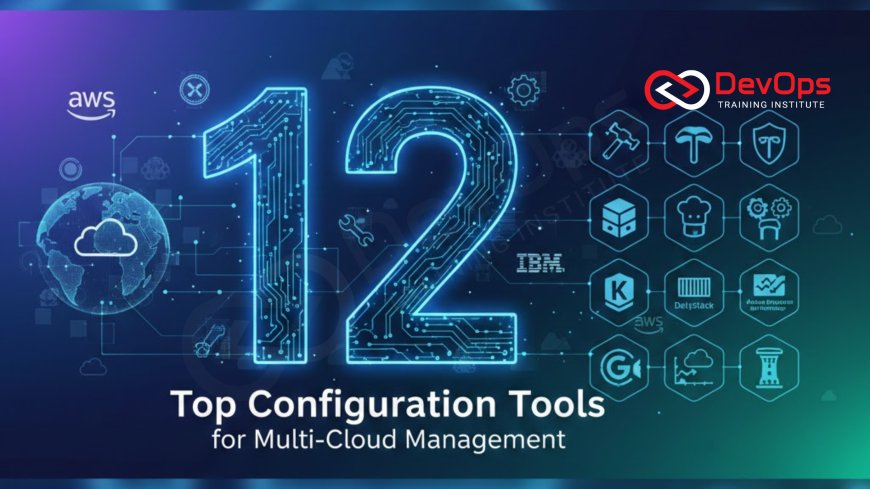
Top 12 Configuration Tools for Multi-Cloud Management
Master multi-cloud complexity with the top 12 configuration tools essential for modern DevOps. This guide details powerful solutions spanning Infrastructure as Code (IaC), configuration management, and cloud-native orchestration (Kubernetes) that enable consistent, automated, and repeatable deployments across AWS, Azure, and GCP. Learn how to leverage tools like Terraform, Ansible, Crossplane, and Chef to achieve desired state configuration, ensure compliance, simplify resource provisioning, and manage host hardening, ultimately driving speed and reliability in your multi-cloud environment.
Introduction
The enterprise trend toward multi-cloud architecture—using infrastructure and services from two or more public cloud providers (such as AWS, Azure, and GCP)—offers unparalleled benefits in terms of flexibility, disaster recovery, and vendor negotiation leverage. However, this diversity introduces a significant operational challenge: managing configurations consistently across fundamentally different platforms. Each cloud uses its own APIs, resource naming conventions, and service models, making manual configuration and even cloud-specific automation inefficient and prone to error.
The solution lies in powerful, abstracted configuration tools that provide a unified approach to managing multi-cloud infrastructure, operating systems, and applications. These tools are the backbone of modern DevOps and Site Reliability Engineering (SRE) practices, allowing teams to define the desired state of their entire fleet, regardless of whether a resource is running on a Kubernetes cluster, a bare metal server, or a cloud function. This declarative, tool-driven approach is essential for achieving the speed, security, and reliability required in high-velocity, heterogeneous environments.
This guide explores the 12 most critical configuration tools categorized by their primary function: Infrastructure as Code (IaC) for provisioning resources, Configuration Management (CM) for maintaining server state, and Cloud-Native Orchestration for managing applications. By mastering these tools and understanding how they interoperate, you can effectively abstract away the complexities of multi-cloud management, ensuring that your deployments are consistent, repeatable, secure, and fully automated from the host operating system up to the application layer.
Category I: Infrastructure as Code (IaC) Provisioning
IaC tools are responsible for the initial creation and lifecycle management of cloud infrastructure itself (VMs, networks, databases, load balancers). In a multi-cloud context, the primary challenge is finding tools that can speak the native API language of all vendors while maintaining a single, consistent configuration language for the user. These tools are foundational, as they define the environments upon which all other configurations are built.
1. HashiCorp Terraform
Terraform is the market leader for multi-cloud IaC. It uses the declarative HashiCorp Configuration Language (HCL) to define infrastructure resources. It achieves multi-cloud consistency through a vast ecosystem of providers (AWS, Azure, GCP, VMware, etc.), allowing a single set of codified deployment practices to be used across all major platforms. This powerful abstraction makes Terraform an indispensable tool for defining the network, compute, and security resources that host your applications.
Multi-Cloud Value: Provides the best balance of multi-cloud abstraction (single language, HCL) and cloud-specific feature access (through specialized providers). It is essential for defining the base infrastructure across hybrid and multi-cloud environments, ensuring resources are provisioned with consistency and auditability, a key requirement for any scalable operation.
2. Pulumi
Pulumi is an open-source IaC tool that allows engineers to define infrastructure using general-purpose programming languages (TypeScript, Python, Go, Java, C#). This approach offers powerful advantages for multi-cloud, as it lets teams leverage familiar programming constructs like loops, functions, and testing frameworks to manage complexity. Pulumi communicates with cloud APIs directly via its SDKs.
Multi-Cloud Value: Excellent for teams that prefer to manage infrastructure using standard software engineering best practices. By using one language (e.g., Python) to target multiple cloud APIs, Pulumi simplifies complex, stateful logic and allows for enhanced testing of IaC configurations, significantly improving code quality and reliability across disparate environments.
3. Crossplane
Crossplane is a CNCF project that extends Kubernetes into a universal control plane for managing cloud infrastructure. It allows you to provision and manage external resources (like AWS S3 buckets, Azure databases, or GCP networking) using Kubernetes Custom Resource Definitions (CRDs). The application defines its required infrastructure through a manifest, and Crossplane handles the vendor-specific provisioning. This is a crucial tool for those adopting GitOps for both applications and infrastructure.
Multi-Cloud Value: Allows cloud infrastructure to be managed using the same declarative API and tooling (kubectl, GitOps operators) used for applications. This enables a unified GitOps model for multi-cloud infrastructure and application deployment, effectively making Kubernetes the central orchestration hub for everything, simplifying operational workflows significantly.
Category II: Configuration Management (CM) & Host State
Configuration Management tools specialize in maintaining the desired operational state of host machines (VMs, bare metal) and applications running on them, typically handling tasks like package installation, service management, and operating system hardening. While IaC provisions the box, CM configures the software and security inside the box. These tools are essential for ensuring a consistent security and compliance baseline across all operating systems, regardless of the cloud vendor hosting them.
4. Ansible
Ansible is the most popular agentless CM tool. It uses YAML playbooks and SSH for communication, making it highly portable and easy to adopt. It excels at automating operating system configurations, application deployments, and executing multi-step orchestrated tasks across different cloud VMs. Ansible's extensive module library includes direct support for all major cloud providers, allowing it to act as both a provisioning and a configuration tool, often working in tandem with Terraform.
Multi-Cloud Value: Highly effective for cross-platform consistency, as the same playbooks can be used to harden a Linux server (e.g., applying RHEL 10 hardening best practices) regardless of whether it’s an EC2 instance or an Azure VM. Its agentless nature simplifies security and setup, making it ideal for managing heterogeneous server fleets.
5. Chef
Chef uses a declarative language (Ruby DSL) and a client-server architecture. It's often used in large enterprises to manage complex configuration scenarios with high assurance and compliance requirements. Chef is excellent at automating complex system setup, handling operating system and security configurations, and maintaining compliance across diverse environments via its built-in auditing capabilities.
Multi-Cloud Value: Its robust client-server model and auditing capabilities ensure continuous compliance and enforcement of configuration policies on managed hosts across all cloud environments, providing high confidence in the operational state of every server regardless of its location.
6. Puppet
Similar to Chef, Puppet is an agent-based CM tool that uses its own declarative language to define the desired state of infrastructure. It is highly valued for its strong reporting, auditing, and compliance enforcement features, making it a staple in regulated industries. Puppet's vast module ecosystem covers a wide range of operating systems and applications.
Multi-Cloud Value: Puppet's focus on reporting and compliance makes it ideal for demonstrating that configuration policies are consistently applied across hosts in different clouds, satisfying complex regulatory requirements and ensuring uniform security controls are maintained at the host OS level.
7. SaltStack
SaltStack (now Salt Project) is an event-driven CM tool that uses a master-minion architecture and can operate in a masterless setup. Its high-speed communication bus allows for rapid, simultaneous execution of commands across thousands of systems, making it excellent for massive-scale, low-latency configuration tasks. It’s written in Python and uses YAML for configuration.
Multi-Cloud Value: Its high-speed, real-time execution capabilities are perfect for incident response and patching across geographically dispersed, multi-cloud fleets. It ensures that critical configuration changes, security updates, or emergency patch deployments are applied instantly across all providers, minimizing the window of exposure.
8. Packer
Packer, another HashiCorp tool, is essential for multi-cloud immutability. It automates the process of creating identical machine images (AMIs for AWS, VHDs for Azure, QCOW2 for open source) from a single source configuration file. This ensures that every server started in any cloud is provisioned from a known, pre-hardened baseline image, which is a core tenet of immutable infrastructure and simplifies host management significantly.
Multi-Cloud Value: Enforces immutable infrastructure principles by guaranteeing that the operating system base is identical and pre-configured (e.g., with RHEL 10 post-installation checklist checks applied) across all clouds before application deployment. This minimizes configuration drift and simplifies patching and security compliance across the entire multi-cloud fleet.
Category III: Cloud-Native Orchestration & Policy
For application delivery, Kubernetes is the universal abstraction layer across multi-cloud, acting as the primary configuration tool for applications. However, managing Kubernetes itself and ensuring consistency between clusters hosted on different vendors (EKS, AKS, GKE) requires specialized tools that operate at the cluster management and policy level. These tools provide the necessary governance and consistency that bare Kubernetes lacks across multi-cloud boundaries.
9. Kubernetes (with Custom Controllers)
Kubernetes provides a powerful declarative API that allows applications and their required resources (storage, networking, secrets) to be managed consistently across any cloud where a cluster runs. While not explicitly multi-cloud, its ubiquity makes it the de-facto application configuration tool. Custom controllers and Operators are used to extend its capabilities, enabling configuration of cloud-specific services like load balancers or databases through simple Kubernetes manifests.
Multi-Cloud Value: Provides a universal application configuration interface. By running your application on Kubernetes, you ensure the service deployment, scaling, and operational configuration is identical, regardless of whether the cluster is running on AWS, Azure, or an on-premises data center.
10. Rancher
Rancher is an open-source platform that provides a complete toolset for managing multiple Kubernetes clusters. It offers a unified console for provisioning, managing, and securing clusters across any infrastructure (AWS EKS, Azure AKS, GCP GKE, or self-hosted RKE). Rancher simplifies the operational complexity of running Kubernetes at scale in a multi-cloud environment.
Multi-Cloud Value: Offers centralized cluster management, allowing operators to monitor health, manage access, and enforce configuration policies consistently across all clusters, irrespective of the underlying cloud provider. This dramatically simplifies the governance model for Kubernetes in a multi-cloud environment.
11. Open Policy Agent (OPA)
OPA is a general-purpose policy engine that enables the expression of policy as code. It can be integrated into the CI/CD pipeline (for IaC validation) or as an Admission Controller in Kubernetes (for runtime policy enforcement). This allows organizations to define security, compliance, and operational policies once and enforce them consistently across all environments, regardless of the underlying cloud vendor.
Multi-Cloud Value: Provides consistent policy enforcement across every layer. Whether checking a Terraform plan for an S3 bucket configuration or validating a Kubernetes manifest for a non-root container, OPA ensures the same governance rules are applied everywhere, a key requirement for multi-cloud compliance and achieving observability pillars consistency in reporting.
12. Argus / Argo CD (GitOps)
While primarily a Continuous Delivery tool, GitOps solutions like Argo CD act as powerful configuration tools. By declaring the desired state of both applications and infrastructure components (via Crossplane or Helm) in Git, Argo CD continuously enforces that state across all target clusters, which can span multiple clouds. This provides a single, unified source of truth for the entire multi-cloud environment, ensuring configuration drift is instantly remediated.
Multi-Cloud Value: Enables the declarative, continuous enforcement of application and cluster configuration across diverse cloud platforms. By using Git as the source of truth, it ensures all clusters are synchronized and compliant, dramatically improving the security and consistency of the multi-cloud delivery pipeline.
Conclusion
Managing configurations in a multi-cloud environment is not about choosing a single tool, but rather about building an integrated toolchain that addresses the entire spectrum of automation needs. The 12 tools outlined—spanning IaC provisioning (Terraform, Pulumi), host state management (Ansible, Chef, Packer), and cloud-native governance (Kubernetes, OPA, Argo CD)—provide the necessary abstraction and consistency to tame multi-cloud complexity. By leveraging these technologies, organizations can move beyond vendor-specific lock-in and manual configuration nightmares to adopt a declarative, automated, and unified operational model that scales with their ambition.
The convergence of IaC and CM tools is central to this success. Terraform provisions the virtual server, while Ansible or Chef ensures that the server's operating system is securely hardened and configured with application dependencies, consistently applied across AWS, Azure, and GCP. Furthermore, the adoption of Kubernetes and GitOps on top of this foundation unifies application deployment, while OPA enforces security and compliance policies at every stage, from the IaC plan to the runtime environment. This layered approach creates an environment where reliability is built into the configuration, not bolted on after the fact.
Mastering this toolchain is the key to unlocking the full potential of multi-cloud. The ability to abstract cloud differences into simple, consistent configuration files empowers DevOps teams to focus on delivering business value faster and more reliably. By investing in these industry-leading configuration tools, you ensure your infrastructure is not only provisioned correctly but is continuously monitored, secured, and maintained across every environment, making multi-cloud management efficient, secure, and highly productive. This strategic adoption is critical for accelerating the modern, high-velocity release cadence in any heterogeneous environment.
Frequently Asked Questions
What is the primary challenge that multi-cloud configuration tools solve?
They solve the challenge of maintaining configuration consistency and automating resource provisioning across different cloud vendor APIs and service models using a single, unified language or interface.
How does Terraform achieve consistency across multiple clouds?
Terraform uses a single language (HCL) and a vast library of cloud-specific providers, abstracting vendor APIs and enabling the same configuration pattern to be applied across AWS, Azure, and GCP.
What is the difference between IaC (Terraform) and CM (Ansible) in multi-cloud?
IaC provisions the raw infrastructure (VMs, networks). CM configures the software and operational state inside the VMs (package installs, user setup, service hardening), ensuring consistency across vendor hosts.
Why is Packer important for a multi-cloud configuration strategy?
Packer enforces immutable infrastructure by creating identical, pre-hardened machine images from a single source across all cloud platforms, minimizing configuration drift and accelerating secure provisioning.
What is Crossplane, and what role does it play in multi-cloud GitOps?
Crossplane extends Kubernetes to manage external cloud infrastructure using CRDs, enabling a unified GitOps model where both applications and cloud resources are managed declaratively via Kubernetes manifests.
How do API Gateways relate to configuration management in microservices?
While not a CM tool, the API Gateways configuration (routing, security policies, load balancing) is often managed by IaC or CM tools to ensure consistent access control and traffic flow across the multi-cloud microservices deployment.
How does Open Policy Agent (OPA) ensure multi-cloud compliance?
OPA allows organizations to write governance policies as code (Rego) once and enforce them across both IaC tools (at the plan stage) and Kubernetes (at the runtime admission stage) across all clouds.
What is the significance of using SELinux in a multi-cloud CM strategy?
SELinux provides mandatory access controls at the host level, and CM tools like Ansible ensure the correct security policies are applied consistently to all RHEL 10-based hosts, regardless of the cloud vendor, enhancing host security and system integrity.
Why is centralized cluster management (Rancher) crucial for Kubernetes multi-cloud?
Rancher provides a unified console and toolset to provision, manage, monitor, and enforce consistent configuration policies across heterogeneous Kubernetes clusters (EKS, AKS, GKE) from a single point of control.
How does SaltStack benefit large-scale, multi-cloud fleet management?
SaltStack's high-speed, event-driven architecture enables rapid, near-real-time execution of configuration changes, security patches, or emergency commands across thousands of geographically dispersed cloud VMs simultaneously.
What is the role of the RHEL 10 post-installation checklist in multi-cloud automation?
CM tools like Ansible automate the execution of the RHEL 10 post-installation checklist, ensuring every newly provisioned VM, regardless of cloud, starts with a standardized, secure, and compliant operational baseline.
How does Pulumi enhance IaC in a multi-cloud environment?
Pulumi allows engineers to use general-purpose programming languages (e.g., Python) to define infrastructure, leveraging familiar software engineering practices for writing complex, testable, and reusable multi-cloud configurations.
Why is Ansible often preferred for host hardening best practices over cloud vendor tools?
Ansible is platform-agnostic; its playbooks can execute host hardening procedures (e.g., applying security controls, managing users) consistently across any Linux distribution, regardless of the underlying cloud, which is key to achieving multi-cloud uniformity.
How do Chef and Puppet ensure continuous compliance in multi-cloud?
Their agent-based models and strong reporting/auditing capabilities ensure that configuration policies are continuously enforced and verifiable on managed hosts in different clouds, satisfying strict regulatory and compliance requirements.
How do GitOps solutions (Argo CD) help manage configurations across multi-cloud?
They continuously monitor Git for the desired state and automatically apply it to all target clusters (in different clouds), ensuring configuration drift is immediately corrected, maintaining consistency and traceability across the entire environment.
What's Your Reaction?
 Like
0
Like
0
 Dislike
0
Dislike
0
 Love
0
Love
0
 Funny
0
Funny
0
 Angry
0
Angry
0
 Sad
0
Sad
0
 Wow
0
Wow
0

![100+ Azure DevOps Interview Questions and Answers [Updated 2025]](https://www.devopstraininginstitute.com/blog/uploads/images/202509/image_140x98_68c40aa9a3834.jpg)




![Future Scope of DevOps Careers in Pune [Updated 2025]](https://www.devopstraininginstitute.com/blog/uploads/images/202510/image_140x98_68e3a84652312.jpg)