

![Kong Interview Preparation Guide [2025]](https://www.devopstraininginstitute.com/blog/uploads/images/202509/image_430x256_68dbb95326997.jpg)


Top 15 DevOps Tools for Testing Automation
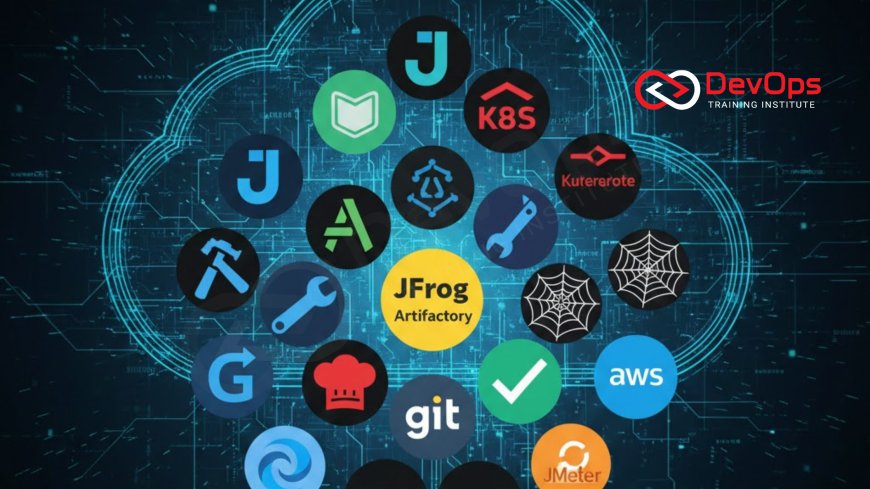
Accelerate your DevOps pipeline and guarantee high quality with the top 15 essential tools for testing automation. This comprehensive guide covers robust solutions for functional UI testing, performance analysis, API validation, and static code analysis. Learn how to integrate tools like Selenium, Playwright, JMeter, Postman, and SonarQube seamlessly into your CI/CD workflows to enable continuous testing, catch defects early, and enforce strict quality gates. Master these tools to achieve faster, more reliable software releases and ensure superior performance in cloud-native environments, proving that security and speed go hand-in-hand.
Introduction
In the DevOps paradigm, testing is not a stage; it is a continuous, automated process. The pressure to deploy frequently and rapidly requires that quality assurance (QA) be integrated from the earliest phases of development—a concept known as Continuous Testing. Manual testing simply cannot keep pace with the velocity of modern Continuous Integration/Continuous Delivery (CI/CD) pipelines, making robust automation tools indispensable. These tools ensure that every code change is instantly validated for functional correctness, performance resilience, and security compliance, providing immediate feedback to developers.
The goal of testing automation in DevOps is two-fold: first, to eliminate manual effort and its associated errors, and second, to build a comprehensive safety net that accelerates delivery by maximizing confidence in the code. A successful automated testing strategy covers the entire testing pyramid—from fast, numerous unit tests to slower, complex end-to-end (E2E) tests. Choosing the right set of integrated tools across various testing types is the key to unlocking this confidence and enabling a true high-velocity release cadence without accumulating technical debt or compromising stability. This strategic integration is crucial for maintaining flow.
This guide presents the top 15 essential DevOps tools for testing automation, categorized by the type of testing they perform. We will cover the core areas of unit testing, API and integration testing, functional UI testing, performance and load testing, and critical security and quality validation. By incorporating these tools into your CI/CD pipeline, you ensure that quality is proactively baked into every commit, making your software reliable, performant, and secure, which are the cornerstones of the modern, cloud-native application lifecycle.
Category I: Unit, Integration, and API Testing (Fast Feedback)
These tools sit closest to the developer and provide the fastest feedback loop, verifying the correctness of individual components and service interactions. API testing, in particular, is vital in microservices architecture, as it validates the contracts between services without the overhead of the UI.
1. JUnit / NUnit / Jest (Unit Testing Frameworks)
Unit testing is the foundation of the testing pyramid. Frameworks like JUnit (Java), NUnit (.NET), and Jest (JavaScript) are used to validate individual functions or classes in isolation. These tests are fast, stable, and run against every code change, providing immediate feedback on functional correctness. Their rapid execution time makes them the first critical gate in any CI pipeline, ensuring that basic logic flaws are caught instantly before they can pollute the main branch.
2. Postman / Newman (API Functional Testing)
While Postman is primarily a platform for API development, it excels at creating collections of automated API requests and validation tests. Newman is Postman's command-line collection runner, allowing these tests to be executed seamlessly within the CI/CD pipeline. This enables teams to validate the core business logic of microservices quickly and efficiently, verifying payloads, status codes, and response times without deploying a frontend application. This is essential for verifying service contracts.
3. Rest-Assured (API Testing Library)
Rest-Assured is a Java library designed specifically for making API testing simpler and more expressive. It supports testing and validating REST services, offering a powerful domain-specific language (DSL) that makes writing complex API validation code highly readable and maintainable. It's often preferred by Java/Kotlin teams for robust, code-driven API integration testing, which provides deep validation into the service layer.
4. Mockito / WireMock (Service Virtualization)
For robust integration testing, it's often necessary to isolate services from their actual dependencies (e.g., external APIs, databases). Mockito (Java) and WireMock (API mocking) allow developers to create mock or virtualized versions of dependencies. This ensures that a service under test is only validated for its own logic, making integration tests faster, more stable, and repeatable, as they are not reliant on the availability or state of external systems.
Category II: UI and Functional Testing (User Experience Validation)
Functional UI testing validates the end-user experience, ensuring that the application works as intended across different browsers and devices. These tests are slower and more complex but are essential for verifying critical user journeys and UI integrity.
5. Selenium (The Industry Standard UI Framework)
Selenium (specifically WebDriver) remains the foundational, open-source tool for automating web browsers. Its broad support across languages (Java, Python, JavaScript, C#) and browsers makes it a versatile choice for cross-browser functional and regression testing. It requires careful coding practices to manage test flakiness but offers unparalleled control over browser interactions, making it the bedrock of many E2E testing strategies.
6. Playwright (Modern, Resilient UI Automation)
Playwright, developed by Microsoft, has rapidly emerged as a powerful alternative, known for its focus on reliability and speed. It offers a single API for Chromium, Firefox, and WebKit (Safari), and provides built-in auto-waiting, network interception, and parallel execution, which significantly reduces the test flakiness often associated with older frameworks. Playwright's modern architecture makes it highly suitable for high-velocity CI/CD environments.
7. Cypress (Developer-Friendly E2E Testing)
Cypress is a JavaScript-only testing framework that runs tests directly inside the browser. It is renowned for its excellent developer experience, interactive debugging features, and fast execution speed. Cypress is popular among JavaScript/TypeScript teams for its seamless integration with the front-end development stack, providing highly reliable, real-time feedback during development, complementing its role in the CI pipeline.
Category III: Performance, Load, and Reliability Testing
Performance testing is crucial for continuous quality, ensuring that new code changes do not introduce performance regressions or capacity issues. By running load tests in the pipeline, teams can proactively guarantee the scalability and stability of their applications under real-world traffic conditions.
8. Apache JMeter (Open-Source Load Testing)
Apache JMeter is the leading open-source tool for analyzing and measuring the performance of web applications and various services (HTTP, SOAP/REST, FTP, databases). JMeter tests can be scripted, parameterized, and executed from the command line, enabling seamless integration into CI/CD pipelines to run automated load tests before every major release or significant infrastructure change. Its versatility makes it indispensable.
9. LoadRunner / NeoLoad (Enterprise Performance Tools)
For complex enterprise-level testing, commercial tools like Micro Focus LoadRunner and NeoLoad (by Tricentis) offer specialized protocol support, massive distributed load generation capabilities, and deep analytics and reporting features. These tools are often preferred in mission-critical environments where extensive support, compliance, and highly realistic, large-scale load simulation are absolute requirements for continuous quality assurance.
10. Chaos Mesh / Gremlin (Chaos Engineering)
Reliability is tested by proactively breaking things. Chaos Engineering tools like Chaos Mesh (Kubernetes-native) and Gremlin allow teams to intentionally inject failures (e.g., network latency, CPU spikes, Pod termination) into environments. Integrating these tools into the pre-production environment ensures that the application's resilience patterns (circuit breakers, retries) actually work, validating the system's stability and ability to recover automatically, which is a key part of modern reliability engineering.
Category IV: Security and Quality Gates (Compliance)
Security testing must be automated and continuous. These tools serve as crucial quality and security gates, verifying the hygiene, compliance, and security posture of the codebase and its dependencies before the application is deployed to production, ensuring a strong DevSecOps foundation.
11. SonarQube / SonarCloud (Static Code Analysis & Quality)
SonarQube and its cloud counterpart, SonarCloud, are open-source platforms for continuous code quality. They perform Static Application Security Testing (SAST) by scanning source code for bugs, code smells, and security vulnerabilities (SQL injection, XSS). SonarQube enforces Quality Gates—defined thresholds that must be met (e.g., zero critical bugs)—which can be configured to fail the CI/CD pipeline, preventing low-quality or insecure code from progressing further. This is a vital practice for maintaining code hygiene.
12. Snyk / Trivy (Vulnerability and Dependency Scanning)
Snyk and Trivy are essential for Software Composition Analysis (SCA) and Vulnerability Scanning of containers and dependencies. They check application dependencies and container images against public CVE databases. Integrating these tools into the build pipeline ensures that known security weaknesses and licenses are validated instantly. This practice is critical for maintaining supply chain security and ensuring that container base images (even those based on RHEL 10 or Alpine) are constantly monitored for known flaws.
13. Checkov / Terrascan (IaC Security Scanning)
These tools specialize in scanning Infrastructure as Code (IaC) files (Terraform, CloudFormation, Kubernetes manifests) for security misconfigurations (e.g., open ports, public S3 buckets, over-privileged IAM roles) before the infrastructure is provisioned. They enforce security policies early, ensuring that the environment itself is secure by design. This IaC validation is a crucial DevSecOps gate.
14. Security Testing Frameworks (OWASP ZAP)
OWASP ZAP (Zed Attack Proxy) is a free, open-source dynamic application security testing (DAST) tool. It runs attacks against the running application in a staging environment to find runtime vulnerabilities like cross-site scripting (XSS) or injection flaws. DAST complements SAST by validating security in a live context, providing a critical final security gate before production deployment, and aligning with continuous threat modeling principles that require continuous validation.
15. Katalon Studio (All-in-One Low-Code Platform)
Katalon Studio is an integrated, low-code platform that combines API, Web, Mobile, and Desktop testing into a single tool. It builds upon Selenium and Appium, offering a user-friendly interface alongside scripting capabilities (Groovy/Java). This all-in-one approach and its low-code features make it highly productive for teams looking to centralize diverse testing needs within a single, maintainable framework, easing the transition to fully automated testing for those with limited coding expertise. Its strong reporting features also aid in compliance assurance, including adherence to host-level security requirements like RHEL 10 hardening best practices, applied via automation.
Conclusion
The success of any DevOps strategy rests on the reliability and speed of its testing automation. The 15 tools covered here—spanning functional, performance, security, and quality categories—form a comprehensive arsenal for achieving Continuous Testing. By integrating these diverse tools into a unified CI/CD pipeline, you create a powerful quality and security control plane that provides instant, actionable feedback to developers. This shift from manual quality assurance to automated validation is what allows organizations to confidently increase their deployment frequency and embrace the high-velocity demands of the cloud-native era.
The key to maximizing the value of these tools is strategic integration. Unit and API tests provide the speed; UI and performance tests provide the confidence; and security and IaC scanners provide the compliance. Tools like SonarQube and Checkov serve as essential quality gates, preventing technical debt and security risks from accumulating. Embrace the "shift-left" mindset, automate every validation step, and ensure your artifacts are always trustworthy, making quality an intrinsic characteristic of your software delivery process.
Investing in mastering and orchestrating these testing automation tools is a direct investment in your application's stability and your team's productivity. A well-tested application is a resilient application, allowing you to innovate faster and safer. Ensure your pipeline continuously validates correctness, performance, and security across the entire stack, from a simple code change to the underlying infrastructure, utilizing robust observability pillars to validate the live performance of deployed artifacts, ensuring operational excellence with every release.
Frequently Asked Questions
What is the highest-level testing in the automation pyramid?
The highest-level testing is End-to-End (E2E) or UI testing, which validates the entire system flow from the user interface down to the backend components.
Why is API testing more valuable than UI testing for microservices?
API testing is faster, more stable, and tests the core business logic and contracts between microservices without the fragility and overhead of a full UI, providing more immediate feedback.
How does SonarQube act as a quality gate in a CI/CD pipeline?
SonarQube performs static analysis and enforces "Quality Gates" with defined thresholds (e.g., zero critical bugs). If these are failed, the CI/CD pipeline automatically stops the build.
What is the difference between SAST and DAST?
SAST (Static Analysis) scans source code without execution; DAST (Dynamic Analysis) attacks a running application in a staging environment to find runtime vulnerabilities like injection flaws.
How do IaC security scanners (Checkov/Terrascan) improve CI/CD?
They scan Terraform and Kubernetes manifests before deployment to catch infrastructure misconfigurations (e.g., public ports, weak IAM policies), enforcing security policies on the environment layer early in the pipeline.
What is the main benefit of using Playwright or Cypress over Selenium?
They offer modern architecture with built-in auto-waiting, faster execution, and better debugging capabilities, significantly reducing the common flakiness associated with UI automation.
Why is Chaos Engineering considered a testing automation tool for DevOps?
Chaos Engineering proactively injects failures (e.g., latency, termination) into pre-production environments to test and validate the system's actual resilience patterns (e.g., circuit breakers) automatically.
How do Vulnerability Scanning tools (Snyk/Trivy) help with container security?
They check container images and dependencies against public CVE databases, blocking the deployment of any artifact containing known security weaknesses, securing the software supply chain.
What is the role of Mocking tools (e.g., Mockito) in integration testing?
Mocking tools simulate dependencies (external APIs, databases) to isolate the service under test, making integration tests faster, more stable, and independent of external system availability.
How does JMeter enable Continuous Testing for performance?
JMeter tests are scripted and executed via the command line within the CI/CD pipeline, automatically running load tests to catch performance regressions before major code merges or production releases.
What is the core function of Katalon Studio?
Katalon is an integrated, low-code platform that unifies API, Web, and Mobile testing, making it easy for teams with mixed skill levels to create and manage comprehensive automation suites.
How do API Gateways relate to testing automation?
API Gateways centralize external traffic, which simplifies testing by providing a single, consistent endpoint for E2E and load tests, abstracting away complex internal routing details, as seen in microservices deployment.
How do testing tools align with observability pillars?
Testing ensures functional correctness, while observability (metrics/logs/traces) is needed to validate the performance and internal state of the running application in test and production environments.
Why is firewall management configuration important for DAST tools?
DAST tools often run attacks from inside or near the network. Proper firewall management ensures the DAST tool is allowed to access the application while blocking malicious external traffic, isolating the security test.
What is the principle of "testing in production" and how do these tools enable it?
It involves using techniques like Canary Deployments and feature flags to expose new features to small user groups while continuously monitoring performance and errors (using tools like SonarQube for quality monitoring) in the live environment for safe validation.
What's Your Reaction?
 Like
0
Like
0
 Dislike
0
Dislike
0
 Love
0
Love
0
 Funny
0
Funny
0
 Angry
0
Angry
0
 Sad
0
Sad
0
 Wow
0
Wow
0

![100+ Azure DevOps Interview Questions and Answers [Updated 2025]](https://www.devopstraininginstitute.com/blog/uploads/images/202509/image_140x98_68c40aa9a3834.jpg)




![Future Scope of DevOps Careers in Pune [Updated 2025]](https://www.devopstraininginstitute.com/blog/uploads/images/202510/image_140x98_68e3a84652312.jpg)