













![Kong Interview Preparation Guide [2025]](https://www.devopstraininginstitute.com/blog/uploads/images/202509/image_430x256_68dbb95326997.jpg)










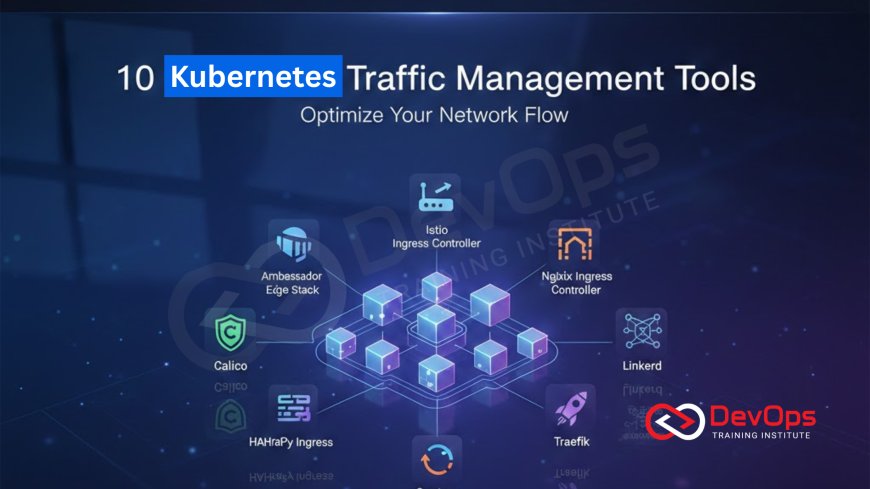
10 Kubernetes Traffic Management Tools
Explore the top ten Kubernetes traffic management tools essential for optimizing application performance, ensuring high availability, and enabling seamless deployments. This guide delves into Ingress controllers, service meshes, and advanced load balancing solutions that empower DevOps engineers to route, control, and secure network traffic within complex containerized environments. Learn how these tools facilitate advanced deployment strategies like canary releases and blue green deployments, enhance fault tolerance, and provide critical insights into network flow, ensuring a robust and responsive user experience for your cloud native applications.
Introduction to Kubernetes Traffic Management
In the world of microservices and containerized applications, effectively managing network traffic within a Kubernetes cluster is paramount. It is not just about getting requests to your services; it is about doing so efficiently, securely, and reliably. Traffic management in Kubernetes encompasses a range of capabilities, from directing external requests to the correct internal services to controlling how internal services communicate with each other. Without robust traffic management, even the most well-designed applications can suffer from performance issues, downtime, and security vulnerabilities.
The complexity arises from the dynamic nature of Kubernetes clusters, where pods are constantly scaling, moving, and being replaced. Traditional networking approaches simply cannot keep up with this fluidity. Therefore, specialized tools have emerged to handle the intelligent routing, load balancing, and policy enforcement necessary for modern cloud-native applications. This guide will explore ten essential Kubernetes traffic management tools that empower DevOps engineers to build resilient, high-performance, and agile application delivery pipelines. Mastering these tools is crucial for anyone operating critical services on Kubernetes.
Ingress Controllers as the Gateway to Your Cluster
For any application running in Kubernetes, the Ingress Controller serves as the primary gateway for external HTTP and HTTPS traffic into the cluster. While Kubernetes Services can expose internal applications, an Ingress provides more sophisticated routing rules, SSL/TLS termination, and name-based virtual hosting. Without an Ingress Controller, you would typically need to provision a separate load balancer for each public-facing service, leading to increased costs and management overhead.
Ingress Controllers are responsible for reading the Ingress resources in your cluster, which define rules for how incoming requests should be routed to specific backend services. This abstraction layer simplifies external access and allows for a single entry point to manage all external traffic. By centralizing these concerns, Ingress Controllers become a critical component for enabling features like canary releases and blue green deployments, allowing teams to safely introduce new versions of their applications to users. They are fundamental to managing external access in a controlled and efficient manner, aligning with platform engineering best practices.
The Rise of the Service Mesh
While Ingress Controllers manage traffic coming into the cluster, a Service Mesh handles the complex inter-service communication within the cluster. In a microservices architecture, services communicate constantly, and managing this traffic flow, applying policies, and gathering telemetry can become overwhelming. A service mesh introduces a "sidecar proxy" alongside each application pod, abstracting away networking concerns from the application code itself.
This sidecar proxy intercepts all incoming and outgoing network traffic for the associated service. It then applies rich routing rules, handles load balancing, manages mTLS for secure communication, and collects vital metrics. This powerful abstraction allows developers to focus on business logic while the service mesh ensures reliability, observability, and security at the network layer. Tools like Istio and Linkerd have become synonymous with service mesh, enabling advanced traffic patterns and providing critical insights into distributed application behavior, crucial for effective observability.
Advanced Deployment Strategies with Traffic Control
Modern DevOps practices emphasize continuous delivery and safe deployment. Kubernetes traffic management tools are indispensable for implementing advanced deployment strategies that minimize risk and downtime. Techniques like canary releases and blue green deployments rely heavily on the ability to precisely control the flow of traffic to different versions of an application. This ensures that new code can be tested in a production environment with minimal impact on the user base.
With traffic splitting capabilities offered by Ingress Controllers and service meshes, teams can route a small percentage of user traffic to a new version of their service. If the new version performs as expected, more traffic can be gradually shifted until it handles all requests. If any issues arise, the traffic can be immediately routed back to the stable version, preventing widespread outages. This controlled rollout process is a cornerstone of agile development and helps maintain high availability, making these tools essential for any team adopting a canary release strategy or blue green deployment in Kubernetes.
Table: Top 10 Kubernetes Traffic Management Tools
| Tool Name | Category | Primary Function | Key Benefit |
|---|---|---|---|
| Nginx Ingress Controller | Ingress Controller | HTTP/HTTPS routing & SSL termination | Widely adopted, robust, flexible configuration. |
| Envoy Proxy | Proxy/Service Mesh Data Plane | High-performance edge & service proxy | Cloud-native, pluggable, central to many meshes. |
| Istio | Service Mesh | Traffic control, security, observability for microservices | Comprehensive feature set, powerful policy enforcement. |
| Linkerd | Service Mesh | Lightweight, simple, ultra-fast service mesh | Focus on simplicity and performance out of the box. |
| HAProxy Ingress Controller | Ingress Controller | High-performance load balancing for Ingress | Excellent for high-throughput and low-latency needs. |
| Contour | Ingress Controller | Envoy-based Ingress Controller | Provides dynamic configuration for Envoy. |
| Traefik | Edge Router/Ingress Controller | Dynamic routing and load balancing | Auto-discovers services, simple configuration. |
| AWS ALB Ingress Controller | Cloud-Native Ingress | Integrates Kubernetes Ingress with AWS ALBs | Leverages native AWS features for scalability. |
| F5 BIG-IP Container Ingress Services | Enterprise Ingress | Integrates BIG-IP with Kubernetes for advanced traffic management | Extends existing F5 investments to Kubernetes. |
| GCP Load Balancer (GKE Ingress) | Cloud-Native Ingress | Managed load balancing for GKE clusters | Seamless integration with Google Cloud infrastructure. |
Enhancing Resilience and Fault Tolerance
Effective traffic management is not solely about performance; it is also a cornerstone of building resilient and fault-tolerant applications. By intelligently routing traffic, these tools can isolate failing services, redirect requests to healthy instances, and prevent cascading failures that could bring down an entire system. This ability to adapt to adverse conditions is critical for maintaining high availability and providing a consistent user experience, even when underlying infrastructure experiences issues.
Service meshes, in particular, offer features like circuit breaking and retry logic at the network layer. A circuit breaker can automatically stop sending traffic to a service that is consistently failing, preventing client services from being overwhelmed. This self-healing capability is central to the concept of chaos engineering, where systems are designed to withstand failures by default. By implementing these sophisticated traffic controls, organizations can build applications that are not only performant but also incredibly robust against unexpected outages and stress, ensuring business continuity in highly dynamic environments.
Security Considerations in Traffic Flow
Every point where traffic enters or moves within your cluster represents a potential security vulnerability. Therefore, robust traffic management tools integrate essential security features to protect your applications and data. Ingress Controllers can handle SSL/TLS termination, ensuring that all external communication is encrypted. This offloads the cryptographic burden from individual services and centralizes certificate management, reducing the risk of misconfiguration.
Service meshes elevate internal security by providing mutual TLS (mTLS) between services. This encrypts all inter-service communication and verifies the identity of both the client and the server, adhering to a zero trust security model. This is a critical aspect of devsecops, embedding security directly into the network layer. Furthermore, many of these tools allow for granular network policies, letting you define exactly which services can communicate with each other, preventing unauthorized access and limiting the "blast radius" of any potential compromise. This layered approach ensures that security is a pervasive concern across the entire traffic landscape.
Observability and Monitoring of Traffic
To effectively manage traffic, you need to know exactly what is happening to it. Kubernetes traffic management tools are integral to providing deep observability and monitoring capabilities. They automatically collect metrics like request rates, error rates, latency, and traffic volumes, offering a real-time pulse of your application's network health. This data is crucial for detecting performance bottlenecks, troubleshooting issues, and making informed decisions about scaling and resource allocation.
Service meshes especially shine in this area by collecting granular telemetry for every service interaction without requiring application code changes. This means you can get detailed traces of requests as they travel across multiple microservices, helping you pinpoint the exact service causing a delay or an error. Centralized logging and tracing, combined with rich dashboards, provide the insights needed to maintain optimal performance and quickly resolve incidents. This deep visibility is essential for operational excellence and for truly understanding the behavior of complex distributed systems. Integrating these insights can also inform finops initiatives by identifying underutilized services.
Simplifying Operations with GitOps Integration
The management of Kubernetes traffic configurations can be complex, involving numerous YAML files for Ingresses, VirtualServices, Gateways, and more. Integrating these configurations with a GitOps workflow significantly simplifies operations and enhances reliability. GitOps means that the desired state of your entire cluster, including all traffic routing rules, is stored declaratively in a Git repository. Any changes to the infrastructure or traffic flow are made by committing changes to this repository.
This approach brings several benefits: Git provides a single source of truth, a full audit trail of all changes, and easy rollback capabilities. Automation tools then continuously synchronize the cluster's actual state with the desired state defined in Git. This ensures consistency, reduces human error, and makes it easier for teams to collaborate on network configurations. By embracing GitOps for traffic management, organizations can achieve a higher degree of operational agility and confidence in their deployments, streamlining the entire infrastructure automation process and making it more predictable.
Future Trends and Dynamic Traffic Routing
The evolution of Kubernetes traffic management is moving towards even more dynamic and intelligent routing decisions. Future tools and enhancements will increasingly leverage machine learning and artificial intelligence to automatically optimize traffic flow based on real-time conditions, predicted load, and even user behavior. Imagine a system that can automatically shift traffic away from a region experiencing performance degradation or reroute users to a service instance that offers the lowest latency for their geographic location without manual intervention.
Furthermore, the integration of traffic management with feature flags and release management tools will become even more seamless. This will enable granular control over feature rollouts, allowing specific user segments to experience new functionalities while the majority remain on the stable version. This level of dynamic control not only enhances the user experience but also empowers developers to iterate faster and deliver innovations with greater confidence. The continuous evolution of these tools promises to make cloud-native applications more adaptive, secure, and performant than ever before.
Conclusion
Effective Kubernetes traffic management is a critical pillar for any organization operating modern cloud-native applications. The ten tools explored in this guide—from robust Ingress Controllers to sophisticated Service Meshes—provide the necessary capabilities to route, control, and secure network traffic with precision and agility. By implementing these solutions, DevOps engineers can ensure high availability, enable advanced deployment strategies like canary releases and blue green deployments, enhance overall system resilience, and maintain a strong security posture. Ultimately, mastering these traffic management tools allows teams to move faster, innovate more safely, and deliver an exceptional user experience in the dynamic and complex world of Kubernetes. Embracing these technologies is not just about keeping up; it is about staying ahead and building the future of scalable and reliable application delivery for an ever-evolving digital landscape.
Frequently Asked Questions
What is the primary role of an Ingress Controller?
An Ingress Controller manages external HTTP/HTTPS access to services within a Kubernetes cluster, providing routing rules and SSL/TLS termination.
Why use a Service Mesh in Kubernetes?
A Service Mesh simplifies inter-service communication, providing advanced traffic control, security (mTLS), and observability features without application changes.
How do traffic management tools help with canary releases?
They allow you to direct a small percentage of user traffic to a new application version, enabling safe, gradual rollouts and quick rollbacks.
What is the difference between Istio and Linkerd?
Istio offers a comprehensive feature set for service mesh, while Linkerd focuses on simplicity, performance, and ease of use out-of-the-box for developers.
Can I use multiple Ingress Controllers in one cluster?
Yes, it is possible to use multiple Ingress Controllers, often for different purposes or environments within the same Kubernetes cluster setup.
How do these tools enhance application security?
They provide features like SSL/TLS termination, mTLS for internal traffic, and granular network policies to secure communication and control access.
What is Envoy Proxy used for?
Envoy is a high-performance, open-source edge and service proxy that forms the data plane for many popular service meshes like Istio and Contour.
Do I need a Service Mesh if I have an Ingress Controller?
Yes, they serve different purposes. Ingress handles external-to-internal traffic, while a Service Mesh manages internal inter-service traffic within the cluster.
How does traffic management aid in fault tolerance?
It allows for intelligent routing, retry logic, and circuit breaking to isolate failing services and redirect traffic to healthy ones, preventing outages.
What is GitOps in the context of traffic management?
GitOps means managing all traffic configurations (Ingress rules, service mesh policies) declaratively in a Git repository as the single source of truth.
Which tool is best for complex traffic splitting?
Service Meshes like Istio or Linkerd offer the most advanced and granular traffic splitting capabilities for sophisticated deployment patterns.
How do cloud-native Ingress Controllers work?
They integrate directly with cloud provider load balancers (e.g., AWS ALB, GCP Load Balancer) to leverage native cloud capabilities for traffic management.
What is the role of Traefik?
Traefik is a dynamic edge router and Ingress Controller that automatically discovers services and routes traffic to them with minimal configuration.
Can these tools help with A/B testing?
Yes, by routing specific user segments to different service versions, these tools are excellent for conducting A/B tests and gathering user feedback efficiently.
Why is logging and tracing important for traffic management?
They provide deep insights into traffic flow, helping identify performance bottlenecks, troubleshoot errors, and understand application behavior in distributed systems.
What's Your Reaction?
 Like
0
Like
0
 Dislike
0
Dislike
0
 Love
0
Love
0
 Funny
0
Funny
0
 Angry
0
Angry
0
 Sad
0
Sad
0
 Wow
0
Wow
0

![100+ Azure DevOps Interview Questions and Answers [Updated 2025]](https://www.devopstraininginstitute.com/blog/uploads/images/202509/image_140x98_68c40aa9a3834.jpg)






![Future Scope of DevOps Careers in Pune [Updated 2025]](https://www.devopstraininginstitute.com/blog/uploads/images/202510/image_140x98_68e3a84652312.jpg)