



























![Kong Interview Preparation Guide [2025]](https://www.devopstraininginstitute.com/blog/uploads/images/202509/image_430x256_68dbb95326997.jpg)











12 DevOps Challenges & How to Solve Them Like a Pro
Explore the 12 most common DevOps challenges in 2025-2026 and proven solutions used by elite teams. From cultural resistance and tool sprawl to security debt and flaky tests – learn how to fix them for good.
Introduction
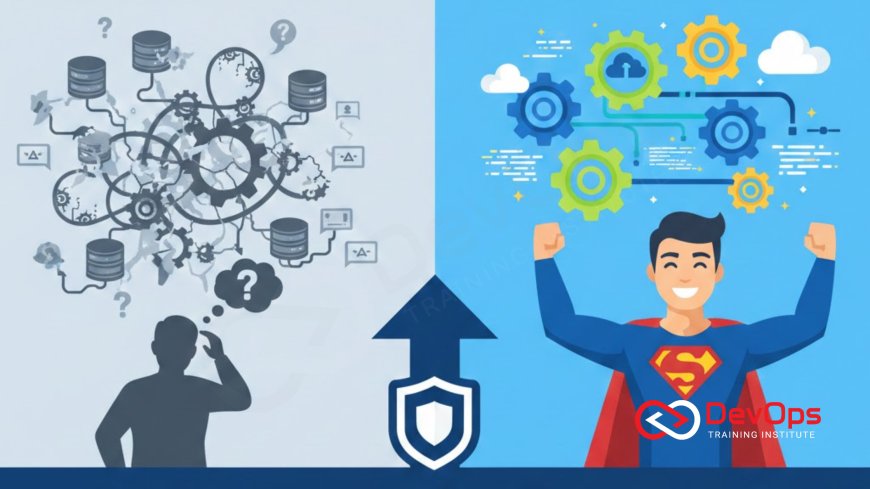
Even the best engineering organizations hit DevOps roadblocks. The difference between average and elite performers isn’t avoiding problems – it’s solving them quickly and permanently. Here are the 12 most painful DevOps challenges in 2025 and exactly how top teams overcome them.
Many of these issues start with poor network isolation inside a Virtual Private Cloud (VPC).
1. Cultural Resistance & Team Silos
- Problem: Dev says “it works on my machine”, Ops throws it over the wall
- Solution: Embed engineers across teams, run blameless post-mortems, celebrate shared wins
- Start small “You build it, you run it” for one service
2. Tool Sprawl & Complexity
Teams end up with Jenkins + GitLab CI + CircleCI + Spinnaker + custom scripts. Standardize on one primary pipeline tool and treat everything else as legacy. Create a paved road that 90% of teams must use.
3. Flaky Tests Slowing Down Pipelines
- Problem: Tests pass locally, fail randomly in CI
- Fix: Quarantine flaky tests automatically, enforce “no merge if flaky” policy
- Use test parallelization and smart reruns
- Track flakiness percentage as a DORA-level metric
CI runners in private subnets still need secure internet access via NAT Gateways to pull containers and packages.
4. Configuration Drift Between Environments
Production works but staging is broken. Enforce Infrastructure as Code everywhere with automated drift detection (Terraform Cloud, Atlantis, or OPA). If drift is detected → block deployments until fixed.
5. Security Treated as an Afterthought
- Shift-left with SAST/SCA/IaC scanning in every PR
- Make security gates fast (<2 min) so developers don’t bypass them
- Use policy-as-code (OPA, Checkov)
- Security teams become enablers, not blockers
6. Manual Deployments & Human Error
If a human can deploy, a human will mess it up eventually. Fully automate promotions using GitOps (ArgoCD/Flux) or progressive delivery tools. Remove all SSH access to production.
Zero-downtime strategies rely on correct route tables and Internet Gateways alignment across environments.
7. Too Much Toil & Firefighting
- Measure toil weekly (>50% = danger zone)
- Top toil tasks → automate or delete
- Build self-service platforms so developers stop opening tickets
- Target <30% engineer time on toil within 12 months
8. Lack of Observability in Production
“It works in staging” is meaningless without proper metrics, traces, and logs. Mandate OpenTelemetry instrumentation, centralized logging, and SLOs for every service.
9. Long Lead Times & Big Bang Releases
- Break work into small batches
- Use feature flags + trunk-based development
- Deploy to production multiple times per day
- Canary everything with automated rollback
Cross-account or cross-region traffic during canaries often flows through VPC Peering for low latency.
10. Shadow IT & Rogue Deployments
Developers spinning up resources outside the platform. Solve with landing zones, mandatory IAM roles, and automated tagging/enforcement via AWS Config or Prisma Cloud.
11. Incident Response Takes Hours Instead of Minutes
- Pre-write runbooks and test them in chaos experiments
- Pager fatigue → intelligent alerting + on-call rotation
- Practice Game Days quarterly
- Aim for MTTR under 30 minutes
12. Scaling DevOps Across Hundreds of Teams
Build an internal developer platform (IDP) with golden paths, self-service portals, and scorecards. Platform teams treat application teams as customers – this is how Netflix, Spotify, and Google scale DevOps.
Secure database access for all those teams is simplified with managed Amazon RDS instances in private subnets.
Conclusion
DevOps transformations fail when leaders treat these as “technical” problems. Every challenge above has both a technical and cultural root cause. Fix the culture first, automate relentlessly, measure everything, and celebrate small wins. Within 6-12 months you’ll move from firefighting to shipping with confidence.
Frequently Asked Questions
How long does it take to fix most DevOps challenges?
Focused teams solve 2–3 major pain points per quarter. Full maturity takes 18–36 months.
Should security slow down delivery?
Never. Fast security = good security. Slow security gets bypassed.
Is it normal to have flaky tests?
Common, but not acceptable. Elite teams keep flakiness under 0.1%.
Can small startups face these challenges?
Yes – solving them early gives you a massive advantage later.
What’s the biggest DevOps anti-pattern?
“DevOps team” that does everything while everyone else keeps throwing work over the wall.
How do you convince leadership to invest in DevOps?
Show DORA metrics improvement and dollar impact of faster feature delivery.
What's Your Reaction?
 Like
0
Like
0
 Dislike
0
Dislike
0
 Love
0
Love
0
 Funny
0
Funny
0
 Angry
0
Angry
0
 Sad
0
Sad
0
 Wow
0
Wow
0




![100+ Azure DevOps Interview Questions and Answers [Updated 2025]](https://www.devopstraininginstitute.com/blog/uploads/images/202509/image_140x98_68c40aa9a3834.jpg)






![Future Scope of DevOps Careers in Pune [Updated 2025]](https://www.devopstraininginstitute.com/blog/uploads/images/202510/image_140x98_68e3a84652312.jpg)