








![Kong Interview Preparation Guide [2025]](https://www.devopstraininginstitute.com/blog/uploads/images/202509/image_430x256_68dbb95326997.jpg)







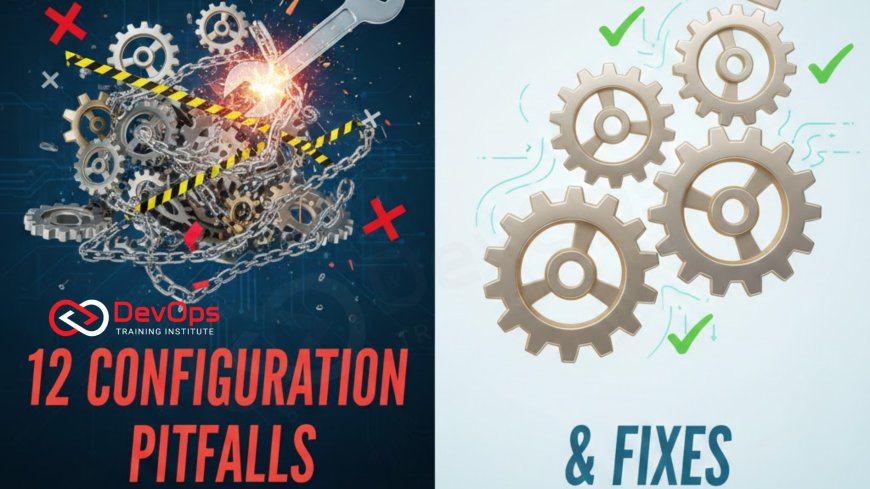
12 DevOps Configuration Pitfalls & Fixes
Identify and resolve the twelve most critical DevOps configuration pitfalls that threaten the stability and security of your modern software delivery pipeline. This extensive guide provides practical fixes for common errors in infrastructure as code, secret management, and environment consistency to help your engineering team maintain peak performance. Learn how to bridge the gap between development and operations by implementing robust validation, automated testing, and secure configuration patterns. Whether you are managing complex Kubernetes clusters or simple cloud environments, these essential insights will empower your team to build a more resilient and predictable technical foundation for your business growth today.
Introduction to DevOps Configuration Challenges
In the era of programmable infrastructure, configuration has become as vital as the application code itself. However, as teams move faster to meet the demands of twenty twenty six, the complexity of managing thousands of configuration parameters across multiple environments often leads to subtle but dangerous errors. A single misconfigured load balancer or an incorrectly scoped security group can cause widespread outages or expose sensitive data to the public internet. These pitfalls are often not the result of a lack of skill but are a byproduct of the sheer scale and speed at which modern continuous synchronization must occur.
Addressing these pitfalls requires a transition from manual, reactive fixes to proactive, automated governance. By identifying the most common configuration traps, DevOps professionals can implement systemic fixes that prevent these issues from ever reaching production. This guide explores twelve specific areas where configurations often go wrong and provides clear, beginner friendly solutions to get your pipeline back on track. Understanding these common failure points is the first step toward building a truly resilient and scalable technical ecosystem that supports rapid innovation without sacrificing safety or reliability for your end users.
The Trap of Manual Infrastructure Changes
One of the most persistent pitfalls in DevOps is the temptation to make "quick fixes" manually through a cloud console or a terminal session. While this might resolve an immediate issue, it creates a discrepancy between the live environment and the documented configuration, a phenomenon known as configuration drift. This makes it nearly impossible to reproduce the environment in a disaster recovery scenario and leads to mysterious failures when the next automated deployment overwrites the manual changes. It undermines the very foundation of cultural change that DevOps seeks to establish within an organization.
The fix for this is the absolute enforcement of Infrastructure as Code (IaC) principles. Every change, no matter how small, must be defined in a template and pushed through a version controlled pipeline. Using tools like Terraform or CloudFormation ensures that your infrastructure is predictable and auditable. By making the code repository the single source of truth, you eliminate the guesswork associated with manual tweaks. Furthermore, integrating GitOps practices allows your system to automatically detect and correct drift, ensuring that your live environment always matches the desired state defined in your repository.
Hardcoded Secrets and Insecure Storage
Hardcoding API keys, passwords, or database credentials directly into configuration files or source code is a catastrophic security pitfall that continues to plague even experienced teams. When these secrets are committed to a repository, they become part of the permanent history, making them accessible to anyone with access to the code. This exposure can lead to unauthorized access, data breaches, and significant financial loss. It is a fundamental violation of modern security standards and a major hurdle for teams trying to implement a robust DevSecOps strategy in the cloud.
The solution is to utilize dedicated secret management services like HashiCorp Vault, AWS Secrets Manager, or Azure Key Vault. These tools allow you to inject secrets into your applications at runtime without ever exposing them in your configuration files. Additionally, you should integrate secret scanning tools into your CI CD pipeline to automatically detect and block any commits that contain sensitive information. By treating secrets as external dependencies rather than static values, you significantly improve your security posture and ensure that your cluster states remain protected from accidental or malicious credential leakage.
Lack of Environment Parity
When the development, staging, and production environments are configured differently, it leads to the infamous "it worked on my machine" problem. Subtle differences in software versions, environment variables, or network settings can cause deployments that passed all tests in staging to fail spectacularly in production. This lack of parity increases the time spent on debugging and reduces the overall confidence of the engineering team. It often stems from managing environments as separate silos rather than as identical instances of the same underlying configuration template.
To fix this, teams should leverage containerization and standardized IaC templates to ensure that every environment is an exact replica of the others. Using containerd or other industry standard runtimes ensures that the application behaves the same way regardless of where it is running. Furthermore, you should use a single configuration manifest with environment specific value files to handle necessary variations like database URLs or resource limits. This approach ensures that you are testing the actual configuration that will be used in production, leading to more predictable release strategies and a much smoother path from code commit to successful user delivery.
Common DevOps Configuration Pitfalls & Fixes Table
| Pitfall | Primary Risk | Recommended Fix | Effort Level |
|---|---|---|---|
| Manual Drift | Unpredictable outages | GitOps & IaC enforcement | Medium |
| Hardcoded Secrets | Data breaches | Secret Management Vaults | High |
| Open Permissions | Security exploits | Least Privilege Identity | High |
| Missing Limits | Resource exhaustion | Define Resource Quotas | Low |
| No Health Checks | Silent failures | Liveness/Readiness probes | Medium |
Overly Permissive Identity and Access Management
In the rush to get services talking to each other, it is a common pitfall to grant overly broad permissions, such as giving an application full administrative access to a cloud account. This violates the principle of least privilege and creates a massive security risk; if that application is compromised, the attacker has the keys to your entire kingdom. This issue is often compounded by the use of static credentials that never expire, making it even harder to contain a breach once it has occurred within your network or cloud architecture patterns.
The fix is to implement granular, role based access control (RBAC) and utilize temporary, short lived credentials whenever possible. Use admission controllers to enforce these security policies automatically within your clusters. Every service should only have the exact permissions it needs to perform its specific task and nothing more. Regularly auditing your IAM roles and using automated tools to identify unused or excessive permissions will help you maintain a tight security perimeter. This disciplined approach to identity management is essential for building a zero trust environment where every interaction is verified and authorized.
Ignoring Resource Limits and Quotas
Deploying applications without defining resource requests and limits is a recipe for instability. Without these boundaries, a single "noisy neighbor" pod can consume all the CPU or memory on a node, causing other critical services to crash or become unresponsive. This leads to unpredictable performance and can even cause the entire cluster to become unstable. Many teams overlook this because they are focused on the application logic rather than the underlying infrastructure constraints of their production environment.
To fix this, you must define clear resource quotas for every namespace and specific requests and limits for every container in your manifests. This allows the Kubernetes scheduler to make intelligent decisions about where to place workloads and ensures that every application has the resources it needs to function correctly. By combining these limits with horizontal pod autoscaling, you can create a system that scales gracefully under load while preventing individual failures from cascading through the cluster. It is a fundamental part of mastering architecture patterns for scalability and reliability in the cloud.
DevOps Best Practices for Configuration Management
- Version Everything: Treat your configuration manifests with the same respect as your application code, using Git for all changes.
- Automate Validation: Use linters and dry run commands in your pipeline to catch syntax errors and misconfigurations before they reach production.
- Use Standardized Modules: Create reusable modules for common infrastructure components to ensure consistency across different projects.
- Implement Health Checks: Always define liveness and readiness probes to allow the orchestrator to detect and fix incident handling issues automatically.
- Monitor Configuration Changes: Use AI augmented devops tools to track configuration changes and correlate them with system performance anomalies.
- Audit Regularly: Conduct frequent audits of your cloud environment to ensure that manual changes haven't crept in and that security policies are being followed.
- Continuous Verification: Integrate continuous verification to confirm that your configuration is delivering the expected performance and security outcomes.
By following these best practices, you can turn your configuration management into a powerful asset rather than a source of stress. It is about creating a "paved road" where the correct and secure path is also the easiest one for developers to take. As you become more proficient in these techniques, you will find that your deployment frequency increases while your change failure rate drops. This synergy is the hallmark of a high performing DevOps organization that is ready to tackle the challenges of twenty twenty six and beyond with confidence and technical excellence.
Conclusion on Avoiding Configuration Failure
In conclusion, the twelve DevOps configuration pitfalls discussed here represent the most common hurdles on the path to a mature and stable infrastructure. By identifying these traps and implementing the recommended fixes, you can significantly reduce the risk of downtime, security breaches, and technical debt. The shift toward automated, version controlled, and secure configuration is not just a technical change but a fundamental shift in how we build and manage software at scale. Embracing these principles ensures that your organization can move fast without breaking things, providing a reliable and secure experience for your users.
As you look toward the future, the integration of AI augmented devops will provide even more sophisticated ways to manage configuration and predict failures. Staying informed about AI augmented devops trends will help you maintain a competitive edge. Ultimately, the goal of configuration management is to provide a stable foundation for your applications to thrive. By focusing on automation, security, and consistency today, you are building a future proof technical ecosystem that can adapt to any challenge the digital world presents. Start by fixing the biggest pitfalls in your current setup and build your way toward a world class DevOps operation.
Frequently Asked Questions
What is configuration drift in a DevOps context?
Configuration drift occurs when the live environment becomes different from the documented or versioned configuration due to manual changes or errors.
Why is hardcoding secrets considered a major pitfall?
Hardcoding secrets makes them visible in the code history, leading to unauthorized access and potential data breaches if the repository is compromised.
How can I achieve environment parity effectively?
Use containerization and Infrastructure as Code to ensure that development, staging, and production environments are built from the exact same templates.
What is the principle of least privilege in IAM?
The principle of least privilege states that every user and service should only have the minimum permissions necessary to perform their specific job.
How do resource limits improve cluster stability?
Resource limits prevent individual applications from consuming too much CPU or memory, which protects other services on the same node from crashing.
What is the role of health checks in configuration?
Health checks allow the orchestrator to monitor the status of an application and automatically restart or reroute traffic if it becomes unhealthy.
Can I automate the detection of configuration drift?
Yes, tools like Terraform and various GitOps controllers can constantly compare the live state with the desired state and notify you of any drift.
What are liveness and readiness probes?
Liveness probes check if a pod is still running, while readiness probes check if it is ready to handle incoming user traffic effectively.
How often should I audit my cloud configurations?
You should conduct automated audits continuously and perform deep manual reviews at least once a quarter to ensure compliance with organization standards.
Does versioning configuration files help in rollbacks?
Absolutely, having a versioned history of your configuration allows you to quickly revert to a previous stable state if a new change causes issues.
What is a noisy neighbor in a cloud environment?
A noisy neighbor is a service that consumes an excessive amount of shared resources, negatively impacting the performance of other services on the same host.
Can AI help in fixing DevOps configuration errors?
AI can analyze patterns in configuration and performance data to suggest fixes or even automatically remediate simple errors before they impact the system.
What is the benefit of using a secret vault?
A secret vault provides a centralized, secure location for storing and managing sensitive data with automated rotation and detailed access logs and auditing.
How do admission controllers enhance cluster security?
Admission controllers intercept requests to the Kubernetes API and enforce policies that prevent insecure or non compliant configurations from being deployed at all.
What is the first pitfall most teams should fix?
Most teams should start by addressing hardcoded secrets and manual changes, as these pose the most immediate and significant risks to security and stability.
What's Your Reaction?
 Like
0
Like
0
 Dislike
0
Dislike
0
 Love
0
Love
0
 Funny
0
Funny
0
 Angry
0
Angry
0
 Sad
0
Sad
0
 Wow
0
Wow
0





![100+ Azure DevOps Interview Questions and Answers [Updated 2025]](https://www.devopstraininginstitute.com/blog/uploads/images/202509/image_140x98_68c40aa9a3834.jpg)






![Future Scope of DevOps Careers in Pune [Updated 2025]](https://www.devopstraininginstitute.com/blog/uploads/images/202510/image_140x98_68e3a84652312.jpg)