



![Kong Interview Preparation Guide [2025]](https://www.devopstraininginstitute.com/blog/uploads/images/202509/image_430x256_68dbb95326997.jpg)




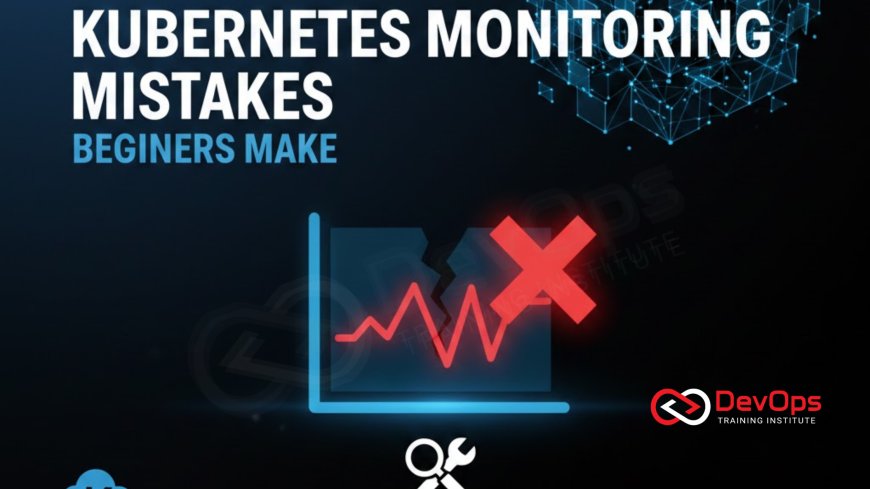
12 Kubernetes Monitoring Mistakes Beginners Make
In the high-stakes world of container orchestration, even small oversights in observability can lead to catastrophic outages and inflated cloud bills. This comprehensive guide identifies the twelve most common Kubernetes monitoring mistakes that beginners frequently encounter as they scale their production clusters in twenty twenty six. From neglecting ephemeral pod lifecycles and over-relying on static thresholds to ignoring control plane health and failing to implement proper label hygiene, we break down each pitfall with professional, clear solutions. Learn how to transform your fragmented logs and metrics into a unified full-stack observability strategy that prioritizes actionable insights over data noise, ensuring your modern DevOps team maintains peak reliability and performance in the ever-evolving cloud-native landscape today.
Introduction to Kubernetes Observability Challenges
Kubernetes is a powerhouse for orchestrating microservices, but its dynamic and ephemeral nature makes monitoring a unique challenge for newcomers. Unlike traditional servers that stay online for months, Kubernetes pods can be created and destroyed in seconds, often leaving behind little trace of their existence. This fluidity means that standard monitoring techniques often fall short, leading to blind spots where critical performance data is lost forever. For beginners, the transition from monitoring static virtual machines to observing a living, breathing container ecosystem is often fraught with subtle errors that only manifest during a production crisis.
As we navigate twenty twenty six, the complexity of these environments has only increased with the addition of service meshes, serverless functions, and distributed tracing. Effective monitoring is no longer just about checking if a service is "up" or "down"; it is about understanding the deep interactions between dozens of moving parts. By recognizing common pitfalls early, engineering teams can build a technical foundation that supports rapid growth without sacrificing reliability. This guide aims to bridge the knowledge gap, providing clear and natural explanations for the twelve most frequent mistakes and offering practical, beginner-friendly fixes to help you master the art of Kubernetes observability.
Mistake 1: Ignoring Ephemeral Workload Lifecycles
One of the most frequent errors beginners make is failing to account for the short-lived nature of Kubernetes pods. Many traditional monitoring systems are designed to poll data from static endpoints at regular intervals. However, in a cluster, a pod might crash, restart, or be rescheduled on a different node before the monitoring tool even realizes it existed. If you only look at "live" data, you will miss the historical context of why a pod failed, making root cause analysis almost impossible during a post-mortem review of a major incident or a minor performance degradation.
The fix for this is to implement a monitoring solution that is natively aware of the Kubernetes API and can track the entire lifecycle of a container from birth to death. Using a "pull" model with service discovery, like Prometheus, ensures that your monitoring system is constantly informed of new pods as they appear. Furthermore, you must ensure that your logs and metrics are forwarded to persistent storage outside of the cluster. This ensures that even after a pod is deleted, its performance data and error logs remain available for investigation, providing the long-term visibility necessary for maintaining a stable and reliable technical ecosystem in the cloud.
Mistake 2: Over-Reliance on Static Alert Thresholds
Setting static alerts—such as "notify me when CPU usage exceeds 80%"—is a common starting point that quickly leads to frustration in a Kubernetes environment. Kubernetes is designed to utilize resources efficiently, which often means that a pod might naturally spike in resource usage during a startup phase or a heavy batch job. In a large cluster with hundreds of pods, these static thresholds generate a constant stream of "noise," leading to alert fatigue where the team begins to ignore notifications. This noise can mask a real, critical failure that requires immediate human intervention to prevent a widespread system outage.
To fix this, teams should move toward more intelligent, context-aware alerting strategies. Instead of static numbers, use rate-of-change metrics or anomaly detection that accounts for historical patterns. For example, an alert should only trigger if the CPU usage is high AND the application latency is increasing. Utilizing AI augmented devops tools can help by automatically adjusting thresholds based on real-time traffic patterns. By focusing on "symptoms" that affect the end-user rather than just technical "causes," you ensure that every alert is actionable and deserves the team's attention, which is a key component of a successful cultural change toward operational excellence.
Mistake 3: Neglecting Control Plane Health
Beginners often focus all their monitoring energy on their own application pods while completely ignoring the health of the Kubernetes control plane itself. The API server, the scheduler, and the etcd database are the "brain" of your cluster; if they fail or become slow, your entire infrastructure becomes unmanageable. A slow API server can delay deployments, prevent auto-scaling, and make it impossible for your incident handling tools to gather the information they need to fix a problem. Many production issues are actually caused by a bottleneck in the control plane rather than a bug in the application code.
The solution is to treat the control plane as a first-class citizen in your monitoring strategy. You should track metrics like API server request latency, etcd disk sync duration, and scheduler queue depth. Most managed Kubernetes providers (like EKS, GKE, or AKS) provide these metrics through their native dashboards, but you should also integrate them into your central Prometheus or Grafana setup. By having a clear view of the cluster's "vital signs," you can identify infrastructure-level issues before they impact your applications. This holistic view is essential for anyone managing cluster states at scale and ensures a more resilient technical foundation for your business.
Mistake 4: Poor Labeling and Metric High Cardinality
In Kubernetes, labels are the primary way to organize and filter your resources, but they can also be a double-edged sword. Beginners often either use too few labels, making it impossible to slice and dice their data, or they use too many unique labels, leading to "high cardinality." High cardinality occurs when you include labels with an infinite number of possible values, such as a unique user ID or a timestamp, in your metrics. This causes your monitoring database to explode in size and slows down your dashboards significantly, eventually making the entire monitoring system unusable during a critical troubleshooting session.
The fix is to establish a strict labeling policy that balances detail with performance. Use a consistent set of standard labels like "app," "env," and "version" across all your deployments. Avoid using high-cardinality values as labels in your metrics; instead, store those details in your logs where they are easier to search without impacting metric storage performance. By maintaining clean "label hygiene," you ensure that your continuous synchronization between code and infrastructure is reflected accurately in your dashboards. This discipline makes it much easier to build reusable Grafana templates and ensures that your monitoring system scales as gracefully as your Kubernetes cluster itself.
Summary of Common Monitoring Pitfalls
| Monitoring Mistake | Primary Risk | Technical Impact | Ease of Fix |
|---|---|---|---|
| Ignoring Lifecycle | Lost Context | Impossible root-cause analysis | Medium |
| Static Alerts | Alert Fatigue | Missing critical failures | High |
| No Control Plane View | System Blindness | Unmanaged cluster outages | Medium |
| High Cardinality | DB Performance | Slow or crashing dashboards | Low |
| Ignoring SLOs | Poor User Exp | Misaligned business goals | Medium |
Mistake 5: Failing to Monitor Application-Level Signals
A common mistake for beginners is stopping at infrastructure metrics like CPU and RAM. While it is important to know if a pod is healthy at a technical level, it doesn't tell you if the application is actually working correctly for the user. A pod can have perfectly low CPU usage while simultaneously returning "500 Internal Server Error" to every single request. This is why monitoring must extend into the application layer to capture what are known as the "Golden Signals": latency, traffic, errors, and saturation. Without these, your monitoring is only telling you half the story of your system's health.
To fix this, you should instrument your code with observability libraries or use a service mesh to capture these signals automatically. Exporting application metrics in a standard format like OpenTelemetry ensures that they can be easily ingested by your central monitoring platform. This allows you to create dashboards that show the direct impact of technical issues on the user experience. By monitoring these high-level signals, you can implement more effective release strategies, such as automated canary rollbacks based on error rates. It turns your technical monitoring into a business-aligned tool that proves the value of your DevOps efforts every day.
Mistake 6: Ignoring Resource Requests and Limits
While this is technically a configuration error, it has a massive impact on your monitoring data. When you don't define resource requests and limits, Kubernetes has no way to calculate "saturation"—one of the most important metrics for cluster health. Without limits, a pod can consume all the resources on a node, causing others to crash without any clear warning in your dashboards. Beginners often see a node with 90% CPU usage but have no idea which pod is responsible because they aren't monitoring the "usage vs. limit" relationship. This makes Capacity planning nearly impossible for the team.
The fix is to always define resource requests and limits in your pod specifications and then monitor the "throttling" metrics. If a pod is frequently hitting its CPU limit, Kubernetes will throttle its performance, which shows up in your metrics as a sudden spike in request latency. By monitoring these cluster states alongside your limits, you can proactively "right-size" your workloads before they cause a production bottleneck. It is also helpful to use admission controllers to enforce that every new deployment includes these resource definitions. This ensures that your monitoring data is always meaningful and helps you avoid the "noisy neighbor" problem in shared clusters.
Mistake 7: Fragmentation of Logs, Metrics, and Traces
Beginners often treat logs, metrics, and traces as three separate projects, leading to a fragmented "tool sprawl" where an engineer has to jump between five different tabs to understand a single issue. This lack of correlation is a major time-waster during an incident. If you see a spike in errors in your metrics (the "what"), but you can't easily click through to the specific logs for those errors (the "why"), your mean time to resolution (MTTR) will be significantly higher than it should be. A truly modern observability strategy requires these signals to be linked together by a common set of labels and metadata.
To fix this, aim for a unified observability platform or ensure that your different tools share the same naming conventions. Using a standard like OpenTelemetry helps by providing a consistent way to collect all three types of data. You should also create "deep links" between your dashboards and your log explorer. For example, a Grafana dashboard showing a spike in 500 errors should have a button that takes you directly to the filtered logs in Loki or ELK for that exact time and application. This "joined-up" thinking is a key part of choosing architecture patterns that scale well. It transforms your monitoring from a collection of graphs into a powerful diagnostic engine that helps your team solve problems faster.
Essential Best Practices for Kubernetes Observability
- Standardize on OpenTelemetry: Use this vendor-neutral standard to collect metrics, logs, and traces, ensuring your cultural change toward better data isn't locked into a single provider.
- Define Service Level Objectives (SLOs): Monitor what actually matters to your users, such as "99% of requests must be faster than 200ms," rather than just technical idle time.
- Monitor Persistent Volumes: Don't forget to track disk space and I/O performance for stateful apps to avoid unexpected incident handling crises caused by full disks.
- Use eBPF for Deep Visibility: Explore tools that use eBPF to gain low-level networking and security insights without the overhead of traditional sidecar agents.
- Audit your RBAC Permissions: Ensure your monitoring tools have only the access they need to scrape data, utilizing who drives cultural change strategies to promote security.
- Set up Heartbeat Monitoring: Use "canary" or synthetic probes to verify that your cluster's networking and DNS are working from an external perspective.
- Optimize your Retention Policies: Balance the cost of storing monitoring data with the need for long-term historical analysis and continuous verification.
Mastering these practices requires an iterative approach—start with the basics and layer on more complexity as your cluster grows. It is important to remember that monitoring is not a "set and forget" task; it must evolve alongside your applications. Regularly reviewing your dashboards with your development teams will ensure that the data remains relevant and actionable. By utilizing containerd optimized tools, you can minimize the resource overhead of your monitoring stack. The ultimate goal is to create a culture where every engineer feels responsible for the health of the system and has the data they need to keep it running smoothly.
Conclusion: Moving from Monitoring to Observability
In conclusion, avoiding these twelve common Kubernetes monitoring mistakes is the first step on the journey toward true full-stack observability. By shifting your focus from static infrastructure metrics to dynamic, user-centric signals, you can build a more resilient and predictable technical environment. The transition involves a mix of choosing the right tools, enforcing strict configuration standards, and fostering a culture of data-driven decision making. As your cluster complexity increases, these foundational strategies will serve as your guide, ensuring that your observability remains a powerful asset rather than a confusing burden for the engineering team.
Looking ahead, the role of AI augmented devops will continue to simplify the management of these complex signals, helping to distinguish real problems from background noise. Integrating continuous verification into your monitoring flow will ensure that every architectural change is validated in real-time. By prioritizing observability today, you are not just preventing downtime; you are empowering your team to innovate with confidence. The future of cloud-native operations is transparent and automated—embrace these principles to build a world-class Kubernetes operation that stands the test of time and scale.
Frequently Asked Questions
What is the difference between monitoring and observability in Kubernetes?
Monitoring tells you what is happening in your system, while observability provides the context to understand why it is happening effectively.
Why is Prometheus the standard for Kubernetes monitoring?
Prometheus uses a pull model with built-in service discovery that is perfectly designed for the dynamic and ephemeral nature of Kubernetes.
How do I avoid alert fatigue in my DevOps team?
Avoid alert fatigue by using symptom-based alerting instead of static technical thresholds and by grouping related alerts together into single notifications.
What are the "Four Golden Signals" of monitoring?
The four golden signals are latency, traffic, errors, and saturation, which together provide a holistic view of any service's performance.
What is high cardinality and why does it matter?
High cardinality occurs when you use unique labels that have too many possible values, which can crash your monitoring database and dashboards.
Should I monitor the Kubernetes control plane if I use EKS or GKE?
Yes, even with managed services, you should monitor control plane metrics to understand how infrastructure bottlenecks might be affecting your application's performance.
What is an SLO and how is it different from an SLA?
An SLO is an internal goal for service performance, while an SLA is a legal agreement with customers about system uptime.
How can I monitor short-lived Kubernetes jobs?
Use a monitoring system like Prometheus that pulls data frequently or use a Pushgateway to send metrics from jobs before they terminate.
What is eBPF and how does it help with monitoring?
eBPF allows for high-performance, low-level system monitoring at the kernel level without the need for complex and heavy sidecar container agents.
Does monitoring consume a lot of cluster resources?
It can, especially with high scrape frequencies or heavy sidecar agents; it is important to monitor and optimize your monitoring stack's usage.
How do I link logs and metrics together for faster debugging?
Use a consistent labeling strategy across all your observability signals to allow for easy cross-referencing between dashboards and log management tools.
What is synthetic monitoring in a cloud-native context?
Synthetic monitoring involves running automated scripts that simulate real user actions to verify that your critical business flows are working correctly.
Can I use the Kubernetes Dashboard for production monitoring?
The Kubernetes Dashboard is great for a quick overview but lacks the historical data and advanced alerting needed for professional production-level monitoring.
What is the benefit of OpenTelemetry for my team?
OpenTelemetry provides a standard, vendor-neutral way to collect all your observability data, making it easier to switch between different monitoring providers.
How often should I review my monitoring dashboards?
You should review your dashboards and alerts at least once a quarter to ensure they still align with your application's evolving needs.
What's Your Reaction?
 Like
0
Like
0
 Dislike
0
Dislike
0
 Love
0
Love
0
 Funny
0
Funny
0
 Angry
0
Angry
0
 Sad
0
Sad
0
 Wow
0
Wow
0

![100+ Azure DevOps Interview Questions and Answers [Updated 2025]](https://www.devopstraininginstitute.com/blog/uploads/images/202509/image_140x98_68c40aa9a3834.jpg)




![Future Scope of DevOps Careers in Pune [Updated 2025]](https://www.devopstraininginstitute.com/blog/uploads/images/202510/image_140x98_68e3a84652312.jpg)