

![Kong Interview Preparation Guide [2025]](https://www.devopstraininginstitute.com/blog/uploads/images/202509/image_430x256_68dbb95326997.jpg)

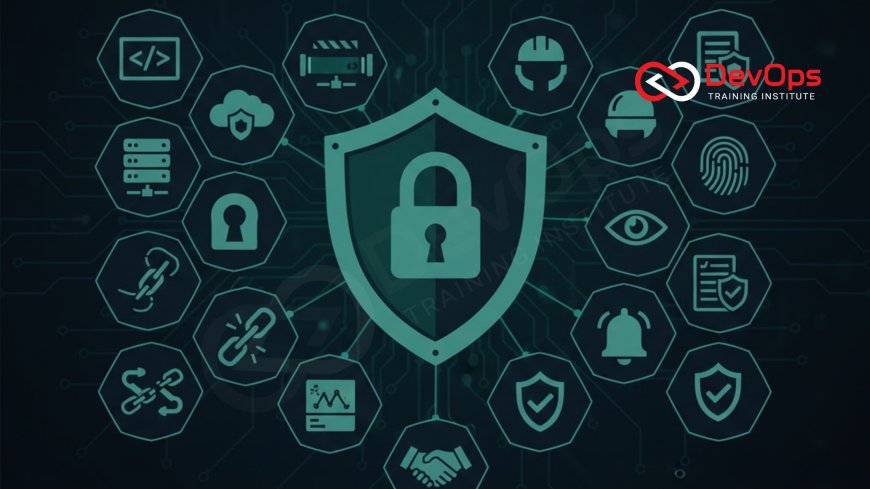
14 CI/CD Security Best Practices for Safe Delivery
Secure your software delivery pipeline end-to-end with these 14 essential CI/CD security best practices. Learn how to implement a comprehensive DevSecOps strategy, focusing on critical steps like shifting security testing left with SAST/DAST, centralizing secrets management, enforcing least privilege for pipeline runners, and utilizing Policy as Code (PaC) for deployment governance. This guide provides actionable advice on hardening your entire workflow, from code commit to production runtime, ensuring every deployment is verified, compliant, and resilient against modern threats, minimizing risk and maximizing delivery speed.
Introduction: The Security Imperative in CI/CD
The core promise of modern DevOps—accelerated software delivery through automation—is fundamentally challenged by the constant and escalating threat of supply chain attacks, configuration drift, and data breaches. Every automated step in the Continuous Integration/Continuous Delivery (CI/CD) pipeline, from code commit to final production deployment, represents a potential attack vector, making the pipeline itself the highest-value target for malicious actors. Therefore, security can no longer be a final checklist item handled by a separate team; it must be an integrated, automated, and continuous responsibility, a philosophy known as DevSecOps.
Implementing a robust security strategy requires more than just adding a few scanning tools. It demands a systematic and cultural shift toward embedding security controls directly into the developer's workflow and the automated pipeline infrastructure itself. The goal is to enforce security policy programmatically, making it difficult—if not impossible—for unverified or vulnerable code to ever reach production. This integration ensures that security becomes an enabler of speed, not a friction point that slows delivery. The following 14 best practices represent the gold standard for hardening enterprise CI/CD workflows, minimizing risk, and guaranteeing safe software delivery at high velocity, a complex challenge given the highly distributed nature of modern cloud computing environments where the perimeter is constantly shifting.
Shift Left Security in the Code and Commit Phase
The "Shift Left" philosophy is the cornerstone of DevSecOps, advocating for the integration of security practices as early as possible in the software development lifecycle, ideally during the coding and initial commit stages. Catching a vulnerability during development costs significantly less time and money to fix than finding it later in staging or, worst of all, in a live production environment. Automating these checks to provide instantaneous feedback is vital for high-performing engineering teams that prioritize speed and quality simultaneously, ensuring security governance is baked into the entire process from inception.
This phase focuses on pre-build checks, leveraging automated tools to analyze the source code and dependencies before the build artifact is even created. Mandatory checks must be enforced via pre-commit hooks or automated Pull Request (PR) checks, ensuring that developers are immediately notified of any potential security weaknesses in their own code. This early detection transforms security from a traditional operations bottleneck into a proactive development function, maximizing the efficiency of the remediation process.
1. Static Application Security Testing (SAST): This practice involves running SAST tools (e.g., SonarQube, Bandit, Checkmarx) against the source code to identify common security flaws and coding errors without executing the code. SAST should be integrated into every pull request as a mandatory check, establishing a low tolerance for high-severity vulnerabilities before merging.
2. Dependency/Supply Chain Scanning: Tools (e.g., Dependabot, Snyk, Nexus Lifecycle) must automatically scan all third-party libraries and dependencies used in the project against known vulnerability databases (CVEs). Since over 80% of modern applications use open-source components, continuously monitoring and alerting on vulnerable dependencies is crucial to securing the software supply chain, which is a major area of risk for modern enterprises.
3. Mandatory Code Review for Security: Every code change must be peer-reviewed, not only for functional correctness but also for security flaws. This requires security experts to provide templates or guidelines for reviewers, ensuring that manual oversight complements the automated SAST checks for identifying complex or logical vulnerabilities that tools often miss.
Securing the CI/Build Environment
The Continuous Integration (CI) server and its execution agents (runners) often require high-level permissions to communicate with various systems, making them highly attractive targets for attackers (known as the "CI bomb"). Hardening the environment where code is compiled and artifacts are generated is essential to prevent lateral movement within the network and to ensure that a compromised build agent cannot access production secrets or critical internal systems. Isolation and immutability are the foundational principles of this stage.
This phase must focus on strict compartmentalization and verifiable artifacts. Build runners should ideally be spun up as ephemeral containers or VMs that only exist for the duration of the build job, minimizing the window for compromise and ensuring all system states are clean. These build artifacts, once created, must be cryptographically signed to ensure their integrity and origin cannot be tampered with as they traverse the rest of the deployment pipeline. This chain of trust is critical for mitigating attacks that attempt to inject malicious code into trusted build output before it reaches production.
4. Isolation of Build Agents/Runners: CI runners must operate with strict network and execution isolation, ideally using dedicated, single-use, ephemeral containers or VMs for each job. This prevents one project's potentially compromised runner from interacting with the files, network, or environment of another project, enforcing strict compartmentalization.
5. Immutability and Artifact Signing: All build artifacts (Docker images, packages, deployable zips) must be treated as immutable, meaning they are never modified after creation. Furthermore, they must be cryptographically signed using tools like Notary or Cosign. This signature verifies the artifact's authenticity and integrity, allowing downstream stages to confirm the artifact originated from a trusted source and was not tampered with—a core concept related to permanent digital identity, much like how MAC addresses are unique identifiers on a network.
6. Environment Variable Sanitization: Sensitive data should never be passed to build jobs via standard, unmasked environment variables. Input validation and sanitization must be strictly enforced for all user-provided pipeline inputs to prevent injection attacks (like command injection). Furthermore, the CI/CD platform must be configured to automatically mask and redact any known secrets from build logs to prevent accidental exposure in searchable outputs, which can compromise the entire infrastructure if exposed to unauthorized team members.
Secrets Management and Pipeline Hardening
The single greatest weakness in many CI/CD pipelines is the mishandling of secrets—API keys, database passwords, and cloud credentials. In a secure pipeline, secrets must be centralized, highly secure, and injected into the execution environment only at the precise moment they are needed, using non-persistent methods. This approach dramatically reduces the risk of secrets being exposed in code, configuration files, or build logs, which is a catastrophic failure mode in enterprise security.
7. Centralized Secrets Management (Vault, etc.): All credentials and sensitive tokens must be stored in a dedicated, secure secrets management platform (e.g., HashiCorp Vault, AWS Secrets Manager, Azure Key Vault). The pipeline should be configured to integrate directly with these systems, fetching credentials at runtime using temporary access tokens tied to the specific job identity, ensuring secrets are never checked into Git or persisted on the runner's disk.
8. Least Privilege Access for Pipeline Jobs: Every pipeline job, runner, or deployment user must be granted the absolute minimum permissions necessary to perform its specific task—no more, no less. This principle of Least Privilege Access must be enforced granularly, often down to the level of restricting access to specific cloud resource types or actions, such as ensuring a build job can only read from a repository and not write to a production database. This is conceptually linked to the need for granular access control over sensitive ports and network services, often using concepts described when discussing essential cloud engineer knowledge, including Least Privilege Access for necessary communication protocols.
9. Pipeline Definition as Code (Auditing): The definition of the CI/CD pipeline itself (e.g., Jenkinsfile, GitLab YAML) must be treated as code, stored in version control, and subjected to mandatory peer review. This practice ensures that any change to the deployment process—such as adding a new stage or relaxing a security check—is auditable, traceable, and approved. This procedural enforcement prevents rogue pipeline changes and provides the essential history required for forensic analysis following an incident, reinforcing the importance of tracking every configuration, much like understanding foundational network models is critical for troubleshooting, as covered when discussing Pipeline Auditability and network tracing.
Deployment Governance and Run-Time Defense
This phase introduces automated governance gates and defense mechanisms that execute immediately before and during the application's deployment to production. Even if code and artifacts are deemed clean during the CI phase, the deployment process itself must be checked against organizational policies, and the resulting live infrastructure must be constantly monitored for emerging threats and vulnerabilities. Governance must be enforced programmatically to avoid manual bottlenecks and ensure consistency.
10. Dynamic Application Security Testing (DAST): Unlike SAST, DAST runs against the *running* application (usually in a staging or pre-production environment) by simulating external attacks (fuzzing, injection attempts) to find vulnerabilities that only manifest during execution. DAST tools (e.g., OWASP ZAP, Burp Suite) must be an automated gate in the pipeline, ensuring that the deployed code's external facing surfaces are hardened before traffic is routed.
11. Policy as Code (PaC) Enforcement: PaC tools (e.g., OPA Gatekeeper, HashiCorp Sentinel) must automatically scan the execution plan (`terraform plan`, Kubernetes manifests) to ensure the configuration adheres to security, compliance, and architectural policies. This critical governance gate blocks non-compliant deployments—such as exposing a sensitive port or deploying an unencrypted resource—before they ever reach production.
12. Automated Rollback on Failure/Drift: The deployment pipeline must include a robust, tested, and fully automated rollback capability. If a deployment fails due to a security violation discovered late in the cycle, performance degradation, or even a critical failure detected during automated canary analysis, the system must automatically and immediately revert to the last known good configuration without human intervention. This capability is paramount for minimizing the Mean Time to Recovery (MTTR) and preserving system stability and overall security posture following a failed deployment.
Cloud and Infrastructure Security
The security of the application is inseparable from the security of the cloud infrastructure it runs on. A vulnerable Kubernetes cluster or an overly permissive cloud network configuration can compromise even the most perfectly written code. These final practices ensure that the underlying infrastructure supporting the CI/CD pipeline and the application itself is provisioned securely, and defended at runtime against exploitation.
13. Infrastructure as Code (IaC) Scanning: Every piece of infrastructure code (Terraform, CloudFormation, Ansible) must be scanned by tools (e.g., Checkov, tfsec) to identify misconfigurations—like public S3 buckets, weak firewall rules, or exposed cloud credentials—before provisioning occurs. This is a critical form of "Shift Left" for operations, ensuring that the Cloud Infrastructure, which is fundamentally different from traditional on-premise networks, is secure by design.
14. Runtime Monitoring and Threat Detection: Even after deployment, continuous monitoring is essential. Tools like Falco or cloud-native security services (e.g., AWS GuardDuty, Azure Sentinel) must monitor the runtime environment for anomalous behavior, such as a container executing an unauthorized process or an application communicating on a commonly exploited port, allowing for instantaneous detection and response before a full breach occurs.
| # | Practice | Pipeline Stage | Mitigation Focus | Core Tool Example |
|---|---|---|---|---|
| 1 | Centralized Secrets Management | Build & Deploy | Prevents credential leakage in Git/logs; enforces temporary, least-privilege access. | HashiCorp Vault, AWS Secrets Manager |
| 2 | Policy as Code (PaC) Enforcement | Deployment Gate | Blocks non-compliant infrastructure (e.g., public database exposure) before provisioning occurs. | OPA Gatekeeper, HashiCorp Sentinel |
| 3 | SAST/Dependency Scanning | Code & Build | Finds code flaws and vulnerable third-party libraries early (Shift Left). | SonarQube, Snyk, Dependabot |
| 4 | Runtime Monitoring & PaC | Operate | Detects unauthorized behavior (e.g., file access, unusual network traffic) in live applications. | Falco, AWS GuardDuty |
| 5 | Immutable Artifacts & Signing | Artifact Management | Guarantees that the artifact built is exactly what is deployed; prevents supply chain tampering. | Notary, Cosign |
The DevSecOps Cultural Mandate
Beyond the tools and the technical controls, the greatest security best practice is the adoption of a true DevSecOps culture where accountability for security is shared across development, operations, and security teams. This cultural mandate requires shifting ownership, providing developers with the right security tools and training to fix vulnerabilities in their own code, and eliminating the traditional "throwing over the wall" handoff to a security team late in the development cycle. Security should be viewed as an integrated quality metric, not a separate, external compliance checklist, which is crucial for high-velocity environments.
This mandate includes establishing a blameless culture around security incidents, focusing on systemic failures and process improvements rather than personal blame. When a vulnerability is found in production, the entire team collaborates to update the CI/CD pipeline with a new, automated control to prevent its recurrence. This dedication to continuous learning and proactive security engineering ensures that the organizational process constantly adapts to new threats, maintaining a strong security posture in the face of continuous delivery. Furthermore, understanding the technical underpinnings of why systems fail, often starting at the most basic level, is vital, which requires knowledge of fundamental network components and common attack vectors.
Part of this culture includes educating engineers on network-level security, understanding why certain port numbers are commonly exploited in cyberattacks, and how to secure cloud resources against these known vulnerabilities by applying the principle of least privilege in firewall rules. This fusion of application and infrastructure knowledge is what elevates DevSecOps practices above traditional security models. The automation of policy derived from this knowledge is the final, essential step in building a secure and highly productive software factory.
Cloud Networking and Protocol Security
Security in the cloud is inextricably linked to network security, even for serverless or containerized workloads. The CI/CD pipeline must be configured to provision and manage cloud networking components with an acute awareness of security implications. This includes ensuring all internal communication uses secure transport protocols (TLS), and minimizing the exposure of management ports to the internet.
The practice of securing the pipeline also extends to defining strict network security group (NSG) and firewall rules as code, ensuring that only necessary ports and protocols are open between microservices. For instance, the deployment process must ensure that a database is accessible only to its required application servers on the necessary port (e.g., 5432 for PostgreSQL), and is entirely inaccessible from the public internet. This strict approach to defining security controls at the network level protects against horizontal attacks and limits the damage a compromised application server can inflict on neighboring systems.
Conclusion
Achieving safe, high-velocity software delivery requires the rigorous implementation of these 14 CI/CD security best practices. By embracing the Shift Left philosophy, automating security testing (SAST/DAST) early, centralizing secrets management, and enforcing deployment governance through Policy as Code, organizations transform their pipeline from a vulnerability into a protective shield. These practices collectively build trust in the automated workflow, allowing teams to deliver incremental changes quickly while minimizing the risk of supply chain attacks and configuration flaws.
The success of this DevSecOps model relies on technical controls—like artifact signing and runtime defense—backed by a cultural mandate where security is a shared responsibility and a continuous learning process. By ensuring every change is verified, every secret is protected, and every deployment is compliant, enterprises guarantee the integrity of their software supply chain, securing their digital assets and maintaining the operational resilience required for sustained competitive advantage in the modern cloud landscape.
Frequently Asked Questions
What is Policy as Code (PaC) used for in CI/CD?
PaC is used to automatically enforce security, compliance, and governance rules against deployment manifests and IaC before resources are provisioned in the cloud.
What is the difference between SAST and DAST?
SAST scans the static source code without running it, while DAST scans the running application (usually in staging) by simulating external attacks to find runtime vulnerabilities.
Why are CI runners considered a high-value target?
CI runners are high-value targets because they often require high-level permissions to access internal systems, repositories, and potentially production credentials.
How does centralized secrets management improve security?
It improves security by preventing credentials from being hardcoded in Git and injecting them only at runtime using temporary, non-persistent access tokens.
What is the purpose of artifact signing?
Artifact signing verifies the integrity and authenticity of a build artifact, ensuring it has not been tampered with since it was created by the trusted CI pipeline.
What is the principle of least privilege?
The principle of least privilege dictates that any user, application, or pipeline job should be granted only the minimum permissions necessary to perform its required function.
Which practice mitigates supply chain attacks?
Dependency scanning and mandatory artifact signing are the primary practices used to mitigate supply chain attacks by verifying code origins and artifact integrity.
What is IaC scanning?
IaC scanning involves using tools (Checkov, tfsec) to check Terraform or CloudFormation code for security misconfigurations before provisioning the infrastructure.
What is the final line of defense after deployment?
The final line of defense is runtime monitoring and threat detection, using tools like Falco to watch for anomalous behavior in the live environment.
How is networking knowledge relevant to DevSecOps?
Networking knowledge is essential for defining strict firewall rules (NSGs) and ensuring sensitive management ports are closed or restricted, protecting against network-based attacks.
What is the main benefit of automated rollback?
The main benefit is minimizing the Mean Time to Recovery (MTTR) by automatically reverting to the last known good state when a failed deployment is detected.
Why must pipeline definitions be stored in Git?
Storing pipeline definitions in Git ensures auditability, version control, and requires peer review for changes, preventing unauthorized modifications to the delivery process.
What should be monitored by runtime threat detection?
Runtime detection should monitor for unauthorized process execution, unusual file access, and unexpected network communication to commonly exploited ports in the live environment.
What is the risk of using unmasked environment variables?
The risk is that unmasked environment variables containing sensitive data can be accidentally exposed in searchable build logs, compromising credentials.
What is the difference between DAST and runtime monitoring?
DAST actively attacks the application in staging before release, while runtime monitoring passively observes the live application behavior in production for ongoing threats.
What's Your Reaction?
 Like
0
Like
0
 Dislike
0
Dislike
0
 Love
0
Love
0
 Funny
0
Funny
0
 Angry
0
Angry
0
 Sad
0
Sad
0
 Wow
0
Wow
0

![100+ Azure DevOps Interview Questions and Answers [Updated 2025]](https://www.devopstraininginstitute.com/blog/uploads/images/202509/image_140x98_68c40aa9a3834.jpg)





![Future Scope of DevOps Careers in Pune [Updated 2025]](https://www.devopstraininginstitute.com/blog/uploads/images/202510/image_140x98_68e3a84652312.jpg)