






![Kong Interview Preparation Guide [2025]](https://www.devopstraininginstitute.com/blog/uploads/images/202509/image_430x256_68dbb95326997.jpg)



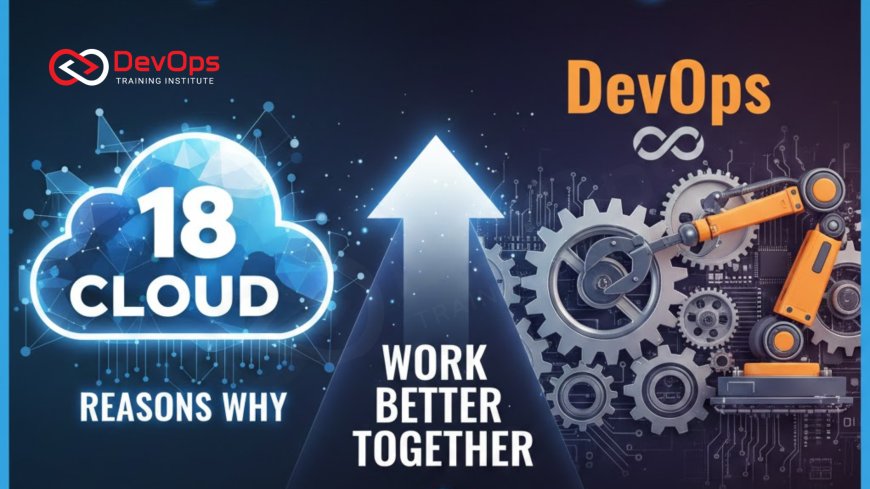
18 Reasons Why Cloud & DevOps Work Better Together
Explore the eighteen essential reasons why cloud and DevOps serve as a powerful catalyst for engineering success in twenty twenty six. This guide details how the synergy between cloud native architecture and automated delivery pipelines drives massive scalability, cost efficiency, and technical resilience. Learn about the latest trends in platform engineering, AI augmented observability, and zero trust security that are reshaping modern digital transformation. Whether you are managing complex multi cloud environments or building agile engineering squads, understanding these eighteen strategic benefits will empower your team to ship faster, reduce downtime, and stay competitive in today's rapidly evolving global software market.
Introduction to the Cloud-DevOps Synergy
In the technical landscape of twenty twenty six, cloud computing and DevOps have moved beyond being complementary tools to becoming an inseparable duo. While cloud provides the flexible, on demand infrastructure, DevOps provides the cultural and technical framework to manage that infrastructure with speed and precision. This partnership allows organizations to move away from static, manual operations toward a dynamic, automated ecosystem that responds instantly to business needs. The synergy between these two paradigms is what enables modern engineering teams to achieve the ultimate goal: delivering high quality software at a global scale with absolute reliability.
As digital transformation accelerates, the integration of cloud and DevOps has become the primary driver of organizational agility. By treating infrastructure as code and leveraging the elastic nature of the cloud, teams can eliminate traditional bottlenecks like hardware procurement and manual environment setup. This guide explores eighteen critical reasons why this combination is the gold standard for software engineering this year. From the cost savings of FinOps to the security of automated compliance, these benefits represent a holistic approach to building and operating resilient systems in an increasingly complex and automated world.
Technique One: On-Demand Infrastructure for Rapid Iteration
One of the most immediate benefits of combining cloud and DevOps is the ability to provision infrastructure on demand. In a traditional environment, developers often wait weeks for new servers to be approved and configured. With cloud native DevOps, an engineer can spin up a complete, production like environment in minutes using simple scripts. This rapid provisioning enables faster feedback loops, allowing teams to test new ideas and iterate on features without being blocked by infrastructure delays. It effectively turns the data center into a programmable resource that scales alongside the development velocity.
This on demand model is powered by Infrastructure as Code (IaC), where environment definitions are stored in version controlled repositories. This ensures that every environment is an exact replica of the others, eliminating the "it worked on my machine" problem. By utilizing continuous synchronization between your code and your cloud resources, you ensure that your technical foundation is always ready to support the next sprint. This level of agility is essential for staying competitive in a market where the time to market for new solutions is measured in days rather than months, providing a clear path to innovation.
Technique Two: Dynamic Scalability and Resource Elasticity
The cloud's inherent elasticity is the perfect partner for DevOps automation. Using automated scaling policies, a DevOps team can ensure that an application automatically allocates more resources during a traffic spike and scales back down during quiet periods. This dynamic adjustment happens without human intervention, ensuring peak performance for users while minimizing waste for the business. This is particularly vital for high traffic applications where sudden surges in demand could otherwise lead to system instability or total outages, protecting the user experience during critical events.
In twenty twenty six, this scalability has reached a new level with serverless and containerized architectures. By using containerd or other efficient runtimes, teams can launch thousands of small, isolated workloads in seconds. This allows for a more granular approach to scaling where only the specific microservices under load are expanded. The synergy here lies in the fact that DevOps pipelines automate the deployment of these scalable components, while the cloud provides the limitless playground for them to grow. This combination ensures that your system is always the right size for the job, regardless of the workload.
Technique Three: Cost Optimization and FinOps Discipline
Cloud and DevOps work together to turn infrastructure costs from a fixed capital expense into a variable operational expense. By adopting a pay as you go model, organizations only pay for the resources they actually use. DevOps practices further enhance this by automating the decommission of unused dev and staging environments during off hours. In twenty twenty six, this has evolved into the discipline of FinOps, where engineering, finance, and business teams unite to manage cloud costs with high precision. This ensures that every dollar spent on the cloud delivers measurable value to the bottom line.
Automated cost analyzers now scan cloud architecture patterns to identify expensive idle resources or suggest more cost effective reserved instances. This proactive approach to fiscal responsibility is a major cultural change for many organizations, moving away from "budget and wait" toward "measure and optimize." By integrating these cost metrics directly into the deployment pipeline, teams can see the financial impact of their architectural choices in real time. This ensures that the business can scale globally without fear of spiraling infrastructure costs or financial guesswork during rapid expansion.
Core Benefits of Cloud and DevOps Integration
| Benefit Category | Primary Value | DevOps Logic | Cloud Lever |
|---|---|---|---|
| Agility | Faster Time-to-Market | CI/CD Pipelines | On-Demand Provisioning |
| Reliability | Zero Downtime | Automated Health Checks | Multi-Region Availability |
| Efficiency | Cost Control (FinOps) | Automated Right-Sizing | Pay-As-You-Go Billing |
| Security | Compliance as Code | Policy Enforcement | IAM & Key Management |
| Innovation | Rapid Experimentation | Fast Feedback Loops | Serverless & AI Services |
Technique Four: Enhanced Security with DevSecOps Automation
In a cloud environment, security is a shared responsibility that must be integrated into the delivery pipeline. DevSecOps practices embed security policies, access controls, and vulnerability scans into every step of the development process. By automating these checks, organizations can detect and remediate risks before they ever reach production. Cloud providers offer built in security tools like identity and access management (IAM) and automated encryption that fit natively into these automated workflows. This ensures that every deployment is verifiable, compliant, and secure by default.
Modern teams utilize admission controllers to enforce these organizational policies automatically within their clusters. For example, a policy might block any container that hasn't been scanned for secrets or one that requires root privileges. By utilizing secret scanning tools, teams can prevent the accidental exposure of cloud credentials in their repositories. This proactive approach transforms security from a final bottleneck into a market leverage, allowing innovation to depend on safety rather than compete with it in a busy global software market.
Technique Five: High Availability and Disaster Recovery
The combination of cloud and DevOps provides a robust foundation for building highly available systems that can survive catastrophic failures. By using multi region deployment strategies and automated failover scripts, organizations can ensure that their applications remain accessible even if an entire cloud data center goes offline. DevOps pipelines facilitate this by ensuring that the same code and infrastructure definitions can be launched in any region at any time. This reproducibility is the key to a successful disaster recovery plan that minimizes downtime and protects customer trust.
Cloud providers offer automated backup and recovery solutions that are integrated directly into DevOps orchestration tools. If an incident occurs, the system can automatically trigger a rollback to the last known stable state or shift traffic to a healthy region. By integrating these incident handling procedures into your cultural change, you ensure that the entire team is prepared for unexpected disruptions. This level of resilience is essential for maintaining customer loyalty in an era where tolerance for downtime is practically zero and global availability is a standard expectation for any digital service.
Technique Six: Unified Observability and Real-Time Feedback
You cannot improve what you cannot see, and the cloud provides a centralized platform for deep system observability. By combining cloud native monitoring tools like Prometheus and Grafana with DevOps practices, teams gain a unified view of their application health, infrastructure performance, and user behavior. This real time feedback loop allows developers to identify root causes faster and resolve issues before they impact the end user experience. In twenty twenty six, this has evolved into "Observability 2.0," where AI and machine learning help correlate events across disparate systems to provide predictive insights.
Integrating continuous verification into this stack ensures that every deployment is meeting its performance targets in production. If a new version shows a spike in latency, the system can automatically notify the engineering squad via ChatOps techniques. This transparency breaks down silos between development and operations, fostering a culture of shared responsibility for the system's success. By leveraging these intelligent observability tools, teams can move from reactive firefighting to proactive optimization, continuously refining their software for peak efficiency and user satisfaction.
18 Reasons for Cloud & DevOps Synergy
- On-Demand Provisioning: Spin up full environments in minutes using version-controlled code.
- Auto-Scaling: Resources automatically match demand, ensuring performance and cost control.
- Pay-As-You-Go: Eliminate massive upfront hardware costs and only pay for actual usage.
- Multi-Region Deployment: Achieve global reach and high availability with a few clicks.
- Infrastructure as Code (IaC): Manage your hardware setup with the same precision as your software.
- Reduced Human Error: Automation replaces manual, error-prone configuration tasks on servers.
- Faster Feedback Loops: Real-time telemetry data guides rapid development and improvement.
- Unified Toolchains: Integrated platforms like AWS CodePipeline or GitLab CI streamline workflows.
- Self-Service Portals: Developers can provision their own resources without waiting for IT experts.
- Enhanced Collaboration: Centralized cloud platforms break down silos between distributed teams.
- Version-Controlled Infra: Track every change to your environment for easy audits and rollbacks.
- Automated Patching: Keep your underlying systems secure without manual administrative effort.
- Serverless Agility: Focus on code logic rather than server management with Fargate or Lambda.
- Edge Computing Integration: Deploy closer to users for ultra-low latency and better experience.
- Compliance Automation: Embed governance into delivery patterns for effortless regulatory audits.
- Incident Response: Rapid recovery through automated rollbacks and multi-site failover.
- GreenOps Sustainability: Optimize for carbon efficiency alongside performance and cost.
- GitOps Mastery: Maintain cluster states using Git as the ultimate source of truth for all changes.
By focusing on these eighteen pillars, you create an engineering environment that is built to evolve and scale effortlessly. It is important to remember that who drives cultural change within the organization is just as important as the tools themselves. A shift toward cross-functional engineering squads ensures that the power of cloud and DevOps is harnessed by those closest to the product. As you build your 12-36 month roadmap, prioritize the integrations that directly shift business outcomes, such as AI augmented devops for predictive maintenance. The future of software delivery is not just about the components you choose, but the synergy you create between them.
Conclusion: The Strategic Lever of 2026
In conclusion, the partnership between cloud and DevOps is more than a technical convenience; it is a strategic lever that defines engineering success in twenty twenty six. By combining the flexibility of the cloud with the automation and culture of DevOps, organizations can achieve unparalleled speed, security, and cost efficiency. The eighteen reasons outlined here provide a comprehensive framework for understanding why these two paradigms are better together. From the rapid iteration enabled by on demand infrastructure to the fiscal discipline of FinOps, this synergy allows for a more resilient and innovative technical ecosystem.
As you move forward, consider how release strategies that prioritize zero downtime can further enhance your customer trust. The integration of platform engineering will continue to simplify the developer experience, making the cloud feel like a native extension of the IDE. By embracing this "better together" philosophy today, you are preparing your organization for the challenges of tomorrow, ensuring that your software delivery process remains a source of strength and growth. The combination of cloud and DevOps is the foundation upon which the next generation of digital innovation will be built, empowering every engineer to deliver world class experiences with confidence and precision.
Frequently Asked Questions
How does cloud computing enhance DevOps practices?
Cloud provides on-demand infrastructure and elastic resources that allow DevOps teams to automate deployments and scale applications instantly without manual hardware management.
What is the primary benefit of Infrastructure as Code (IaC)?
IaC allows infrastructure to be defined in version-controlled files, ensuring that environments are reproducible, consistent, and can be tested just like application code.
Can DevOps help in reducing cloud infrastructure costs?
Yes, through FinOps practices and automated scaling, DevOps teams can optimize resource allocation and pay only for the compute power they actually need.
What is the role of DevSecOps in cloud security?
DevSecOps integrates security scans and policy enforcement directly into the CI/CD pipeline, ensuring that vulnerabilities are caught early before they reach production servers.
Does the cloud improve collaboration between engineering teams?
Absolutely, cloud platforms provide centralized repositories and shared dashboards that allow development, operations, and security teams to collaborate in real-time from anywhere.
What is FinOps and why is it important in 2026?
FinOps is the practice of uniting engineering and finance to manage cloud spend effectively, ensuring that cloud investments deliver measurable and maximum business value.
How does the cloud support disaster recovery in DevOps?
Cloud providers offer multi-region replication and automated backup tools that allow DevOps teams to recover systems quickly from any major geographic or technical failure.
What is the difference between cloud-native and cloud-ready?
Cloud-native applications are built specifically for the cloud using microservices and containers, while cloud-ready apps are traditional apps modified to run on cloud servers.
How do serverless architectures benefit DevOps workflows?
Serverless eliminates the need for server management, allowing developers to focus strictly on code while the cloud provider handles all scaling and maintenance automatically.
What is GitOps and how does it relate to the cloud?
GitOps uses Git as the source of truth for infrastructure and deployments, with automated controllers ensuring the live cloud environment matches the repository state.
Can I use DevOps with on-premise infrastructure?
Yes, but you miss out on the elasticity and on-demand resources of the cloud, making automation and scaling significantly more difficult and time-consuming.
How does observability 2.0 differ from traditional monitoring?
Observability 2.0 uses AI to correlate complex events across the entire stack, providing predictive insights into why a system is behaving in a certain way.
What is an Internal Developer Platform (IDP)?
An IDP is a curated set of tools and services that allow developers to self-serve their infrastructure needs, reducing friction and increasing overall delivery speed.
How does the cloud facilitate global scalability?
Cloud providers have data centers worldwide, allowing DevOps teams to deploy applications close to users for ultra-low latency with just a few clicks or commands.
Is security a bigger risk in the cloud for DevOps teams?
While the cloud introduces new risks, it also provides advanced security tools and automation that can actually make a system more secure than traditional on-premise setups.
Would you like me to help you draft a specific FinOps checklist to help your team start optimizing your cloud spend for the upcoming quarter?
What's Your Reaction?
 Like
0
Like
0
 Dislike
0
Dislike
0
 Love
0
Love
0
 Funny
0
Funny
0
 Angry
0
Angry
0
 Sad
0
Sad
0
 Wow
0
Wow
0


![100+ Azure DevOps Interview Questions and Answers [Updated 2025]](https://www.devopstraininginstitute.com/blog/uploads/images/202509/image_140x98_68c40aa9a3834.jpg)






![Future Scope of DevOps Careers in Pune [Updated 2025]](https://www.devopstraininginstitute.com/blog/uploads/images/202510/image_140x98_68e3a84652312.jpg)