

![Kong Interview Preparation Guide [2025]](https://www.devopstraininginstitute.com/blog/uploads/images/202509/image_430x256_68dbb95326997.jpg)

20 Cloud Security Tools Every DevOps Engineer Must Know
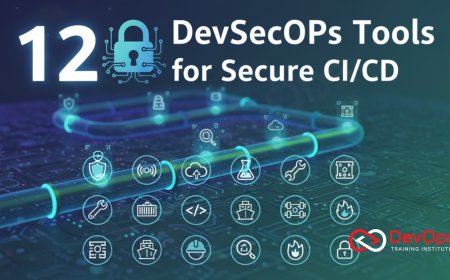
In the age of DevSecOps, security is the shared responsibility of every engineer. Explore the 20 essential cloud security tools that every DevOps Engineer must master to build and maintain compliant, resilient, and attack-resistant systems. This guide covers everything from IaC static analysis (Checkov, tfsec) and container runtime protection (Falco) to centralized secrets management (Vault) and crucial cloud posture management (CSPM) solutions. Learn how to automate security from code commit to cloud runtime, effectively implementing the "Shift Left" principle across AWS, Azure, and GCP for enterprise-grade protection and continuous compliance.
Introduction
The convergence of rapid software delivery and complex cloud environments has fundamentally transformed the landscape of system security. In the modern era, security is no longer the responsibility of a siloed team that acts as a final gate before deployment; it is a shared, continuous responsibility embedded within the entire development and operations lifecycle, a principle famously known as DevSecOps. Every DevOps Engineer, as the architect and guardian of the automated pipeline and cloud infrastructure, must be fluent in a robust set of security tools to implement the "Shift Left" philosophy—catching vulnerabilities and misconfigurations at the earliest, cheapest, and safest point possible.
Cloud environments introduce unique security challenges, primarily due to the vast surface area of attack, the ephemeral nature of containerized workloads, and the complexity of managing thousands of access policies (IAM roles). A single misconfigured cloud resource, left unchecked, can expose an entire enterprise. To combat this, the modern DevOps Engineer relies on an arsenal of automated tools that integrate seamlessly into the Continuous Integration/Continuous Delivery (CI/CD) pipeline and provide constant monitoring in production. Mastering these 20 tools—covering every layer from application code and infrastructure definition to container images and runtime activity—is essential for building systems that are not only scalable and fast but also secure, compliant, and attack-resistant across any cloud environment.
Phase 1: Static Analysis and Pre-Deployment Security (Shift Left)
The "Shift Left" movement dictates that security testing must occur at the development stage, preventing vulnerable code or misconfigured infrastructure from ever reaching the live environment. The following tools enable engineers to scan code and declarative configuration files long before deployment, ensuring compliance with organizational and regulatory security policies right from the source repository. This proactive approach drastically reduces the cost and effort of fixing issues later, making the deployment process safer and faster.
1. Checkov: An open-source static analysis tool that scans Infrastructure as Code (IaC) files (Terraform, CloudFormation, Kubernetes, ARM, Helm) for security and compliance misconfigurations. It analyzes the code against hundreds of predefined security policies, helping engineers catch insecure settings—like unencrypted S3 buckets or publicly accessible databases—during the pull request review phase, embedding security directly into the code review workflow.
2. tfsec: Focused specifically on Terraform code, tfsec is a lightweight security scanner that uses static analysis to detect potential vulnerabilities. Its speed and ease of integration into the CI pipeline make it a favorite for DevOps teams that rely heavily on Terraform to provision multi-cloud infrastructure. It is often run as a mandatory gate before a `terraform plan` is approved, ensuring resource definitions adhere to security best practices.
3. Bandit: A simple but powerful Python-specific security tool designed to find common security issues in Python application code. It scans the Abstract Syntax Tree (AST) of the code and flags issues like hardcoded passwords, insecure use of cryptography, or risky function calls, allowing developers to catch basic application-level vulnerabilities before code is merged into the main branch.
4. SonarQube/SonarCloud: A comprehensive commercial platform (with open-source components) used for continuous code quality and continuous code security. It performs Static Application Security Testing (SAST) for many languages, providing centralized dashboards for tracking code quality metrics, technical debt, and security vulnerabilities across large application portfolios, providing a single source of truth for code health across the enterprise.
Phase 2: Secrets and Identity Management
Properly managing secrets (API keys, database credentials, TLS certificates) is a critical pillar of cloud security. If secrets are hardcoded into configuration files or stored in clear text, the entire infrastructure is at risk of compromise. These tools provide centralized, secure vaulting and dynamic generation of credentials, adhering strictly to the principle of least privilege and eliminating the need for long-lived, static access keys in deployment pipelines.
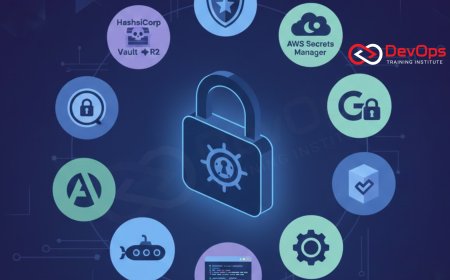
5. HashiCorp Vault: The industry-leading tool for centralized secrets management. Vault securely stores, accesses, and dynamically generates secrets for applications and infrastructure across multiple clouds and deployment targets. DevOps Engineers use it to provide applications with short-lived, time-bound credentials (tokens, database passwords) on demand, automatically revoking them when they expire. This practice eliminates the exposure risk associated with static secrets and enforces strict governance.
6. Cloud-Native Secret Managers (AWS Secrets Manager, Azure Key Vault, GCP Secret Manager): Every major cloud provider offers a managed service for storing and managing secrets. These tools are often preferred for their tight integration with the cloud's native Identity and Access Management (IAM) systems and ease of use within their respective ecosystems. They are typically accessed by application code via SDKs or dedicated APIs, ensuring that credentials are encrypted both at rest and in transit, simplifying compliance for engineers focused on a single cloud platform.
7. Cloud IAM Tools (e.g., AWS IAM Access Analyzer, Azure AD): Managing access to thousands of cloud resources requires precise control. IAM tools help implement the critical security practice of "least privilege" by allowing engineers to define policies that grant the minimum permissions necessary for users and services to function. Tools like Access Analyzer proactively review policies to identify unintended or overly broad public access, which is a common source of major cloud security breaches and misconfigurations.
Phase 3: Container and Runtime Security
Containers and Kubernetes introduce a unique set of security challenges, particularly at runtime, where misconfigurations can allow attackers to break out of a container and compromise the host machine. These tools are crucial for scanning container images before they are deployed and for continuously monitoring the runtime behavior of applications within Kubernetes clusters to detect and prevent malicious activity in real-time.
8. Trivy: A simple, comprehensive, and widely popular open-source scanner that checks container images, file systems, and configuration files for known vulnerabilities (CVEs), misconfigurations, and sensitive data. DevOps teams integrate Trivy into the CI/CD pipeline to automatically scan every newly built Docker image before it is pushed to the container registry, creating a security gate that prevents vulnerable components from ever reaching the production cluster.
9. Falco: The de facto open-source runtime security tool for Kubernetes, developed by Sysdig and a Cloud Native Computing Foundation (CNCF) project. Falco monitors the behavior of running containers and hosts by analyzing system calls, alerting on suspicious activity such as a web server spawning a shell process, a container writing to the host file system, or unauthorized network connection attempts. It is essential for detecting threats that bypass static security checks.
10. Docker Bench for Security: A script that automatically checks Docker containers and hosts against common security best practices defined in the CIS (Center for Internet Security) benchmarks. It helps harden the Docker daemon configuration and the running state of containers, ensuring that the container environment itself adheres to strict security standards before critical applications are deployed, minimizing the attack surface presented by the host operating system.
Phase 4: Cloud Security Posture Management (CSPM) and Compliance
Cloud Security Posture Management (CSPM) tools provide continuous, automated governance by scanning the live cloud environment to ensure configurations adhere to security policies and compliance standards (e.g., CIS Benchmarks, HIPAA, PCI DSS). These tools are vital because Infrastructure as Code only covers initial deployment; human or programmatic drift can occur later, leaving configurations vulnerable. CSPM continuously checks the live state against the desired compliant baseline.
11. Prowler: A comprehensive, open-source command-line tool that performs security auditing, hardening, and incident response for AWS. Prowler runs hundreds of checks covering CIS benchmarks, GDPR, HIPAA, and other standards across various AWS services, outputting detailed reports. DevOps Engineers use it for continuous, deep-level auditing of their AWS accounts to ensure compliance is maintained and to rapidly identify misconfigurations that may have been introduced outside of the automated IaC pipeline.
12. Cloud-Native CSPM (AWS Security Hub, Azure Security Center, GCP Security Command Center): Each major cloud provider offers a managed CSPM solution that automatically aggregates security alerts, performs continuous checks against industry benchmarks, and provides centralized visibility into the overall security posture of the cloud environment. These managed services are the first line of defense, providing integrated threat detection and compliance monitoring natively within the respective cloud platform's console, which is crucial for meeting regulatory requirements and simplifying complex organizational audits.
| # | Tool & Category | Primary Function | DevSecOps Phase | Tool Type |
|---|---|---|---|---|
| 1 | Checkov (IaC Security) | Static analysis of IaC for security misconfigurations. | Commit/CI | Open Source |
| 5 | HashiCorp Vault (Secrets) | Centralized storage and dynamic generation of application secrets/credentials. | CI/Deployment | Open Source / Commercial |
| 8 | Trivy (Vulnerability Scan) | Scans container images and file systems for known software vulnerabilities (CVEs). | Build/CI | Open Source |
| 9 | Falco (Runtime Security) | Real-time detection of suspicious container/host behavior at the kernel level in Kubernetes. | Runtime | Open Source / CNCF |
| 11 | Prowler (Cloud Auditing) | Performs extensive security and compliance auditing against AWS environments. | Audit/Runtime | Open Source |
Phase 5: Network and Application Security
While the cloud abstracts away physical hardware, the underlying network, and the application's exposure points remain critical security concerns. These tools focus on hardening the network layer, managing traffic flow, and providing advanced threat protection at the perimeter and within the application itself. A deep understanding of network traffic and security protocols, as detailed in the concepts of the OSI and TCP/IP models, is vital for configuring these systems correctly.
13. Cloud Web Application Firewalls (WAFs): Services like AWS WAF, Azure Application Gateway WAF, and GCP Cloud Armor protect web applications from common attacks such as SQL injection, cross-site scripting (XSS), and denial-of-service (DDoS) attempts. DevOps Engineers configure these WAFs as part of the infrastructure definition (via IaC), defining rules that filter malicious incoming traffic before it reaches the application servers, providing essential perimeter defense and ensuring only legitimate traffic accesses the exposed application ports.
14. Network Security Groups (NSGs) / Security Groups (SGs): These are the fundamental, stateful virtual firewalls that control traffic at the instance level (NSGs in Azure, SGs in AWS). Although not technically "tools," their proper configuration is the most basic and critical security task. DevOps Engineers must define and manage rules that enforce the "least privilege" principle, ensuring that instances only communicate on necessary ports and protocols, thereby isolating network components and minimizing lateral movement potential in the event of a breach.
15. Kali Linux / Metasploit: Though used for offense, these are indispensable defensive tools. Kali Linux is a distribution preloaded with penetration testing tools. DevOps Engineers should learn to use tools like Metasploit, Nmap, and Wireshark to conduct internal vulnerability assessments and penetration tests against their own infrastructure and applications. By actively testing for common exploits, engineers can proactively identify and patch security weaknesses before an attacker can exploit them, ensuring the security of publicly exposed application services.
Phase 6: Comprehensive Application and Platform Tools
These advanced tools provide integrated security, combining multiple scanning and governance capabilities into unified platforms, or offering deep specialization in container image management, simplifying the overall DevSecOps toolchain for large enterprise environments.
16. Snyk: A commercial developer security platform that focuses on finding and fixing vulnerabilities in code, dependencies (open source libraries), containers, and IaC. Snyk scans continuously throughout the development process, providing developers with actionable fix recommendations in their IDE or during the pull request phase, integrating security checks earlier than most traditional tools and making the security feedback loop rapid and effective.
17. Clair: An open-source, vulnerability static analysis tool specifically designed for container images. Unlike simple CLI scanners, Clair maintains a central database of CVEs (Common Vulnerabilities and Exposures), allowing for continuous, ongoing vulnerability monitoring of images stored in container registries, ensuring that images remain secure even after they have been built and deployed.
18. Open Policy Agent (OPA): An open-source, general-purpose policy engine that allows DevOps Engineers to define security, compliance, and governance policies as code using a high-level declarative language (Rego). OPA can be integrated across the entire stack—in CI/CD pipelines, Kubernetes admissions controllers, and API gateways—to uniformly enforce policy decisions everywhere, ensuring consistency across diverse infrastructure components.
Phase 7: Advanced Cloud Governance and Logging
The final layer of security involves ensuring the continuous integrity and compliance of the deployed environment and establishing robust audit trails for forensic analysis. These tools ensure that even if an attacker gains access, their actions are logged and auditable, enabling rapid incident response.
19. AWS CloudTrail, Azure Monitor (Activity Log), GCP Cloud Audit Logs: These cloud-native services are the indispensable audit logs that track every API call, action, and event that occurs within the cloud account, showing who did what, when, and from where. DevOps Engineers use these logs for compliance auditing, troubleshooting misconfigurations, and performing critical forensic analysis following a security incident, proving that security is not just about prevention but also about rapid detection and response. Analyzing these logs is the foundation of incident management.
20. Cloud Access Security Brokers (CASBs): Commercial tools that sit between the cloud users and the cloud service providers to enforce security policies. They provide crucial visibility into cloud application usage, enforce data loss prevention (DLP), and control access to managed cloud applications like Office 365 or Salesforce, extending the governance model beyond mere infrastructure and into the end-user application layer.
Conclusion
The role of the modern DevOps Engineer is synonymous with that of a security engineer. Successfully delivering software in the cloud requires mastery over a diverse, integrated toolchain that automates security from the moment code is written to the continuous monitoring of production environments. By embracing the principles of DevSecOps and strategically implementing these 20 tools—covering IaC scanning, centralized secrets management, runtime protection, and continuous posture auditing—engineers transform security from a late-stage barrier into a built-in, automated capability that accelerates delivery. Investing in these tools and practices is the single most effective way an organization can minimize risk, meet strict compliance requirements, and ensure the resilience of its cloud infrastructure, guaranteeing both speed and safety at enterprise scale.
Frequently Asked Questions
What is the "Shift Left" security principle?
It means moving security testing and vulnerability detection earlier in the development lifecycle, catching issues during code or IaC creation rather than in production.
How does HashiCorp Vault improve security?
It improves security by eliminating static passwords and generating short-lived, dynamic secrets, enforcing the principle of least privilege for applications and services.
What is CSPM used for in cloud security?
CSPM (Cloud Security Posture Management) continuously scans the live cloud environment to ensure configurations adhere to security benchmarks and compliance standards, preventing environment drift.
What is the difference between Checkov and Trivy?
Checkov scans IaC (Terraform) configuration files before deployment, while Trivy scans container images and application dependencies for known vulnerabilities.
Why must DevOps Engineers understand network fundamentals?
They must understand fundamentals like TCP/IP to configure cloud network security groups, firewalls, and application load balancers correctly, ensuring network isolation and controlled traffic flow.
What is Falco's primary function?
Falco's primary function is real-time runtime security, monitoring system calls inside Kubernetes containers to detect suspicious behavior, such as a shell opening in a production web server container.
What are NSGs and Security Groups used for?
They are the fundamental, stateful virtual firewalls used to control inbound and outbound network traffic at the instance level, strictly enforcing the principle of least privilege network access.
What is SAST?
SAST (Static Application Security Testing) is a set of tools (like SonarQube) that analyze application source code without executing it, looking for known security flaws and vulnerabilities.
What are CloudTrail/Activity Logs used for?
These services provide an indispensable, auditable record of every API call and action performed in the cloud account, crucial for forensic analysis and compliance auditing after an incident.
Why use OPA (Open Policy Agent)?
OPA is used to define and uniformly enforce security, compliance, and governance policies as code across the entire technology stack, including CI/CD and Kubernetes admission control.
Is Kali Linux used for defense?
Yes, while offensive, Kali Linux tools like Nmap are used defensively by DevOps Engineers to conduct internal penetration tests against their own infrastructure to proactively find and fix vulnerabilities.
What is the role of a WAF in the cloud?
A Web Application Firewall (WAF) protects web applications at the perimeter from common internet threats like SQL injection, XSS, and layer 7 DDoS attacks.
How does Snyk speed up the development process?
Snyk speeds up development by integrating vulnerability checks directly into the IDE and pull request process, allowing developers to find and fix issues quickly without losing context.
What is the risk of environment drift?
Environment drift means the live system deviates from the IaC definition, creating configuration inconsistencies and potential security gaps that can be exploited by attackers.
What is a CASB?
A Cloud Access Security Broker (CASB) enforces security policies between cloud users and cloud services, providing crucial visibility, access control, and data loss prevention for SaaS applications and cloud platforms.
What's Your Reaction?
 Like
0
Like
0
 Dislike
0
Dislike
0
 Love
0
Love
0
 Funny
0
Funny
0
 Angry
0
Angry
0
 Sad
0
Sad
0
 Wow
0
Wow
0

![100+ Azure DevOps Interview Questions and Answers [Updated 2025]](https://www.devopstraininginstitute.com/blog/uploads/images/202509/image_140x98_68c40aa9a3834.jpg)



![Future Scope of DevOps Careers in Pune [Updated 2025]](https://www.devopstraininginstitute.com/blog/uploads/images/202510/image_140x98_68e3a84652312.jpg)